• العربية
  • فارسی
Brand
  • Iran Insight
  • Politics
  • Economy
  • Analysis
  • Special Report
  • Opinion
  • Podcast
  • Iran Insight
  • Politics
  • Economy
  • Analysis
  • Special Report
  • Opinion
  • Podcast
  • Theme
  • Language
    • العربية
    • فارسی
  • Iran Insight
  • Politics
  • Economy
  • Analysis
  • Special Report
  • Opinion
  • Podcast
All rights reserved for Volant Media UK Limited
volant media logo

Israel Accuses Defense Minister's Household Aide Of Iran-Related Espionage

Nov 18, 2021, 11:52 GMT+0
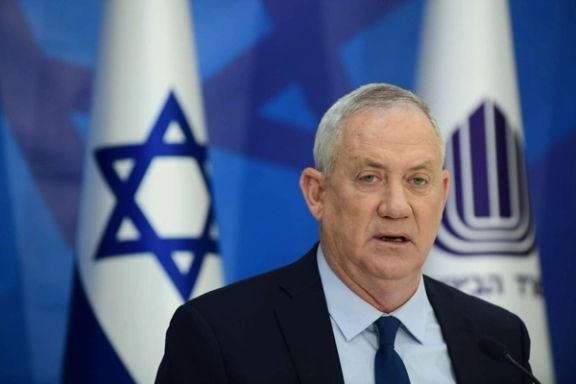
Israeli Defense Minister Benny Gantz. FILE PHOTO

Israel has charged a household aide of Defense Minister Benny Gantz's with espionage, saying on Thursday he offered to spy on him on behalf of "a person identified with Iran.”

In a statement, the Shin Bet security service said the suspect corresponded with the unnamed person over social media. It said he provided photographs taken in the house as proof he had access and proposing installing malware on Gantz's computer.

The Shin Bet said the suspect, who performed housekeeping and cleaning tasks in Gantz's residence, was indicted on espionage charges by a court in Lod, a city near Tel Aviv. It said he was arrested after an investigation earlier this month.

It was not immediately clear whether he had entered a plea.

The Public Defender's Office, which assigned a lawyer to aid the suspect, said he had acted out of "financial duress" and had not intended to harm national security.

Gal Wolf, the attorney representing him, implied on Kan public radio that the man had intended to extract money without actually being able to carry out any espionage.

"A person can boast and say he can deliver the goods, (but) the Shin Bet's statement does not stand the test of reality," Wolf said.

In its announcement, the Shin Bet said that while the suspect posed a potential danger to national security, he "was not exposed to classified material and subsequently none was passed on from him to the elements with whom he made contact".

Report by Reuters

Most Viewed

Ghalibaf defends Iran-US talks amid hardline backlash
1
INSIGHT

Ghalibaf defends Iran-US talks amid hardline backlash

2
INSIGHT

A nation in limbo: 100 days after the massacre, has the world moved on?

3
ANALYSIS

From instability to influence: Pakistan’s pivotal role in US-Iran diplomacy

4
ANALYSIS

100 days on: why Iran’s January protests spread across social classes

5

War-hit homeowners feel abandoned as Iran’s reconstruction aid fades

Banner
Banner

Spotlight

  • War-hit homeowners feel abandoned as Iran’s reconstruction aid fades

    War-hit homeowners feel abandoned as Iran’s reconstruction aid fades

  • 100 days on: the anatomy of Iran’s January crackdown
    INSIGHT

    100 days on: the anatomy of Iran’s January crackdown

  • Ghalibaf defends Iran-US talks amid hardline backlash
    INSIGHT

    Ghalibaf defends Iran-US talks amid hardline backlash

  • 100 days on: why Iran’s January protests spread across social classes
    ANALYSIS

    100 days on: why Iran’s January protests spread across social classes

  • From instability to influence: Pakistan’s pivotal role in US-Iran diplomacy
    ANALYSIS

    From instability to influence: Pakistan’s pivotal role in US-Iran diplomacy

  • A nation in limbo: 100 days after the massacre, has the world moved on?
    INSIGHT

    A nation in limbo: 100 days after the massacre, has the world moved on?

•
•
•

More Stories

US, GCC Countries Condemn Iranian Policies In Advance Of Nuclear Talks

Nov 18, 2021, 11:30 GMT+0
•
Mardo Soghom

The United States and the Gulf Cooperation Council (GCC) have condemned Iran’s ballistic missiles program days before nuclear talks with Iran resume in Vienna.

The US and the GCC, which have a Strategic Partnership agreement, held a meeting of their working group in Riyadh, Saudi Arabia on Wednesday. A statement by the US State Department said the two sides “affirmed the longstanding partnership between the US and the members of the GCC”, as well as “shared determination to contribute to regional security and stability” in the Middle East.

But the two sides focused on “a range of aggressive and dangerous Iranian policies, including the proliferation and direct use of advanced ballistic missiles and Unmanned Aircraft Systems.” The statement said that these weapons have been by Iran or its proxies “in hundreds of attacks against civilians and critical infrastructure in Saudi Arabia and civilian merchant seamen in international waters of the Sea of Oman, and endangered American troops combatting ISIS.”

US allies in the Persian Gulf have been long concerned about Tehran’s belligerent regional policies and its expanding military and political influence in Iraq, Syria, Lebanon and Yemen, where they maintain and support tens of thousands of proxy forces.

The joint US and GCC meeting also “agreed that Iran’s nuclear program is of grave concern, as Iran has taken steps for which it has no civilian need but that would be important to a nuclear weapons program.”

As Iran has delayed the resumption of nuclear talks held earlier this year, the Biden Administration seems eager to offer assurances to its Arab allies in the region, which could also serve as a tough message to Tehran.

The Biden team came into office aiming to distance itself from the Trump administration’s tough approach toward Iran and its very close ties with Saudi Arabia and Israel. But as its attempts to reach agreement with Tehran to revive the 2015 nuclear agreement (JCPOA) have so far failed, Washington needs to keep ties with traditional allies strong.

But the US and the GCC also appeared to be extending a carrot to Iran, urging Tehran to shift its long-held aggressive policies.

The State Department statement said the US and GCC believe, “Iran has a better alternative to these continued escalations and can contribute to a more secure and stable region.” GCC members briefed the meeting about their continued efforts to build diplomatic channels with Tehran and expressed hope that “these regional diplomatic efforts developing over time to promote peaceful ties in the region, based on a long history of economic and cultural exchanges.”

Saudi Arabia has held four rounds of talks with Iran this year, but Saudi officials have said while the meetings have been cordial and useful, they have not been substantive. The United Arab Emirates will also soon send a delegation to Iran.
Kuwait Detains 18 Suspected Of Financing Lebanon's Hezbollah

Nov 18, 2021, 10:48 GMT+0

Prosecutors in Kuwait have detained 18 people suspected of financing Lebanon's Shi'ite Muslim group Hezbollah, local newspapers reported on Thursday.

They said the prosecution ordered the detainees to be held at the central prison for 21 days while investigations continue into alleged "membership in a prohibited party, money laundering and spying".

The Interior Ministry did not immediately respond to a Reuters request for comment. Gulf Arab states in 2016 designated Iran-allied Hezbollah a terrorist organization.

Lebanon is facing a diplomatic crisis as Gulf states become increasingly dismayed by Hezbollah's expanding influence over Lebanese politics.

Saudi Arabia, Kuwait and Bahrain last month expelled Lebanese diplomats and recalled their own envoys following a minister's critical comments about the Saudi-led military intervention in Yemen. Riyadh banned all imports from Lebanon.

Saudi Arabia's foreign minister said the measures were driven not just by those comments but rather by Riyadh's objections to the "domination" of Hezbollah.

Kuwait has long maintained balanced ties between its larger neighbors, but in 2016 it convicted a group of Shi'ite Kuwaitis for spying for Iran and Hezbollah, accusing Tehran at the time of seeking to destabilize it. Iran had denied any connection.

Report by Reuters

Saudi Coalition In Yemen Targets Iran-Affiliated Bases

Nov 18, 2021, 10:30 GMT+0

The Saudi-led coalition attacked Iran-affiliated targets in Yemen after intercepting a drone that attempted to attack an airport in Saudi Arabia on Thursday.

The coalition was taking "operational measures to deal with the sources of hostile cross-border attacks," Saudi state news agency SPA reported.

The coalition said later it conducted a wide operation on military targets in the Yemeni provinces of Sanaa, Dhamar, Saada, and al-Jawf in response to ballistic and drone threats, Saudi state TV reported.

Workshops and warehouses for ballistic missiles, drones, and communications systems were destroyed, it said.

The coalition added that it targeted what was described as a secret facility for experts from the Iranian Revolutionary Guards and Lebanon's Hezbollah, who it accuses of being involved in hostile attacks against the kingdom.

The military coalition led by Saudi Arabia intervened in Yemen in March 2015 after the Iran-aligned Houthi group ousted the government from the capital Sanaa.

Saudi Arabia says Hezbollah arms, supplies and trains the Houthis. Western countries and UN experts have accused Iran of arming the Houthis.

US Defense Chief Warns Iran 'We Will Defend Ourselves And Our Partners'

Nov 17, 2021, 22:07 GMT+0

US Defense Secretary Lloyd Austin Wednesday told reporters that Iran presents serious security and regional challenges that go beyond its nuclear program.

Speaking in Washington before his trip to the Middle East, Austin said “This trip comes at a time when Iran is stoking tensions in undermining stability in the region.”

The US defense chief also reiterated the Biden Administration pledge not to allow Iran to acquire nuclear weapons. “We remain deeply committed to preventing Iran from gaining nuclear weapons. No problem in Middle East gets easier solved with a nuclear-armed Iran, and that's why we fully support the president's efforts to achieve a new diplomatic agreement with Iran over its nuclear program.”

But Austin warned the Islamic Republic about threats it poses in the region. “I'm going to be very clear. We will defend ourselves and our partners and our interests against threats from Iran or its proxies,” he maintained.

Multilateral nuclear talks with Iran are scheduled to resume in Vienna on November 29 after Tehran walked away from negotiations in June. Meanwhile it has been enriching more uranium to higher purity, narrowing the window to accumulating enough fissile material for a bomb.

Iran-Backed Hackers Launching Disruptive Cyberattacks, US Government Warns

Nov 17, 2021, 19:05 GMT+0

A hacking group "associated with the government of Iran" is launching disruptive-style cyberattacks according to a cybersecurity alert published by the US Homeland Security Department on Wednesday.

The attacks have targeted American companies, including healthcare providers and transportation companies.

CISA, the Federal Bureau of Investigation (FBI), the Australian Cyber Security Centre (ACSC), and the United Kingdom’s National Cyber Security Centre (NCSC) have released a joint Cybersecurity Advisory highlighting ongoing malicious cyber activity” by a group that FBI, CISA, ACSC, and NCSC assess is associated with the government of Iran.

“FBI, CISA, ACSC, and NCSC urge critical infrastructure organizations to apply the recommendations listed in the advisory to mitigate risk of compromise from Iranian government-sponsored cyber actors,” the statement by Cybersecurity and Infrastructure Security Agency has said.

Iranian hacking groups linked with the government of the Islamic Republic are among the world’s top cybersecurity threats, especially in targeting US, Israeli and European targets.