• العربية
  • فارسی
Brand
  • Iran Insight
  • Politics
  • Economy
  • Analysis
  • Special Report
  • Opinion
  • Podcast
  • Iran Insight
  • Politics
  • Economy
  • Analysis
  • Special Report
  • Opinion
  • Podcast
  • Theme
  • Language
    • العربية
    • فارسی
  • Iran Insight
  • Politics
  • Economy
  • Analysis
  • Special Report
  • Opinion
  • Podcast
All rights reserved for Volant Media UK Limited
volant media logo

Differences Emerge Among Iran's Conservatives Over Social Media Bans
Iran International Newsroom
Nov 3, 2021, 08:52 GMT+0Updated: 17:28 GMT+1
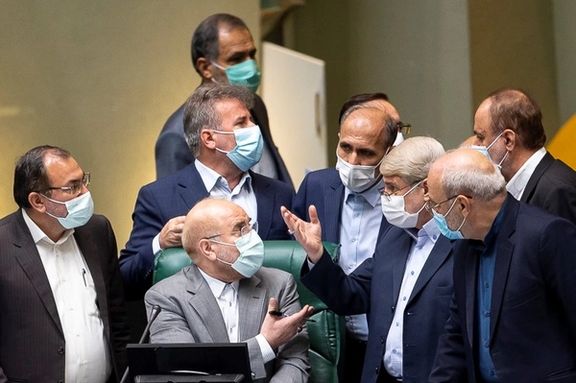
Conservative members of Iran's parliament discuss issues with Speaker Ghalibaf. October 17, 2021

A comment on the proposed bill to restrict Internet access in Iran by a leading lawmaker has revealed deep differences among conservatives over the legislation.

Iranian Labour News Agency, ILNA, on Tuesday quoted Reza Mir-Tajeddini, a conservative member of Iran’s parliament as saying, "Not only the Majles is not after restricting Internet access, but even the ban on social media platform Twitter should be lifted as revolutionaries can spread our message in the world using the platform."

The comment by Mir Tajeddini was in sharp contrast to remarks by the staunchest opponent of social media at the Iranian parliament Morteza Agha-Tehrani who happens to be the former leader of ultraconservative Paydari Party holding the majority at the conservative-dominated parliament.

Agha Tehrani said last week that over 20,000 Iranians have cursed him for his opposition to social media, adding that he would try to further the legislation and have foreign social media banned even if 80 million Iranians oppose him.

Mir-Tajeddini, on the other hand, said on Tuesday, "Why should Twitter be banned in Iran when the country's officials are using it? If it is bad, it should be banned for everyone, but now that the officials are using it, everyone else should also have access to the platform."

Mir-Tajeddini was alluding to the fact that Supreme Leader Ali Khamenei has several Twitter accounts in various languages, and other civilian officials and military commanders including President Ebrahim Raisi, Judiciary Chief Ghiolamhossein Ejei, Majles Speaker Mohammad Bagher Ghalibaf and national security chief Ali Shamkhani also use Twitter and other social media platforms for their messaging.

Mir-Tajeddini further stressed at the bans on other social media platforms should also be lifted. He said different ideas are being put forward on social media and there are so many insightful cultural figures in Iran who can remove possible doubts and answer possible questions. Facebook and You Tube are also blocked in Iran

Hardliners in Iran including Khamenei have spoken against free access to social media and have said that they should be regulated.

Iran during the past years has banned all major social media apps in Iran except Instagram where some 22 million Iranians are reportedly active. More than twice as much Iranian accounts are active on Telegram where sending video, audio and text is much easier. Telegram is also blocked but people use VPNs to connect.

Following the bans on most social media platforms after 2017, the Iranian government spent hefty budgets to develop its own homegrown applications. But Iranians did not trust government-made apps fearing surveillance and invasion of their privacy by security agencies.

On the other hand, homegrown applications have proven to be ineffective as they cannot support more than a few thousand users at any given time. Furthermore, they cannot facilitate cultural and scientific exchanges with the outside world.

The bigger concern on the part of more open-minded conservatives such as Mr. Mir-Tajeddini is that by restricting access to popular social media platforms such as Twitter, Telegram, Instagram and Facebook, Iranians are not likely to turn to Iran's own heavily restricted television and other media outlets that have been losing their audiences to foreign-based satellite television. This group of conservatives are probably concerned that in the absence of social media, the shaping of public opinion in Iran will fall totally into the hands of foreign-based satellite television channels whose sharp disagreement with the party-line in Iran is more than obvious and Iran's state-run TV cannot compete with those networks in terms of uncensored news and quality entertainment.


Most Viewed

Iran negotiators ordered to return after internal rift over Islamabad talks
1
EXCLUSIVE

Iran negotiators ordered to return after internal rift over Islamabad talks

2
ANALYSIS

US blockade enters murky phase as tankers spoof signals and buyers hesitate

3
ANALYSIS

Why the $100 billion Hormuz toll revenue is a myth

4

US tightens financial squeeze on Iran, warns banks over oil money flows

5
ANALYSIS

US blockade targets Iran oil boom amid regional disruption

Banner
Banner

Spotlight

  • Hardliners push Hormuz ‘red line’ as US blockade tests Iran’s leverage
    INSIGHT

    Hardliners push Hormuz ‘red line’ as US blockade tests Iran’s leverage

  • Ideology may be fading in Iran, but not in Kashmir's ‘Mini Iran'
    INSIGHT

    Ideology may be fading in Iran, but not in Kashmir's ‘Mini Iran'

  • War damage amounts to $3,000 per Iranian, with blockade set to add to losses
    INSIGHT

    War damage amounts to $3,000 per Iranian, with blockade set to add to losses

  • Why the $100 billion Hormuz toll revenue is a myth
    ANALYSIS

    Why the $100 billion Hormuz toll revenue is a myth

  • US blockade targets Iran oil boom amid regional disruption
    ANALYSIS

    US blockade targets Iran oil boom amid regional disruption

  • Iran's digital economy battered by prolonged blackout
    INSIGHT

    Iran's digital economy battered by prolonged blackout

•
•
•

More Stories

Syria Says Israel Attacked Targets With Surface-To-Surface Missiles

Nov 3, 2021, 08:09 GMT+0

Syrian state media reported Wednesday that Israel attacked targets near Damascus using surface-to-surface missiles instead of warplanes it has usually used.

There are no details about what targets were hit, but past attacks have aimed at destroying weapons and ammunition depots belonging to Iran-backed forces. Also, weapons destined for the Lebanese Hezbollah have been a prime target for Israeli attacks in the past four year.

Israel does not comment about attacks in Syria.

Recent reports have said Iran is transferring surface-to-air missiles and attack drones to Syria, training militia forces under its command to use the drones. Last month, suspected Iranian drones hit a US base in southern Syria, in what could be seen as an escalation of Iranian sponsored attacks against US forces.

Israeli media say that the use of surface-to-surface missiles instead of aircraft could be a sign of an agreement with Russia not to expose the weakness of Russian air defense systems provided to Syria. The Russian air defense systems have not harmed or stopped Israeli air attacks since 2017.

The attack took place just after midnight, local time, but Syria has said another attack on Saturday was also conducted with surface-to-surface missiles.

Israel's Bennett Discusses Iran With World Leaders In Glasgow

Nov 2, 2021, 21:48 GMT+0
•
Iran International Newsroom

Israeli Prime Minister Naftali Bennett had meetings with world leaders in Glasgow, discussing Iran's nuclear issue, and advising them to be tough with Tehran.

Israeli media report quoting sources that Bennett had many productive meetings during the world climate summit in Glasgow, where other leaders were interested to know Israel’s opinion about how to deal with Iran and its analysis on Tehran’s intentions.

The Israeli prime minister had long talks with French President Emmanuel Macron and British Prime Minister Boris Johnson. The Times of Israel reported that discussions about Iran revolved two major issues – “what world powers can do to change Iranian behavior, and what Israel is doing independently.”

Iran suspended negotiations with world powers in June and has not returned to Vienna where six rounds of talks took place starting in April. Iran’s new hardline government is increasingly adopting a tougher posture that intends to change what was already agreed and perhaps even the established process whereby the United States was negotiation indirectly with the Iranian delegation.

A source told The Times of Israel that “There is a feeling in the world something has to happen,” and other countries want to know what Israel thinks.

Israeli media are also reporting that Bennet advised other leaders to be tough with Tehran, while most are thinking to use the traditional carrot and stick approach to coax Iran to play by diplomatic rules and reach an agreement on reestablishing limits to its nuclear program.

Meanwhile Bennett tried to solidify Israel’s strengthening ties with regional and Asian countries. He accepted an invitation to visit India and he invited Bahrain’s Salman Al Khalifa to visit Israel, an invitation he accepted.

Jerusalem Post reported that Bennett told world leaders to put more pressure on Iran, taking a hard line in the UN Security Council and in the International Atomic Energy Agency (IAEA).

Iran has reduced its cooperation with the UN nuclear watchdog this year but Western countries decided in the September meeting of the agency’s board of governors not to table a censure against Iran.

Bennett also reiterated Israel’s argument that without a firm plan to prevent Iran from obtaining nuclear weapons it would be a mistake to lift sanctions, giving Tehran a financial lifeline that it can use to finance its malign activities in the region.

US officials believe a drone attack in October on a US base in southern Syria was supported and “encouraged” by Iran, and last Friday the Treasury Department announced sanctions against Iranian officials and entities that assist its military drone program.

The Soufan Center, a counterterrorism and anti-extremism think tank reported on Tuesday that Iran is increasingly willing “to take direct military action against its adversaries” and force the US out of Iraq and Syria to be able to have free access for resupplying Hezbollah in Lebanon.

The report said, “It can be argued that the U.S. withdrawal from Afghanistan in August has led Iranian leaders to assess that direct U.S. military pressure can compel the United States to withdraw from the region completely.”

Iranian Newspaper Calls South Korean Ambassador 'Putrid'

Nov 2, 2021, 18:38 GMT+0
•
Maryam Sinaiee

Iranian newspapers launched savage attacks Tuesday on the South Korean ambassador after he visited a private hospital Sunday and donated 2,000 Covid masks.

Javan newspaper affiliated to the Revolutionary Guards, called the ambassador Yun Kang-hyeon’s action “cheap and shameless” on its frontpage, reflecting anger at South Korean banks holding up billions in payments owed to Iran due to fear of punitive United States action.

The Persian word the paper used means 'rotten' or 'putrid'.

While several papers, and many prominent citizens, criticized Yun for insensitivity, Javan in a commentary condemned "a conspiracy" targeting the "honor of a nation." The newspaper insisted that "expulsion of the putrid ambassador of South Korea" would be an insufficient response to such "shamelessness."

"How many million dollars are you charging the Iranian people for each mask?" Javan asked.

Vatan-e Emrouz, another principlist newspaper, used a headline "Charity of Thieves" on its front page alongside a photograph of ambassador and a box of donated masks. Principlist media also slammed Atieh hospital, one of the most expensive private hospital in Tehran, for accepting the gift.

Two Korean banks are holding billions owed to Iran in payment for oil shipments supplied before United States president Donald Trump in May 2019 extended US threats to take action against any third party buying Iranian oil or dealing with its financial sector. South Korea stopped buying Iranian oil, and despite entreaties from Tehran has not released the assets.

Iran foreign ministry spokesman Saeed Khatibzadeh Monday called the donations of masks “a joke” and demanded South Korea unfreeze Iran's assets, which have been estimated at $7 billion.

Iran's foreign minister Hossein Amir-Abdollahian said October 2 that that the US should make a goodwill gesture − before talks resume to revive Iran’s 2015 nuclear deal, the Joint Comprehensive Plan of Action (JCPOA) – by ‘unfreezing’ $10 billion in Iranian funds. This amounted to a request for Washington to state it would take no punitive action against a named third party or parties transferring money owed to Tehran, which could include payments owed by South Korea.

In a tweet Monday, the South Korean embassy listed its donations to Iran since the beginning of the Covid pandemic, including 1 million doses of AstraZeneca in October, 1 million masks in June, PCR test kits worth $2 million in May, and $1 million-worth of medicine for rare medical conditions in February 2020.

Jamshid Barzgar, a London-based journalist, said all the criticism of the South Korean ambassador was “populistic” and motivated simply by wanting to have Iran’s assets unfrozen. He told Iran International it was “selective” to ignore Korea’s recent donation of 1 million vaccine doses and “blow up out of proportion” the 2,000 masks.

After a letter from Iran's Supreme Leader Ali Khamenei September 6, President Ebrahim Raisi (Raeesi) instructed ministers not to allow imports from South Korea’s LG and Samsung. While Khamenei framed the letter as a way to boost local manufacturers, state media also described the move as a diplomatic message to South Korea.

Iran Lawmaker Says Rouhani's Central Bank Chief Sold 62 Tons Of Gold

Nov 2, 2021, 18:15 GMT+0

A lawmaker in Iran has alleged that during former president Hassan Rouhani’s administration the central bank chief engaged in corruption and mismanagement.

Ali Akbar Karimi, a trained economist and an occasional critic of corruption, told the conservative Mehr news agency on Tuesday that former central bank chief Valiollah Seif “auctioned off the country’s wealth” and no one has looked into this case.

He said that the central bank sold 62 tons of gold as government-issued gold coins, but he did not say how this was related to corruption. Seif headed the institution from 2013-2018, and Iran was under international sanctions during the first three years and short of cash.

He insisted that Seif inflicted “huge damage” during his tenure at the bank. Iran’s Judiciary has announced that Seif has been convicted in another case related to corruption and sentenced to 10 years in prison.

Iranian hardline conservatives have long been pursuing corruption and mismanagement in Rouhani’s government to show that shortcomings are the result of bad actors rather than the political system.

Similar cases have been common in other Iranian presidential administrations, and it is hard to prove that Rouhani’s government was worse than its predecessors.

With US Sanctions In Place Iran Cannot Deal With Its Budget Deficit

Nov 2, 2021, 17:24 GMT+0
•
Mardo Soghom

Iran’s government is pledging not to dip into the pockets of the central bank or print more money to balance its budget, but skeptics doubt there are any magic solutions to lack of income.

Iran’s budget deficit in the current fiscal year is 40-50 percent or around 5,000 trillion rials. If we convert the devalued rial amount to the highly appreciated dollar, it is around $20 billion. This would be a manageable amount if Iran could export 1.5 million barrels of crude oil daily, but currently it sells a few hundred thousand barrels at discounted prices.

According to estimates published by the parliament’s research center, only 15-20 percent of the projected oil revenues have been realized. The projection in the budget was to export 1.5 million barrels a day, which certainly was a gross overestimation, as US sanctions remained in place.

President Ebrahim Raisi’s ‘revolutionary’ government took office in August with pledges of solving the economic crisis, with his hardline supporters blaming the former administration for ineptitude. But it is common knowledge in Iran that the main cause for the steep economic decline since 2018 has been US sanctions, especially on its oil exports.

Then, why are the hardliners blaming Rouhani? The ruling elite headed by Supreme Leader Ali Khamenei does not want to admit that sanctions have caused misery. If they admit that, it means they must also admit that their confrontational foreign policy has led to economic disaster.

The Raisi government is now saying that they have found ways to generate income without borrowing from the central bank or printing money – although both mean the same thing, since the central bank has no extra foreign reserves. Former president Rouhani’s administration was printing money and fueling inflation that has reached close to 50 Percent. Absent a deal with the United States it had no other choice.

But few economists outside the government believe Raisi can magically generate revenues. Maysam Radpour, a well-known analyst in Iran was quoted by local media on Tuesday as expressing surprise that the government can find additional revenues without borrowing from the central bank or printing money. He said that neither expenditures have been cut nor tax collection increased, and US sanctions remain in place. He added that the government is muddling through amid a lack of real information about its actions.

The conservative website, Alef, published an analysis on the role of both sanctions and structural problems in generating Iran’s economic crisis. The article said that lifting sanctions is necessary for dealing with economic challenges but not sufficient without structural reforms.

Iran’s economy has many structural shortcomings and there is no choice but to do a “deep and painful surgery”, Alef said. It is an economy that has survived with injecting petrodollars to keep it going temporarily and when oil sanctions hit, it has no legs to stand on. If sanctions are lifted, economic conditions will somewhat improve the article said, but on the long-run “the reality of a sick economy will again impose its harsh impact on the country and on the people.”