• العربية
  • فارسی
Brand
  • Iran Insight
  • Politics
  • Economy
  • Analysis
  • Special Report
  • Opinion
  • Podcast
  • Iran Insight
  • Politics
  • Economy
  • Analysis
  • Special Report
  • Opinion
  • Podcast
  • Theme
  • Language
    • العربية
    • فارسی
  • Iran Insight
  • Politics
  • Economy
  • Analysis
  • Special Report
  • Opinion
  • Podcast
All rights reserved for Volant Media UK Limited
volant media logo

Israel's Bennett Discusses Iran With World Leaders In Glasgow
Iran International Newsroom
Nov 2, 2021, 21:48 GMT+0Updated: 17:22 GMT+1
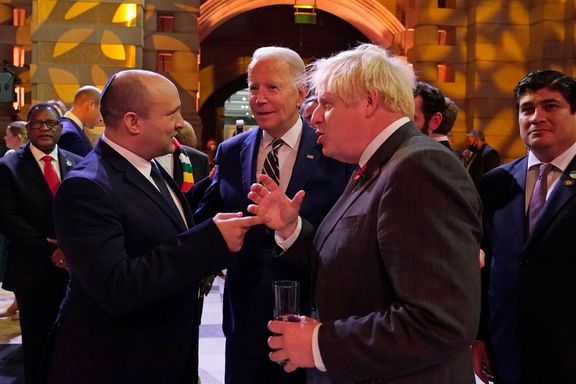
Israel's PM Naftali Bennett, US President Joe Biden and Britain's PM Boris Johnson chat as they attend an evening reception, in Glasgow, Scotland, November 1, 2021.

Israeli Prime Minister Naftali Bennett had meetings with world leaders in Glasgow, discussing Iran's nuclear issue, and advising them to be tough with Tehran.

Israeli media report quoting sources that Bennett had many productive meetings during the world climate summit in Glasgow, where other leaders were interested to know Israel’s opinion about how to deal with Iran and its analysis on Tehran’s intentions.

The Israeli prime minister had long talks with French President Emmanuel Macron and British Prime Minister Boris Johnson. The Times of Israel reported that discussions about Iran revolved two major issues – “what world powers can do to change Iranian behavior, and what Israel is doing independently.”

Iran suspended negotiations with world powers in June and has not returned to Vienna where six rounds of talks took place starting in April. Iran’s new hardline government is increasingly adopting a tougher posture that intends to change what was already agreed and perhaps even the established process whereby the United States was negotiation indirectly with the Iranian delegation.

A source told The Times of Israel that “There is a feeling in the world something has to happen,” and other countries want to know what Israel thinks.

Israeli media are also reporting that Bennet advised other leaders to be tough with Tehran, while most are thinking to use the traditional carrot and stick approach to coax Iran to play by diplomatic rules and reach an agreement on reestablishing limits to its nuclear program.

Meanwhile Bennett tried to solidify Israel’s strengthening ties with regional and Asian countries. He accepted an invitation to visit India and he invited Bahrain’s Salman Al Khalifa to visit Israel, an invitation he accepted.

Jerusalem Post reported that Bennett told world leaders to put more pressure on Iran, taking a hard line in the UN Security Council and in the International Atomic Energy Agency (IAEA).

Iran has reduced its cooperation with the UN nuclear watchdog this year but Western countries decided in the September meeting of the agency’s board of governors not to table a censure against Iran.

Bennett also reiterated Israel’s argument that without a firm plan to prevent Iran from obtaining nuclear weapons it would be a mistake to lift sanctions, giving Tehran a financial lifeline that it can use to finance its malign activities in the region.

US officials believe a drone attack in October on a US base in southern Syria was supported and “encouraged” by Iran, and last Friday the Treasury Department announced sanctions against Iranian officials and entities that assist its military drone program.

The Soufan Center, a counterterrorism and anti-extremism think tank reported on Tuesday that Iran is increasingly willing “to take direct military action against its adversaries” and force the US out of Iraq and Syria to be able to have free access for resupplying Hezbollah in Lebanon.

The report said, “It can be argued that the U.S. withdrawal from Afghanistan in August has led Iranian leaders to assess that direct U.S. military pressure can compel the United States to withdraw from the region completely.”


Most Viewed

Iran negotiators ordered to return after internal rift over Islamabad talks
1
EXCLUSIVE

Iran negotiators ordered to return after internal rift over Islamabad talks

2
ANALYSIS

US blockade enters murky phase as tankers spoof signals and buyers hesitate

3
ANALYSIS

Why the $100 billion Hormuz toll revenue is a myth

4

US tightens financial squeeze on Iran, warns banks over oil money flows

5
INSIGHT

Ideology may be fading in Iran, but not in Kashmir's ‘Mini Iran'

Banner
Banner

Spotlight

  • Hardliners push Hormuz ‘red line’ as US blockade tests Iran’s leverage
    INSIGHT

    Hardliners push Hormuz ‘red line’ as US blockade tests Iran’s leverage

  • Ideology may be fading in Iran, but not in Kashmir's ‘Mini Iran'
    INSIGHT

    Ideology may be fading in Iran, but not in Kashmir's ‘Mini Iran'

  • War damage amounts to $3,000 per Iranian, with blockade set to add to losses
    INSIGHT

    War damage amounts to $3,000 per Iranian, with blockade set to add to losses

  • Why the $100 billion Hormuz toll revenue is a myth
    ANALYSIS

    Why the $100 billion Hormuz toll revenue is a myth

  • US blockade targets Iran oil boom amid regional disruption
    ANALYSIS

    US blockade targets Iran oil boom amid regional disruption

  • Iran's digital economy battered by prolonged blackout
    INSIGHT

    Iran's digital economy battered by prolonged blackout

•
•
•

More Stories

Iranian Newspaper Calls South Korean Ambassador 'Putrid'

Nov 2, 2021, 18:38 GMT+0
•
Maryam Sinaiee

Iranian newspapers launched savage attacks Tuesday on the South Korean ambassador after he visited a private hospital Sunday and donated 2,000 Covid masks.

Javan newspaper affiliated to the Revolutionary Guards, called the ambassador Yun Kang-hyeon’s action “cheap and shameless” on its frontpage, reflecting anger at South Korean banks holding up billions in payments owed to Iran due to fear of punitive United States action.

The Persian word the paper used means 'rotten' or 'putrid'.

While several papers, and many prominent citizens, criticized Yun for insensitivity, Javan in a commentary condemned "a conspiracy" targeting the "honor of a nation." The newspaper insisted that "expulsion of the putrid ambassador of South Korea" would be an insufficient response to such "shamelessness."

"How many million dollars are you charging the Iranian people for each mask?" Javan asked.

Vatan-e Emrouz, another principlist newspaper, used a headline "Charity of Thieves" on its front page alongside a photograph of ambassador and a box of donated masks. Principlist media also slammed Atieh hospital, one of the most expensive private hospital in Tehran, for accepting the gift.

Two Korean banks are holding billions owed to Iran in payment for oil shipments supplied before United States president Donald Trump in May 2019 extended US threats to take action against any third party buying Iranian oil or dealing with its financial sector. South Korea stopped buying Iranian oil, and despite entreaties from Tehran has not released the assets.

Iran foreign ministry spokesman Saeed Khatibzadeh Monday called the donations of masks “a joke” and demanded South Korea unfreeze Iran's assets, which have been estimated at $7 billion.

Iran's foreign minister Hossein Amir-Abdollahian said October 2 that that the US should make a goodwill gesture − before talks resume to revive Iran’s 2015 nuclear deal, the Joint Comprehensive Plan of Action (JCPOA) – by ‘unfreezing’ $10 billion in Iranian funds. This amounted to a request for Washington to state it would take no punitive action against a named third party or parties transferring money owed to Tehran, which could include payments owed by South Korea.

In a tweet Monday, the South Korean embassy listed its donations to Iran since the beginning of the Covid pandemic, including 1 million doses of AstraZeneca in October, 1 million masks in June, PCR test kits worth $2 million in May, and $1 million-worth of medicine for rare medical conditions in February 2020.

Jamshid Barzgar, a London-based journalist, said all the criticism of the South Korean ambassador was “populistic” and motivated simply by wanting to have Iran’s assets unfrozen. He told Iran International it was “selective” to ignore Korea’s recent donation of 1 million vaccine doses and “blow up out of proportion” the 2,000 masks.

After a letter from Iran's Supreme Leader Ali Khamenei September 6, President Ebrahim Raisi (Raeesi) instructed ministers not to allow imports from South Korea’s LG and Samsung. While Khamenei framed the letter as a way to boost local manufacturers, state media also described the move as a diplomatic message to South Korea.

With US Sanctions In Place Iran Cannot Deal With Its Budget Deficit

Nov 2, 2021, 17:24 GMT+0
•
Mardo Soghom

Iran’s government is pledging not to dip into the pockets of the central bank or print more money to balance its budget, but skeptics doubt there are any magic solutions to lack of income.

Iran’s budget deficit in the current fiscal year is 40-50 percent or around 5,000 trillion rials. If we convert the devalued rial amount to the highly appreciated dollar, it is around $20 billion. This would be a manageable amount if Iran could export 1.5 million barrels of crude oil daily, but currently it sells a few hundred thousand barrels at discounted prices.

According to estimates published by the parliament’s research center, only 15-20 percent of the projected oil revenues have been realized. The projection in the budget was to export 1.5 million barrels a day, which certainly was a gross overestimation, as US sanctions remained in place.

President Ebrahim Raisi’s ‘revolutionary’ government took office in August with pledges of solving the economic crisis, with his hardline supporters blaming the former administration for ineptitude. But it is common knowledge in Iran that the main cause for the steep economic decline since 2018 has been US sanctions, especially on its oil exports.

Then, why are the hardliners blaming Rouhani? The ruling elite headed by Supreme Leader Ali Khamenei does not want to admit that sanctions have caused misery. If they admit that, it means they must also admit that their confrontational foreign policy has led to economic disaster.

The Raisi government is now saying that they have found ways to generate income without borrowing from the central bank or printing money – although both mean the same thing, since the central bank has no extra foreign reserves. Former president Rouhani’s administration was printing money and fueling inflation that has reached close to 50 Percent. Absent a deal with the United States it had no other choice.

But few economists outside the government believe Raisi can magically generate revenues. Maysam Radpour, a well-known analyst in Iran was quoted by local media on Tuesday as expressing surprise that the government can find additional revenues without borrowing from the central bank or printing money. He said that neither expenditures have been cut nor tax collection increased, and US sanctions remain in place. He added that the government is muddling through amid a lack of real information about its actions.

The conservative website, Alef, published an analysis on the role of both sanctions and structural problems in generating Iran’s economic crisis. The article said that lifting sanctions is necessary for dealing with economic challenges but not sufficient without structural reforms.

Iran’s economy has many structural shortcomings and there is no choice but to do a “deep and painful surgery”, Alef said. It is an economy that has survived with injecting petrodollars to keep it going temporarily and when oil sanctions hit, it has no legs to stand on. If sanctions are lifted, economic conditions will somewhat improve the article said, but on the long-run “the reality of a sick economy will again impose its harsh impact on the country and on the people.”

Iran ‘Closely Examining' Biden's Behavior, Foreign Minister Tweets

Nov 2, 2021, 14:28 GMT+0
•
Maryam Sinaiee

Iran’s foreign minister tweeted Tuesday that Tehran was closely watching the behavior of US President Joe Biden after the latest US sanctions imposed last week.

"The White House calls for negotiations with Iran and claims to be ready to return to the JCPOA,” wrote Hossein Amir-Abdollahian, referring to Iran’s 2015 nuclear deal with world powers, the Joint Comprehensive Plan of Action, which the US left in 2018.

“Yet it simultaneously imposes new sanctions on Iranian individuals and entities,” the foreign minister continued. “We are closely examining Mr. Biden's behavior.”

Iran has long argued that the onus for reviving the JCPOA lies with the US as the party that left it. Washington has said its own return should be negotiated alongside agreement as to how Iran reduces its nuclear program, which it has expanded and refined since 2019.

Talks in Vienna aimed at reviving the JCPOA – with remaining world powers and Iran participating formally and the US indirectly – began in April but were suspended in June by Iran saying that its new president Ebrahim Raisi (Raeesi) needed time for transition. But it is now clear that Tehran has been delaying it return trying to adopt a tougher posture.

In another tweet Tuesday, Amir-Abdollahian reiterated that negotiations should not be "talking for the sake of talking, but to achieve tangible results." Amir-Abdollahian suggested Monday that the US could simply lift sanctions incompatible with the JCPOA through executive action, the means used by previous president Donald Trump to impose them.

On Monday Foreign Ministry Spokesman Saeed Khatibzadeh said Tehran was waiting for Washington to "take action" and that the latest US sanctions, related to Iran's drone program, highlighted contradictions in White House behavior. The spokesman said the JCPOA could be revived "very quickly" if the US lifted all sanctions imposed by Trump.

Another pressing issue is a request from Rafael Mariano Grossi, head of the International Atomic Energy Agency (IAEA) for an urgent meeting in Tehran to discuss IAEA access to the Karaj site, near Tehran, where Iran makes centrifuges, which are used to enrich uranium. Tehran has not allowed agency access on the grounds it is carrying out a security investigation after a drone attack in June.

Amir-Abdollahian has been quarantined since Monday due to coronavirus infection and the foreign minister spokesman Saeed Khatibzadeh has said his schedule of programs has changed but his general condition is good and he is doing his daily work in quarantine.

While some social media users have pointed out that Amir-Abdollahian did not wear a mask in public and have suggested that his Covid infection may be due to using the homegrown Barakat coronavirus vaccine, some journalists and social media users have suggested that the foreign minister's illness may be an excuse to delay Grossi’s looming visit to Tehran and his team's return to nuclear talks.

"What a time for Amir-Abdollahian to have a Covid infection! Exactly on time!," Saeed Maleki, an independent journalist tweetedwhile another user tweeted that the foreign minister's illness and change of programs was similar to Iranian athletes' excuses to avoid competing against Israeli rivals in international competitions.

In interview with Euronews Thursday Grossi said he hoped to visit Tehran "in the near future" and meet with Raisi. Amir-Abdollahian referred to the visit as “certain” but said the date was “not important.”

For weeks Tehran has said that while it considers when it should resume talks, the US should as a goodwill measure waive the threat of punitive action against third parties to allow them to transfer $10 billion owed to Iran.

Iran's Foreign Minister Slams US Negotiating Posture In Nuclear Talks

Nov 2, 2021, 10:42 GMT+0

Iran’s foreign minister has criticized the United States for its posture in JCPOA nuclear talks, demanding lifting of all US sanctions imposed since 2018.

Hossein Amir-Abdollahian tweeted Tuesday that “The White House calls for negotiations with Iran…Yet it simultaneously imposes new sanctions on Iranian individuals & entities”.

The US Treasury Department on October 29 announced new sanctions on a few Iranian officials and companies for their role in the Unmanned Aerial Vehicle (UAV) program of the IRGC and its Qods (Quds) Force. Days earlier, drones suspected to have been supplied by Iran hit a US base in southern Syria.

The Iranian foreign minister fired off a second tweet saying that the goal of the nuclear talks should be “tangible results on the basis of respect for mutual interests”. He added that the remaining members of the Joint Comprehensive Plan of Action (JCPOA) should be ready for talks.

Iran has been hardening its posture in recent days, demanding the full removal of all US sanctions imposed since 2018, when former president Donald Trump withdrew from the JCPOA. It is has also said it will not have any contacts with the US until all sanctions are lifted.

Amir-Abdollahian has tested positive for Covid-19 and is in quarantine.

Iran's Parliament Wants Judiciary To Look Into Rouhani's Handling Of Pandemic

Nov 2, 2021, 10:02 GMT+0

Iranian lawmakers agreed on Tuesday to send a report to the Judiciary on “Covid mismanagement” by former president Hassan Rouhani for possible legal action.

The parliament packed with hardliners was always critical of Rouhani in all aspects of governance and blamed him for the economic crisis gripping the country.

Rouhani’s defenders in the media have argued that United States sanctions are the main cause of the economic crisis and the country needed to resolve its differences over the nuclear issue with the West to be able to reduce inflation, raise wages and stimulate employment.

However, Iran’s major policy issues are decided by Supreme Leader Ali Khamenei and the president of the republic simply manages government operations.

The same applied to the Covid-19 pandemic when Khamenei banned the government from purchasing American and British vaccines in January, setting back the national vaccination plan for months.

Iran experienced a severe wave of the pandemic in July and August, with around 40,000 new deaths from June to mid-September. An increase in vaccinations since August has reduced the rate of new infections and deaths.





