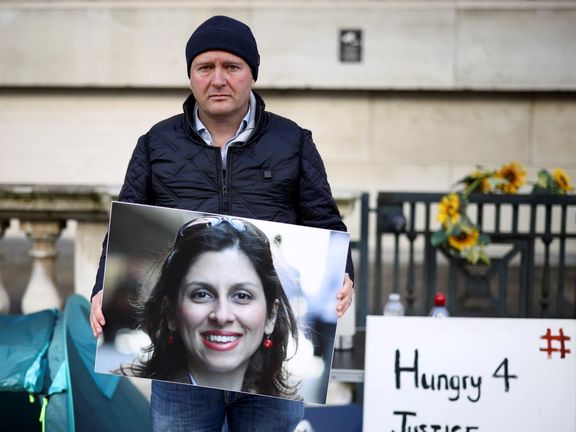
Richard Ratcliffe on hunger strike in London demanding his wife to be freed in Iran. October 27, 2021
Richard Ratcliffe whose wife Nazanin Zaghari-Ratcliffe again faces prison in Iran, has said he will continue his hunger strike until Britain secures her return.
Ratcliffe − who has encamped since Sunday in a tent outside the entrance of the foreign office in Whitehall, London − met Thursday with Liz Truss, the foreign secretary, and Tulip Siddiq, the member of parliament for Ratcliffe’s north London constituency of Hampstead and Kilburn.
“Going on hunger strike is the absolute last resort for anyone, and Richard told me that he feels there is no other option left, because he feels our government’s response to his wife’s case has been pitiful,” Siddiq said ahead of the meeting.
Ratcliffe went on a 15-day hunger strike in 2019, which he claims led to the couple’s daughter returning from Iran, where she was staying with grandparents.
Zaghari-Ratcliffe, who had worked for the BBC World Service Trust training ‘citizen journalists’ and for Reuters-Thomson Foundation, was sentenced in April to a year in jail after conviction for spreading “propaganda against the system.” She previously served around two years of a five-year term, following conviction in 2016 on spying charges, before being given a series of furloughs.
Zaghari-Ratcliffelost an appeal against the recent sentence in September. “Instead of threatening to return Nazanin to prison Iran must release her permanently so she can return home,” the British Foreign Office said in a statement.
On Wednesday Zabihollah Kohdaeian, spokesman of the Iranian judiciary, said the one-year sentence was final but had not been referred for enforcement.
Ratcliffe insists UK ministers are "too timid" in efforts on behalf of his wife and has repeatedly linked the case to the British government’s failure to repay £400 million ($550 million) owed to Tehran after failing to deliver Chieftain tanks in the 1970s.
Ratcliffe has recently charged that his wife’s plight has been considered less important than talks in Vienna designed to revive the 2015 agreement restricting Iran’s nuclear program.
“My criticism of the British government is they’ve not prioritized the safety of British citizens in the course of their nuclear negotiations, in the course of their discussions with Iran and other stuff’s been more important,” he told the BBC.
“Iran conducts its diplomatic business through hostage-taking, in part because it is cost-free,” he told the Guardian 19 September.
Former foreign secretary Jeremy Hunt told parliament Wednesday that Zaghari-Ratcliffe would not be able to leave Iran until the UK government returned the money paid for the tanks. "When are we going to repay that debt?” he asked.
An IRGC colonel who slapped a general is taken out by security in Iran. October 23, 2021
The IRGC officer who slapped a general last week in Iran is under pressure in military detention to confess that his action was based on personal reasons.
The Human Rights Activists’ News Agency (HRANA) a monitoring group based abroad quoted “an informed source” on Friday that a court set his bail at 3 billion rials ($11,000) but outside pressures have kept the assailant behind bars.
The Revolutionary Guard colonel identified unofficially as Ayyub Alizadeh, walked on the stage on October 23 during the inauguration of a new governor, General Abedin Khorram, and slapped him hard in the face. The reason for his daring act has never been officially disclosed, but some have said he was angry that Khorram had denied him a promotion.
Official media reported that he was angry for a personal reason unrelated to Khorram. According to HRANA, interrogators are now pressuring him to make a confession along those lines.
The unidentified source told the human rights monitoring group that Alizadeh is under pressure and might have even been beaten to make a false confession.
Despite censorship, Iranian media did report the incident, which was an embarrassment for the Revolutionary Guard.
A huge crack in land near the Iranian city of Esfahan. Undated
Iran’s natural disaster taskforce says 20 million urban residents face ground subsidence in 18 of 31 provinces, warning about agricultural overuse of water.
Ali Baytollahi, the head of the taskforce said Iran has not come up with policies and rules to deal with the disaster, as drought and wasteful irrigation methods are depleting ground water reserves.
Depletion of underground water is one of the main causes for ground subsidence that can threaten not only cities but also agricultural lands.
Iran’s capital city Tehran is facing a serious problem of rapid ground subsidence due to decreasing ground water levels, Intel Lab intelligence an imagery consulting firm reported July 1.
Intel Lab published a series of satellite imagery showing relative levels of sinking ground between January 2020 and April 2021. In some areas the ground has sank up to 25 centimeters or more than 8 inches.
Reports and images showed in early October that international airport and historic buildings in Esfahan are sustaining damage from sinking land, as a result of over-reliance on ground water for agriculture amid recurring droughts.
Baytollahi has said that if Iran does not take serious action now, the country can soon reach a point of no return.
Motorists buying gas at higher prices in Tehran after major disruption. October 26, 2021
Hardliners in Iran have used Tuesday's attack on the national fuel distribution system as an excuse to promote quicker restrictions on access to the Internet.
Kayhan, the flagship hardliner newspaper in Tehran, accused Israel and the United States Thursday of launching Tuesday’s apparent cyberattack on Iran’s gasoline stations in a bid to spark protests and riots.
Social media posts from hardliners said parliament should expedite the approval of a bill that will require the government to launch a national intranet − the National Information Network (NIN) − that would reduce the threat of cyberattacks from abroad.
It would also curb access to content deemed undesirable and could not be circumvented by the VPNs used by many Iranians to reach blocked websites.When the authorities shut down the Internet in 2019 during protests, the NIN was used by business for online activities, including cab services.
Tuesday’s attack affected all service stations across Iran, bringing the sales of cheap fuel, accessed through smart ration cards, to a standstill. The problem persisted at some service stations two days after the incident, meaning only unrationed fuel could be sold, at twice the 6 cents a liter price of rationed fuel.
Previous cyberattacks have affected both nuclear sites and Iranian railways.
How Tuesday’s attack was perpetrated remains unclear. Amir Nazemi, a former deputy telecommunications minister and head of information technology organization, tweeted Tuesday that connections within the fuel distribution network were isolated from the Internet. Ali Forouzandeh, spokesman of the oil ministry, also said Tuesday that the system was "offline."
Mehdi Saremifar, a Canada-based science and technology reporter, claimed Tuesday that the attack could not have been orchestrated outside the country. He told Iran International that Iran's gas stations rely on their own antenna and a dial-up connection to transmit data on smart fuel ration cards to the central server of the National Iranian Refining and Distribution Company (NIORDC).
"Therefore, this attack was carried out in the closed system of NIORDC,” Saremifar said. “The person who perpetrated the attack probably had security clearance to access [the NIORDC server]… The perpetrator of the attack was from inside the system.”
Afshin Kolahi, head of New and Science-Based Businesses of Iran Chamber of commerce, told the Iranian Labour News Agency (ILNA) Wednesday said that while service stations were independent from the Internet, their technology was very outdated.
Kolahi said it would be better to improve security systems that were not vulnerable to Internet attack rather than look at general restrictions of access, even if this suited the general approach of some principlists. "Their major aim is cutting people's connection to the cyberspace outside the country and their access to information," Kolahi said.
Lebanese pushing cars near a gas station amid a gasoline shortage. August 19, 2021
The US Treasury on Thursday imposed sanctions on two top Lebanese contractors and a lawmaker close to the Hezbollah movement over large-scale corruption.
Businessmen Jihad al-Arab and Dany Khoury, close to former Lebanese Prime Minister Saad al-Hariri and Christian politician Gebran Bassil respectively, were sanctioned for alleged corruption related to state contracts.
Lawmaker Jamil Sayyed was sanctioned for allegedly seeking to "skirt domestic banking policies and regulations" and transfer $120 million abroad, "presumably to enrich himself and his associates," a Treasury statement said. This will have an impact on Hezbollah’s reputation.
The Treasury alleged that Khoury and Arab both received state contracts worth hundreds of millions of dollars, thanks to political connections.
The allegations come amid an unprecedented economic crisis in Lebanon blamed on years of bad policies and corruption by the ruling elite.
Thursday's sanctions mark the first time a close associate of Hariri, a pro-western figure, is sanctioned by the US, which previously focused on Iran-backed Hezbollah and its allies.
"The Americans are sending a message to the entire political class, not just those backed by Iran," Maha Yahya, director of the Carnegie Middle East Center in Beirut, told Reuters.
US Secretary of State Anthony Blinken characterized the new sanctions on Twitter as "an important step in promoting accountability in Lebanon."
"Lebanese officials must end corruption and take urgent action to address the crises the Lebanese people face," he said.
A natural gas platform in Iran's South Pars offshore gas fields. FILE PHOTO
A top oil official in Iran has said that if new investments are not made in natural gas industry, the country will become a net importer in the next few years.
Iran has the second largest natural gas reserves in the world, holding more than 17 percent of global discovered gas fields, but the government has warned people of power cuts this winter, as it cannot supply enough gas to power plants that have to switch to dirty liquid fuels.
Mohsen Khojastepur, general director of the Iranian national oil company said this week that if investments in the gas industry are not secured Iran will become a net importer in the coming years.
Fararu news website in Tehran has confirmed that the natural gas crisis is solely the result of insufficient investments and lack of technology that only a handful of Western energy giants can provide. Just to maintain current production, Iran needs to invest up to $50 billion in its gas fields, especially in the Persian Gulf offshore South Pars reserves shared with Qatar.
Without this urgent infusion of cash and know-how, Iran will become a natural gas importer. But the Islamic Republic does not have the cash and US sanctions currently in place would not allow Western companies to have any business dealings with Iran.
The last chance Iran had of collaboration with a Western energy giant was a $5 billion deal it had struck with Total in 2016 to develop the South Pars gas fields, which fell apart in 2018 when former US president Donald Trump withdrew from the Iran nuclear deal and began imposing sanctions.
Iran’s gas fields, like any other in the world and similar to Qatar’s, have a natural production curve and underground pressure that pushes the gas out declines over time, needing modern technology to maintain production level. Qatar has invested in 20,000-ton production platforms, not only maintaining output but even increasing production.
Fararu also pointed out that not only in gas sector but also in oil production Iran has seriously fallen behind. On top of investment for gas fields, $150 billion is needed to modernize and increase oil production.
These facts have been known all along, but some local media in Iran are more openly and persistently discussing the huge economic challenges facing the country, which to an extent are linked with the resolution of Iran’s disputes with the United States.
The issue that some writers cautiously mention in Iran is whether the lifting of US sanctions can solve the huge economic challenges. If Iran did little to upgrade its energy industry a decade ago when its annual oil export revenue reached $100 billion, what it can do now with exporting $60 or $70 billion if the sanctions are lifted. They say the country has so many serious financial issues that it would hardly be able to make investments that for example Saudi Arabia has been making.
The other issue being discussed in Iran, both by critics and indirectly by the government, is the high level of energy consumption. Even with lack of investments Iran is the third largest producer of natural gas but most of it is used domestically without the corresponding level of industrial production. The reason is extremely cheap prices for both gas and electricity, which leads to waste.