• العربية
  • فارسی
Brand
  • Iran Insight
  • Politics
  • Economy
  • Analysis
  • Special Report
  • Opinion
  • Podcast
  • Iran Insight
  • Politics
  • Economy
  • Analysis
  • Special Report
  • Opinion
  • Podcast
  • Theme
  • Language
    • العربية
    • فارسی
  • Iran Insight
  • Politics
  • Economy
  • Analysis
  • Special Report
  • Opinion
  • Podcast
All rights reserved for Volant Media UK Limited
volant media logo

Iran Court Rejects Appeal From Zaghari-Ratcliffe
Oct 16, 2021, 18:02 GMT+1Updated: 15:00 GMT+0
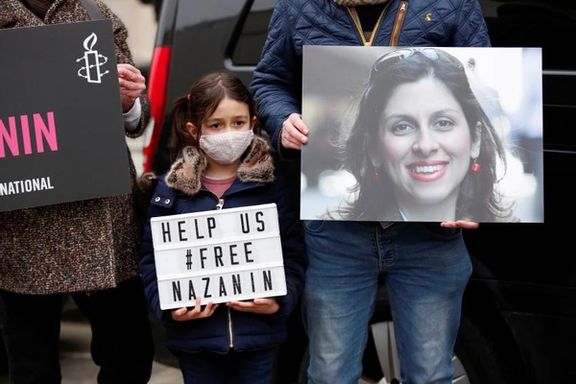
Nazanin Zaghari-Ratcliff's daughter picketing in London for her mother's release. Undated

An appeal court in Iran has upheld the verdict and one-year prison sentence of British-Iranian citizen Nazanin Zaghari-Ratcliffe, held on ambiguous charges.

The project manager for the Thomson-Reuters Foundation has also been barred from leaving Iran for a year, Hojjat Kermani, Zaghari-Ratcliffe's attorney, told Emtedad news Saturday.

In March Zaghari-Ratcliffe completed a previous five-year sentence, with eight months in solitary confinement, but a second trial convicted her of further charges, which related to

a protest at the Iranian embassy in London in 2009, which was judged punishable under the Iranian Penal Code.

“It seems that every time we dare to hope that Nazanin might soon be free, there is another dreadful setback that puts freedom out of sight," Zaghari-Ratcliffe's member of parliament in Britain Tulip Siddiq tweeted Saturday. "She could now be returned to prison at any time.”

Zaghari-Ratcliffe was arrested in April 2016 while visiting her family in Iran and convicted on espionage charges without due process of law.

Security charges in Iran are tried in closed-door courts, usually with limited representation. Her husband Richard Ratcliffe has repeatedly alleged that that Iran has taken his wife as a bargaining chip to encourage the British government to repay £400 million ($550 million) owed to Iran for Chieftain tanks that Tehran paid for in the 1970s but never received.

In September 2020, United Kingdom Defence Secretary Ben Wallace acknowledged the debt in a letter to lawyers representing Zaghari-Ratcliffe and relatives of ,dual nationals held in Iran. Wallace said he was seeking to make arrangements for repaying it.

“Iran conducts its diplomatic business through hostage-taking, in part because it is cost-free,” Richard Ratcliffe was quoted by the Guardian newspaper as saying on September 19. “British citizens will not be protected from hostage-taking by words and soundbites, but by actions that cause the perpetrators to reassess their calculations and consider the personal costs – for their role in what is a serial organized crime,”

Zaghari-Ratcliffe has been under house arrest at her parents' house in Tehran since March 2020 when she was given furlough from prison due to the Covid pandemic. Two forensic specialists produced a report in February 2021 after examining Zaghari-Ratcliffe by video-link that she suffered from post-traumatic stress disorder, depression, and obsessive-compulsive disorder due to her treatment in prison, house arrest, uncertainty, and separation from her family.

Most Viewed

US blockade enters murky phase as tankers spoof signals and buyers hesitate
1
ANALYSIS

US blockade enters murky phase as tankers spoof signals and buyers hesitate

2
INSIGHT

Ideology may be fading in Iran, but not in Kashmir's ‘Mini Iran'

3
INSIGHT

Hardliners push Hormuz ‘red line’ as US blockade tests Iran’s leverage

4
VOICES FROM IRAN

Hope and anger in Iran as fragile ceasefire persists

5

US sanctions oil network tied to Iranian tycoon Shamkhani

Banner
Banner

Spotlight

  • Hardliners push Hormuz ‘red line’ as US blockade tests Iran’s leverage
    INSIGHT

    Hardliners push Hormuz ‘red line’ as US blockade tests Iran’s leverage

  • Ideology may be fading in Iran, but not in Kashmir's ‘Mini Iran'
    INSIGHT

    Ideology may be fading in Iran, but not in Kashmir's ‘Mini Iran'

  • War damage amounts to $3,000 per Iranian, with blockade set to add to losses
    INSIGHT

    War damage amounts to $3,000 per Iranian, with blockade set to add to losses

  • Why the $100 billion Hormuz toll revenue is a myth
    ANALYSIS

    Why the $100 billion Hormuz toll revenue is a myth

  • US blockade targets Iran oil boom amid regional disruption
    ANALYSIS

    US blockade targets Iran oil boom amid regional disruption

  • Iran's digital economy battered by prolonged blackout
    INSIGHT

    Iran's digital economy battered by prolonged blackout

•
•
•

More Stories

Expert Warns Iran Has Less Than 10 Years To Deal With Land Subsidence

Oct 16, 2021, 14:06 GMT+1

An expert in Iran has warned that the country has less than ten years to deal with dangerous land subsidence because of over-extraction of ground water.

Reports and images last week showed that international airport and historic buildings in Esfahan are sustaining damage from sinking land, as a result of over-reliance on ground water for agriculture amid recurring droughts.

Ali Baytollahi, an expert on roads and buildings, told Tejarat News that most plains in Iran are sinking and the problem is worse in Esfahan.

Land subsidence is not limited to Esfahan and its surrounding plain. In many other areas in Iran cracks and huge hollows that resemble meteor craters have appeared in the ground in recent years. Ali Saberi, a geologist told local media recently that one million hectares of land in the country is affected by subsidence and the main cause is unlimited extraction of ground water.

Alireza Shahidi, head of Iran’s Geological Organization said earlier this year that land subsidence is a “disaster” and a “silent earthquake” that can lead to political and security crises.

Iran's Former Central Bank Governor Sentenced To Ten Years

Oct 16, 2021, 13:07 GMT+1

A former governor of the Central Bank of Iran (CBI) has been sentenced to 10 years in prison, along with several others, the Judiciary announced on Saturday.

Valiollah Seif headed the CBI from 2013 to 2018, during the first six years of Hassan Rouhani’s presidency but was accused of improper foreign currency transactions together with one his deputies, Ahmad Araghchi, nephew of Iran’s former chief nuclear negotiator, Abbas Araghchi.

The spokesman of the notorious Judiciary, which combines both prosecutorial and court functions, said that Ahmad Araghchi was sentenced to 8 years. The charges were improperly selling160 million US dollars and 20 million euros on the open market.

Another person charged in the case is Salar Aghakhani, a foreign currency dealer for Ansar Bank of the Revolutionary Guard Cooperatives Foundation.

Ahmad Araghchi in his defense in 2018 had said that the sale of hard currencies took place for boosting the value of the Iranian currency, rial, in coordination with the Intelligence Ministry and based on a request by the Supreme National Security Council and orders by president Rouhani.

Iran’s central bank routinely intervenes in the volatile foreign currency market, usually to defend the ever falling value of the rial.

Iran, Armenia Reject Azerbaijani Drug-Smuggling Accusations

Oct 16, 2021, 12:34 GMT+1
•
Maryam Sinaiee

Ali Shamkhani, Iran’s top security official, warned Azerbaijan to avoid "costly traps set by devils" after President Ilham Aliyev accused Iran and Armenia of colluding in drug trafficking.

“Accusation against a country that the world recognizes as a hero in the fight against drugs has no effect other than invalidating the speaker's words," Shamkhani tweeted Friday.

Mahmoud Abbaszadeh-Meshkini, spokesman for the parliamentary committee on national security and foreign policy, told Tasnim news agency Saturday that said Iran's efforts against drug trafficking were "unparalleled in the world” and that without Iranian efforts, in which thousands of security officers had died, Europe and the Caucasus would have been flooded with drugs. He said that Azerbaijan was acting again good neighborliness, with ill-wishers trying to harm relations between the two Muslim countries.

Addressing Friday a videoconference of the Commonwealth of Independent States (CIS) heads of state, Aliyev alleged that Iran and Armenia had used Nagorno-Karabakh, which was under Armenian control from 1994 until last year’s Azerbaijan-Armenia 44-day war, to transport drugs to Europe. Armenia and Azerbaijan remain technically at war after an uncertain ceasefire.

Aliyev said Azerbaijan had shut down this drug-trafficking route, through Jabrayil region bordering Iran, after taking over the disputed territory of Nagorno-Karabakh last year and "restoring the [Azeri] 130-km border with Iran.” He also claimed that the volume of heroin his country had seized in other areas of the Azerbaijani-Iranian border had doubled since Baku took over Nagorno-Karabakh.

Prime Minister Nikol Pashinyan told the CIS that law enforcement bodies of Armenia and Iran were in close cooperation against drug trafficking. "I can also present numbers which demonstrate that the volume of seized drugs and the number of arrests in illegal drug trafficking cases have grown by three, four and even more times,” he said.

Tensions between Iran and Azerbaijan in recent weeks have seen Azerbaijan arrest Iranian truck drivers travelling to Armenia in a segment of territory under its control, and military drills on both sides of the border.Tehran is wary of potential geopolitical changes, the reported presence of Sunni fighters brought by Turkey from Syria to fight alongside Azerbaijani forces, and Baku allegedly opening its airspace to Israeli military flights.Baku freed the truck drivers Wednesday.

The United Nations Office on Drugs and Crime describes the trafficking of illicit Afghan opiates as “one of the world's greatest transnational drug and crime threats.”

Views Clash In Debate Over Iran's Foreign Economic Relations

Oct 16, 2021, 11:08 GMT+1

A roundtable discussion in Tehran has revealed two different visions about the economic future of Iran - improved ties with the world or reliance on the East.

Two local research institutes jointly sponsored a mini conference about economic diplomacy, which mainly revolved around the merits of the current emphasis by Iran on expanding ties with China and Russia to save its economy from crisis and a subtle rebuttal by one of the speakers.

At the two ends of the spectrum, a former ambassador to South Africa and former deputy oil minister Asghar Ebrahimi-Asl defended the strategy of relying on East, while the head of the Iran-China chamber of commerce Majid Reza Hariri spoke about the importance of foreign investments and strong ties with all economic powers.

Ebrahimi-Asl, who is a petroleum engineer reportedly with an MS degree from the University of Southern California (USC), criticized what he said was the policy of the former Rouhani administration in trying to improve ties with Europe and the United States. He was referring to nuclear negotiations with world powers that resulted in the 2015 nuclear deal later abandoned by former US president Donald Trump and the imposition of harsh sanctions.

Ebrahimi-Asl argued for Iran’s self-reliance, echoing arguments by Principlists and hardliners who follow Supreme Leader Ali Khamenei’s dictum. The former deputy oil minister insisted that fossil fuels will remain important well into the next decades and Iran has plenty of oil and gas reserves it can rely on. He also defended the view that the US is not a reliable country and will continue to plot against Iran.

Clearly, Ebrahimi-Asl said, the United States has faced defeats and failures while countries in the East and members of BRICS have become economic powers that Iran can rely on.

Majid Reza Hariri, with carefully observing the redlines of the Islamic Republic in public discourse, tried to put the emphasis on the acute need for foreign investments, which need good relations with the rest of the world.

First, he argued that the recent media and official emphasis on ‘economic diplomacy’ to boost trade suffers from a lack of clear definition. Iran’s decision makers should clarify what the term economic diplomacy means.

Hariri said that Iran chooses military influence in the region over influence in commerce with countries such as Iraq, Syria and Lebanon, but economic power is another important factor in strengthening national security.

The head of the China chamber of commerce implicitly referred to Iran’s policies which encouraged self-isolation after the 1980s Iran-Iraq war and said that if foreign companies had come and stayed in Iran and invested, it would have been much harder for others to impose sanctions on the country.

Hariri also drew attention to capital flight from Iran. He said capital that has left the country is three times more than foreign investments in the past three decades. He argued that state entities and three consecutive presidents since 1997 have failed to reach their targets in industrial development and expansion.

Hariri’s remark means that he is pinpointing inherent and systemic problems with Iran’s economic vision and policies, even before serious sanctions were imposed first by the United Nations from 2011-2015 and then by the US in 2018.

Hariri, at the end, emphasized the importance of economic ties with China but he also highlighted Iran’s favorable geo-economic position in the Persian Gulf and the Sea of Oman and argued for the country to expand on commerce and serve as an international commercial hub.

Iran Farmers Demand Lawmaker To Deliver On Promise To Pray For Rain

Oct 16, 2021, 08:48 GMT+1

Farmers in Esfahan entered the office of a lawmaker and demanded he deliver on his promise of prayers for rain, saying they would not leave until it rains.

Iranian media published a video of the farmers sitting in the office Hossein Mirzaei a cleric and a member of parliament representing a district of Esfahan. Mirzaei had earlier said that special prayers for rain could help alleviate drought in the province. Farmers who have long blamed the government for mismanaging water resources decided to stage a protest.

Farmers around the ancient city of Esfahan have been protesting since 2017 for lack of irrigation water that has been diverted by the government to the neighboring Yazd province. These protests at times have been rowdy but so far authorities have failed to solve the problem.

During the sit-in at the lawmaker’s office, the farmers said they will wait until he shows up and prays for rain and will leave only when it rains.

The Islamic Republic newspaper wrote, “This gathering is in reality a protest to those who instead of taking practical steps to solve problems, invite the people to pray.”






