• العربية
  • فارسی
Brand
  • Iran Insight
  • Politics
  • Economy
  • Analysis
  • Special Report
  • Opinion
  • Podcast
  • Iran Insight
  • Politics
  • Economy
  • Analysis
  • Special Report
  • Opinion
  • Podcast
  • Theme
  • Language
    • العربية
    • فارسی
  • Iran Insight
  • Politics
  • Economy
  • Analysis
  • Special Report
  • Opinion
  • Podcast
All rights reserved for Volant Media UK Limited
volant media logo

US Role Unclear As EU Confirms Nuclear Talks With Iran In Brussels
Oct 15, 2021, 18:08 GMT+1
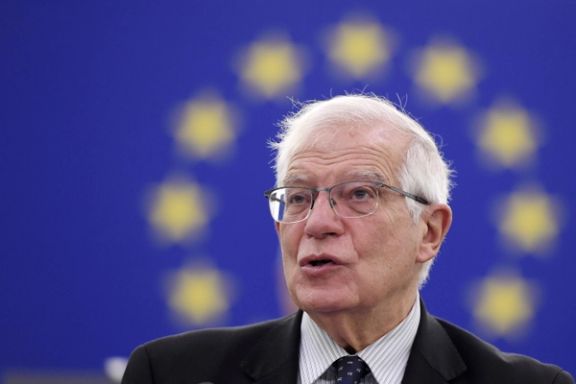
EU Foreign Policy Chief Josep Borrell. File Photo

EU Foreign Policy Chief Josep Borrell said Friday that he would meet with Iranian diplomats for nuclear talks in Brussels instead of Vienna, the main venue of talks.

Enrique Mora, the EU coordinator of the Iran nuclear talks in Vienna, has failed in a visit to Tehran to agree a concrete date for resuming negotiations.

Mora met Thursday with Ali Bagheri, a new deputy foreign minister who appears to lead for Iran’s new administration on the nuclear issue, to discuss stalled efforts to revive Iran’s 2015 nuclear deal with world powers, the JCPOA (Joint Comprehensive Plan of Action).

The Iranian foreign ministry after the meeting said in a statement there had been agreement to continue dialogue in Brussels in coming days.

Borrell said that Iran wants to meet in Brussels with EU officials who are coordinating indirect talks between the United States and Iran along with some other parties to the 2015 nuclear deal.

There was no mention of a US presence if a meeting takes place in brussels, which would mean that Iran in effect stops the process of indirect talks with the Biden Administration.

Borrell told reporters in Washington that he was ready to meet the Iranians, but could not say when that might happen.

"I am ready to receive them, if needed," Borrell said, adding that he did not think talks in Brussels were absolutely necessary but that he had to be willing to be somewhat "patient on this issue, because we cannot afford to fail."

Not yet ready

An EU official said that while Tehran was “not yet ready for engaging in Vienna” it was “absolutely decided to go back to Vienna…They insisted they want practical talks…with a final agreement on how to bring the JCPOA back to life.”

The Vienna talks were suspended in June for Iran’s presidential election and transition to the administration of President Ebrahim Raisi (Raeesi). Tehran has insisted it needs time to review the process.

Signaling growing impatience in Europe, a French foreign ministry spokesman said Friday Iran needed to show by action its willingness to resume talks.With European Union foreign policy chief Josep Borrell in Washington for soundings, his spokesman Peter Stano said Thursday: “We are awaiting the Iranians' response…There is an urgent need to resume discussions very soon."

“If Iran demands more or offers less, these negotiations will not succeed," US Press Secretary Jen Psaki said in her Thursday briefing, adding that she was not going to "get into hypotheticals.”

Washington takes part in the Vienna talks only indirectly, although removing US sanctions are Iran’s key demand. President Joe Biden has continued ‘maximum pressure’ sanctions against Iran despite his campaign pledge to return to JCPOA, from which President Donald Trump withdrew the US in 2018.

Good-will gesture

Iran’s foreign minister Hossein Amir-Abdollahian last week said he had suggested to the US that they release $10 billion of Tehran’s blocked funds as a good-will gesture. There have also been reports that Iran wants guarantees the US would not again leave any agreement and re-impose sanctions.

In a tweet Mikhail Ulyanov, Russia’s envoy in Vienna, said that Amir-Abdollahian and Russian foreign minister Sergei Lavrov had reaffirmed in a phone call Thursday that restoring the JCPOA "in initial configuration" was the only way to “ensure all parties' rights and interests." Moscow is committed to the original logic of the JCPOA as a non-proliferation agreement and has distanced itself from reports that the US wants to include defense and security issues in the talks.

In another tweet, reacting to remarks from Mora Thursday, Ulyanov stressed Moscow’s shared position with the Europe while noting Russia saw "no reason for pessimism."

Other options

On Wednesday, US Secretary of State Antony Blinken and his British, French and German counterparts all described Mora’s trip as critical in bringing Iran back to the table. Blinken said the US would look to “other options” if Iran refused to cut its nuclear program back to JCPOA limits, which Tehran began to exceed in 2019 in response to US ‘maximum pressure’ sanctions.

In an interview Tuesday Rob Malley, the US special envoy on Iran, said Washington wanted to “get back to the JCPOA to calm things down,” but there has also been wide media coverage of US-Israel consultation, with former Mossad chief Yossi Cohen stressing Israel’s option of bombing Iran’s nuclear sites.


Most Viewed

Ideology may be fading in Iran, but not in Kashmir's ‘Mini Iran'
1
INSIGHT

Ideology may be fading in Iran, but not in Kashmir's ‘Mini Iran'

2
INSIGHT

Hardliners push Hormuz ‘red line’ as US blockade tests Iran’s leverage

3
VOICES FROM IRAN

Hope and anger in Iran as fragile ceasefire persists

4

Iran International says it won’t be silenced after London arson attack

5

US sanctions oil network tied to Iranian tycoon Shamkhani

Banner
Banner

Spotlight

  • Hardliners push Hormuz ‘red line’ as US blockade tests Iran’s leverage
    INSIGHT

    Hardliners push Hormuz ‘red line’ as US blockade tests Iran’s leverage

  • Ideology may be fading in Iran, but not in Kashmir's ‘Mini Iran'
    INSIGHT

    Ideology may be fading in Iran, but not in Kashmir's ‘Mini Iran'

  • War damage amounts to $3,000 per Iranian, with blockade set to add to losses
    INSIGHT

    War damage amounts to $3,000 per Iranian, with blockade set to add to losses

  • Why the $100 billion Hormuz toll revenue is a myth
    ANALYSIS

    Why the $100 billion Hormuz toll revenue is a myth

  • US blockade targets Iran oil boom amid regional disruption
    ANALYSIS

    US blockade targets Iran oil boom amid regional disruption

  • Iran's digital economy battered by prolonged blackout
    INSIGHT

    Iran's digital economy battered by prolonged blackout

•
•
•

More Stories

Saudi Arabia Says Iran's Nuclear Program Endangering Region

Oct 15, 2021, 18:01 GMT+1

Saudi Arabian Foreign Minister Prince Faisal bin Farhan said on Friday that Iran was accelerating its nuclear activities and putting the region in “a very dangerous place”.

Diplomatic efforts since April to bring Tehran back into the 2015 nuclear deal have not succeeded as Iran continues enriching uranium and getting closer to the threshold of having enough fissile material for a bomb.

Israeli, Saudi and Emirati top officials in Washington this week discussed the stalled Iran nuclear negotiations with top US officials. The US regional allies have been concerned over the Biden Administration’s plans to revive the 2015 nuclear deal (JCPOA), which they think is inadequate to address their concerns over Iran’s policies.

In an interview with the Financial Times earlier bin Farahan said bilateral talks between Riyadh and Tehran have been “cordial” and “exploratory”, adding that Saudi Arabia has a serious approach to the negotiations, but they have not made substantial progress and to reach a stage for normalization of relations.

Riyadh severed ties with Tehran after rioters ransacked its diplomatic mission in Iran in January 2016.

Bin Farhan gave a wide-ranging news conference in Washington on regional developments during his visit to the United States.

Iran Condemns Shiite Mosque Deadly Bombing In Afghanistan

Oct 15, 2021, 16:57 GMT+1

Iran’s foreign ministry harshly condemned a terror attack on a Shiite mosque in Afghanistan on Friday that killed at least 35 people, blaming Sunni extremists.

The embassy of Iran, Afghanistan's neighbor and the region's largest Shi'ite power, condemned the attack. "We hope Taliban leaders take decisive action against these wicked terrorist incidents," it said in a tweet.

A large explosion tore through the mosque in the southern Afghan city of Kandahar, the second week in a row that militants bombed Friday prayers and killed dozens of worshippers from the minority sect.

There was no immediate claim of responsibility for Friday's attack in Kandahar, but Islamic State claimed the similar bombing that killed scores of Shi'ites in the northern city of Kunduz a week earlier.

The attacks have caused shock and terror among members of Afghanistan's Shi'ite minority and undermine the ruling Taliban movement's claim to have restored security since taking control of the country in August.

Kamal Kharazi, a top foreign policy advisor to Supreme Leader Ali Khamenei said on Wednesday that Iran expects the Taliban to respect Iran’s interests, and the protection of Shiites and Persian speakers is at the top of the list.

The foreign ministry Friday warned about plots “by enemies of Islam” in Afghanistan and called for unity among Sunnis and Shiites.

Haji Sarwar Hazara, a local construction contractor who worships at the mosque and arrived soon after the blast, said there had been at least three attackers. One attacked security guards at the entrance, allowing two suicide bombers to get into the mosque in the confusion.

"When I arrived at the mosque, I saw injured, dead bodies, and people who had fallen on top of each other," he said, adding that he had seen the bodies of two attackers.

"I do not know who did this work, it is the enemy of Islam. But they cannot bring differences among Muslims," he said.

Taliban spokesman Zabihullah Mujahid said security forces had been ordered to capture the perpetrators and bring them to justice under Islamic law.

Sunni Muslim fighters of Islamic State have repeatedly targeted Shi'ites in the past with large-scale attacks intended to kill civilians, including one that killed scores of schoolgirls in a Shi'ite district of Kabul in May last year.

The Taliban are also strict Sunni Muslims but consider Islamic State their enemy and have pledged to protect all ethnic and sectarian groups since sweeping into power in August as U.S. forces withdrew.

The UN mission in Afghanistan said those responsible should be held to account.

Taliban special forces arrived to secure the site and an appeal went out to residents to donate blood for the wounded.

The blast, coming so soon after the Kunduz attack, underlined uncertainty over security in Afghanistan as the Taliban grapple with an escalating economic and humanitarian crisis that threatens millions with hunger.

With reporting by Reuters

Iran Not Ready To Return To Vienna Talks, Asks For Review Of Texts

Oct 15, 2021, 13:24 GMT+1

The visit of a top EU official to Tehran seems not to have produced any immediate results for resuming nuclear talks in Vienna, European officials indicate.

A senior EU official said on Friday Iran is not ready to return to talks with world powers yet and its new negotiating team wants to discuss the texts of previous talks when it meets with the EU in Brussels in the next few weeks, Reuters reported.

EU political director Enrique Mora, the chief coordinator for the talks, was in Tehran on Thursday to meet members of Iran's new nuclear negotiating team, four months after discussions broke off between Iran and world powers.

Iranian President Ebrahim Raisi (Raeesi) who assumed office in Auguat, has so far refused to resume indirect talks with the United States in Vienna despite earlier claims that it needed time to form a new government and return to the talks.

Diplomats from France, Britain and Germany, who are party to the accord along with China and Russia, said ahead of Mora's visit that it came at a critical time and things could not be deemed "business as usual" given escalating Iranian nuclear activities and the stalling of negotiations. The United States has also repeatedly said time was running short. Secretary of State Antony Blinken said this week that Washington would consider “other options” if Iran delayed a resolution.

Meanwhile, Iran has been enriching uranium far beyond limits set by the Joint Comprehensive Plan of Action (JCPOA), or the Iran nuclear deal. Israel and many in the West are concerned that Tehran is getting close to a nuclear breakout while delaying talks to revive the JCPOA.

"They are not yet ready for engaging in Vienna," the official told reporters on condition of anonymity, adding that he believed Tehran was "absolutely decided to go back to Vienna and to end the negotiations." The Islamic Republic has repeatedly said it will return to the negotiations "soon", but it has not given a clearer timeline. Western diplomats had hoped the Vienna talks might resume before the end of October.

However, after Mora's visit, Iran's foreign ministry said it would hold talks in the coming days with the EU in Brussels.

"They insisted that they don't want talks for talks, they want talking with practical results and with a final agreement on how to bring JCPOA back to life," the official said.

Describing a meeting in Brussels as a "good idea", the official said it would give both sides the opportunity to go through the texts on the table from June and clarify questions that Iran's new negotiating team may have.

"I think we are just clarifying even more the situation for a final destination, which is going to be resuming in Vienna. I expect that soon," he said.

As Iran is enriching more uranium, it is also building more leverage to make new demands, which Western countries have dismissed as unacceptable. Iran has been mentioning lifting of sanctions and unfreezing of its blocked funds by the United States as a show of goodwill, while there is still no agreement on how the parties would return to the JCPOA.

With reporting by Reuters

Saudi Official Says Talks With Iran Are Serious But Exploratory

Oct 15, 2021, 12:49 GMT+1

Saudi Arabia says talks with Iran have not made sufficient progress to restore full diplomatic relations, but it is “serious about” ongoing bilateral talks.

In an interview with the Financial Times, foreign minister Price Faisal bin Farhan al-Saud told the daily that talks with Tehran have been “cordial” and “exploratory”.

Iran has highlighted the negotiations that began in April in a much more positive light. Officials and state-controlled media have often reported major progress and optimism. Saudis seem to believe that Tehran is highlighting the talks to tell the West that they can improve ties with their neighbors without Western pressure.

The United States and its European and Middle Eastern allies have been demanding that Iran change its regional policies and stop supporting militant groups and interference in Arab countries. Ebrahim Raisi (Raeesi), the new Iranian president has reiterated that the priority of his administration is improving ties with neighbors.

AFP quoted an unnamed diplomat earlier this week that the two countries are close to reopening consulates, after mobs attacked and burned Saudi diplomatic missions in Iran in January 2016, which led to severance of relations.

A Saudi diplomat told the Financial Times that his country was considering allowing Iran to reopen its consulate in Jeddah, but the talks have not progressed far enough to reestablish full relations.

Iran Census Bureau Says 791 Babies Born to Mothers 10-14 Years-Old

Oct 15, 2021, 09:59 GMT+1

Based on figures published by Iran’s census registration bureau, 791 babies were born in the past six months from mothers aged 10-14 years-old.

The highest number of child mothers giving birth came from one of the poorest provinces, Sistan and Baluchistan in the southeast with 248 births.

Activists have said that poverty is big reason for child marriages as poor families receive a few hundred dollars to allow their young girls to marry with prospective grooms who are also often as young as 14. In other cases, young girls are wed to much older men.

Despite years of efforts by activists and some politicians to outlaw child marriage, the ruling clerics have opposed a legal ban, saying that in Islam it is up to the parents to decide if their child is ready for marriage. The minimum age according to Islamic tradition is nine.

A report earlier this year said there were up to 30,000 marriages of children younger than 14 in one year.





