• العربية
  • فارسی
Brand
  • Iran Insight
  • Politics
  • Economy
  • Analysis
  • Special Report
  • Opinion
  • Podcast
  • Iran Insight
  • Politics
  • Economy
  • Analysis
  • Special Report
  • Opinion
  • Podcast
  • Theme
  • Language
    • العربية
    • فارسی
  • Iran Insight
  • Politics
  • Economy
  • Analysis
  • Special Report
  • Opinion
  • Podcast
All rights reserved for Volant Media UK Limited
volant media logo

Iran Not Ready To Return To Vienna Talks, Asks For Review Of Texts
Oct 15, 2021, 13:24 GMT+1Updated: 15:20 GMT+0
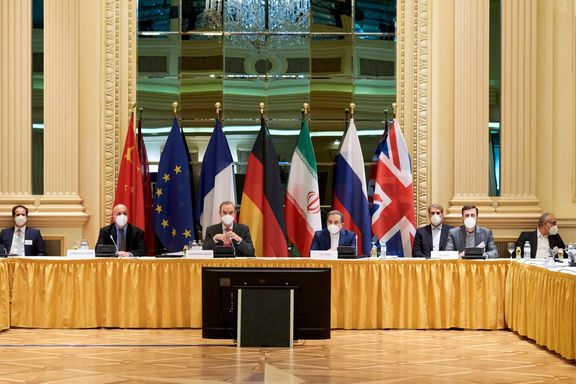
Diplomats meeting in Vienna to discuss the revival of the Iran nuclear deal. FILE PHOTO

The visit of a top EU official to Tehran seems not to have produced any immediate results for resuming nuclear talks in Vienna, European officials indicate.

A senior EU official said on Friday Iran is not ready to return to talks with world powers yet and its new negotiating team wants to discuss the texts of previous talks when it meets with the EU in Brussels in the next few weeks, Reuters reported.

EU political director Enrique Mora, the chief coordinator for the talks, was in Tehran on Thursday to meet members of Iran's new nuclear negotiating team, four months after discussions broke off between Iran and world powers.

Iranian President Ebrahim Raisi (Raeesi) who assumed office in Auguat, has so far refused to resume indirect talks with the United States in Vienna despite earlier claims that it needed time to form a new government and return to the talks.

Diplomats from France, Britain and Germany, who are party to the accord along with China and Russia, said ahead of Mora's visit that it came at a critical time and things could not be deemed "business as usual" given escalating Iranian nuclear activities and the stalling of negotiations. The United States has also repeatedly said time was running short. Secretary of State Antony Blinken said this week that Washington would consider “other options” if Iran delayed a resolution.

Meanwhile, Iran has been enriching uranium far beyond limits set by the Joint Comprehensive Plan of Action (JCPOA), or the Iran nuclear deal. Israel and many in the West are concerned that Tehran is getting close to a nuclear breakout while delaying talks to revive the JCPOA.

"They are not yet ready for engaging in Vienna," the official told reporters on condition of anonymity, adding that he believed Tehran was "absolutely decided to go back to Vienna and to end the negotiations." The Islamic Republic has repeatedly said it will return to the negotiations "soon", but it has not given a clearer timeline. Western diplomats had hoped the Vienna talks might resume before the end of October.

However, after Mora's visit, Iran's foreign ministry said it would hold talks in the coming days with the EU in Brussels.

"They insisted that they don't want talks for talks, they want talking with practical results and with a final agreement on how to bring JCPOA back to life," the official said.

Describing a meeting in Brussels as a "good idea", the official said it would give both sides the opportunity to go through the texts on the table from June and clarify questions that Iran's new negotiating team may have.

"I think we are just clarifying even more the situation for a final destination, which is going to be resuming in Vienna. I expect that soon," he said.

As Iran is enriching more uranium, it is also building more leverage to make new demands, which Western countries have dismissed as unacceptable. Iran has been mentioning lifting of sanctions and unfreezing of its blocked funds by the United States as a show of goodwill, while there is still no agreement on how the parties would return to the JCPOA.

With reporting by Reuters

Most Viewed

Ideology may be fading in Iran, but not in Kashmir's ‘Mini Iran'
1
INSIGHT

Ideology may be fading in Iran, but not in Kashmir's ‘Mini Iran'

2
INSIGHT

Hardliners push Hormuz ‘red line’ as US blockade tests Iran’s leverage

3
VOICES FROM IRAN

Hope and anger in Iran as fragile ceasefire persists

4

Iran International says it won’t be silenced after London arson attack

5

US sanctions oil network tied to Iranian tycoon Shamkhani

Banner
Banner

Spotlight

  • Hardliners push Hormuz ‘red line’ as US blockade tests Iran’s leverage
    INSIGHT

    Hardliners push Hormuz ‘red line’ as US blockade tests Iran’s leverage

  • Ideology may be fading in Iran, but not in Kashmir's ‘Mini Iran'
    INSIGHT

    Ideology may be fading in Iran, but not in Kashmir's ‘Mini Iran'

  • War damage amounts to $3,000 per Iranian, with blockade set to add to losses
    INSIGHT

    War damage amounts to $3,000 per Iranian, with blockade set to add to losses

  • Why the $100 billion Hormuz toll revenue is a myth
    ANALYSIS

    Why the $100 billion Hormuz toll revenue is a myth

  • US blockade targets Iran oil boom amid regional disruption
    ANALYSIS

    US blockade targets Iran oil boom amid regional disruption

  • Iran's digital economy battered by prolonged blackout
    INSIGHT

    Iran's digital economy battered by prolonged blackout

•
•
•

More Stories

Saudi Official Says Talks With Iran Are Serious But Exploratory

Oct 15, 2021, 12:49 GMT+1

Saudi Arabia says talks with Iran have not made sufficient progress to restore full diplomatic relations, but it is “serious about” ongoing bilateral talks.

In an interview with the Financial Times, foreign minister Price Faisal bin Farhan al-Saud told the daily that talks with Tehran have been “cordial” and “exploratory”.

Iran has highlighted the negotiations that began in April in a much more positive light. Officials and state-controlled media have often reported major progress and optimism. Saudis seem to believe that Tehran is highlighting the talks to tell the West that they can improve ties with their neighbors without Western pressure.

The United States and its European and Middle Eastern allies have been demanding that Iran change its regional policies and stop supporting militant groups and interference in Arab countries. Ebrahim Raisi (Raeesi), the new Iranian president has reiterated that the priority of his administration is improving ties with neighbors.

AFP quoted an unnamed diplomat earlier this week that the two countries are close to reopening consulates, after mobs attacked and burned Saudi diplomatic missions in Iran in January 2016, which led to severance of relations.

A Saudi diplomat told the Financial Times that his country was considering allowing Iran to reopen its consulate in Jeddah, but the talks have not progressed far enough to reestablish full relations.

Iran Census Bureau Says 791 Babies Born to Mothers 10-14 Years-Old

Oct 15, 2021, 09:59 GMT+1

Based on figures published by Iran’s census registration bureau, 791 babies were born in the past six months from mothers aged 10-14 years-old.

The highest number of child mothers giving birth came from one of the poorest provinces, Sistan and Baluchistan in the southeast with 248 births.

Activists have said that poverty is big reason for child marriages as poor families receive a few hundred dollars to allow their young girls to marry with prospective grooms who are also often as young as 14. In other cases, young girls are wed to much older men.

Despite years of efforts by activists and some politicians to outlaw child marriage, the ruling clerics have opposed a legal ban, saying that in Islam it is up to the parents to decide if their child is ready for marriage. The minimum age according to Islamic tradition is nine.

A report earlier this year said there were up to 30,000 marriages of children younger than 14 in one year.

Iran Condemns Lebanon Violence, Blames Army And Israel

Oct 15, 2021, 09:18 GMT+1

Iran has condemned the killing of protesters in Lebanon, describing Thursday's shootings as seditions backed by Israel, state-run Press TV said on Friday.

"Iran believes that the people, the government, the army and the resistance in Lebanon will successfully overcome seditions backed by the Zionist entity," IRNA news agency quoted the Iranian Foreign Ministry spokesman Saeed Khatibzadeh.

Tension over an investigation into a massive blast last year in Beirut developed into the worst street violence in more than a decade on Thursday, with six Shi'ites shot dead and gun battles reviving memories of the country's 1975-90 civil war.

Shiite protesters came out in force to stop a judge from continuing his work related to the port explosion. Unknown elements opened fire at the crowd, leading to hours of gunfire and chaos.

The official IRNA report however, said the “Lebanese Army forces attacked people marching toward the Justice Palace”. So far, no other reports have mentioned the army being responsible for the shooting.

The United States offered an additional $67 million to support the Lebanese army, US Under Secretary of State Victoria Nuland said in Beirut on Thursday. The US has traditionally assisted the Lebanese army as the best-placed institution to maintain order in the conflict-ridden country.

Saudi, US Top Diplomats Discuss Iran Nuclear Program In Washington

Oct 15, 2021, 08:38 GMT+1

In a string of visits by Middle Eastern allies to Washington this week Saudi Arabia’s foreign minister has also met with the Secretary of State to discuss Iran.

Saudi Foreign Minister Prince Faisal bin Farhan Al Saud met US Secretary of State Antony Blinken in Washington and exchanged views on Iran's nuclear program and international talks on the matter, Saudi Arabia's foreign ministry said in a statement on Friday.

"Had a productive meeting today with my friend Secretary Blinken, during which we discussed a range of issues of common interest & concern to both our nations & ways to strengthen our strategic partnership & cooperation on multiple fronts," Al Saud said in a twitter post on Friday.

Israeli, Saudi and Emirati top officials in Washington this week discussed the stalled Iran nuclear negotiations with top US officials. The US regional allies have been concerned over the Biden Administration’s plans to revive the 2015 nuclear deal (JCPOA), which they think is inadequate to address their concerns over Iran’s policies.

Al Saud also met the US Special Envoy for Iran, Robert Malley, and discussed intensifying joint efforts against "Iranian violations of international treaties related to the nuclear agreement," the Saudi foreign ministry said.

Lawmaker Swiftly Denies Remarks Over Chinese Role In Iran’s Housing Plans

Oct 15, 2021, 08:03 GMT+1
•
Maryam Sinaiee

A member of the Iranian Parliament's has pulled back from an assertion that officials were in talks with Chinese companies over building affordable housing.

Eghbal Shakeri, who is a member of Parliament's urban development committee, was quoted by Tasnim news agency on Monday that the ministry of roads and urban development was discussing with Chinese operators their possible involvement in President Ebrahim Raisi's (Raeesi) ambitious housing plans in order to avoid the delays in building projects under previous administrations. The urban development minister has also hinted that foreign companies, including those from China might be invited to bid on the housing project.

Iranian Students News Agency Thursday reported that Shakeri, who is also a member of the ministry's housing council, had now explained that the negotiations he referred to were "related to the ministry's own works," and not to Raisi’s scheme for building one million affordable units for sale every year.

The economic website Tejarat news last month suggested Raisi’s plans would need 10 trillion rials ($40 million) daily, or $15 billion annually, which is more than Iran’s oil export revenues last year. The World Bank noted this month that despite slight economic growth “poor economic activity, partly due to US [United States] sanctions, low oil revenues and higher recurrent and COVID-19 related expenditures” meant that Iran’s government faced a widened fiscal deficit.

Shoddy government-built housing sustained more damage in a 2017 earthquake
100%
Shoddy government-built housing sustained more damage in a 2017 earthquake

China is easily the world’s biggest lender for development projects, with Chinese banks committing over $462 billion in development finance to 93 countries between 2008 and 2019, including building projects from Hong Kong to north America. China itself has had a massive program of social and affordable housing.

But Iranian private-sector operators and some media have rejected Chinese involvement, arguing that both resources and technical know-how are available in Iran. Speaking to the economic website Eghtesad News Wednesday, Iraj Rahbar, deputy chairman of Iran's Housing Companies Association, said Chinese companies could not expedite matters.

"The problem of delay in delivery [by Iranian companies] results from cash flow issues, not their technical and engineering incompetence in comparison with the Chinese," he said. Rahbar argued that the government's failure to pay contractors on time would hinder projects whether domestic or Chinese. "They will just abandon the work," he said.

Rahbar cited the Tehran-North Freeway project to connect the capital to the Caspian Sea region through the Alborz mountains. "We used Chinese companies but they abandoned the project after 20 years and left Iran," he said. "Sadly, we haven't learned a lesson from such cases."

The new minister for urban development, Rostam Ghasemi, has also suggested that Iran has everything needed for a large housing program − land, building material and engineering. On Thursday Ghasemi said money was also available, with 3,600 trillion rials (about $14.5 billion at current exchange rates) to be offered in loans to buyers in the first year.

Land would be provided free, the minister said, with the government also investing in infrastructure and amenities, and offering discounts on building tax.

While most principlist media and politicians welcome Raisi's plan, critics disparage it by citing the Mehr housing scheme of President Mahmoud Ahmadinejad (2005-13), when oil prices were far higher than today and Iran, especially until 2011, was under far less stringent sanctions.

Three million units were built under the plan during Ahmadinejad’s presidency and a further 1.3 million under President Hassan Rouhani (2013-21), although Rouhani in 2014 conceded the scheme had boosted inflation.

In a devastating earthquake in western Iran in 2018, Mehr apartment buildings sustained more damage than other constructions and President Hassan Rouhani called for an investigation . Many new owners complained about problems, including a lack of infrastructure and amenities like public transport and schools near new apartment blocks, often built away from cities and towns.