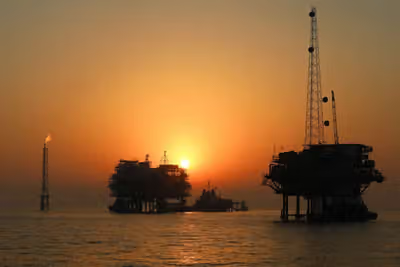
An aerial view shows a crude oil tanker at an oil terminal off Waidiao island in Zhoushan, Zhejiang province, China January 4, 2023.
A new Iranian oil trading network has been entrusted with selling millions of barrels of sanctioned crude even though its members still owe billions of dollars from earlier sales, according to documents obtained by Iran International and Oil Ministry sources.
One document, a confidential letter from the Supreme National Security Council’s protection unit to the Oil Ministry, raises concerns over the ministry’s decision to hand large volumes of crude to four trusted intermediaries, known as trustees, on credit and at steep discounts.
The crude was allocated after a new oil sales team took control in July, according to the letter.
The former chief executive of Naftiran Intertrade Company (NICO) had identified the intermediaries as carrying large debts and failing to return billions of dollars from previous oil sales, the document says.
The ministry nevertheless offered the intermediaries a discount of $8.50 per barrel, a level the confidential letter described as unusual.
The documents and two Oil Ministry sources point to Mohammad Javad Bavand, a former Revolutionary Guards intelligence official appointed to oversee oil trading, as a central figure in the new arrangement.
Disputed cargo tied to sanctioned tankers
A second confidential document records a closed Oil Ministry meeting on June 28 concerning Iranian crude exported to China aboard three sanctioned tankers linked to Hossein Shamkhani, also known as Hector, an oil trader and son of Ali Shamkhani, a former adviser to slain Supreme Leader Ali Khamenei.
Two million barrels of crude were shipped through a front company aboard the tanker Lily to China’s Dongjiakou port on March 24, according to the document.
The owner of Lily subsequently took control of the cargo, citing a financial dispute with Panel Good Wholesalers, the company involved in the shipment, the document says.
Lily belongs to a shipping network and shadow fleet controlled by Hossein Shamkhani that has been sanctioned by the US Treasury. Dubai-registered Panel Good Wholesalers is also one of Shamkhani’s companies used for oil trading.
Oil trader Mohammad Hadi Momenin recovered the two-million-barrel cargo at NICO’s request and stored it in tanks at Dongjiakou, participants at the June meeting were told, according to the document.
Momenin then sought $33 million in compensation from the Iranian oil company, including $27 million for the loss in value of the tanker Covenio following US sanctions and $6 million for charter costs involving another tanker, Jaya.
Bavand instructed Momenin to return ownership of the cargo to the Oil Ministry and, through one of Momenin’s companies, charter Covenio for one year at $90,000 per day, according to the meeting record.
Both Covenio and Jaya belong to Shamkhani’s sanctioned shadow fleet.
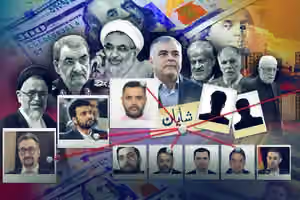
Iran International reported three weeks ago that Momenin was a member of an Intelligence Ministry network known as the Shayan network. Momenin, born in 1989, has failed to return about $2 billion in Iranian oil proceeds, according to Iran International’s previous investigation.
Five traders form Bavand’s network
Momenin is one of five trustees in an oil trading network assembled by Bavand following his return to the Oil Ministry, two ministry sources told Iran International.
Another member is Mostafa Niazazari, the fifth defendant in the corruption case involving former senior judiciary official Akbar Tabari.
Niazazari was accused in the case of giving Tabari 15,000 square meters of land as a bribe. After fleeing to Canada, he returned to Iran four years ago and has since resumed oil trading while residing in a European country.
Niazazari is the son of Kioumars Niazazari, a former Intelligence Ministry director-general in Mazandaran province.
Two businessmen known for importing essential commodities have also joined Bavand’s network after entering the oil trade during the tenure of former NICO chief executive Saeed Sadeghi, according to the Oil Ministry sources.
Hassan Afrashtehpour, also known as Dariush and the owner of Afra Holding, has for years controlled imports of some essential commodities. An Iranian court sentenced him to 25 years in prison for economic corruption in 1997, but he was released four years later.
Masoud Modallal, a major importer of cooking oil and animal feed who has faced large banking debts, is another member of the network, the sources said.
Modallal previously received $985 million in preferential-rate foreign currency for essential-goods imports and owed 5.75 trillion rials to Sarmayeh Bank and 7.82 trillion rials to Pasargad Bank.
Modallal shifted his focus toward oil trading after Iran ended preferential currency allocations, according to the sources.
The fifth member is Ali Bayandorian, a trader sanctioned by the United States six years ago over what Washington described as financing for the Revolutionary Guards’ Quds Force.
Bayandorian uses a network of companies registered in Iran and Southeast Asia to sell oil and petrochemical products outside conventional markets, according to the sources.
Together, the five traders make up what the Oil Ministry sources described as Bavand’s new trustee network.
The two confidential documents obtained by Iran International show members of this network continuing to receive Iranian oil despite outstanding proceeds from previous sales.
From Guards intelligence to oil sales
Bavand studied at Imam Sadiq University, known for combining Islamic studies with modern social sciences, and until 2021, served as deputy to Mostafa Ahadi, the economic deputy of the Revolutionary Guards Intelligence Organization.
Ahadi is a nephew of Ali Akbar Hosseini Mehrab, a security official whose name has appeared in major Iranian corruption cases, including the Crescent gas dispute.
Bavand entered a Supreme National Security Council committee in 2018 following the US withdrawal from the nuclear agreement and Washington’s restoration of sanctions on Iranian oil.
The council created a working group to manage oil sales designed to bypass the restrictions, alongside a security committee composed of representatives from Iranian military and intelligence organizations.
The Revolutionary Guards Intelligence Organization sent Bavand, then deputy head of its economic division, to the security committee.
Bavand built a network of trusted oil intermediaries during his time on the committee, including Majid Azami, chief executive of Sepehr Energy Jahan Nama Pars, Majid Taj, brother of Iranian Football Federation president Mehdi Taj, and trader Hamed Kachoui.
Iran’s oil sales structure changed further after Ebrahim Raisi became president in 2021 and his government authorized the armed forces to participate formally in oil trading.
The Revolutionary Guards subsequently sent Bavand to the Oil Ministry, where he took responsibility for trading oil under sanctions.
A significant part of the problems involving trustees and unreturned oil proceeds emerged during that period.
Following Raisi’s death, Oil Minister Mohsen Paknejad initially entrusted management of sanctioned oil sales to officials with previous links to Shayan, an Intelligence Ministry official involved in fuel operations.
Bavand returned to the Oil Ministry following Shayan’s removal.
Paknejad appointed Bavand special assistant to the oil minister for supervision of oil trading after the previous NICO chief executive was removed following disclosures concerning trustees and unreturned oil proceeds.
Bavand is also related to Hossein Taeb, the former head of the Revolutionary Guards Intelligence Organization, who is currently the commander of the Basij paramilitary unit, and a figure close to Supreme Leader Mojtaba Khamenei.
Bavand now plays a central role in decisions over sanctioned oil sales and has assembled a new group of trusted intermediaries.
The documents show that traders carrying large outstanding debts from earlier oil sales have again been entrusted with millions of barrels of Iranian crude, placing Bavand and his network at the center of the system used to sell Iran’s oil under sanctions.
Dogharoun border crossing between Iran and Afghanistan.
Iran's exports to Afghanistan have fallen by at least 25% since the US-Iran war began this year, while competitors have moved quickly to expand their share of the Afghan market, the head of the Iran-Afghanistan Joint Chamber of Commerce said on Wednesday.
Mahmoud Siadat told Iran's ILNA news agency that restrictions on exports of petrochemicals, steel, food and other goods had contributed to the decline, including limits imposed because of war damage and domestic demand.
Siadat said the greater concern was the speed at which other countries were moving into the market while Iranian trade was shrinking.
"The more important problem is that during the same period in which we faced a decline in exports to Afghanistan, our competitors entered the Afghan market very seriously," Siadat said.
He said Uzbekistan's exports to Afghanistan had risen 42% this year, adding that the growth was rapidly reducing Iran's share of the Afghan market. He also pointed to what he described as a multibillion-dollar Saudi gas extraction agreement near Iran's border.
Saudi Arabia-based Delta Energy International signed an agreement with Afghanistan's Ministry of Mines and Petroleum this week to explore and extract oil and gas in the Kushk-Tirpul basin in the western provinces of Herat and Badghis.
Afghan authorities put the initial investment at $200 million, while Delta has said a wider energy program could involve tens of billions of dollars in potential investment if exploration and feasibility studies support further development.
The decline comes amid a broader contraction in Iran's foreign trade since the war began. An Iranian trade official has said non-oil exports and imports fell by about 30% in the first four months of the current fiscal year, while customs data from China and Turkey showed steep declines in trade with Iran. Indian exports to Iran also fell sharply, although India's imports from Iran rose on higher purchases of Iranian crude oil and liquefied petroleum gas.
Siadat said Iran was also hurting its position in Afghanistan through long delays at its own borders, with hundreds of trucks waiting to cross at Milak and Dogharoun.
He said some trucks were being held for between 12 and 15 days before leaving Iran, while traffic moved much more smoothly on the Afghan side.
"There is no logic in our trucks being held for 13, 14 and sometimes 15 days at the border with Afghanistan," he said. "Long stops at the border cause an unusual increase in transport costs and freight rates and reduce our competitiveness in the Afghan market."
Siadat broadened his criticism beyond border management, saying the problem reflected wider weaknesses in Iran's state structure and fragmented decision-making.
"Many of the organizations that are not even directly under the government's supervision play a fundamental role in creating this problem," he said, adding that regulatory and military bodies needed to reach a common position.
He also criticized the limited role of businesses in policymaking. "The private sector in Iran is, in many cases, largely a ceremonial presence in decision-making," he said. "It only hears promises but sees no action."
US pressure adds to wider trade strain
Siadat said, however, that sanctions were making Iranian goods more expensive in export markets, adding another layer of pressure on businesses already dealing with transport restrictions.
The United States has intensified economic pressure on Iran through an oil export blockade and expanded secondary sanctions aimed at restricting Tehran's access to dollars, foreign financing and international trade channels. Iran's total trade has fallen by between 25% and 35%, according to President Masoud Pezeshkian.
Washington has continued to add measures. The US Treasury on Tuesday imposed a new round of Iran-related sanctions targeting the country's aviation sector and companies and intermediaries in several countries, part of the Trump administration's wider economic pressure campaign.
Siadat said Afghanistan had become more important because problems at Iran's southern ports and other trade routes had cut or reduced transit flows.
"Afghanistan's border is currently one of the few borders through which we can work," he said, warning that delays on the Iranian side were putting one of the country's remaining export outlets at risk.
The US Treasury on Tuesday imposed fresh Iran-related sanctions on one individual and 35 entities, including all 27 remaining Iranian airlines, as Washington expanded pressure on Tehran’s aviation sector and networks supporting sanctioned carrier Mahan Air.
The Office of Foreign Assets Control added airlines including Iran Aseman Airlines, Iran Airtour, Kish Air, Qeshm Air, Taban Airlines, Sepehran Airlines, Varesh Airlines, Zagros Airlines, Karun Airlines, Chabahar Airlines and Fly Persia to its Specially Designated Nationals list.
Newer carriers including Air Shiraz, Ava Airlines, Fly Kish, Mehr Airways, Raimon Airways and Soroush Air were also listed.
Saha Airlines, formally listed as the Armed Forces Air Transport Service, was among those targeted. OFAC describes it as providing both passenger and freight air transport. The Iranian airlines were designated under Executive Order 13902 and are subject to secondary sanctions, according to Treasury’s notice.
Treasury Secretary Scott Bessent warned companies against doing business with Iranian airlines in a post on X.
“Let this be a warning to anyone doing business with Iran’s remaining airlines, all of which we sanctioned today: You are at risk of being cut off from the global financial system,” Bessent said.
He said the measures were part of Operation Economic Outcast, Washington’s campaign to cut financial lifelines to the Islamic Republic, adding that the United States had also sanctioned companies continuing to support Mahan Air.
The new sanctions follow an Aug. 24 determination by the Treasury making Iran’s aviation sector, along with its digital asset, gold, shipping and technology sectors, subject to sanctions under Executive Order 13902.
A separate group of designations targeted aviation and logistics companies outside Iran with links to Mahan Air. They included ECT Aviation Support in the United Arab Emirates, ECT Aviation Support Ltd in Britain, Malaysia-based iCargo, Kazakhstan-based Tour Invest and Turkish companies MES Cargo, S Sistem Logistics and Sky Phoenix Airways. Dubai-based Aerobravo Airplane Management and Operation was also sanctioned through its link to ECT Aviation Support.
OFAC also designated Mahran Ibrahim, an Egyptian national based in the UAE, listing him as linked to ECT Aviation Support.
Mahan Air has been under US counterterrorism sanctions since 2011. Washington accuses the carrier of serving as a conduit for the Revolutionary Guards, including by transporting personnel, weapons and military equipment. Treasury has stepped up action against companies providing logistical and commercial support to the airline in recent months.
A mounted machine gun deployed in Khorramabad, western Iran, on Monday, September 7, ahead of a fuel price increase.
Iranian security forces deployed around fuel stations and on streets across the country as a gasoline price increase took effect, with people warning of further pressure on household budgets and rising prices for other goods and services.
Messages, videos and accounts sent to Iran International described deployments of police, special units and Basij forces in Tehran, Mashhad, Shiraz, Karaj, Isfahan, Tabriz, Birjand, Khorramabad, Khomein, Abadan and Qeshm.
Reports of slower internet connections also emerged from several cities, including Tabriz and Babol.
Petrol prices doubled on Monday for drivers buying fuel outside their monthly subsidised quota, rising from 50,000 to 100,000 rials a litre, about 2.3 to 4.5 US cents. The government announced the increase two days earlier.
Monthly subsidized allocations remain unchanged. Motorists can buy 60 liters at 15,000 rials per liter, about 0.7 cents, and another 50 liters at 30,000 rials, about 1.3 cents.
The dollar figures are negligible. The wages are the point. Average monthly pay in Iran is around 250 million rials, about $113 at Tuesday's rate, and many workers earn closer to 200 million, or roughly $90 a month.
Security forces gather around fuel stations
Several residents of Mashhad told Iran International that security forces appeared around petrol stations on Sunday, hours before the new price took effect.
“On Monday evening, I passed three gas stations. Several police vehicles were stationed outside each one, and at one station there were large numbers of Basij motorcyclists and special unit forces,” one resident said.
Another Mashhad resident described police and special units positioned at fuel stations across the city.
Video sent to Iran International from Khorramabad in western Lorestan province showed security personnel, vehicles and motorcycles deployed around the city, including what appeared to be a mounted machine gun.
Fuel supplies had already faced disruptions over the previous three weeks in areas including Razavi Khorasan, South Khorasan, Tehran and Alborz provinces.
Citizens in early September reported station closures, long lines, restrictions on purchases and waits of about two hours to obtain 10 liters of gasoline.
A Birjand resident said some filling stations had closed and displayed notices blaming “technical problems,” while police were positioned at others.
Similar deployments were described in Shiraz, where a local reported a large security presence around Maali-Abad early Tuesday, and in Karaj, particularly Fardis, Gohardasht and Mehrshahr.
A resident of Khomein in Markazi province also described a long line and numerous police officers at a fuel station on Shohadaye Daneshjoo Street.
Special units deploy in Tehran
Several Tehran residents reported increased security deployments from Monday evening, including in Shahr-e Rey and Salsabil neighborhoods.
“The station was heavily secured. Special units and the Basij were constantly moving around, and the streets were crowded,” a resident who visited a fuel station near Ferdowsi Square in central Tehran around midnight said.
Another who went to a station on Pirouzi Street in the east described long vehicle lines with special units positioned nearby.
People in Isfahan and Abadan also reported armed police at filling stations. In Qeshm, a resident said armed personnel were deployed around major squares on Monday evening and that a confrontation occurred at the entrance to a filling station in Dargahan.
Two messages from Tabriz described a large security presence alongside deteriorating internet service.
“The city of Tabriz is full of special units. The forces are armed, and heavy equipment can also be seen,” one said.
A Babol citizen also reported slower mobile and fixed internet connections, though the reason for the disruption could not be established.
Gasoline prices carry particular political sensitivity in Iran. A sudden increase and rationing in November 2019 triggered demonstrations across dozens of cities that quickly expanded into nationwide anti-government protests.
Security forces killed around 1,500 people during the crackdown, according to a Reuters tally at the time. Thousands were arrested and authorities imposed a nationwide internet shutdown.
Government defends higher gasoline price
First Vice President Mohammad Reza Aref defended the new rate, arguing that even 100,000 rials per liter remains far below the government's cost of importing gasoline.
Imported gasoline costs the government more than 700,000 rials per liter, equivalent to about 30 cents, Aref said. Imported fuel would gradually be sold at prices closer to its cost, he added.
The government's figures for what petrol costs to produce have not held up well to examination. In November 2025, after officials put the cost at 340,000 rials a litre, about 15 cents at current rates, Iran International went through the refineries' own financial statements. They showed operating costs, excluding the value of the crude going in, of around 35,000 rials a litre, roughly 1.6 cents, a tenth of the official figure.
A general view of a gas station in Iran
Economist Mousa Ghaninejad has estimated actual gasoline consumption inside Iran at about 70 million liters a day and argued that much of the remainder recorded as consumption is smuggled out of the country.
Iranians warn of knock-on price increases
Thousands of people responding to an Iran International question about the fuel increase focused on its potential impact beyond filling stations, warning that transportation costs could push up food prices, fares and other everyday expenses.
“100,000 rials for a liter of gasoline may just be a number for some people, but for people it means another step toward making life harder,” one respondent wrote.
Another said petrol was not the problem on its own, and pointed to food. A five-liter container of cooking oil that used to cost 22 million rials, about $9.90, now sells for 40 million, roughly $18.
On a monthly wage of 200 million rials, that is a fifth of a month's pay for one container of oil.
“We buy everything at expensive dollar-linked prices, but our base salary is only $100. Where in the world can you see something like this?” one person wrote.
Another said wages would have to rise alongside prices, since households could not absorb repeated increases on incomes that had barely moved.
For younger respondents the loss was smaller and more particular. "The feeling of going on a trip is gone. Going out for a 10-minute drive is gone. We young people said goodbye to small pleasures a long time ago," one wrote.
A general view of the Houses of Parliament at sunrise, in London, Britain.
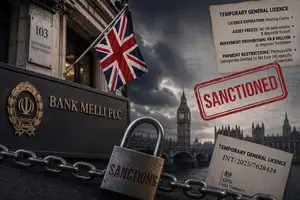
Britain said on Tuesday it was expanding sanctions on Iran, targeting key sectors including energy, metals, banking, insurance and shipping as part of efforts to restrict Tehran's nuclear program and other hostile activity.
Minister of State Stephen Doughty said the government was introducing legislation to tighten financial and trade restrictions, widen powers to sanction ships linked to Iran and bar Iranian aircraft from landing in the UK unless exemptions apply.
“Today we are laying legislation which will tackle Iranian nuclear activity and other hostile Iranian activity,” Doughty said in a written statement to parliament.
Focus on nuclear program
Doughty said Iran had expanded its nuclear program in ways that had no credible civilian justification and pointed to its stockpile of more than 400 kg of uranium enriched to 60%.
“Iran is the only country without nuclear weapons to enrich uranium to this level,” he said.
Britain restored UN sanctions on Iran in October 2025 after the snapback mechanism was triggered and also designated 71 people and entities linked to Iran's nuclear program, including financial institutions and energy companies.
Wider trade and financial restrictions
The new rules expand restrictions on goods, technology and services tied to sectors including energy, software, metals and gold, as well as shipping, insurance and banking.
They also ban exports of additional goods and technology that Britain says could support Iran's conventional weapons and nuclear capabilities.
Doughty said the financial measures would “further reduce the Government of Iran’s ability to access the UK financial system and raise funds in support of its nuclear programme.”
Britain will also gain broader powers to sanction ships that it says enable or facilitate Iran's nuclear program or other destabilizing activity.
Iranian aircraft will be barred from landing in the UK unless exemptions apply, following Britain's termination of bilateral air service arrangements with Iran in 2024.
The legislation includes exemptions to allow continued operations at the Shah Deniz gas field in Azerbaijan, which supplies energy to European countries.
Doughty said Britain remained committed to diplomacy, saying a negotiated outcome was “the only long-term solution” to the dispute over Iran's nuclear program.
Canada’s Federal Court has ordered the government to decide within 60 days on a visitor visa application from a former project manager at Iran’s Bushehr Nuclear Power Plant after the case remained in security screening for more than 900 days.
Naser Mansoursharifloo, an Iranian citizen, applied for the visa in January 2024. About six weeks later, government records marked his case as “approved pending info from partners,” but no final decision followed for more than two years.
By the time the case reached a court hearing in August, the application had spent about 911 days in security screening, far longer than government processing estimates for Iranian visitor visas during the period.
Mansoursharifloo holds a doctorate in mechanical engineering and previously worked as a project manager at the Bushehr Nuclear Power Plant. He also served as head of engineering at Islamic Azad University in central Tehran, according to the court.
The court said the government had not provided enough evidence to explain why the screening had taken so long. It ordered authorities to make a decision within 60 days of the September 1 ruling.
The order does not require Canada to approve Mansoursharifloo’s visa and the court did not find that he was inadmissible. It only requires the government to make a decision.
The case comes amid a broader push by Canada to keep out or remove former senior officials of the Islamic Republic, particularly people whose past government roles could make them inadmissible under Canadian law.
Ottawa moved in 2022 to bar senior Iranian government officials from entering or remaining in Canada after the Islamic Republic’s crackdown on nationwide anti-establishment protests.
Canada has since pursued a number of cases involving former Iranian officials already in the country, while immigration authorities have increased scrutiny of applicants with backgrounds in Iranian government institutions.
Canada also listed the Islamic Revolutionary Guard Corps as a terrorist entity in 2024, adding another layer to its increasingly confrontational approach toward people and institutions tied to the Islamic Republic.
In one recent case, Canadian authorities are seeking to deport Abbas Omidi, a former senior official in Iran’s Ministry of Industry, Mines and Trade who lives in Toronto.
Canadian government documents reported by Global News said Omidi had played a significant role in Iran’s mining sector and that revenue generated by the sector helped support the Iranian government, its military and the IRGC.
Omidi acknowledged during his deportation proceedings that he had served as a deputy director general in the ministry but said his position was mainly technical.
The Canada Border Services Agency is seeking his removal on the grounds that he served as a senior Iranian government official.
Canada has also pursued other former officials under measures introduced after 2022, including people connected to Iranian state institutions and security bodies.