• العربية
  • فارسی
Brand
  • Iran Insight
  • Politics
  • Economy
  • Analysis
  • Special Report
  • Opinion
  • Podcast
  • Iran Insight
  • Politics
  • Economy
  • Analysis
  • Special Report
  • Opinion
  • Podcast
  • Theme
  • Language
    • العربية
    • فارسی
  • Iran Insight
  • Politics
  • Economy
  • Analysis
  • Special Report
  • Opinion
  • Podcast
All rights reserved for Volant Media UK Limited
volant media logo
INSIGHT

First red meat, now dairy: Iran’s household diet keeps shrinking

Dalga Khatinoglu
Dalga Khatinoglu

Oil, gas and Iran economic analyst

Aug 9, 2026, 22:00 GMT+1
A man looks at the packaging of red meat at a supermarket in Iran, undated file photo

Soaring food prices are reshaping what Iranian families eat, with new figures showing a steep decline in dairy consumption alongside a longer retreat from red meat as household purchasing power erodes.

Annual dairy consumption has fallen from around 130 kilograms per person in 2010 to just 40 kilograms today, according to Ali Ehsan Zafari, head of Iran's Dairy Cooperatives Union.

According to the latest figures from the Statistical Center of Iran, dairy products in July cost around 147 percent more than a year earlier.

The fall in consumption leaves Iran well below both international and regional levels. Global dairy consumption averages roughly 117–119 kilograms per person annually, according to the UN Food and Agriculture Organization (FAO), while neighboring Turkey consumes more than 250 kilograms per capita.

At 40 kilograms, Iran's consumption is now roughly one-third of the global average.

Meat disappears

The retreat from dairy follows a longer change in Iranian diets as years of inflation and declining purchasing power have pushed households away from more expensive sources of animal protein.

FAO data show Iran's red meat supply fell to approximately 623,000 metric tons last year, around 20 percent lower than in 2024 and nearly 39 percent below its 2010 level.

Over much of that period, poultry offered families a cheaper alternative. Per capita poultry consumption has risen by roughly 40 percent since 2010, suggesting households have increasingly substituted chicken for more expensive beef and lamb.

The comparison with Turkey illustrates how differently consumption has developed across the two neighboring countries.

Poultry consumption in Turkey also rose by about 40 percent over the same period, but red meat consumption increased by 146 percent. FAO estimates put per capita red meat consumption in Turkey at roughly 3.9 times the Iranian level.

The figures do not by themselves explain the reasons for the divergence, but Iran's shift toward cheaper poultry has taken place during a prolonged erosion of household purchasing power and repeated surges in food prices.

Fewer alternatives

That substitution is becoming harder as inflation spreads across virtually every source of animal protein.

Prices of beef, lamb and chicken were all around 149 percent higher in July than a year earlier, according to the Statistical Center of Iran. Dairy prices rose by a similar 147 percent.

The latest increases follow the recent war, which added to existing inflationary pressures and accelerated price rises across basic goods.

For years, households unable to afford beef and lamb could turn to chicken. The sharp increase in poultry prices now threatens that fallback, while the collapse in dairy consumption suggests even relatively basic sources of animal protein are becoming harder for many families to afford.

The consequences are potentially significant, particularly for lower-income households and children whose diets depend on affordable sources of protein and calcium.

But the figures also point to a broader change in Iranian living standards: families are not simply paying more for the same food. They are changing what they eat, and increasingly giving up foods that were once ordinary parts of the household diet.

After years of substituting cheaper foods for more expensive ones, the narrowing range of affordable alternatives raises a more immediate question: what is left to substitute?

Most Viewed

Tehran rents hit three times many workers’ monthly pay
1

Tehran rents hit three times many workers’ monthly pay

2

Cleric summoned after calling to replace Islamic Republic with ‘Islamic government’

3
INSIGHT

Iran moves to ratify Caspian Sea pact with seabed rights still unsettled

4

Iranian religious singer abducted and killed - IRGC media

5
ANALYSIS

What the Islamic Republic does to its women footballers

Banner
Banner
Banner

Spotlight

  • First red meat, now dairy: Iran’s household diet keeps shrinking
    INSIGHT

    First red meat, now dairy: Iran’s household diet keeps shrinking

  • Tehran rents hit three times many workers’ monthly pay

    Tehran rents hit three times many workers’ monthly pay

  • Iran’s reality TV boom abroad captures a generation in limbo
    ANALYSIS

    Iran’s reality TV boom abroad captures a generation in limbo

  • What the Islamic Republic does to its women footballers
    ANALYSIS

    What the Islamic Republic does to its women footballers

  • Ending Iran war could expose regime to its greatest threat yet, experts say
    PODCAST

    Ending Iran war could expose regime to its greatest threat yet, experts say

  • US miscalculated Iran’s resilience and hurt deal prospects, expert says
    ANALYSIS

    US miscalculated Iran’s resilience and hurt deal prospects, expert says

•
•
•

More Stories

Iran’s healthcare crunch forces patients to cut treatment

Aug 9, 2026, 14:37 GMT+1
•
Hooman Abedi
100%
AI-generated image: A woman holds her wallet at a pharmacy counter as a pharmacist retrieves medicine, illustrating the growing financial burden of healthcare and medication costs in Iran.

Iranians are struggling to afford medicines and medical care, with some foregoing treatment as prices rise, drug shortages spread and insurance coverage falls short, according to accounts from patients.

Messages sent to Iran International on described medical bills consuming much or all of a typical monthly income, even for people covered by Iran’s Social Security Organization, the country’s main state-run social insurer.

One person undergoing tests for an abdominal and pelvic mass said CT and MRI scans, with and without contrast, cost 210 million rials ($113) despite having Social Security insurance.

“How are we supposed to pay these costs with such meager incomes?” the citizen said.

  • Rising care costs hit Iranians with spinal injuries

    Rising care costs hit Iranians with spinal injuries

Many Iranian workers earn around 200 million to 250 million rials ($108-$134) a month, meaning the scans alone can cost roughly a month’s income. The rial trades at around 1.86 million to the dollar on the free market.

Another said an echocardiogram, electrocardiogram and clinic appointment cost 120 million rials ($65), with the medical provider requiring payment upfront rather than accepting Social Security insurance.

The patient was given documents to seek reimbursement from the insurer but said the process involved extensive bureaucracy and could result in only around half the money being returned.

A 33-year-old said the cost of dental treatment had left him without half his teeth.

“I feel like I’m 60,” he said. “The bitter part is that this humiliating way of life has become normal for me.”

100%
A pharmacy in Iran

Another worker earning 10 million rials ($5.40) a day said an appointment with an ear, nose and throat doctor cost 5 million rials ($2.70), followed by 8.6 million rials ($4.60) for medicine.

“We really cannot afford to live anymore,” the worker said.

Lawmaker says shortages could worsen

The accounts echo comments from Salman Es’haghi, spokesman for parliament’s Health and Treatment Committee, who said shortages and rising prices were already causing some patients to stop treatment.

Around 43 medicines are in “critical shortage” and nearly 1,000 pharmaceutical products face some degree of shortage, Es’haghi told the Tabnak news website in an interview published Saturday.

Prices for chemotherapy drugs and medicines used by patients with cancer, hemophilia and thalassemia have risen enough to reduce consumption, with some patients stopping treatment because they cannot afford it, he said.

Es’haghi said patients now pay more than 70% of their healthcare expenses themselves, despite policies intended to leave individuals covering around 30% and the government and insurers paying the remainder.

Some hospitals and pharmacies are also refusing to provide certain services or medicines because insurers have delayed reimbursements or failed to pay them in full, he added.

The difficulties described by Iran International’s audience reflected those problems. One viewer said a packet of Sertraline tablets that previously cost 500,000 rials had risen to 8 million rials, a sixteen-fold increase.

  • Iran’s legal drug market is being hollowed out as shortages feed illicit channels

    Iran’s legal drug market is being hollowed out as shortages feed illicit channels

Another said the cost of healthcare had left the family worried about something as routine as a child catching a cold during the winter.

“We’re stressed about where we would get the money for treatment if, God forbid, we or our children even catch a cold,” the audience said.

Drug subsidy faces uncertain future

The pressure could intensify if the government removes preferential foreign currency for medicines and medical equipment from the budget for the Iranian year beginning in March 2027, Es’haghi warned.

Iran has used preferential exchange rates to lower the rial cost of importing medicines, pharmaceutical ingredients and medical supplies. Removing that support can expose producers and importers to much higher exchange rates and ultimately increase prices for patients.

Discussions about eliminating the preferential rate have been under way since late 2025, with the government viewing the change as a possible way to address corruption and preferential access to subsidized foreign currency, Es’haghi said.

“If the currency allocated to medicines and medical equipment is removed from next year’s budget, it could become a ‘year of patient slaughter,’” Es’haghi said.

  • Iranians borrow for medicine while state shields Arbaeen healthcare

    Iranians borrow for medicine while state shields Arbaeen healthcare

Iran International reported in April that prices for some domestically produced insulin had risen by as much as 212% compared with before the Persian New Year in March, while some imported varieties had increased by as much as 271%.

Pharmaceutical industry figures have attributed rising production costs to a combination of exchange-rate changes, the rial’s depreciation, more expensive raw materials and packaging, higher wages and financing costs, and disruption to supply chains from war.

Es’haghi said more than 70% of medicines had increased in price and argued that authorities should tackle corruption through closer oversight of the pharmaceutical supply chain rather than eliminating subsidized currency.

For patients confronting medical bills comparable to their monthly earnings, however, the pressure is already being measured in delayed care, abandoned treatment and anxiety over whether they can afford the next illness.

Tehran rents hit three times many workers’ monthly pay

Aug 9, 2026, 09:20 GMT+1
•
Hooman Abedi
100%
Residential apartment blocks on the outskirts of Tehran.

Average advertised monthly rent in Tehran has climbed above 720 million rials, roughly three times the earnings of many Iranian workers, exposing a widening affordability gap as some tenants face increases of up to 100%, market data showed in late July.

Tindex, an Iran-focused economic data platform tracking housing listings and other market indicators, put average advertised monthly apartment rent in Tehran at about 723 million rials, or roughly $389 at an open-market exchange rate of 1.86 million rials to the dollar, in its late-July data.

The figure is based on advertised properties rather than completed rental agreements, but provides a snapshot of prices confronting tenants searching for homes in the capital.

  • Shared housing spreads in Iran’s deepening rent crisis

    Shared housing spreads in Iran’s deepening rent crisis

Monthly salaries for many Iranian workers are commonly put at around 200 million to 250 million rials, equivalent to roughly $108 to $134 at the same exchange rate. That means the average advertised rent can approach three times the upper end of that monthly salary range.

Rent increases reach 100%

The pressure becomes greater when tenants seek to renew their leases.

Rokna News reported on Sunday that rents have risen by 70% to 100% in parts of Tehran, far exceeding the 25% ceiling set for the capital by the Supreme Housing Council.

100%
Prospective tenants look at property listings displayed at a real estate agency in Tehran, Iran.

The findings point to a wide divide between restrictions imposed by authorities and the increases some landlords demand from tenants.

A member of parliament’s construction committee also acknowledged that government rent restrictions are widely disregarded.

“The 25% rent increase is clearly not being observed, and in practice landlords do not implement it,” Alireza Novin said.

Some landlords justify increases of more than 50% by pointing to inflation of around 60%, but rents should not simply rise at the same rate as broader prices, Novin said.

Weak government oversight has left the housing market largely unchecked, according to Novin, who called for stronger enforcement against those who disregard the restrictions.

“If we identify 10 violators and close their places of business, others will also understand that the law must be implemented,” Novin said.

Tenants can file complaints against landlords who breach the ceiling, but pursuing a case can lead to legal proceedings and uncertainty over whether the landlord and tenant can subsequently reach an agreement, according to Novin.

Housing costs reshape how Iranians live

Iran has been grappling with a prolonged housing affordability crisis as property prices and rents have risen faster than wages. Years of high inflation, currency depreciation and rising construction costs have pushed homeownership beyond the reach of many ordinary Iranians while increasing pressure on renters.

The pressure is particularly acute in Tehran, where roughly half of residents are renters.

  • Skyrocketing rents push Iranians back to parents’ homes, shared housing

    Skyrocketing rents push Iranians back to parents’ homes, shared housing

Buying a home presents an even greater obstacle. Tindex put the average advertised value of a Tehran home at more than 240 billion rials, or about $129,000 at the open-market exchange rate, in late July, placing ownership far beyond the purchasing power of households dependent on ordinary salaries.

The widening gap between incomes and housing costs has also changed how some Iranians live. Tenants have moved from Tehran to cheaper cities or peripheral areas, returned to their parents’ homes or begun sharing smaller apartments with others to divide housing costs.

Housing experts have warned that continued movement toward cheaper areas on the outskirts of major cities could contribute to further expansion of informal settlements.

100%
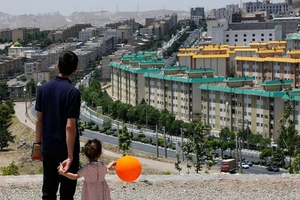
A view of residential buildings in central Tehran.

The government has sought to ease the burden through rent ceilings, deposit loans and measures intended to protect tenants. But the increases documented in Tehran show how difficult those policies are to enforce when housing costs continue to outrun earnings.

For workers earning around 200 million to 250 million rials a month, an average advertised Tehran rent above 720 million rials amounts to roughly three months of individual pay – before food, transport and other basic household expenses are considered.

Iran moves to ratify Caspian Sea pact with seabed rights still unsettled

Aug 8, 2026, 11:20 GMT+1
•
Maryam Sinaiee
100%

Iran is moving to ratify the Caspian treaty it left dormant for seven years, choosing the depths of a war to settle the status of its one quiet frontier, and reopening the oldest wound in its modern diplomacy: the belief that Tehran signed away half a sea.

President Masoud Pezeshkian's government has sent the 2018 Convention on the Legal Status of the Caspian Sea to parliament for ratification, ending years in which the treaty sat untouched and reviving a charged argument over the country's historical rights, energy interests and position in the strategically vital basin.

The convention, signed by the leaders of Iran, Russia, Azerbaijan, Kazakhstan and Turkmenistan in the Kazakh port of Aktau in August 2018, takes effect only once all five littoral states ratify it. The other four completed the process long ago. Tehran, alone, held back.

The charge that shadows the bill is older than the bill itself: a belief, widely held in Iran and rooted in readings of its 1921 and 1940 treaties with Moscow, that the country was entitled to half the Caspian and stands to end up with barely a tenth.

The convention in fact allocates no national shares at all, but the ghost of the fifty percent has trailed every Iranian discussion of the sea since Aktau.

The timing sharpens the argument. The move lands in the middle of a war that has set Iran's southern coast under nightly strikes and closed the Strait of Hormuz, leaving the Caspian corridor to Russia carrying an outsized share of the country's commerce and its strategic weight.

What the treaty actually does is narrower than either its champions or its critics suggest.

It defines the Caspian as a "special and unique landlocked body of water," placing it outside the UN Convention on the Law of the Sea. Each coastal state receives 15 nautical miles of fully sovereign territorial waters and a further 10 nautical miles of exclusive fishing rights, with the remaining surface designated a shared navigation zone.

The wealth, however, is postponed. Article 8 leaves ownership and delimitation of the seabed and its oil and gas to "bilateral or multilateral agreements between the states concerned."

Russia, Kazakhstan and Azerbaijan have largely settled their boundaries in the sea's north; the lines involving Iran, Azerbaijan and Turkmenistan remain unresolved, tangled in the complexity of dividing energy-rich waters.

A century-old dispute over Iran's share

Before the Soviet collapse, the Caspian was governed by the 1921 and 1940 treaties between Tehran and Moscow, which recognized equal navigation and fishing rights but drew no maritime boundaries.

The Soviet breakup turned two littoral states into five, and Iran has argued since that the sea should be divided equally, 20 percent to each.

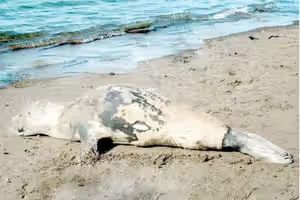
  • Caspian seals face extinction threat as deaths continue

    Caspian seals face extinction threat as deaths continue

  • Iran warns a quarter of Caspian Sea could dry up in 20 years

    Iran warns a quarter of Caspian Sea could dry up in 20 years

Russia, Kazakhstan and Azerbaijan instead adopted a modified median-line method, a formula that, because of Iran's concave coastline, would shrink Tehran's share of the sea and its bed to roughly 11 to 13 percent. Iran has never accepted that division.

The government's case: a sealed northern flank

The government presents ratification as completing the Caspian's legal framework, deepening cooperation among the littoral states and, above all, keeping outside powers away.

Officials point to Article 3, which bars the armed forces of non-coastal countries from the Caspian, as the convention's central security prize, a provision long championed by both Tehran and Moscow.

  • Iran says Caspian Sea a foreign policy priority on par with Persian Gulf

    Iran says Caspian Sea a foreign policy priority on par with Persian Gulf

Defa Press, an outlet affiliated with Iran's armed forces, wrote that the clause would "turn Iran's northern borders into a secure region, far removed from scenarios of foreign military intervention," at a moment when the country faces pressure along its southern and western frontiers.

The critics' case: ratifying before the real negotiation

Opponents argue parliament is sequencing the deal backwards: locking in the framework before the seabed, where the money lies, has been divided.

They note that the northern states have already parceled out much of the seabed and pressed ahead with oil and gas development, while fields shared with Iran, including Alborz, remain in limbo.

  • Ukraine's Iran ship strike was more about messaging than a new front, analysts say

    Ukraine's Iran ship strike was more about messaging than a new front, analysts say

Dariush Safarnejad, an international affairs analyst, told the Revolutionary Guards-linked Javan newspaper that lawmakers should return the bill to the government, since supplementary agreements that were meant to be completed within six months of the 2018 signing have never been finalized.

Approving the convention without them, he warned, "could provide other Caspian states with legal grounds in the future and influence the security, political and geopolitical dynamics of the Caspian region."

Shoaib Bahman, an international relations analyst focused on Eurasia, told the same paper that ratifying before the seabed boundaries are set would "effectively reduce Iran's legal leverage in future negotiations and could undermine its claim to a 20% share of the Caspian Sea."

Pipelines, corridors and the Turkic map

The critics' second front is Article 14, under which undersea pipelines require the consent only of the states whose sectors they cross, not all five. Bahman argued the clause could open the way for eastern Caspian producers to export oil and gas directly toward Europe, eroding Iran's transit position.

Mehdi Seif-Tabrizi, a Russia specialist, offered a more measured reading to the news website Fararu. Iran's 15 miles of territorial waters and 10 miles of fishing rights are guaranteed, he said, and "the real dispute concerns the seabed and subsoil," not the surface percentages that dominate the public argument.

  • As Caspian states pursue energy growth, Iran watches

    As Caspian states pursue energy growth, Iran watches

Yet he shares the strategic worry: that the long-discussed Trans-Caspian pipeline from Turkmenistan or Kazakhstan to Azerbaijan could finally be built.

"That could strengthen Azerbaijan's position and, in turn, reinforce the Zangezur corridor and the so-called Turkic World project," he said. "If Iran ratifies the convention, it would remove one of the most important legal obstacles to implementing those projects."

The opposition joins the attack

Criticism has come from beyond the establishment's factions. Exiled Prince Reza Pahlavi wrote on X that ratifying the agreement without the Iranian people's mandate and without "a clear and comprehensive guarantee of Iran's historic rights" is "deeply concerning and constitutes a serious threat to Iran's national interests."

Iran's rights in the Caspian, he added, "are not negotiable, nor can they be relinquished. Any action that undermines these rights will be recorded in the historical memory of the Iranian nation, and those responsible will ultimately be held accountable by the people of Iran."

Saeed Ghasseminejad, a senior Pahlavi adviser, went further, alleging that Hassan Rouhani's government had already "ceded Iran's share of the Caspian Sea" and that Pezeshkian and parliament speaker Mohammad-Bagher Ghalibaf now seek to "legalize and make that concession permanent."

He called the move "the biggest surrender of Iran's land and waters to foreign powers since the Qajar-era humiliations."

Ending Iran war could expose regime to its greatest threat yet, experts say

Aug 7, 2026, 22:08 GMT+1
•
Negar Mojtahedi
100%
Iran's President Masoud Pezeshkian (left), Parliament Speaker M.B. Ghalibaf, and Judiciary Chief Mohseni-Ejei attend a funeral ceremony for slain Supreme Leader Ali Khamenei in July 2026.

Ending the Iran war could expose the Islamic Republic to one of its greatest vulnerabilities, experts say, as Tehran confronts a battered post-war economy that may strain its ability to finance the institutions underpinning its rule.

From a strictly economic perspective, former US Treasury official and sanctions strategist Miad Maleki says the greater danger to the regime may emerge once the fighting stops and it must govern a country burdened by soaring inflation, reconstruction costs and years of economic decline.

"If the conflict ends today, then you're going to see the economic effect of the war doing its work," Maleki told Eye for Iran.

"That would be very scary if I was an Iranian regime official, having to face the reality of a post-war economy."

Maleki argues Iran is already inside what he describes as a "tipping zone," where years of inflation, currency depreciation and economic mismanagement have steadily eroded purchasing power.

The question, he says, is no longer simply whether the government can continue paying salaries, but whether those salaries still buy enough to sustain loyalty.

"The salary might keep coming," he said. "You just won't be able to afford very basic needs."

The scale of that pressure is reflected in official consumer-price data.

In June, food and non-alcoholic beverage prices were nearly 134% higher than a year earlier, while prices for oils and fats rose about 278% and meat about 172%, according to data from the Statistical Center of Iran.

Those increases squeeze not only ordinary households, counterterrorism and security specialist Roger Macmillan argues, but also lower-ranking members of the Basij, IRGC conscripts and their families—people drawn from the same society on which the state relies to maintain internal security and suppress dissent.

"The real question isn't how much damage a bomb can do," he said. "It's what happens when the money stops moving."

Iran's financial center of gravity

Military pressure has dominated discussion of Iran for months, with much of the debate centered on missile stockpiles, drone production and how long it might take Tehran to rebuild its military capabilities.

Macmillan argues that focus overlooks something more fundamental.

"They are built to absorb military pressure," he said. "But are they able to absorb payroll pressure?"

His argument is not that economic pressure alone will weaken the regime. Rather, he says policymakers should focus on disrupting the broader financial ecosystem that allows the Islamic Republic to function, from government payrolls to military-linked economic networks.

"We need to be looking at the financial center of gravity, which is not just the payroll but also the military bonyads," he said.

Bonyads are powerful quasi-official foundations that expanded after the 1979 Islamic Revolution, with some of the largest developing extensive holdings in sectors including banking, construction, manufacturing, agriculture and energy.

Major foundations enjoy significant economic privileges and limited public oversight, and several are overseen by or closely connected to institutions under the Supreme Leader.

Some have also served as important patronage networks and maintained extensive economic links with Iran's political and security establishment.

For Macmillan, the question is not simply how much revenue those networks generate. It is whether they can continue supporting rank-and-file security forces if inflation keeps eroding wages while the government takes on the additional burden of rebuilding a post-war economy.

"What we need to look at is how we can remove the will, shatter the cohesion and the will of the foot soldiers from the Basij and from the IRGC, and separate them from the state," he said.

The argument represents a different way of thinking about pressure on Iran.

Rather than asking only how much military capability can be destroyed, Macmillan and Maleki argue policymakers should also consider how much financial strain the Islamic Republic can absorb before maintaining the institutions that enforce its rule becomes increasingly difficult.

Peace itself could reduce some war-related economic pressures, particularly if it improves trade conditions or is accompanied by sanctions relief. But Maleki argues it would also force Tehran to confront accumulated economic problems while meeting the costs of reconstruction.

For him, that may be precisely where the regime is most vulnerable.

"The most punishing thing they can do to this regime is send it back to govern Iran in a state of peace and face the reality they had to kill their way out of," Maleki said.

What the Pentagon learned from the Iran war

Aug 7, 2026, 19:45 GMT+1
•
Mehdi Beigi
100%
An F/A-18F Super Hornet, assigned to Strike Fighter Squadron (VFA) 41, prepares to make an arrested landing on the flight deck of the US Navy Nimitz-class aircraft carrier USS Abraham Lincoln in the Pacific.

President Donald Trump's latest order to investigate leaks about US munitions stockpiles may look like another dispute between the White House and the American media. In Tehran, it is being read as vindication.

Iran's military and state media have spent months portraying the depletion of American interceptors and precision weapons as evidence of a newfound way to impose costs on a vastly more powerful military.

The United States has not run out of weapons, and the Pentagon does not disclose exact inventories. But beneath the propaganda is a real strategic argument.

Iran does not need to match the United States missile for missile. It needs to make the United States expend expensive, slow-to-replace weapons at a rate that becomes difficult to sustain.

Washington increasingly appears to be treating that challenge as an industrial problem, not simply a battlefield one.

Tehran is not hiding the calculation

The clearest evidence comes from the IRGC itself. In a July 23 statement announcing an attack on a US base in Kuwait, the Revolutionary Guards said they would not allow Washington to use what they called "deceptive ceasefires" to replenish its oil and munitions stockpiles before resuming attacks.

The IRGC was not simply claiming to have damaged American forces. It was identifying the time required to replenish US stocks as a factor in how Iran viewed ceasefires and the continuation of the war.

On March 10, IRGC spokesman Ali Mohammad Naeini told American officials that Iran knew their ammunition stocks were being depleted. In April, Aerospace Force commander Majid Mousavi claimed Iran was replenishing its missile and drone capacity faster than the United States could replace weapons sent to the region.

Those statements cannot establish the actual condition of either country's arsenal. They do, however, show that Iranian commanders are treating ammunition consumption as part of the strategic contest.

On July 26, the hardline daily Kayhan ran a report referring to the "running dry" of Pentagon weapons stocks, using American media reports to challenge Washington's claims of overwhelming military power. Tasnim has similarly highlighted estimates of depleted Patriot, THAAD, Tomahawk and other missile inventories.

The claims are propagandistic, but they take aim at a genuine vulnerability.

Iran's advantage

Iran's military model was shaped partly by necessity. A May 13 analysis by the Carnegie Endowment traced Tehran's emphasis on ballistic missiles and drones to decades of sanctions and restricted access to Western military technology.

Rather than attempting to recreate an American-style force built around advanced aircraft and expensive precision systems, Iran invested heavily in weapons it could manufacture domestically and deploy in large numbers.

Carnegie cited estimates putting the cost of a Shahed-136 drone at roughly $20,000 to $50,000. Iranian ballistic missiles are substantially more expensive—roughly $1 million to $2 million by some estimates—but can still cost far less than the defensive systems used against them.

That does not mean a $30,000 drone automatically forces the launch of a multimillion-dollar Patriot interceptor. Air defense is layered. Fighters, guns, electronic warfare and cheaper interceptors can also be used.

Iran can also threaten an array of military and energy targets across the region with weapons flying at different speeds and altitudes. The defender must keep radars active, aircraft airborne and sufficient interceptors available for the threats that matter most.

Iran therefore does not have to win every exchange. It can fail to penetrate most defenses and still impose costs through volume, persistence and geography. That is the part of Iran's approach that an inventory count alone misses.

Politically sensitive numbers

Reuters reported on August 4, citing three people familiar with US military data, that the Army had consumed much of its stock of long-range ground-launched precision missiles during five months of war. Two sources said "virtually all" available ATACMS and Precision Strike Missiles had been used.

The Pentagon has not confirmed those numbers.

Three days later, The Wall Street Journal reported that Trump had ordered investigations into leaks about US munitions stockpiles. According to the report, the administration is seeking $52.9 billion for munitions and another $21 billion specifically to replace stocks depleted during the Iran war.

Trump publicly insists the United States retains "massive" quantities of ammunition. The two positions are not necessarily contradictory. The US military can have enough ammunition to continue current operations while simultaneously concluding that its inventories and production rates are inadequate for another major war.

That matters because Iran is not the Pentagon's only concern, and a potential conflict with China would place vastly greater demands on US stocks.

Future problems

The United States has spent years preparing for the possibility of conflict in the Indo-Pacific while simultaneously supplying Ukraine and maintaining commitments in Europe and the Middle East.

Every Patriot interceptor, Tomahawk or long-range precision missile used against Iran is therefore part of a larger calculation: What remains available if another crisis begins before the first one ends?

That is why the most revealing evidence is not the disputed number of missiles left in storage. It is what Washington is doing to its factories.

On January 6, the Pentagon announced a seven-year agreement aimed at increasing the annual production capacity of the PAC-3 MSE Patriot interceptor from roughly 600 to as many as 2,000.

On July 27, L3Harris announced agreements designed to nearly triple production of propulsion components for PAC-3 and quadruple propulsion production for THAAD. The Pentagon has also brought new suppliers into missile production and launched a program for lower-cost, air-launched cruise missiles that can be manufactured at greater scale.

These are not signs that American military power has collapsed. They are signs that the Pentagon believes industrial capacity itself has become a weapon.

The bigger picture

Iranian state media have turned the US stockpile debate into evidence that Washington has been defeated. That conclusion goes beyond what the public evidence supports.

The United States retains enormous military advantages in intelligence, air power, logistics, precision strike and global deployment. Iran has also suffered severe military, economic and human losses during the war.

But Tehran does appear to have demonstrated something narrower and strategically significant. A weaker state does not necessarily have to compete with America's most advanced technology. It can attack the economics and tempo behind that technology.

Michael Duffey, the Pentagon official responsible for acquisition and sustainment, recently described the shift in American thinking in unusually direct terms. For decades, he said, the United States benefited from its ability to engineer the world's most sophisticated weapons.

"We're no longer in that global environment," Duffey said, arguing that the Pentagon needs not only superior technology but speed and volume.

The argument over whether America's missile stocks are "running out" will continue, particularly while the actual numbers remain classified. The more consequential change is already visible.

Iran spent decades building a military around the assumption that it could not compete with the United States in sophistication. Washington is now spending billions to ensure that its technological superiority does not leave it vulnerable on quantity.

The next arms race is no longer only about who can build the better missile. It is also about who can build the next one fast enough.