Iran says US must meet its demands before Hormuz reopens

Iran says the Strait of Hormuz will not reopen until the United States meets its conditions, even as Tehran and Oman move closer to an agreement on a temporary shipping route.
Iran says the Strait of Hormuz will not reopen until the United States meets its conditions, even as Tehran and Oman move closer to an agreement on a temporary shipping route.
Mohammad-Bagher Zolghadr, secretary of Iran’s Supreme National Security Council, said Saturday that the waterway would remain closed until Washington “corrects its behavior,” spelling out the conditions in a written message.
“Correcting its behavior means that Iran must never again be threatened or humiliated, aggression against Iran and its allies must end permanently, the naval blockade must be lifted, US naval and air forces must withdraw from around Iran, war damages must be compensated, sanctions must be lifted and Iran’s frozen assets must be released,” Zolghadr said.
“The Supreme National Security Council will never back down, whether in war or in negotiations,” he added.
The demands came even as Iran and Oman moved closer to an agreement on a temporary shipping route through the strait.
Foreign Minister Abbas Araghchi said Saturday that the two countries were “very close” to completing negotiations on the route, which is intended as an interim arrangement while technical and legal work continues on a new permanent Traffic Separation Scheme, or TSS.
Araghchi said an agreement with Oman on the route “does not necessarily mean the reopening of the Strait of Hormuz.”
He said reopening remained subject to separate conditions, including the United States compensating for what Tehran considers violations of the Islamabad memorandum of understanding.
The IRGC reinforced that distinction earlier Saturday, saying the Iran-Oman negotiations and a decision to reopen the strait were separate issues.
“Whenever America accepts Iran’s conditions, the Strait of Hormuz will certainly reopen,” IRGC spokesperson Hossein Mohebi said.
Oman, which has been negotiating the shipping arrangements with Tehran, described the talks as proceeding in a “positive and constructive” atmosphere. Its Foreign Ministry also condemned repeated attacks on vessels transiting the strait and urged all sides to avoid actions that could undermine progress in the negotiations.
From Washington, Vice President JD Vance said Iran had told the United States it had no plans to impose tolls in the Strait of Hormuz and that Tehran and Persian Gulf states, particularly Oman, were discussing arrangements for safe passage.
Vance said those discussions included demining and a commitment from Iran not to fire on commercial vessels. Washington expected oil and gas flows from the Persian Gulf to return to pre-conflict levels, he said, but would judge Tehran by its actions.
“We don’t trust, we verify,” Vance said in an interview aired by Fox News Saturday.
US officials have also linked relief from Washington’s pressure campaign to the restoration of shipping. The Wall Street Journal reported Friday that Washington had told mediators it would not accept Iranian restrictions or tolls and that the Trump administration would lift its blockade on Iranian ports if Tehran reopened the waterway without impediments.
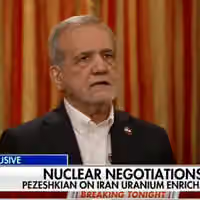
President Masoud Pezeshkian, meanwhile, called the United States “untrustworthy” but said Saturday that now was the “best time” to reach an agreement. He said Tehran was discussing diplomacy almost daily in an effort to move Iran out of a state of “neither war nor peace.”
“You cannot fight forever; at some point, it has to be brought to an end,” Pezeshkian said.
The negotiations with Oman may therefore settle how vessels would move through the Strait of Hormuz, but Iranian officials say the decision to reopen it remains contingent on Washington meeting broader demands set by Tehran.