Will the Islamic Republic trade with the 'Great Satan'?
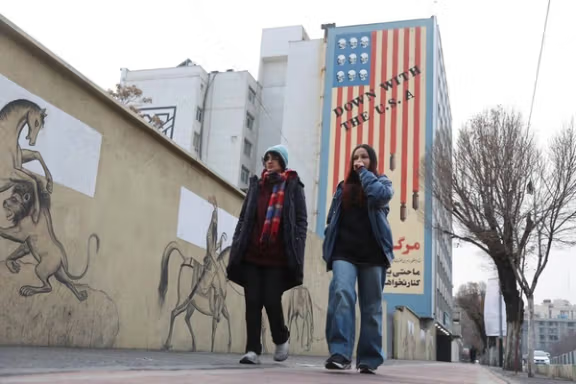
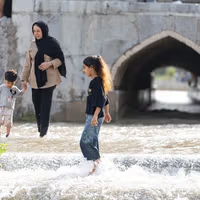
Nearly half a century after Iran's revolutionary government severed ties with Washington, took US diplomats hostage and turned "Death to America" into one of its defining slogans, a new US proposal could see frozen Iranian assets used to purchase American goods.
The proposal points to one of the more striking ironies of the emerging US-Iran agreement: using Iranian assets to buy American products from a country the Islamic Republic has long cast as the "Great Satan" and a threat to the revolution.
Speaking in Switzerland on Monday, US Vice President JD Vance said Washington could agree to unfreeze Iranian assets for purchases of American products such as soybeans, corn and wheat.
"If Iranian assets are ever unfrozen, they're going to go to make American farmers richer and to feed the Iranian people," Vance said, adding that the United States and Qatar would oversee the process.
Read the full article here.




Nearly half a century after Iran's revolutionary government severed ties with Washington, took US diplomats hostage and turned "Death to America" into one of its defining slogans, a new US proposal could see frozen Iranian assets used to purchase American goods.
The proposal points to one of the more striking ironies of the emerging US-Iran agreement: using Iranian assets to buy American products from a country the Islamic Republic has long cast as the "Great Satan" and a threat to the revolution.
Speaking in Switzerland on Monday, US Vice President JD Vance said Washington could agree to unfreeze Iranian assets for purchases of American products such as soybeans, corn and wheat.
"If Iranian assets are ever unfrozen, they're going to go to make American farmers richer and to feed the Iranian people," Vance said, adding that the United States and Qatar would oversee the process.
The proposal marks one of the clearest signs yet that the Trump administration may be shifting from its longstanding "maximum pressure" approach toward a strategy centered on incentives and compliance.
It has also revived questions about whether limited economic engagement could eventually evolve into something that once seemed unimaginable: renewed trade between Iran and the United States.
Vance said the proposal was developed by Jared Kushner, President Donald Trump's son-in-law and one of the lead US negotiators, together with Qatari officials.
Close allies turn sworn adversaries
Before the 1979 revolution, Iran was one of Washington's closest allies in the Middle East and an important market for American goods and services.
"There was no embargo, no sanctions and no limitation," said Mohamad Machine-Chian, economist and journalist at Iran International. "Iranian industrial infrastructure is American to begin with," Machine-Chian said.
The revolution transformed that relationship. The hostage crisis, sanctions and decades of political hostility largely froze direct commerce between the two countries.
At the same time, the Islamic Republic built much of its identity around opposition to the United States. Iranian leaders frequently portrayed American economic and cultural influence as a threat to the revolution, while late Supreme Leader Ali Khamenei repeatedly warned against what he described as Western "cultural aggression."
A market that never disappeared
Yet American products never entirely disappeared from Iran.
Machine-Chian said some US goods continued reaching the country through intermediaries, often passing through several countries and layers of traders before reaching Iranian consumers.
The arrangement was costly and inefficient, but demand remained. And it led to a contradiction that persists today. While many Iranians continued to seek out American products, the country’s rulers repeatedly warned against them.
The Islamic Republic has long viewed unrestricted American economic and cultural influence with suspicion, arguing that it could undermine the values the revolution sought to promote. Khamenei often described such influence as a form of "cultural aggression."
"There is a great deal of potential between Iran and the US," Machine-Chian said. "Iran remains the last untapped developing market in the world … Iranian people love American products and would love a good deal to be able to buy and sell, trade with America."
Still, he cautioned against assuming the latest proposal signals a broader economic opening.
"The result will be decided by compliance, the negotiations and the political aspect of it all," he said. "I wouldn't hold my breath."
Will American goods reach ordinary Iranians?
Supporters of the proposal argue that using frozen assets to purchase food and agricultural products could help ease economic pressure on ordinary Iranians without handing Tehran unrestricted cash.
Mahdi Ghodsi, Economist and Leader of the International Economics Group at the Vienna Institute for International Economic Studies (wiiw) and Senior Fellow at the Centre for Middle East and Global Order (CMEG), said the arrangement could help stabilize prices and reduce pressure on Iran's currency reserves.
"It means there is a lower pressure on currency reserves," Ghodsi said. "There could be some stabilization in the currency market of Iran."
He argued that preventing further economic deterioration is important not only for Iran's economy but for ordinary households already struggling with soaring costs.
But Ghodsi also warned about oversight.
"The regime is corrupt. The regime is a kleptocracy," he said. "We cannot be sure that they don't benefit from such behavior to fill their pockets."
Critics, however, argue that the success of any such arrangement would depend on how strictly it is monitored.
Max Meizlish, a sanctions expert at the Foundation for Defense of Democracies and former US Treasury official, warned that humanitarian trade does not automatically guarantee humanitarian outcomes.
He said Washington would need safeguards to ensure goods purchased with frozen Iranian assets actually reach ordinary people and are not diverted through networks linked to the Islamic Revolutionary Guard Corps.
"The question is whether they might be providing an indirect form of support to the IRGC," Meizlish said.
Without a transparent mechanism, he warned, American goods intended for civilians could end up strengthening the very actors Washington says it wants to constrain.
Meizlish also questioned the administration's broader shift in approach.
Just days before the latest proposal, US officials were still describing Iranian oil revenues as a major source of funding for Tehran's armed forces, regional partners and proxies.
"Iran's oil and petroleum exports are a primary source of revenue for its armed forces, terrorist partners and proxies," the State Department wrote in a report sent to Congress on June 16.
For critics, the contrast is striking: a government that only days ago warned that Iranian revenues fund armed groups is now considering a framework that could unlock billions of dollars in Iranian assets under a US-approved arrangement.
Whether the proposal becomes a meaningful opening or remains a narrowly defined humanitarian mechanism remains unclear. Whatever its economic impact, however, the symbolism is difficult to miss.
A state founded on opposition to the United States may soon use billions of dollars in frozen assets to purchase American goods, while a US administration once committed to maximum pressure is increasingly betting on incentives instead.
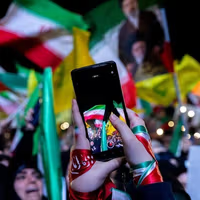
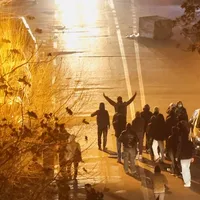
Iranian hardliners have sharply criticized a government-linked report that warned prolonged nightly pro-state gatherings could obstruct diplomacy, exposing a growing dispute over the role of street mobilization in postwar Iran.
The controversy highlights tensions within Iran's political establishment over whether the rallies represent a source of national unity or an increasingly disruptive force in debates over diplomacy and relations with the United States.
The backlash was triggered by a document published by the presidential Strategic Affairs Office (SAO) following a conference titled "The Street Movement for Protecting Iran: Nature, Opportunities and Ways to Enhance It."
The report examined the nightly gatherings that have spread across Iranian cities since the war and argued that their continued presence could complicate decision-making and undermine diplomatic efforts.
Read the full article here.
Iranian hardliners have sharply criticized a government-linked report that warned prolonged nightly pro-state gatherings could obstruct diplomacy, exposing a growing dispute over the role of street mobilization in postwar Iran.
The controversy highlights tensions within Iran's political establishment over whether the rallies represent a source of national unity or an increasingly disruptive force in debates over diplomacy and relations with the United States.
The backlash was triggered by a document published by the presidential Strategic Affairs Office (SAO) following a conference titled "The Street Movement for Protecting Iran: Nature, Opportunities and Ways to Enhance It."
The report examined the nightly gatherings that have spread across Iranian cities since the war and argued that their continued presence could complicate decision-making and undermine diplomatic efforts.
Many of the nightly gatherings—known in Iran's political discourse simply as "the street"—began as public mourning ceremonies for Khamenei before evolving into organized political events.
It warned that the "continuation of gatherings would constitute a serious obstacle to adopting strategic and expedient decisions at sensitive moments." Left unchecked, the report said, the gatherings could "lead to obstruction in the path of diplomacy."
The report drew an immediate backlash from hardline media and politicians.
The website Jahan News criticized what it described as the report's "inappropriate and offensive" language, particularly its characterization of the gatherings as "emotional" rituals.
"This terminology is used despite the fact that the Supreme Leader repeatedly praised the nightly gatherings and even explicitly stated that people's chants in public squares influence the course of negotiations."
Initially encouraged by senior officials as demonstrations of national solidarity during wartime, the rallies attracted large crowds. Witnesses say attendance has since declined as the rhetoric has become more radical, with many gatherings now drawing between 100 and 200 participants.
Ali Khezriyan, a member of parliament's National Security and Foreign Policy Committee, criticized the Strategic Affairs Office for portraying the gatherings as an obstacle to diplomacy.
"While we speak about the role of the people, the SAO has described the people's gatherings as causing obstruction in diplomacy, whereas the Supreme Leader considers the people to be overseers," he told IRGC-linked Fars News.
"These same people brought themselves and their loved ones into the streets under enemy bombardment," he added.
The SAO report appeared to recommend gradually winding down the gatherings after the first ten days of Muharram or following the funeral of former Supreme Leader Ali Khamenei, scheduled for July 4-5.
Hardline political groups have increasingly used the events as platforms for speeches and mobilization. Speakers have addressed contentious issues including ceasefire terms and negotiations with the United States.
Some have targeted prominent political figures, particularly Parliament Speaker Mohammad Bagher Ghalibaf, who heads Iran's negotiating team, with crowds encouraged to chant slogans against him.
Fars News Agency, which is linked to the Revolutionary Guards (IRGC), published a photograph of a participant holding a banner that read: "Instead of deciding how to empty the streets, the government should think about the emptying of people's dinner tables."
One commenter wrote: "We did not gather on the orders of officials so that we would leave the streets based on their decisions."
Another wrote: "Why do you think you have the right to talk about these gatherings? People did not come into the streets with your permission for you to disperse them. Keep your mouth shut before we open ours."
The recent war between Iran and the United States has left Tehran facing a diplomatic challenge that extends well beyond Washington: rebuilding trust with Arab neighbors unsettled by weeks of regional instability.
Former ambassador Mohammad Irani argues that effort will depend largely on the success of negotiations between Tehran and Washington.
Speaking to Shargh on Thursday, June 18, Irani said that "the restoration of Iran's damaged relations with its Arab neighbors is directly contingent upon the success and final quality of the broader Tehran-Washington agreement."
He argued that with hostilities paused and a tentative memorandum of understanding now on the table, "Iran must adopt an optimistic and rational diplomatic approach to break out of political and economic isolation."
Iran cannot repair relations with Arab and regional neighbors "in a vacuum," he said, insisting that regional diplomacy is inseparable from the outcome of negotiations with Washington.
His comments reflect a broader theme across Iran's press, where discussions of relations with Persian Gulf states have become increasingly tied to post-war diplomacy and the emerging Tehran-Washington understanding.
A recurring argument is that the conflict exposed the vulnerability of Iran's Arab neighbors and reinforced their interest in a durable understanding between Tehran and Washington. Many voices in Tehran argue that regional states now view a sustainable agreement as the best guarantee of their own economic and technological stability.
Irani also argued that a lasting regional order cannot be imported or built through symbolic agreements alone, as smaller states remain engaged in a constant balancing act between larger regional powers, particularly Iran and Saudi Arabia.
Many commentators have likewise suggested that Persian Gulf states are reassessing their security doctrines in the aftermath of the war, particularly regarding Israel's growing strategic and technological footprint across the region.
Several outlets, including Etemad, ISNA and Eghtesad News, have argued that Iran's long-term place in the regional order will ultimately depend on the fate of the nuclear file and the broader understanding taking shape between Tehran and Washington.
At the same time, analysts warn that if the current 60-day negotiation window fails to produce a more permanent framework, Iran's Arab neighbors are likely to deepen security, cybersecurity and defense partnerships with Western and other global powers, further marginalizing Tehran.
For the talks to succeed, Irani argued, the negotiating team needs strong domestic backing to convert wartime resilience into peacetime development.
"The negotiating team must feel that it enjoys the support of the nation," he said. "We must show that the steadfastness and resistance shown during recent conflicts is now gradually bearing fruit."
Ultimately, he concluded, a durable homegrown security framework will remain elusive as long as Persian Gulf states prioritize regime survival over collective security and fundamental disparities in regional power remain unresolved.
A message attributed to Iran’s Supreme Leader suggesting he had reservations about the agreement with the United States has sparked a fierce debate in Tehran, with hardliners and moderates offering sharply different interpretations of its meaning and implications.
Supporters of the government presented it as a roadmap for the next phase of diplomacy, while critics argued it showed the leader’s preferred approach had been sidelined during negotiations.
Hardline media outlets and political figures offered a starkly different reading, arguing that the message showed the leader’s views had not been fully reflected in the negotiation process.
Read the full article here.