Iran's postwar rallies become flashpoint in diplomacy debate
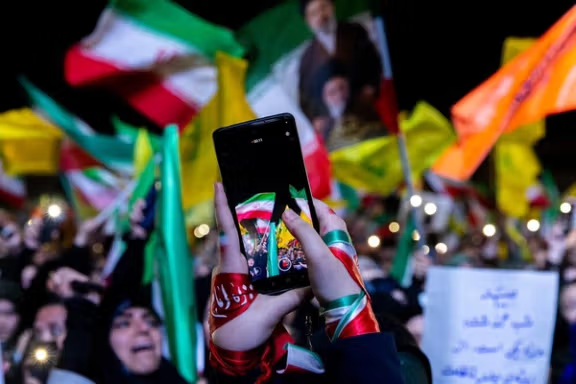
Iranian hardliners have sharply criticized a government-linked report that warned prolonged nightly pro-state gatherings could obstruct diplomacy, exposing a growing dispute over the role of street mobilization in postwar Iran.
The controversy highlights tensions within Iran's political establishment over whether the rallies represent a source of national unity or an increasingly disruptive force in debates over diplomacy and relations with the United States.
The backlash was triggered by a document published by the presidential Strategic Affairs Office (SAO) following a conference titled "The Street Movement for Protecting Iran: Nature, Opportunities and Ways to Enhance It."
The report examined the nightly gatherings that have spread across Iranian cities since the war and argued that their continued presence could complicate decision-making and undermine diplomatic efforts.
Read the full article here.






Iranian hardliners have sharply criticized a government-linked report that warned prolonged nightly pro-state gatherings could obstruct diplomacy, exposing a growing dispute over the role of street mobilization in postwar Iran.
The controversy highlights tensions within Iran's political establishment over whether the rallies represent a source of national unity or an increasingly disruptive force in debates over diplomacy and relations with the United States.
The backlash was triggered by a document published by the presidential Strategic Affairs Office (SAO) following a conference titled "The Street Movement for Protecting Iran: Nature, Opportunities and Ways to Enhance It."
The report examined the nightly gatherings that have spread across Iranian cities since the war and argued that their continued presence could complicate decision-making and undermine diplomatic efforts.
Many of the nightly gatherings—known in Iran's political discourse simply as "the street"—began as public mourning ceremonies for Khamenei before evolving into organized political events.
It warned that the "continuation of gatherings would constitute a serious obstacle to adopting strategic and expedient decisions at sensitive moments." Left unchecked, the report said, the gatherings could "lead to obstruction in the path of diplomacy."
The report drew an immediate backlash from hardline media and politicians.
The website Jahan News criticized what it described as the report's "inappropriate and offensive" language, particularly its characterization of the gatherings as "emotional" rituals.
"This terminology is used despite the fact that the Supreme Leader repeatedly praised the nightly gatherings and even explicitly stated that people's chants in public squares influence the course of negotiations."
Initially encouraged by senior officials as demonstrations of national solidarity during wartime, the rallies attracted large crowds. Witnesses say attendance has since declined as the rhetoric has become more radical, with many gatherings now drawing between 100 and 200 participants.
Ali Khezriyan, a member of parliament's National Security and Foreign Policy Committee, criticized the Strategic Affairs Office for portraying the gatherings as an obstacle to diplomacy.
"While we speak about the role of the people, the SAO has described the people's gatherings as causing obstruction in diplomacy, whereas the Supreme Leader considers the people to be overseers," he told IRGC-linked Fars News.
"These same people brought themselves and their loved ones into the streets under enemy bombardment," he added.
The SAO report appeared to recommend gradually winding down the gatherings after the first ten days of Muharram or following the funeral of former Supreme Leader Ali Khamenei, scheduled for July 4-5.
Hardline political groups have increasingly used the events as platforms for speeches and mobilization. Speakers have addressed contentious issues including ceasefire terms and negotiations with the United States.
Some have targeted prominent political figures, particularly Parliament Speaker Mohammad Bagher Ghalibaf, who heads Iran's negotiating team, with crowds encouraged to chant slogans against him.
Fars News Agency, which is linked to the Revolutionary Guards (IRGC), published a photograph of a participant holding a banner that read: "Instead of deciding how to empty the streets, the government should think about the emptying of people's dinner tables."
One commenter wrote: "We did not gather on the orders of officials so that we would leave the streets based on their decisions."
Another wrote: "Why do you think you have the right to talk about these gatherings? People did not come into the streets with your permission for you to disperse them. Keep your mouth shut before we open ours."
The recent war between Iran and the United States has left Tehran facing a diplomatic challenge that extends well beyond Washington: rebuilding trust with Arab neighbors unsettled by weeks of regional instability.
Former ambassador Mohammad Irani argues that effort will depend largely on the success of negotiations between Tehran and Washington.
Speaking to Shargh on Thursday, June 18, Irani said that "the restoration of Iran's damaged relations with its Arab neighbors is directly contingent upon the success and final quality of the broader Tehran-Washington agreement."
He argued that with hostilities paused and a tentative memorandum of understanding now on the table, "Iran must adopt an optimistic and rational diplomatic approach to break out of political and economic isolation."
Iran cannot repair relations with Arab and regional neighbors "in a vacuum," he said, insisting that regional diplomacy is inseparable from the outcome of negotiations with Washington.
His comments reflect a broader theme across Iran's press, where discussions of relations with Persian Gulf states have become increasingly tied to post-war diplomacy and the emerging Tehran-Washington understanding.
A recurring argument is that the conflict exposed the vulnerability of Iran's Arab neighbors and reinforced their interest in a durable understanding between Tehran and Washington. Many voices in Tehran argue that regional states now view a sustainable agreement as the best guarantee of their own economic and technological stability.
Irani also argued that a lasting regional order cannot be imported or built through symbolic agreements alone, as smaller states remain engaged in a constant balancing act between larger regional powers, particularly Iran and Saudi Arabia.
Many commentators have likewise suggested that Persian Gulf states are reassessing their security doctrines in the aftermath of the war, particularly regarding Israel's growing strategic and technological footprint across the region.
Several outlets, including Etemad, ISNA and Eghtesad News, have argued that Iran's long-term place in the regional order will ultimately depend on the fate of the nuclear file and the broader understanding taking shape between Tehran and Washington.
At the same time, analysts warn that if the current 60-day negotiation window fails to produce a more permanent framework, Iran's Arab neighbors are likely to deepen security, cybersecurity and defense partnerships with Western and other global powers, further marginalizing Tehran.
For the talks to succeed, Irani argued, the negotiating team needs strong domestic backing to convert wartime resilience into peacetime development.
"The negotiating team must feel that it enjoys the support of the nation," he said. "We must show that the steadfastness and resistance shown during recent conflicts is now gradually bearing fruit."
Ultimately, he concluded, a durable homegrown security framework will remain elusive as long as Persian Gulf states prioritize regime survival over collective security and fundamental disparities in regional power remain unresolved.
A message attributed to Iran’s Supreme Leader suggesting he had reservations about the agreement with the United States has sparked a fierce debate in Tehran, with hardliners and moderates offering sharply different interpretations of its meaning and implications.
Supporters of the government presented it as a roadmap for the next phase of diplomacy, while critics argued it showed the leader’s preferred approach had been sidelined during negotiations.
Hardline media outlets and political figures offered a starkly different reading, arguing that the message showed the leader’s views had not been fully reflected in the negotiation process.
Read the full article here.
A message attributed to Iran’s Supreme Leader suggesting he had reservations about the agreement with the United States has sparked a fierce debate in Tehran, with hardliners and moderates offering sharply different interpretations of its meaning and implications.
According to the message, Mojtaba Khamenei had "a different view in principle" regarding the memorandum but approved it after receiving assurances from the Supreme National Security Council (SNSC) and its chairman, President Masoud Pezeshkian, that Iran’s rights and the interests of the "Axis of Resistance" would be safeguarded.
The statement quickly produced competing narratives. Supporters of the government presented it as a roadmap for the next phase of diplomacy, while critics argued it showed the leader’s preferred approach had been sidelined during negotiations.
Pezeshkian said the message had "clarified the responsibility of all influential components in the upcoming negotiation process."
Parliament Speaker and lead negotiator Mohammad Bagher Ghalibaf said it strengthened Tehran’s hand in holding Washington to its commitments under the memorandum.
Leader ‘ignored’
Hardline media outlets and political figures offered a starkly different reading, arguing that the message showed the leader’s views had not been fully reflected in the negotiation process.
The conservative website Raja News described Pezeshkian’s response as disrespectful, writing: "Mr. Pezeshkian, your duty is obedience and compliance, not merely consideration."
The outlet also criticized Ghalibaf’s comments, arguing that he appeared to treat the leader’s conditions as negotiating leverage rather than binding red lines.
"It seems he has forgotten that the leader’s red lines are not bargaining tools in negotiations but mandatory boundaries by which his future performance will be judged," the website wrote.
Mohsen Maghsoudi, writing for Fars News Agency, argued that opponents of negotiations had effectively been vindicated because their position had been aligned with that of the leader.
He claimed that "the compromise camp" had made decisions on behalf of both society and officials and that "the principled view of the Guardian Jurist was not followed."
Kian Abdollahi, editor-in-chief of IRGC-linked Tasnim News Agency, wrote that if officials advanced the memorandum despite knowing the leader held a different view, they bore responsibility for the consequences.
Competing narratives
Analysts offered sharply different interpretations of the political significance of the message.
Political analyst Ruhollah Rahimpour argued that Khamenei was seeking to reassure hardliners that he had not abandoned his previous positions and had accepted the agreement only because of state interests and the guarantees he received.
"But this manner of expression unintentionally reveals a reality," he wrote.
"The agreement is so costly and controversial for part of the power structure that the leader of the Islamic Republic felt compelled to clear himself of blame before defending it."
Political analyst Shahir Shahid Saless argued that the statement implicitly acknowledged direct negotiations with Washington, noting that the reference to "future face-to-face talks" amounted to recognition of direct engagement with the United States.
Historian and commentator Abdollah Shahbazi argued that the message would increase pressure on Ghalibaf, Pezeshkian and Foreign Minister Abbas Araghchi from opponents of the memorandum.
He also compared the statement to former leader Ali Khamenei’s habit of maintaining distance from controversial decisions while allowing them to proceed.
The 'poisoned chalice'
The debate quickly spread to social media, where some users compared the statement to Ayatollah Ruhollah Khomeini’s acceptance of the ceasefire that ended the Iran-Iraq War.
But while Khomeini openly accepted responsibility for the decision, famously describing it as "drinking a chalice of poison," critics argued Mojtaba Khamenei’s message emphasized his reservations before endorsing the agreement.
Moderate commentators rejected suggestions that the leader was attempting to distance himself from the memorandum.
Ahmad Zeidabadi argued that relations between the president and the leader remained "close and based on mutual trust."
He said the emphasis on the role of the president and the SNSC amounted to an expression of confidence in Pezeshkian and a reminder of the presidency’s importance as the second-highest office in the political system.
Seraj Mirdamadi similarly argued that the statement reflected trust in an elected official rather than an attempt to shift responsibility, describing it as "democratic and encouraging."
The dispute is ultimately about more than the wording of a single statement. It reflects an emerging struggle over ownership of the memorandum itself.
With talks set to enter a new phase, that battle over credit and blame may prove almost as consequential as the negotiations themselves.
A message attributed to Iran's Supreme Leader Mojtaba Khamenei and the swift reactions from President Masoud Pezeshkian and chief negotiator Mohammad Bagher Ghalibaf highlighted the uneasy coalition behind the agreement with the United States and the lingering doubts about it.
The intervention comes after weeks of criticism from hardline media outlets, clerics and political factions that viewed the agreement as a dangerous concession to Washington.
While the ultraconservative Paydari Party is often portrayed as the main opponent of rapprochement with the United States, recent debate in Iran has highlighted a broader network of political, media and ideological actors resisting a Tehran-Washington understanding.
In a message issued after the signing of the memorandum, Mojtaba Khamenei warned that actions creating “pessimism among the people” effectively serve the enemy, language widely interpreted as a rebuke to hardline critics of the agreement.
Both Pezeshkian and Ghalibaf quickly issued statements pledging to follow the leader's guidance and defend the negotiating process.
The apparent effort to impose discipline on the debate has coincided with growing scrutiny of those opposing diplomacy.