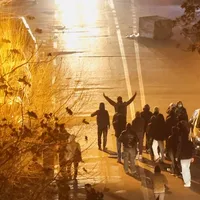
Erdogan warns of efforts to sabotage Iran-US talks in call with Pezeshkian
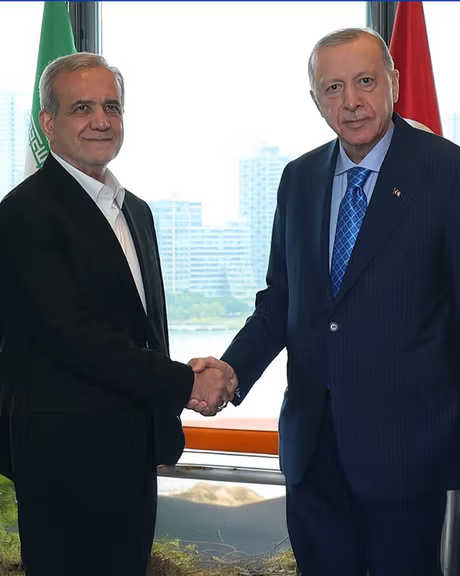

Turkish President Recep Tayyip Erdogan warned of efforts to sabotage Iran-US negotiations in a phone call with Iranian President Masoud Pezeshkian, Turkey’s presidency said, adding that Ankara welcomed the understanding between Tehran and Washington and was ready to support its peaceful completion.
Pezeshkian, in turn, said Iran was ready to continue diplomacy within the framework of international law and was “not seeking war.” He also called for Lebanon to be included in the peace process, saying Israel should no longer be allowed to bomb Lebanon and Palestine.
The two sides also discussed the normalization of relations between regional states as well as ties among Islamic countries.




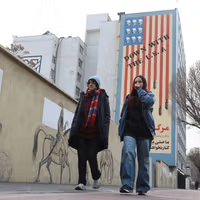
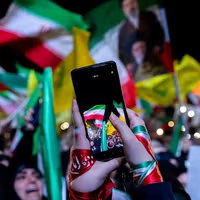
Iran has committed to ensuring free and open transit through the Strait of Hormuz and allowing International Atomic Energy Agency inspectors into the country under a framework discussed in ongoing talks in Switzerland, US Treasury Secretary Scott Bessent said on Monday.
“Under President Donald Trump and Vice President JD Vance, we continue to make the world safer and more prosperous,” Bessent wrote on X.
“In line with the ongoing productive talks in Switzerland, Iran has committed to free and open transit in the Strait of Hormuz and to permit International Atomic Energy Agency (IAEA) inspectors into their country,” he added.
As part of the framework, the Treasury Department has issued a temporary 60-day general license authorizing the production, delivery and sale of Iranian oil, Bessent said.
The US Treasury Department issued a general license authorizing the production, delivery and sale of Iranian-origin crude oil, petroleum products and petrochemical products through August 21, 2026, according to information published on its website.
The authorization also permits the importation into the United States of Iranian-origin crude oil, petroleum products and petrochemical products under specified conditions.
The Treasury Department said the general license does not authorize transactions involving North Korea, Cuba or Ukraine.
A representative of Iran’s Supreme Leader to the Islamic Revolutionary Guards Corps warned US President Donald Trump on Monday that Iranians would not rest until they had “drowned” him in their “sea of anger.”
“The arrogant powers should know that they will take to their graves the dream of one day ruling this nation,” Abdollah Haji Sadeghi said.
Addressing Trump directly, he added: “You who resemble Pharaoh, know that this nation will not rest until it drowns you in its sea of anger.”
Haji Sadeghi also urged Iran’s negotiators to remain wary in dealings with Washington.
“Negotiators should know that they are negotiating with an enemy that we will never befriend and never tolerate,” he said. “We do not forget enmity.”
A cyber campaign using fake accounts impersonating Iran International journalists and staff continues to target media figures and analysts, according to the broadcaster, which warned earlier this month that the operation was aimed at stealing information and compromising devices.
The broadcaster said in a statement published on Sunday that the operation involved accounts created on messaging platforms including WhatsApp and Telegram that falsely presented themselves as managers, reporters and producers working for the network.
“The main objective of these deceptive contacts is to make fraudulent interview requests or distribute malicious links designed to hack devices, steal sensitive information and conduct phishing attacks,” the statement said.
Iran International attributed the operation to hackers linked to the Islamic Revolutionary Guards Corps, describing the activity as a coordinated effort aimed at individuals who regularly interact with the network.
According to the statement, the fake accounts have contacted a range of public figures and invited them to participate in interviews or engage through links sent via messaging applications.
The broadcaster urged journalists, experts, activists and guests appearing on its programs to verify the identity of anyone claiming to represent the network before responding to messages.
It advised recipients to confirm the authenticity of contacts through official communication channels, including email addresses using the Volantmedia.net domain.
The network also warned users not to click on links sent through suspicious messages, particularly those related to unfamiliar online interview platforms, identity verification requests or file attachments.
Iran International called on anyone receiving such messages to block and report the accounts involved and to notify local security authorities of suspected phishing attempts.
The broadcaster said it condemned what it described as unlawful actions targeting the security of activists and freedom of expression.
“Security and privacy for our experts and guests remain a priority,” the statement said.
Iran International added that it would pursue technical and legal action regarding the cyber campaign through international channels.
High school students in several Iranian cities gathered outside education offices on Monday, demanding that final exams be postponed after a compressed testing schedule left them with too little time to prepare.
Videos and reports received by Iran International showed 11th- and 12th-grade students protesting in multiple cities on Monday, calling on authorities to revise the timetable for final examinations.
The students say the short gaps between exams, combined with the proximity of final tests to the national university entrance exam, have increased pressure and reduced opportunities for study.
"We do not have enough time to prepare for both the final exams and the university entrance exam," one protesting student told Iran International.
The final exams were originally scheduled to begin in late May but were postponed following disruptions linked to recent events and the aftermath of the conflict between the Islamic Republic and the United States.
The dispute comes after education officials said the exam calendar had been arranged to conclude before Arbaeen, the annual Shiite pilgrimage marking 40 days after the killing of the third Shiite Imam.
On June 6, Hossein Sadeghi, head of the Education Ministry's information center and public relations office, said final exams were scheduled to end before the event so students could benefit from what he described as Arbaeen's "spiritual and educational opportunity."
The controversy touches on a longstanding debate in Iran over the role of religious ideology in education. Critics of the Islamic Republic's policies argue that authorities frequently align academic and civic programs with religious events as part of broader efforts to promote the state's ideological and religious narrative.
Some students, however, have objected to the timetable and are calling for exams to be postponed until after Arbaeen, arguing that the compressed schedule has reduced the time available for preparation.
Students seek timetable revision
Students had circulated calls in recent days urging classmates to join demonstrations and press officials to change the exam schedule.
In some provinces, including Lorestan, parents joined the gatherings and discussed the students' demands with education officials.
Several students also criticized what they described as efforts to prevent the protests from gaining visibility.
A student in Mashhad told Iran International that officials warned participants that city surveillance cameras would record their presence and that they could later be questioned about attending the gathering.
Another student said demonstrations outside education offices in Tehran and Karaj were quickly dispersed and participants were not allowed to continue protesting. Some students later gathered outside the Supreme Council of the Cultural Revolution building, according to the same account.
Education policies draw repeated criticism
The latest protests follow earlier demonstrations over education policies, including the weighting of 11th-grade final exam scores in university admissions and the format of final examinations.
On June 2, groups of 11th- and 12th-grade students gathered outside the Education Ministry in Tehran, calling for the cancellation of a policy that gives 11th-grade scores a decisive role in university entrance results, or at least changing it to a positive weighting system.
Students have repeatedly complained about changes to exam schedules, testing procedures and university admission regulations, warning that frequent policy shifts have disrupted educational planning and increased psychological pressure.
The issue has also spread beyond secondary education. On Sunday, graduate and doctoral students at Tehran's Islamic Azad University protested outside the university's central offices against the decision to hold exams in person while the whole term courses were held online.