Trump says Netanyahu will have ‘no choice’ but to accept Iran deal - FT
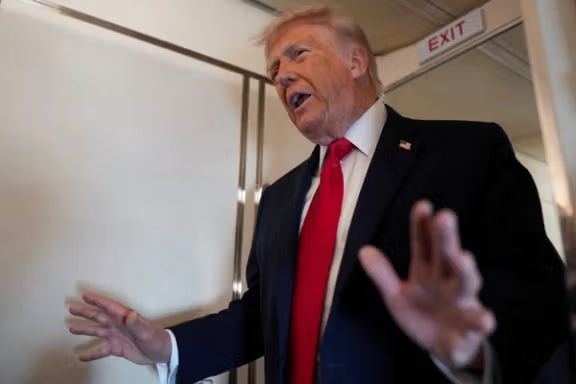
US President Donald Trump said Israeli Prime Minister Benjamin Netanyahu would have "no choice" but to accept an agreement with Iran, according to the Financial Times.
The comments follow reports that Trump has urged the Israeli premier not to retaliate after Iran's latest missile attack, underscoring Washington's determination to prevent further escalation while negotiations continue.
According to the report, asked what he would do if a potential deal with Iran failed "on its merits," President Donald Trump said he would consider a commando raid on Iran.






Former Israeli Prime Minister Naftali Bennett said Israel faces a test of whether it is “a sovereign state capable of defending itself,” urging a forceful response.
“Containment or a symbolic response will signal to our enemies that the blood of our citizens is permitted,” Bennett said, adding that Israel must act “with strength and effectiveness.”
He said all Israelis stand together on the issue.
The Israeli military said Iran is attempting to establish a new deterrence equation by launching direct attacks on Israeli territory in response to Israeli operations in Beirut's southern suburbs.
In a statement posted on X, the military said Tehran was seeking to impose "new rules" linking Israeli strikes in Lebanon to attacks on Israel.
"We will not allow this," the statement said.
It added that Israeli forces were operating forcefully on both offense and defense, while air defense systems remained deployed across the country.
“The Iranian strikes didn’t hurt anybody. Hopefully Israel is not going to retaliate. If Bibi strikes them back it’s just gonna keep going like the last 47 years, or the last 3000 years,” President Donald Trump told Axios.
"I’m going to call Bibi right now and tell him not to retaliate. Each of them had their fun. Israel had its strike and Iran had its strike. We don't need another one.”
"We are very close to a final deal with Iran. It is going to be a good deal. I don’t want it to blow up because of what is happening now,” he was quoted as saying.
Iran's Revolutionary Guards said they targeted Israel's Ramat David air base with ballistic missiles fired by the IRGC Aerospace Force.
The IRGC said the attack was a warning and that, if aggression is repeated, Iran's responses would be broader and include all US-Israeli targets in the region.
The IRGC added that Iran's acceptance of a ceasefire had been conditional on fire ending on all fronts, but that the United States and Israel had not adhered to their commitments.
The Trump administration's sanctions on Iran's largest cryptocurrency exchange mark an escalation in Washington's effort to disrupt the financial infrastructure Tehran uses to operate outside the formal banking system.
The US Treasury designated Nobitex alongside Wallex, Bitpin and Ramzinex and sanctioned senior figures connected to Nobitex, including chairman, co-founder and former chief executive Amir Hossein Rad.
According to the Treasury, Nobitex processed more than half of all Iranian digital asset inflows in 2025. Washington also accused it of facilitating transactions linked to the Islamic Revolutionary Guard Corps (IRGC), sanctions evasion, ransomware activity and the Central Bank of Iran's access to hundreds of millions of dollars in stablecoins.
The sanctions therefore struck at part of the infrastructure that has allowed Iranian individuals, companies and state-linked actors to access international digital asset markets despite years of financial restrictions.
Crypto vs sanctions
Iran's interest in cryptocurrency is not difficult to explain. Sanctions have sharply limited access to international banking networks, dollar transactions, trade finance and oil revenues. Digital assets do not eliminate these constraints but can provide alternative channels for moving value across borders.
Cryptocurrencies and stablecoins can help facilitate transactions, preserve value and maintain access to foreign markets. Stablecoins are particularly attractive because they reduce exposure to price volatility while still operating outside traditional correspondent banking networks.
Crypto mining has also become part of Iran's sanctions-evasion toolkit. By using subsidized electricity to mine Bitcoin, Iran can effectively convert domestic energy resources into a globally transferable digital asset.
The strategy comes with costs. Mining places additional strain on Iran's electricity grid and has been linked to power shortages and public frustration. Yet for a sanctioned economy, the logic remains compelling: when access to conventional finance is restricted, any mechanism capable of transforming local resources into internationally usable value becomes strategically important.
Hormuz and crypto
Cryptocurrency has also emerged in discussions surrounding the Strait of Hormuz, one of the world's most important energy chokepoints.
Chainalysis reported recently that Iran intended to demand cryptocurrency payments from oil tankers seeking safe passage through the strait during periods of heightened tension. Whether such plans were fully implemented is less important than what they reveal about the potential role of digital assets in future geopolitical confrontations.
For Tehran, cryptocurrency offers several advantages in such scenarios. Payments can move rapidly across borders, avoid some traditional banking restrictions and reduce exposure to frozen accounts or conventional financial controls.
The prospect of crypto-based payments linked to maritime security demonstrates how digital assets could potentially be used not only to move money quietly but also to generate revenue during periods of geopolitical crisis.
The US Treasury has warned of sanctions risks associated with Iranian demands for transit-related payments through the Strait of Hormuz, including payments made through digital assets, fiat currency, offsets, swaps or other arrangements.
Blockchain evasion limits
Despite its advantages, cryptocurrency is not a magic shield against sanctions.
Blockchain transactions often leave traces that can be analyzed by firms such as Chainalysis and Elliptic or by government financial-intelligence agencies.
Once the United States designates a platform such as Nobitex, international exchanges, liquidity providers and counterparties face increased risks if they continue interacting with Iranian-linked wallets. This pushes activity toward smaller, less liquid and often riskier channels.
The sanctions also highlight another vulnerability. Treasury officials noted that Nobitex suffered a major hack in June 2025, underscoring the risks associated with relying on digital financial infrastructure.
Another area of interest is the role of the IRGC, which under Iran's previous budget law was tasked with exporting roughly 700,000 barrels of crude oil per day—about half of the country's exports at the time. The organization is also one of Iran's largest infrastructure contractors.
While available data do not reveal where imported services originated or who ultimately benefited from them, the overlap illustrates the growing importance of non-traditional financial channels within Iran's sanctioned economy.
Iran is likely to adapt. Activity may shift toward peer-to-peer trading, decentralized platforms, foreign intermediaries, stablecoin networks or new domestic exchanges. Yet each alternative carries costs, whether through reduced liquidity, greater compliance risks or increased exposure to future sanctions.
For Washington, the challenge is sustained enforcement. Sanctioning Nobitex will matter most if it is accompanied by international cooperation, improved blockchain intelligence, pressure on foreign exchanges and clear guidance for shipping firms, insurers and commodity traders.
The United States does not need to stop every Iranian crypto transaction to have an effect. It only needs to make the system more expensive, more traceable, riskier and less attractive for counterparties.
The Nobitex case illustrates how financial warfare has moved from banks to blockchains. Digital assets have given Tehran greater flexibility under sanctions, but they have also created new vulnerabilities.
The more Iran relies on crypto infrastructure, the more that infrastructure becomes part of the sanctions battlefield.