Iran political prisoner thanks exiled princess for rights advocacy

Reza Mohammadhosseini, a monarchist political prisoner held in Ghezel Hesar Prison in Iran’s Alborz province, thanked exiled Iranian princess Noor Pahlavi for her human rights advocacy and for carrying Iranians’ voices to the world.
“From behind the cold, high walls of Ghezel Hesar Prison — where for years I have watched the sky through the bars — the words of Princess Noor Pahlavi reached me from thousands of kilometers away; yet they were so bound to the pain, the suffering, and the aspirations of the people of Iran that it was as if they had risen from these very cells,” Mohammadhosseini wrote, according to the statement by exiled Prince Reza Pahlavi’s office.
Mohammadhosseini cited Noor Pahlavi’s speech in Oslo as a reminder that “the voice of the people of Iran is still being heard” and said the struggle for freedom, justice and human rights had no borders.
He called for the release of political prisoners and said many people in Iran were held “solely for the crime of thinking, writing, protesting, and demanding their human rights.”
"Today, more than ever, Iran needs global solidarity in defense of human dignity,” he wrote.
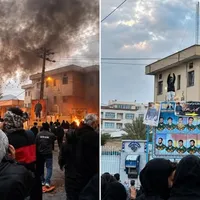


Security forces opened fire on protesters, blocked medical aid and secretly removed bodies as they crushed demonstrations in Rasht, northern Iran, during January’s nationwide uprising, eyewitness accounts and documents sent to Iran International show.
Witnesses described security forces shooting at protesters, blocking aid to the wounded, demanding money from families before returning bodies, and pressuring relatives to hold secret burials and avoid public ceremonies.
The new accounts add to an Iran International public documentation campaign that has gathered testimony saying protesters in Rasht were driven into narrow market passages, trapped as fire spread and fired upon by security forces during January’s unrest.
The morning of Jan 9: a city in smoke, blood and fire
One eyewitness told Iran International that around 5 a.m. on January 9, heavy smoke and fire were still rising in the municipality area of Rasht.
The witness said streets leading to the municipality, including Namjoo Street, Imam Street, Shahrdari Street and the route from the bazaar toward Saqlan Square, were badly damaged and parts of the city had burned.
“On the morning of January 9, the city smelled of smoke. Traces of blood were clearly visible on Shahrdari and Saadi streets. The bloody handprints of protesters were on the city walls. Basijis in Sabzeh Meydan Square were busy erasing slogans with spray paint, and large parts of the bazaar had completely burned,” the witness said.
Bodies moved in pickup trucks and garbage trucks
An eyewitness told Iran International that on the morning of January 9, several municipal pickup trucks left Shahrdari Street, and the bodies of some of those killed were in the back of one vehicle, covered with cloth.
Iran International has also received multiple reports indicating that the bodies of some of those killed in Rasht were collected with garbage trucks and secretly transferred.
Witnesses said some wounded people were also among the bodies transferred to Bagh-e Rezvan cemetery in Rasht.
A source said one wounded person who had been transferred to Bagh-e Rezvan along with the bodies managed to escape and hid for a while in a nearby forest.
Transfer of bodies to an unmarked warehouse
New information received by Iran International shows that on January 8 and 9, the bodies of some of those killed in Rasht were transferred to a warehouse on Tehran Road, between Bagh-e Rezvan and Saravan.
The warehouse was painted red, white and green and had no specific sign or official marking.
The bodies were kept there temporarily before burial or transfer to other locations.
Witnesses describe DShK machine gun fire on protesters
Witnesses told Iran International that security forces used heavy weapons including DShK machine guns against people who had entered parts of the city’s military areas.
According to the accounts, the area around the Rasht governor’s office was one of the main sites where protesters were killed on January 8 and 9.
One eyewitness said Basij and Revolutionary Guards forces directed the crowd toward the governor’s office, placing protesters on a route where their ability to leave or retreat was limited.
The witnesses said armed forces shot at people after the gates of the governor’s office were opened.
The accounts indicated that the crackdown in Rasht was not limited to streets around the municipality, the bazaar, Namjoo Street and Sajjad Clinic, and that the area around the governor’s office was also a key site of shootings and killings.
Families told to pay for slain protesters’ bodies
Sources told Iran International that slain protesters' families faced severe security pressure.
Some families were asked to pay money to receive the bodies of their children, with the amount depending on the family’s financial situation, according to the accounts.
Some families were asked for several billion rials, equivalent to several thousand dollars, and in some cases more than 10 billion rials, or over $5,700 at the open-market rate, the sources said.
An eyewitness said one family was told to bring a box of sweets along with the payment before they could receive their loved one’s body.
The witness said the request was part of a humiliating process of dealing with the survivors.
Families forced into secret night burials
Witnesses told Iran International that the families of some slain protesters were not allowed to wash their loved ones’ bodies, a standard Islamic burial rite performed before burial.
One eyewitness said security agents told a family the victims were “ritually impure” and had to be buried as they were, bloodied and still in their clothes.
According to witness accounts, burials were often carried out late at night or near dawn, with a limited number of family members present and under pressure from security forces.
The burial place of many of the victims is in the far sections of Bagh-e Rezvan in Rasht.
Families said they were repeatedly humiliated and threatened while receiving and burying the bodies.
Iran’s Supreme Court has upheld death sentences against five political prisoners held in Sheiban Prison in Ahvaz, in southwest Iran, the Karun Human Rights Organization said.
The rights group said the five prisoners were at imminent risk of execution after trials it said were marked by denial of access to independent lawyers, violations of defendants’ rights and reliance on “forced confessions.”
The group named the prisoners as Masoud Jamei, Alireza Mordasi, also known as Hamidavi, Farshad Etemadi-Far, Hassan Mosallavi (Torfi), and Reza Abdali, also known as Daghaghleh.
It said Jamei, Mordasi and Etemadi-Far were tried last year on charges including “corruption on earth,” “membership in rebel groups opposed to the Islamic Republic,” “propaganda against the system” and “assembly and collusion.”
Mosallavi, a 38-year-old Arab civil and cultural activist detained since 2022, was sentenced to death in absentia on charges of “waging war against God” and “membership in Arab groups opposed to the Islamic Republic,” the organization said.
Abdali, a 35-year-old political prisoner, was given a death sentence and a 15-year prison term on a charge of “contact with organizations outside the country,” the group said.
The Karun Human Rights Organization called for urgent international action to stop the executions.
A British couple imprisoned in Tehran’s Evin prison remain on hunger strike over access restrictions, raising health concerns as one of them is now barely able to walk, sources familiar with the matter told Iran International.
Lindsay Foreman and Craig Foreman were arrested in January 2025 while traveling through Iran during an around-the-world motorcycle trip.
They were later sentenced to 10 years in prison on espionage charges after Iranian authorities accused them of gathering information in several parts of the country, allegations they deny.
The couple lost their appeal against the sentence earlier this week, Reuters reported, citing their family.
The Foremans are being held in separate wings of Tehran’s Evin prison, which rights groups have long criticized over alleged torture and inhumane conditions.
The couple began a strike after being denied phone calls, visits with each other and meetings with their lawyer following an interview with the BBC World Service.
Health concerns grow as hunger strike continues
Prison officials have exerted various forms of pressure on the two detainees in recent weeks to force them to end their hunger strike, a source familiar with their condition told Iran International.
The source said both prisoners had lost a significant amount of weight and that the prison deputy had visited their wards only once during that period.
Lindsay Foreman is now barely able to walk after nearly three weeks on hunger strike, the source added.
The head of Evin prison has stopped nurses from entering the women’s ward, where nurses had previously been present regularly, the source said. As a result, Lindsay Foreman’s blood pressure has not been measured or recorded for about a week.
In recent days, Lindsay Foreman’s cellmates obtained a blood pressure monitor from the guard officer after protesting and following up on her condition, and measured her blood pressure at 8 over 5, according to the source, who is familiar with the situation of political prisoners in Evin.
Her transfer to the infirmary was also difficult because she had to be carried up about 30 steps to reach it, the source said. Despite her condition, prison officials refused to record her medical status or provide the necessary care and returned her to the ward.
The source also said officials had refused in recent weeks to allow Lindsay Foreman to receive glasses, vitamin tablets and some hygiene items she needed, measures the source said are usually approved after some time even in similar cases.
A source close to the family of one prisoner held in Evin told Iran International that one of Lindsay Foreman’s cellmates quoted her as saying: “We only spoke about the conditions we live in; about the executions we see and hear about, and the names of those announced every day. This is the reality of our lives. Now, because we said what is happening, we have been denied phone calls and visits, while we are far from our families and children. We did not say anything new; we only recounted what is happening every day in Iran.”
The source added that Craig Foreman, explaining the reasons for his hunger strike to his cellmates, said: “In addition to being denied calls and visits, many of my cellmates have been taken away in recent months for their execution sentences to be carried out and never returned. Five people have been executed from the room where I am being held alone.”
High school students in about 20 Iranian provinces have held protests against education policies, final exam rules and changes affecting the national university entrance exam, with some gatherings met by violence and arrests.
The protests, which began in late May in western and central Iran, initially focused on how final exams were being held. They later grew into a broader demand to cancel the fixed impact of 11th-grade GPA scores on the national university entrance exam, or at least change it to a positive-only effect.
Students have protested in West Azarbaijan, Isfahan, Tehran, Chaharmahal and Bakhtiari, Razavi Khorasan, North Khorasan, Khuzestan, Zanjan, Sistan and Baluchestan, Fars, Qazvin, Qom, Kohgiluyeh and Boyer-Ahmad, Gilan, Lorestan, Mazandaran, Markazi and Yazd provinces.
In Yazd, several students were injured during clashes at a protest. In Qom, at least one person was arrested. In Saveh, education department staff clashed with protesters.
Students in Shahrekord, Chaharmahal and Bakhtiari province, gathered on Saturday alongside students in other provinces and chanted against education policies, including: “Student, cry out! demand your rights” and “Incompetent official we don’t want you.”
A video sent to Iran International showed students in Tehran gathering outside the Supreme Council of the Cultural Revolution to protest its decisions on the university entrance exam. They chanted: “Justice, education, our undeniable right.”
Earlier in June, students in Khorramabad gathered outside Lorestan’s education department and demanded transparency over the holding of exams. Similar gatherings were reported in Arak and Isfahan, where students protested in-person exams and poor educational conditions.
The protests reached a peak this week in Tehran, when a group of 11th- and 12th-grade students gathered outside the Ministry of Education to oppose the fixed impact of 11th-grade GPA scores on university entrance results.
Students held banners reading “Hear the voice of Iran’s students” and demanded that the policy be scrapped or changed to a positive-only effect.
Dozens of students have sent messages to Iran International criticizing uncertainty in education policy, saying repeated changes to exam and entrance rules have placed heavy psychological pressure on them.
They say the current generation of university applicants has already faced school closures, online education, social crises and repeated changes to education rules, and should not be harmed again by another shift in entrance exam policy.
Qatar strongly condemned repeated Iranian attacks on Kuwait and Bahrain, calling them a flagrant violation of the two countries’ sovereignty and a clear breach of international law.
In a statement, Qatar’s Foreign Ministry said the region must be spared the consequences of what it called unjustified attacks, and called for de-escalation to restore regional and international security and stability.
The United Arab Emirates also condemned what it called Iranian “terrorist attacks” on Bahrain with missiles and drones.
The UAE Foreign Ministry said the attacks represented a clear violation of Bahrain’s sovereignty and a threat to its security and stability.
It expressed full solidarity with Bahrain and said Abu Dhabi supported all measures aimed at preserving the country’s security and stability.


