• العربية
  • فارسی
Brand
  • Iran Insight
  • Politics
  • Economy
  • Analysis
  • Special Report
  • Opinion
  • Podcast
  • Iran Insight
  • Politics
  • Economy
  • Analysis
  • Special Report
  • Opinion
  • Podcast
  • Theme
  • Language
    • العربية
    • فارسی
  • Iran Insight
  • Politics
  • Economy
  • Analysis
  • Special Report
  • Opinion
  • Podcast
All rights reserved for Volant Media UK Limited
volant media logo

Oman says no plans to charge ships in Hormuz

Apr 8, 2026, 10:20 GMT+1

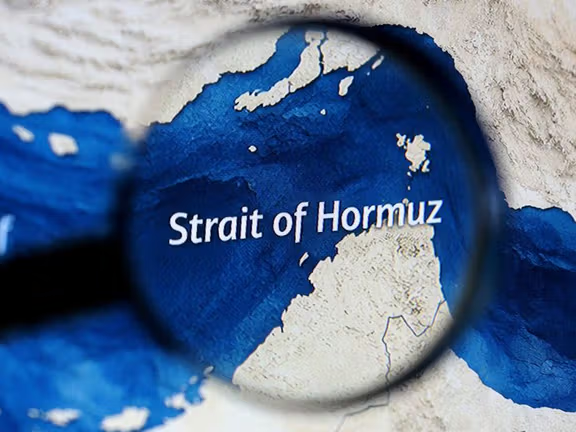
Oman’s transport minister said the country would not impose fees on ships transiting the Strait of Hormuz, after reports that Iran and Oman could charge vessels during a ceasefire period.

The minister said Oman had signed agreements that prohibit charging ships passing through the waterway.

Under the two-week ceasefire plan, both Iran and Oman could be allowed to charge fees on ships transiting the strait, according to a regional official, with Iran expected to use the funds for reconstruction, while the strait has historically been treated as an international waterway without transit fees.

Most Viewed

The Hormuz get out of jail card turned to a grave
1
OPINION

The Hormuz get out of jail card turned to a grave

2

State media slam Araghchi's Hormuz tweet, say it let Trump claim victory

3
INSIGHT

100 days after carnage: Iran economy reels from war, inflation, unemployment

4
INSIGHT

How Tehran bends its own red lines to boost state rallies

5
PODCAST

Too early to tell who is winning Iran war, experts say

Banner
Banner

Spotlight

  • A nation in limbo: 100 days after the massacre, has the world moved on?
    INSIGHT

    A nation in limbo: 100 days after the massacre, has the world moved on?

  • 100 days after carnage: Iran economy reels from war, inflation, unemployment
    INSIGHT

    100 days after carnage: Iran economy reels from war, inflation, unemployment

  • The Hormuz get out of jail card turned to a grave
    OPINION

    The Hormuz get out of jail card turned to a grave

  • Too early to tell who is winning Iran war, experts say
    PODCAST

    Too early to tell who is winning Iran war, experts say

  • How Tehran bends its own red lines to boost state rallies
    INSIGHT

    How Tehran bends its own red lines to boost state rallies

  • Iran blackout cripples freelancer, small business incomes
    VOICES FROM IRAN

    Iran blackout cripples freelancer, small business incomes

•
•
•

More Stories

Zelenskyy backs Middle East ceasefire, calls for end to Russia war

Apr 8, 2026, 09:58 GMT+1

Ukrainian President Volodymyr Zelenskyy voiced support for the ceasefire in the Middle East on Wednesday, calling for a ceasefire in Russia’s war on Ukraine.

“Ukraine has always called for a ceasefire in the war waged by Russia here in Europe against our state and our people,” he wrote on X.

Zelenskyy said the United States had taken an important diplomatic step and added that Ukrainian military expert teams would continue working in the region to help strengthen security capabilities.

The Ukrainian president said a ceasefire saves lives, halts the destruction of cities and villages, and allows power plants and other infrastructure to function normally.

Oil drops, stocks rally after US-Iran ceasefire eases supply fears

Apr 8, 2026, 09:44 GMT+1

Oil prices fell sharply and global stocks rallied after the United States and Iran agreed to a two-week ceasefire, easing concerns over disruptions to energy supplies.

Brent crude dropped about 15% to below $95 a barrel after Tehran said it would allow ships two weeks of safe passage through the Strait of Hormuz, a key route for global oil flows, the Financial Times reported.

Europe’s STOXX Europe 600 rose nearly 4%, while Germany’s DAX gained 5% and London’s FTSE 100 climbed 3%.

Asian shares also advanced, while US markets were set to open higher. US Treasuries rose as investors reacted to the easing of tensions.

India, Turkey welcome US-Iran ceasefire, back talks and Hormuz access

Apr 8, 2026, 09:20 GMT+1

India and Turkey welcomed the ceasefire between the United States and Iran on Wednesday, calling for de-escalation and renewed diplomacy.

India said it hoped for the free flow of commerce through the Strait of Hormuz, while Turkey said it would support negotiations set to take place in Islamabad.

Both countries stressed the need for the ceasefire to be fully implemented and for all sides to adhere to the agreement.

Macron says 15 countries working to restore Hormuz traffic after US-Iran ceasefire

Apr 8, 2026, 09:07 GMT+1

Emmanuel Macron said on Wednesday about 15 countries were working to help resume shipping through the Strait of Hormuz after a ceasefire between the United States and Iran.

“About 15 countries are currently mobilized… to enable the implementation of this strictly defensive mission … to facilitate the resumption of traffic,” Macron said.

He said the effort was being coordinated with Iran and led by France.

Hardline Kayhan editor says US cannot be trusted, calls truce ‘gift to enemy’

Apr 8, 2026, 09:01 GMT+1

Hossein Shariatmadari, editor-in-chief of the hardline Kayhan newspaper, argued that any temporary ceasefire or negotiation with the United States would only help Washington recover and prepare for further attacks, and said Iran should not release pressure on an enemy he described as weakened and desperate.

Writing in Kayhan, Shariatmadari said even if the other side accepted all of Iran’s reported conditions, there was no reason to believe the United States would honor them.

He argued that the conflict with Washington was not over specific events but over the Islamic Republic’s very existence, and said the confrontation could end only if either Iran surrendered to the US-led order or that order changed its nature.

He said expecting the United States to abandon hostility after a ceasefire was “unreasonable” and “naive,” and argued that any pause in fighting would simply give the enemy time to rebuild.

He also said that talk of a truce could weaken public unity, encourage divisions among officials and embolden what he described as compromise-seeking currents inside Iran.

“A ceasefire, compromise and negotiation are a gift to the enemy,” he wrote.

Shariatmadari also said the enemy should not be released from pressure while it was, in his words, “out of breath,” and framed the continuation of the war as tied not only to strategy but also to vengeance for those killed, especially the slain supreme leader.