Iran stays under internet blackout a month after shutdown, NetBlocks says
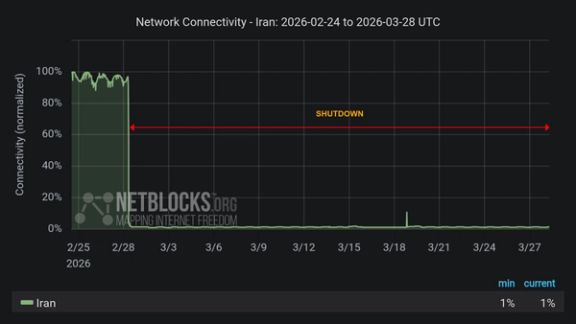

Iran remained under a nationwide internet blackout on Saturday, four weeks after authorities cut access to the global internet on February 28, internet monitoring group NetBlocks said.
NetBlocks said the disruption had reached 672 hours, with the blackout still in effect at the end of its fourth full week.
"After four full weeks, 672 hours, the blackout remains in effect, violating Iranians' right to communicate and stay informed," the internet monitoring group said.







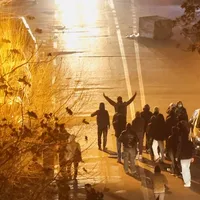
More than 40 explosions were heard across Isfahan early on Saturday and parts of an artillery facility on Artesh Street were hit, according to eyewitness accounts sent to Iran International.
Widespread attacks and multiple explosions were reported across the city from about 1:30 a.m.
At least two fighter jets were heard at 1:40 a.m., followed by several heavy explosions in different areas, including the southwest of the city.
Targets in military areas in Farahabad were hit at about 2:10 a.m., with aircraft reported flying at low altitude.
In Shahreza, south of Isfahan, fighter jets were heard at about 6:30 a.m., followed by an explosion and black smoke rising near the Tharallah military base.
Iran-aligned Houthis in Yemen said on Saturday they had launched an attack on Israel amid the Iran war.
The Houthis said they launched a barrage of missiles in response to continued strikes on Iran, Lebanon, Iraq, and the Palestinian territories.
They added their operations would continue until "aggression" across multiple fronts ends.
The announcement marks the group’s formal entry into the conflict, raising concerns about a broader regional escalation involving Iran-aligned forces.
Israel’s military earlier said it was working to intercept a missile fired from Yemen.
Iran-aligned Houthis in Yemen said on Saturday they had launched an attack on Israel amid the Iran war.
The Houthis said they launched a barrage of missiles in response to continued strikes on Iran, Lebanon, Iraq, and the Palestinian territories.
They added their operations would continue until "aggression" across multiple fronts ends.
The announcement marks the group’s formal entry into the conflict, raising concerns about a broader regional escalation involving Iran-aligned forces.
Israel’s military earlier said it was working to intercept a missile fired from Yemen.
More than 50 Israeli warplanes struck weapons production sites and facilities tied to Iran’s nuclear program in three areas of Iran on Friday, the Israeli military said on Saturday.
The strikes, carried out with intelligence guidance, included sites in Arak and Yazd and unfolded in three waves over several hours, the Israel Defense Forces said.
Among the targets were a military industry site used to make different weapons, a Defense Ministry site used to develop advanced explosive devices, and a facility producing components for ballistic missiles and anti-aircraft missiles, it said.
The military said the attacks were carried out alongside a strike on the heavy water facility in Arak, which it described as a key part of plutonium production for nuclear weapons, and on a plant in Yazd used to make explosive materials needed in uranium enrichment.
A lawmaker said a fast-tracked bill proposing Iran’s exit from the Nuclear Non-Proliferation Treaty and a shift in nuclear policy has been submitted to parliament’s legislative body.
The proposal includes three measures: withdrawal from the NPT, repeal of a law governing Iran’s commitments under the nuclear deal, and support for a new international pact with aligned countries on developing peaceful nuclear technology, Malek Shariati said Saturday.
The remarks come as parliament has not convened since the start of joint Israeli and US strikes on Iran, with no clarity on when sessions will resume.