Putin says Iran war could have impact similar to Covid pandemic
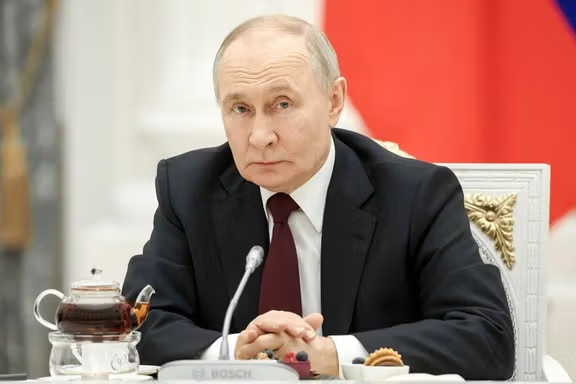

Russian President Vladimir Putin said on Thursday the consequences of the Iran war could be comparable to those of the Covid pandemic.
“The consequences of the conflict in the Middle East are still difficult to accurately predict,” Putin said, adding that some estimates suggest they “can be compared with the coronavirus epidemic.”
He said the conflict was already disrupting global supply chains and putting pressure on energy, metals and fertilizer sectors.




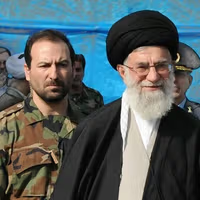

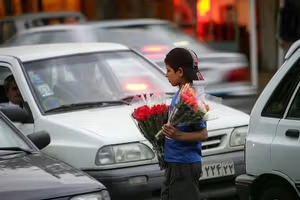
An official from Iran’s Revolutionary Guards said the minimum age for participation in war-related support roles has been lowered to 12, according to remarks aired on state media.
Rahim Nadali, a cultural official with the Guards in Tehran, said an initiative called “For Iran” was recruiting participants to assist with activities such as patrols, checkpoints and logistics.
“Given that the age of those coming forward has dropped and they are asking to take part, we lowered the minimum age to 12,” he said, adding that 12- and 13-year-olds could now take part if they wished.
The comments were broadcast as part of state media coverage of the war effort.
The announcement has revived concerns over the use of minors in security-related roles in Iran.
During the 2022 protests triggered by the death of Mahsa Amini, images shared on social media appeared to show children and teenagers in military-style uniforms and protective gear, drawing criticism from child rights advocates.
The move comes despite Iran’s commitments under the Convention on the Rights of the Child, which prohibits the use of children in military activities.
Human rights groups have also repeatedly accused Iranian authorities of killing child protesters during past crackdowns. The Center for Human Rights in Iran said security forces killed more than 200 children during a wave of protests in early 2026.
Amnesty International and Human Rights Watch have also documented cases of children being shot, detained and abused during demonstrations, saying government forces have used lethal force against minors in violation of international law.
Iranian police said on Thursday they had blocked 61 bank accounts belonging to users of Starlink satellite internet in the central city of Yazd, as part of a broader crackdown on unauthorized connectivity.
A local police commander said six Starlink devices were seized and six people detained following searches carried out with judicial approval.
Authorities accused the suspects of trading access to the service, sharing information with foreign-based outlets and engaging in activities deemed hostile. The individuals were referred to prosecutors, police said.
The move comes amid a broader wave of arrests across Iran, with authorities detaining dozens in recent days on security-related charges, including alleged links to militant activity, contacts with foreign media and online activity. Officials have also reported seizing weapons, explosives and Starlink devices in multiple provinces.
Starlink is banned in Iran, where authorities have imposed a near-total internet blackout during the war. Monitoring group NetBlocks says connectivity has dropped to around 1% of normal levels, leaving satellite services among the few ways to access the global internet.
A local police commander said six Starlink devices were seized and six people detained following searches carried out with judicial approval.
Authorities accused the suspects of buying and selling access to the service, sharing information with foreign-based outlets and using the network for what they described as hostile purposes. The individuals were referred to prosecutors, police said.
Iran should withdraw from the nuclear Non-Proliferation Treaty (NPT), IRGC-affiliated Tasnim news agency said on Thursday.
“Iran must leave this treaty as soon as possible,” Tasnim said, arguing that membership had brought no benefit and instead enabled the United States and Israel to gather intelligence on its nuclear program.
The outlet also accused the International Atomic Energy Agency of facilitating access to information used in attacks on Iranian facilities and said Tehran should exit the treaty while continuing its stated pursuit of "peaceful nuclear energy."
GCC Secretary General Jasem al-Budaiwi said on Thursday that the member states want to be involved in any talks between the United States and Iran.
He said in a televised speech that including the Arab states of the Persian Gulf in any agreement was necessary to strengthen security and stability.
“We emphasize the necessity of involving the GCC countries in any talks or agreements to resolve this crisis, in a way that contributes to strengthening their security and stability,” he said.
Al-Budaiwi also pointed to reports that Tehran made vessels pay transit fees to cross the Strait of Hormuz and Iran’s attacks on civilian sites as well as
“Iran directed more than 85 percent of its attacks at Gulf countries,” al-Budaiwi said. “Iran targeted hotels, embassies, water facilities, and airports, striking civilian sites and resulting in civilian deaths.”