Iran says Hormuz ‘not closed,’ ships hesitate over war risks
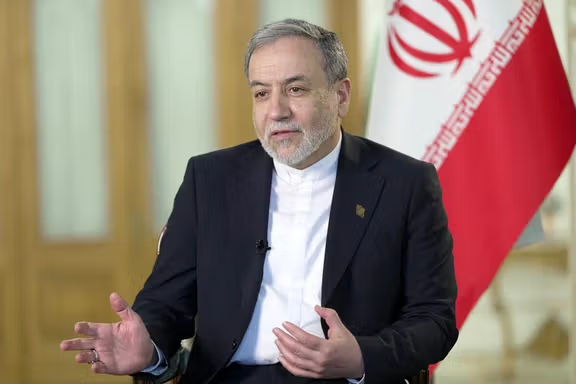

Iran’s foreign minister Abbas Araghchi said on Sunday that commercial shipping through the Strait of Hormuz has slowed because insurers are wary of the conflict, blaming the United States for creating the conditions that have unsettled maritime traffic.
“The Strait of Hormuz is not closed,” Araghchi wrote on X. “Ships hesitate because insurers fear the war of choice you initiated—not Iran.”
“Freedom of Navigation cannot exist without Freedom of Trade. Respect both—or expect neither,” he added. “No insurer—and no Iranian—will be swayed by more threats. Try respect.”





The Dubai Financial Market (DFM) General Index has fallen sharply since the start of hostilities, Reuters reported on Sunday.
After closing at 6,503.50 on Feb. 27, the day before military action against Iran began, the index dropped to 5,550.24 by March 18, the last trading day before the Eid al-Fitr holiday — a decline of about 14.7 percent.
Property transactions have cooled markedly, with Dubai Land Department data showing deals falling from 9,029 in the second half of February to 6,541 in the first two weeks of March, a drop of 27.6 percent.
UAE foreign minister and deputy prime minister Sheikh Abdullah bin Zayed Al Nahyan said the country would not be “blackmailed by terrorists” in a post on X on Sunday, responding to criticism of remarks by UAE presidential adviser Anwar Gargash.
“We will never be blackmailed by terrorists,” Abdullah bin Zayed said.
His comment came in reply to former French ambassador Gérard Araud, who criticized Gargash’s remarks on Iran’s attacks and the strengthening of security partnerships with Washington.
UAE presidential adviser Anwar Gargash said efforts should go beyond a ceasefire to ensure long-term regional security and address threats from Iran.
“Our thinking does not stop at a ceasefire," Gargash said in a post on X.
He said the focus should instead be on solutions that ensure sustainable security in the Persian Gulf, and curb Iran's "nuclear threat, missiles, drones, and the intimidation of maritime straits."
"It is not reasonable for aggression to turn into a permanent state of threat," he added.
France’s president Emmanuel Macron said on Sunday in a call with Saudi Crown Prince Mohammed bin Salman that all parties should halt attacks on energy and civilian infrastructure and that Iran should reopen the Strait of Hormuz.
“It is more essential than ever that all parties … agree to establish a moratorium on energy and civilian infrastructure and that Iran restore freedom of navigation in the Strait of Hormuz,” Macron said in a post on X
He warned of the risk of uncontrolled escalation and called for restraint to allow a return to dialogue.
Macron added that France stands ready to support Saudi Arabia’s air defense and said the G7 and the Gulf Cooperation Council (GCC) should strengthen coordination.
US President Donald Trump said his ultimatum to Iran to reopen the Strait of Hormuz or face strikes on its power plants would “work very well,” in an interview with Israel’s Channel 13.
“You will soon see what will happen with the ultimatum on the power plants — the result will be very good,” Trump said.
“There will be total destruction of Iran and it’s going to work very well,” he added.
Trump also criticized NATO countries, saying they are “not doing anything” and that Iran is now receiving “the punishment it deserves.”