Iran internet blackout enters 23rd day, NetBlocks says
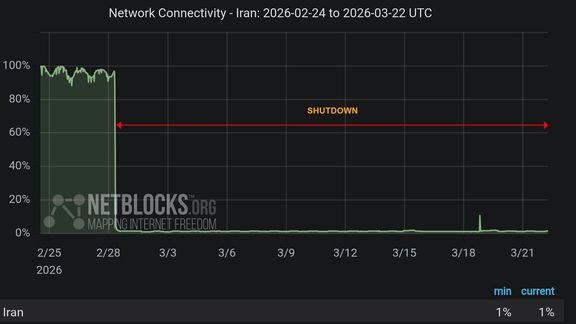

Iran’s internet blackout has entered its 23rd day, leaving the country isolated from the outside world for more than 528 hours, internet monitoring group NetBlocks said.
The group said the state-imposed shutdown, now in its fourth week, is adding to the wartime strain on millions of civilians who lack access to independent information and alerts.






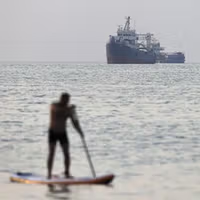
An Iranian lawmaker said the Islamic Republic is charging some vessels $2 million to pass through the Strait of Hormuz, describing it as the start of a new approach to control over the waterway.
Alaeddin Boroujerdi, a member of parliament’s national security committee, said the measure has already been implemented and reflects what he called a new “sovereign regime” in the strait after decades.
“Now, because war has costs, naturally we must do this and take transit fees from ships passing through the Strait of Hormuz,” he said, adding the move shows the Islamic Republic’s “authority.”
Boroujerdi also referred to Donald Trump’s warning that the United States could target Iran’s power infrastructure if the strait is not reopened within 48 hours, saying Israel’s energy infrastructure would be within Iran’s reach and could be destroyed “within a day.”
After Donald Trump gave the Islamic Republic 48 hours to reopen the Strait of Hormuz and warned Iranian power plants could be targeted, Mehr news agency threatened that even a limited strike on Iran’s electricity infrastructure would plunge the entire region into darkness.
The outlet wrote, “Say goodbye to electricity,” and said that “with the smallest attack” on the Islamic Republic’s power infrastructure, “the entire region will fall into darkness.”
Mehr also published a map marking major power plants across countries on the Persian Gulf, including sites in the UAE, Saudi Arabia, Qatar and Kuwait, and said 70% to 80% of the region’s major power plants are built along the Persian Gulf coastline and are within range of Iranian missiles.
After Donald Trump gave the Islamic Republic 48 hours to reopen the Strait of Hormuz, Iran’s permanent representative to the International Maritime Organization said the waterway remains open to all except what he called Iran’s “enemies.”
Ali Mousavi said ships can pass through the strait if security and safety arrangements are coordinated with Iranian authorities, adding that Tehran is ready to work with the International Maritime Organization and other countries to improve maritime safety and protect seafarers in the Persian Gulf.
“Diplomacy remains Iran’s priority,” Mousavi said, but added that a “complete cessation of aggression” and “mutual trust and confidence” were more important.
He added that US and Israeli attacks on Iran were at the “root of the current situation in the Strait of Hormuz.”
A Japanese national detained in Iran last year has been released and is returning home, Foreign Minister Toshimitsu Motegi said, adding that another Japanese citizen remains in custody.
Motegi said the release followed repeated requests to Iranian Foreign Minister Abbas Araghchi and that efforts are ongoing to secure the release of the second detainee.
He did not identify either individual but said the released national had been held since 2025 and departed via Azerbaijan.
Witnesses reported early-morning strikes and air activity across several parts of Iran, including Chabahar, Ahvaz, Bushehr, Yazd and Rasht.
Messages sent to Iran International said fighter jets were heard over Chabahar around dawn, while repeated jet activity and several explosions were reported in Ahvaz later in the morning.
In Bushehr, residents reported multiple overnight explosions, followed by two more blasts near daybreak, one of them near a Revolutionary Guards site.
A missile base in Yazd was also reported bombed in the morning. In Rasht, an explosion was heard before dawn and electricity was briefly cut in some areas.