• العربية
  • فارسی
Brand
  • Iran Insight
  • Politics
  • Economy
  • Analysis
  • Special Report
  • Opinion
  • Podcast
  • Iran Insight
  • Politics
  • Economy
  • Analysis
  • Special Report
  • Opinion
  • Podcast
  • Theme
  • Language
    • العربية
    • فارسی
  • Iran Insight
  • Politics
  • Economy
  • Analysis
  • Special Report
  • Opinion
  • Podcast
All rights reserved for Volant Media UK Limited
volant media logo

Germany says Iran-linked threat level ‘very high’
Mar 21, 2026, 10:23 GMT+0Updated: 19:00 GMT+0

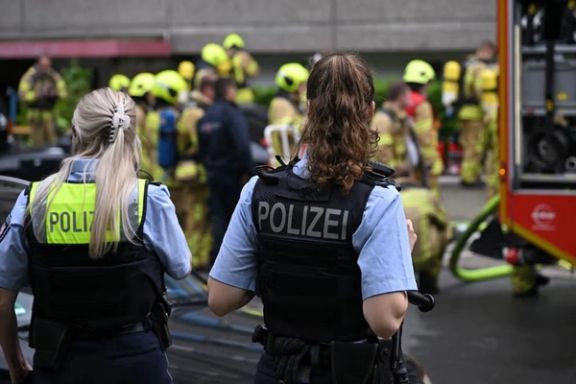
Germany’s Interior Ministry assessed the threat posed by the Islamic Republic and its operatives as “very high” and said security agencies are on full alert.

“The threat level from the Iranian government and its actors is assessed as very high, and we are on full alert,” a spokesperson for Germany’s Interior Ministry said in response to Iran International on Saturday.

Federal and state security agencies, the spokesperson said, have adjusted protective measures for Jewish communities and Israeli and Jewish institutions since October 7, 2023, when Hamas attacked Israel, strengthening them where necessary.

According to the ministry, German security bodies are continuously reassessing the threat environment, maintaining a heightened state of readiness, and adapting protective measures as needed.

Berlin flags transnational repression risks

German security agencies are in close coordination with each other, state authorities, and international partners, sharing intelligence on potential threats, the spokesperson said.

“There is also close cooperation between the federal government and the states on the issue of transnational repression,” the spokesperson added.

Monitoring, pressure, and targeting of opposition figures beyond national borders remain part of the activities of Iranian state actors, the spokesperson said.

Responding to threats by Iranian officials against Persian-language media, the spokesperson said the German government treats any activities by foreign state bodies or affiliated actors on its soil with utmost seriousness and does not tolerate them.

The Interior Ministry is working with security agencies and in coordination with the Foreign Ministry to counter transnational repression, according to the statement.

Shooting in Netherlands coincides with warning

The comments came as a 36-year-old Iranian man opposed to the Islamic Republic was shot and seriously wounded in the Netherlands on Thursday morning.

Information received by Iran International identified the man as Mohi Shafiei, a monarchist activist and a member of the Dutch police, who is currently hospitalized.

It remains unclear who carried out the attack.

Dutch prosecutors said “all possible scenarios” are being considered. The country’s justice minister said security measures had been taken in light of the officer’s background.

History of overseas targeting

The warning from Berlin comes after Mohsen Rafiqdoust, the first minister of the Islamic Revolutionary Guards Corps, said in March 2025 in an interview with the Didban Iran website that he had overseen operations targeting opponents abroad in the years following the 1979 revolution.

German newspaper Welt also reported in December 2025 that Iranian intelligence services had expanded pressure tactics into Germany by threatening the families of Iranian migrants inside Iran, coercing some exiles into cooperation.


Most Viewed

Iran diplomacy wobbles as factions compete to avoid looking soft on US
1
INSIGHT

Iran diplomacy wobbles as factions compete to avoid looking soft on US

2
ANALYSIS

The politics of pink: how Iran uses cuteness to rebrand violence

3

Scam messages seek crypto for ships’ safe passage through Hormuz, firm warns

4
EXCLUSIVE

Family told missing teen was alive, then received his body 60 days later

5
TEHRAN INSIDER

The future has been switched off here

Banner
Banner

Spotlight

  • Diplomacy tolls at Hormuz as conflict returns to its doorstep
    OPINION

    Diplomacy tolls at Hormuz as conflict returns to its doorstep

  • Opposition to US talks grows in Tehran as ceasefire deadline nears
    INSIGHT

    Opposition to US talks grows in Tehran as ceasefire deadline nears

  • Tehran moderates see ‘no deal–no war’ limbo as worst outcome
    INSIGHT

    Tehran moderates see ‘no deal–no war’ limbo as worst outcome

  • The future has been switched off here
    TEHRAN INSIDER

    The future has been switched off here

  • Lights out, then gunfire: Witnesses recount Mashhad protest crackdown
    VOICES FROM IRAN

    Lights out, then gunfire: Witnesses recount Mashhad protest crackdown

  • Is Iran entering its Gorbachev moment?
    INSIGHT

    Is Iran entering its Gorbachev moment?

  • Arms trade funded Iranian assassinations abroad, ex-IRGC minister says

    Arms trade funded Iranian assassinations abroad, ex-IRGC minister says

•
•
•

More Stories

South Pars strike stirs debate among Iranians over impact and intent

Mar 19, 2026, 12:31 GMT+0

Messages sent to Iran International and posts on social media showed a split reaction to Wednesday’s strike on Iran’s South Pars gas field, with some welcoming the hit on state-linked assets and others warning of civilian costs.

Messages sent to Iran International and posts on social media were divided over Wednesday’s strike on the South Pars gas field in southern Iran, with some welcoming the hit on state-linked assets and others warning of civilian costs.

US President Donald Trump said Israel had struck Iran’s South Pars gas field “out of anger” over developments in the Middle East, describing the damage as limited and warning there would be no further attacks unless Iran targeted Qatar again.

The strike marked a shift in a conflict that has spread across the Persian Gulf, disrupting energy flows after Iranian missiles targeted facilities in Qatar and Saudi Arabia.

  • Iran floats Hormuz transit tolls as Persian Gulf states warn of military response

    Iran floats Hormuz transit tolls as Persian Gulf states warn of military response

Strike seen as blow to state-linked networks

Some messages sent to Iran International framed the attack as a setback for institutions tied to the Islamic Revolutionary Guards Corps.

“Israel, by hitting South Pars, saved us from more theft… the money was turned into bullets fired at our children,” one citizen wrote.

Another, who said he had worked on projects in the field, downplayed the long-term impact.

“Even with the complete destruction of all 24 gas refineries… they will return to production in less than three months,” he wrote, adding that supply lines from offshore platforms would shut automatically and protect reserves.

A separate message from an engineer challenged concerns about offshore facilities.

“The platforms are not even fully operational because of sanctions… after the Islamic Republic, they can be rebuilt better,” he wrote, contrasting them with higher-quality installations on the Qatari side.

Others shifted the focus away from infrastructure entirely.

“The main infrastructure was the young people they took from us… the rest can be rebuilt with better technology.”

Social media posts echoed that line in sharper language. “Don’t worry about infrastructure,” one post read. “What infrastructure are you talking about? What life was left that needed infrastructure?” it added.

Concerns over civilian impact

Other messages cautioned that strikes on energy infrastructure would translate directly into hardship for civilians.

“Don’t look at infrastructure so simply,” one user wrote. “Lack of electricity and gas means death – cold, hunger, medicine shortages.”

Another post rejected attacks on non-military targets. “Hitting Iran’s infrastructure by any side is condemnable. It belongs to all Iranians,” the message read.

Some called for limiting strikes strictly to military-linked targets. “Please just hit those responsible and leave non-military infrastructure alone.”

One message also questioned the timing. “Hitting South Pars at this moment is not the last and best solution,” it read.

Back to corruption and rebuilding

Even among those critical of the strike, some framed the debate through long-standing economic grievances.

“If infrastructure belonged to the people, no one would be searching in trash for food.”

Another argued that damaged facilities could ultimately be replaced. “That worn-out infrastructure… will be rebuilt better – but those lives won’t return,” the user wrote referring to thousands of people killed during the January protests.

Others pointed to historical reconstruction. “Germany and Japan were flattened in World War II – where are they now?” one user said.

Across the exchanges, a recurring thread linked both support for and opposition to the strike back to mistrust of the Islamic Republic, with many portraying the country’s energy wealth as mismanaged or diverted, and arguing that any future recovery depends less on infrastructure than on political change.

Two men charged with spying for Iran targeting London Jewish community

Mar 19, 2026, 11:25 GMT+0

Two men have been charged with spying for Iran after allegedly carrying out surveillance of sites linked to London’s Jewish community, British police said on Wednesday.

Nematollah Shahsavani, 40, a dual British-Iranian national, and Alireza Farasati, 22, an Iranian national, were charged under the National Security Act with assisting a foreign intelligence service.

The Crown Prosecution Service said the charges relate to activities including “reconnaissance of targets” between July and August 2025.

Counter Terrorism Policing said the investigation focused on alleged surveillance of locations and individuals linked to the Jewish community in London.

Deputy Assistant Commissioner Vicki Evans described the charges as “extremely serious” and said police would be “relentless” in pursuing those who threaten public safety.

“We fully recognise that the public - and in particular the Jewish community - will be concerned, but I hope this investigation reassures them that we will not hesitate to take action,” she said.

The two men are due to appear at Westminster Magistrates’ Court on Thursday.

Iran executes Swedish citizen accused of spying for Israel, judiciary says

Mar 18, 2026, 08:17 GMT+0

Iran has executed a Swedish-Iranian man identified as Kourosh Keyvani after convicting him of espionage for Israel, according to reports by the judiciary-linked Mizan news agency.

Mizan said Keyvani was executed on Wednesday morning after his death sentence was upheld by the Supreme Court. He had been accused of passing “images and information of sensitive locations” to officers of Israel’s Mossad intelligence agency.

The report said Keyvani was arrested in Savojbolagh on the fourth day of the 12-day war in June. Authorities said the case had gone through legal procedures, but no independent evidence supporting the allegations was made public.

Later in the day, Swedish Foreign Minister Maria Malmer Stenergard said in a statement that a Swedish citizen was executed in Iran without naming him. However, it confirmed that the person was arrested in June.

The legal proceedings leading up to the execution did not meet the standards of due process, she added.

  • Sweden summons Iran envoy amid reports citizen faces death sentence

    Sweden summons Iran envoy amid reports citizen faces death sentence

The semi-official Tasnim news agency said Keyvani had been detained by the Revolutionary Guards’ intelligence arm and was found with cash, vehicles and what it described as advanced communication and surveillance equipment.

Tasnim also reported that he had allegedly been recruited through online contact and trained abroad before returning to Iran, though these claims could not be independently verified.

Keyvani is the latest in a series of executions in Iran involving individuals accused of espionage for Israel, particularly since the outbreak of the June war.

Iran has one of the highest execution rates in the world and has long used the death penalty in national security cases, including allegations of spying. Following the conflict, rights groups and international media have reported a sharp increase in arrests and executions on such charges.

The Telegraph reported that executions in Iran have surged since the June war, citing data from human rights group HRANA indicating that the number of executions has risen significantly, including for those accused of links to Israel. The Sunday Times has also reported that dozens more people could face execution on similar charges.

Son of FBI agent missing in Iran says US strikes are step toward justice

Mar 17, 2026, 14:14 GMT+0
•
Negar Mojtahedi

Daniel Levinson, son of retired FBI agent Robert Levinson who vanished in Iran over 19 years ago, says the US‑Israeli strikes could bring long‑delayed justice to his family and strengthen the fight for freedom against Tehran's oppressive regime.

Few Americans have been more entangled with the secretive world of Iran’s intelligence operations than the Levinson family.

Robert Levinson, a 22‑year FBI veteran who spent his career dismantling criminal networks and pursuing corrupt regimes, vanished in March 2007 after traveling to Kish Island for what was later revealed to be an unsanctioned CIA mission.

He had gone to meet a source as part of an investigation into corruption and money laundering when Iranian intelligence detained him.

Washington later concluded that Levinson likely died in Iranian custody, though his remains were never recovered. In 2020, the US Treasury Department sanctioned Iranian officials Mohammad Baseri and Ahmad Khazai for their roles in his disappearance.

Baseri’s name resurfaced this week when Iranian state media confirmed he was killed in the joint US‑Israeli airstrikes on Tehran that also hit Islamic Revolutionary Guard Corps (IRGC) sites and intelligence facilities.

Learning of Baseri’s death, Levinson said, felt like a long‑overdue turning point, matched in significance only by the death of Supreme Leader Ali Khamenei on first day of war.

“Khamenei had the power to free my dad at any point and chose not to. He knew what was happening and did nothing, so for our family, it’s been an emotional moment — but not one of grief.”

His father, he said, “was a patriotic American who always wanted to make sure justice was served — not just in the United States, but around the world.”

The recent strikes, he believes, “may finally hold some of those responsible accountable.”

Levinson has spent nearly twenty years seeking answers and helping other families do the same. He was instrumental in advancing the Robert Levinson Hostage Recovery and Hostage‑Taking Accountability Act, which strengthened US tools for responding to hostage situations abroad.

From those efforts, he’s come to see patterns in how authoritarian states operate — and how they collapse.

“There are people who know exactly what happened to my dad,” he said. As pressure mounts on the regime, “maybe some will defect or reveal the truth.

Iran’s armed forces are reportedly under heavy strain as the war intensifies.

"There’s still a 25 multimillion‑dollar US reward for information about his case.” The strikes, he said, could finally create the conditions where long‑hidden information emerges.

Although the family continues to grieve, Levinson said they also feel a renewed sense of purpose.

“Justice is coming,” he said. “We’re not going to forget. Those involved still have the chance to do the right thing.”

Levinson drew a stark contrast between Iran’s leaders and its citizens, saying that ordinary Iranians “are living under unimaginable tyranny” yet continue to fight bravely for their rights. Many, he said, “want freedom — and they look to America with hope.”

The Levinson family’s fight has transformed from a personal search for truth into a symbol of broader resistance against impunity.

“We’ve worked to protect his legacy and make sure what happened to him never happens to another American family,” Daniel said.

“Now, with the regime shaken and the world watching, maybe it’s finally time for justice — and for freedom for the Iranian people.”

Israel says Larijani, Basij chief killed in major blow to Iran leadership

Mar 17, 2026, 10:35 GMT+0

Israeli forces killed senior Iranian official Ali Larijani and IRGC-Basij commander Gholamreza Soleimani in overnight airstrikes inside Iran, Israel’s defense minister and military said on Tuesday, as Tehran has yet to confirm the deaths.

Defense Minister Israel Katz said Larijani had been killed in the strikes, while the Israeli military confirmed it targeted him in Tehran. The military separately said a strike killed Soleimani, head of the Basij paramilitary force, along with other senior officials.

Katz used stark language in comments released by his office after a security assessment.

“Larijani and the Basij commander were eliminated overnight and joined the head of the annihilation program, Khamenei, and all the eliminated members of the axis of evil, in the depths of hell,” Katz said.

The Israeli military said Soleimani was struck at a tent camp recently established by the Basij after earlier Israeli attacks damaged several headquarters used by the paramilitary organization.

According to the military, the strike also killed the deputy commander of the Basij and several other senior officials.

The Basij, which operates under the Islamic Revolutionary Guards Corps, has long been associated with the enforcement of ideological policies and the suppression of dissent inside Iran.

The reported killings mark one of the most significant decapitation strikes against Iran’s leadership structure since the outbreak of the current conflict.

Larijani: Insider and wartime power broker

Ali Ardashir Larijani, born on June 3, 1945 in Najaf, Iraq, rose to become one of the most influential figures in the Islamic Republic over four decades.

He came from a clerical family originally from Mazandaran province in northern Iran. His father, Hashem Larijani, was a cleric, and several of his brothers also held senior posts within the Iranian state.

Iran's former Secretary of the Supreme National Security Council Ali Larijani
100%
Iran's former Secretary of the Supreme National Security Council Ali Larijani

His political career began in the early years after the 1979 Islamic Revolution, when he joined the Islamic Revolutionary Guards Corps and later moved into government posts.

Larijani served as deputy labor minister and later as deputy minister of information and communications technology before he was appointed in 1994 as the head of the state broadcasting organization, Islamic Republic of Iran Broadcasting (IRIB).

He led the state media network for a decade, a role that gave him a position in shaping the government’s propaganda during a politically turbulent period.

In 2005 he was appointed secretary of the Supreme National Security Council, placing him at the center of Iran’s security policy and nuclear negotiations. In that role he served as Iran’s chief nuclear negotiator in talks with European powers.

Larijani later entered parliamentary politics and became speaker of the Iranian parliament in 2008, a position he held until 2020.

He ran for president in 2005 but finished sixth, and later attempted to run again in 2021 and 2024. Both candidacies were blocked by the Guardian Council, which vets candidates for high office.

In August 2025, he returned to the center of national security policy when he was appointed once again as secretary of the Supreme National Security Council.

Following the death of Supreme Leader Ali Khamenei during the 2026 US-Israeli strikes, some analysts and media reports described Larijani as acting as Iran’s wartime leader, relying on long-standing ties to security institutions and clerical networks.

Iran's former Secretary of the Supreme National Security Council Ali Larijani
100%
Iran's former Secretary of the Supreme National Security Council Ali Larijani

The United States imposed sanctions on Larijani in January 2026 over his role in the violent suppression of protests inside Iran.

Iranian on social media blame him as the mastermind behind the massacre of around 36,500 protesters during January uprising. Israeli officials said their overnight strike targeted him in Tehran.

Soleimani: Basij commander

Gholamreza Soleimani, born in 1963 in Farsan in Iran’s Chaharmahal and Bakhtiari province, built his career inside the Islamic Revolutionary Guards Corps and the Basij militia.

Despite sharing the surname, he was not related to Qasem Soleimani, the commander of the Guard’s Quds Force who was killed in a US drone strike in Iraq in January 2020.

Iran's former Basij Cheif Gholamreza Soleimani
100%
Iran's former Basij Cheif Gholamreza Soleimani

Soleimani joined the Basij as a volunteer during the Iran-Iraq War in the 1980s and later became a member of the Revolutionary Guards.

He steadily rose through the ranks and eventually became commander of the Basij Organization in 2019.

The Basij, a paramilitary network with branches across Iran, operates under the authority of the Revolutionary Guards and has played a key role in enforcing ideological policies and mobilizing supporters of the Islamic Republic.

The force has also been widely accused by human rights groups of participating in violent crackdowns on protests.

Soleimani was sanctioned by the European Union in 2021 for his role in the repression of those protests.

The United States Treasury placed him on its Specially Designated Nationals list later the same year.

Additional sanctions were imposed by the United Kingdom and Canada in connection with human rights abuses.

Iran's former Basij Cheif Gholamreza Soleimani
100%
Iran's former Basij Cheif Gholamreza Soleimani

The strikes occurred as Israel and the United States continued a broad aerial campaign against Iranian military and nuclear infrastructure.

Meanwhile, Israeli air defenses detected a new ballistic missile launch from Iran toward northern Israel on Tuesday.