• العربية
  • فارسی
Brand
  • Iran Insight
  • Politics
  • Economy
  • Analysis
  • Special Report
  • Opinion
  • Podcast
  • Iran Insight
  • Politics
  • Economy
  • Analysis
  • Special Report
  • Opinion
  • Podcast
  • Theme
  • Language
    • العربية
    • فارسی
  • Iran Insight
  • Politics
  • Economy
  • Analysis
  • Special Report
  • Opinion
  • Podcast
All rights reserved for Volant Media UK Limited
volant media logo

Russia calls for 'a safety island' around Bushehr nuclear plant
Mar 19, 2026, 12:56 GMT+0

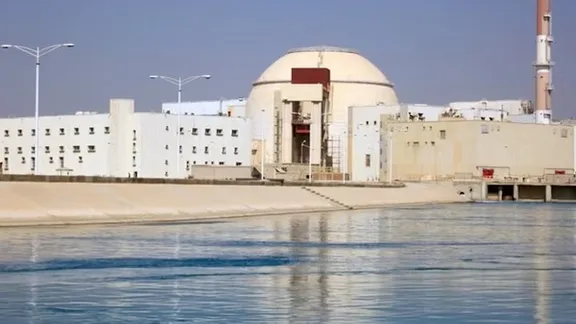
Russia called on Thursday for a safety zone around Iran’s Bushehr nuclear plant after a projectile struck near the site earlier this week.

Alexei Likhachev, head of Russia’s state nuclear corporation Rosatom, said a strike on the Russian-built plant could trigger a catastrophe affecting countries across the Middle East. He said the site holds 72 tons of fissile material and 210 tons of spent nuclear fuel.

“If an incident were to occur, it would be at least regional in scale and would affect a large number of countries in the Middle East,” Likhachev said.

Likhachev urged all sides to make the area “an island of safety” and said Rosatom was planning a further evacuation of personnel, leaving only a few dozen employees at the site.

Iran said on Tuesday that a projectile hit the area near the Bushehr plant. The International Atomic Energy Agency later said a structure about 350 meters from the reactor was hit and destroyed, but the reactor itself was not damaged and no staff were hurt.


Most Viewed

Behind Tehran’s unity show: The secret letter to the shadow king
1
INSIGHT

Behind Tehran’s unity show: The secret letter to the shadow king

2
ANALYSIS

Rapid deterioration of Iran-UAE ties threatens a critical trade lifeline

3

Iran officials project unity after Trump leadership remarks

4

Starmer pledges to move on banning Iran's IRGC in next parliament session

5

Iranian national charged in US over migrant smuggling scheme

Banner
Banner

Spotlight

  • US should use Iran talks leverage to help Iranian people, veteran journalist says
    PODCAST

    US should use Iran talks leverage to help Iranian people, veteran journalist says

  • Iran’s economy after the March war: how bad can it get?
    ANALYSIS

    Iran’s economy after the March war: how bad can it get?

  • Behind Tehran’s unity show: The secret letter to the shadow king
    INSIGHT

    Behind Tehran’s unity show: The secret letter to the shadow king

  • Rapid deterioration of Iran-UAE ties threatens a critical trade lifeline
    ANALYSIS

    Rapid deterioration of Iran-UAE ties threatens a critical trade lifeline

  • Tehran stocks head for reopening, but it risks triggering a new crisis
    ANALYSIS

    Tehran stocks head for reopening, but it risks triggering a new crisis

  • Power vacuum in Tehran emboldens hardliners
    INSIGHT

    Power vacuum in Tehran emboldens hardliners

  • Inflation spikes, basic goods slip out of reach for Iranians, citizens say
    VOICES FROM IRAN

    Inflation spikes, basic goods slip out of reach for Iranians, citizens say

•
•
•

More Stories

South Pars strike stirs debate among Iranians over impact and intent

Mar 19, 2026, 12:31 GMT+0

Messages sent to Iran International and posts on social media showed a split reaction to Wednesday’s strike on Iran’s South Pars gas field, with some welcoming the hit on state-linked assets and others warning of civilian costs.

Messages sent to Iran International and posts on social media were divided over Wednesday’s strike on the South Pars gas field in southern Iran, with some welcoming the hit on state-linked assets and others warning of civilian costs.

US President Donald Trump said Israel had struck Iran’s South Pars gas field “out of anger” over developments in the Middle East, describing the damage as limited and warning there would be no further attacks unless Iran targeted Qatar again.

The strike marked a shift in a conflict that has spread across the Persian Gulf, disrupting energy flows after Iranian missiles targeted facilities in Qatar and Saudi Arabia.

  • Iran floats Hormuz transit tolls as Persian Gulf states warn of military response

    Iran floats Hormuz transit tolls as Persian Gulf states warn of military response

Strike seen as blow to state-linked networks

Some messages sent to Iran International framed the attack as a setback for institutions tied to the Islamic Revolutionary Guards Corps.

“Israel, by hitting South Pars, saved us from more theft… the money was turned into bullets fired at our children,” one citizen wrote.

Another, who said he had worked on projects in the field, downplayed the long-term impact.

“Even with the complete destruction of all 24 gas refineries… they will return to production in less than three months,” he wrote, adding that supply lines from offshore platforms would shut automatically and protect reserves.

A separate message from an engineer challenged concerns about offshore facilities.

“The platforms are not even fully operational because of sanctions… after the Islamic Republic, they can be rebuilt better,” he wrote, contrasting them with higher-quality installations on the Qatari side.

Others shifted the focus away from infrastructure entirely.

“The main infrastructure was the young people they took from us… the rest can be rebuilt with better technology.”

Social media posts echoed that line in sharper language. “Don’t worry about infrastructure,” one post read. “What infrastructure are you talking about? What life was left that needed infrastructure?” it added.

Concerns over civilian impact

Other messages cautioned that strikes on energy infrastructure would translate directly into hardship for civilians.

“Don’t look at infrastructure so simply,” one user wrote. “Lack of electricity and gas means death – cold, hunger, medicine shortages.”

Another post rejected attacks on non-military targets. “Hitting Iran’s infrastructure by any side is condemnable. It belongs to all Iranians,” the message read.

Some called for limiting strikes strictly to military-linked targets. “Please just hit those responsible and leave non-military infrastructure alone.”

One message also questioned the timing. “Hitting South Pars at this moment is not the last and best solution,” it read.

Back to corruption and rebuilding

Even among those critical of the strike, some framed the debate through long-standing economic grievances.

“If infrastructure belonged to the people, no one would be searching in trash for food.”

Another argued that damaged facilities could ultimately be replaced. “That worn-out infrastructure… will be rebuilt better – but those lives won’t return,” the user wrote referring to thousands of people killed during the January protests.

Others pointed to historical reconstruction. “Germany and Japan were flattened in World War II – where are they now?” one user said.

Across the exchanges, a recurring thread linked both support for and opposition to the strike back to mistrust of the Islamic Republic, with many portraying the country’s energy wealth as mismanaged or diverted, and arguing that any future recovery depends less on infrastructure than on political change.
Prince Pahlavi calls on Iranians to form local groups to protect heritage sites

Mar 19, 2026, 12:28 GMT+0

Iran’s exiled Prince Reza Pahlavi called on Iranians on Thursday to form local groups to protect the country’s cultural and natural heritage, saying the risk of looting, destruction and seizure could rise after the overthrow of the Islamic Republic.

Pahlavi urged Iranians inside the country to join what he called the “Iran Heritage Unit” to protect sites they believe may be under threat.

“This unit’s task is very simple: each of you, wherever you are in Iran, form a local group, even a small one, with your friends and acquaintances to protect a national site you believe may be at risk,” Prince Pahlavi said.

He added that Iran had experienced damage in 1979, when parts of the country’s natural landscapes and historical sites were harmed or destroyed.

He said Iranians abroad could also join the effort by helping cover possible costs or by raising awareness.

Pahlavi said he would himself join the unit that would be within a network called “Immortal Guard,” and added that it could become a permanent institution for protecting Iran’s national heritage.

US says strikes expanding deeper into Iran, targets missile and naval sites

Mar 19, 2026, 12:25 GMT+0

The US military is expanding strikes deeper into Iranian territory as part of efforts to degrade its missile, drone and naval capabilities, Chairman of the Joint Chiefs of Staff General Dan Caine said on Thursday.

“CENTCOM remains on plan… and remains unrelenting in our pursuit of Iranian missile capabilities, UAV capabilities and their navy,” Caine said during a briefing.

He said US forces had used 5,000-pound bunker-busting munitions against underground facilities storing coastal defense cruise missiles.

“These weapons are designed to get through concrete… and function after penetrating those barriers,” he said.

Caine said US forces were targeting mine storage sites, naval depots and vessels, adding that more than 120 vessels and dozens of mine-laying platforms had been hit.

“We’re flying further to the east now and penetrating deeper into Iranian airspace,” he said.

He added that A-10 aircraft and Apache helicopters were operating in the Strait of Hormuz and surrounding areas, targeting fast attack boats and Iranian-aligned groups.

US says over 7,000 targets hit in Iran as campaign intensifies

Mar 19, 2026, 12:17 GMT+0

US Defense Secretary Pete Hegseth said on Thursday that American forces had struck more than 7,000 targets across Iran and its military infrastructure.

“To date, we’ve struck over 7,000 targets… that is overwhelming force applied with precision,” Hegseth said, adding that a new wave of strikes would be “the largest strike package yet.”

He said Iran’s military capabilities were being degraded, with air defenses “flattened” and missile and drone production severely reduced.

“Iran’s defense industrial base… is being overwhelmingly destroyed,” he said, adding that ballistic missile and drone attacks were down about 90% since the start of the conflict.

Hegseth said more than 120 Iranian naval vessels had been damaged or sunk and that Iran’s surface fleet was “no longer a factor.”

He said the campaign’s objectives remain unchanged, including destroying Iran’s missile capabilities, defense industry and ensuring it does not obtain a nuclear weapon.

US may ease restrictions on Iranian oil stranded on water, Bessent says

Mar 19, 2026, 12:14 GMT+0

US Treasury Secretary Scott Bessent said on Thursday that Washington could in the coming days remove restrictions on Iranian oil already at sea and put the volume at about 140 million barrels.

"In the coming days, we may unsanction the Iranian oil that's on the water. It's about 140 million barrels," he said in an interview with Fox Business.

He added that the United States was not attacking Iran’s energy infrastructure and had allowed Iranian oil exports to continue flowing out of the Persian Gulf.

Bessent also said that the United States still had “plenty more” it could do on oil supply.