Exiled Queen Farah Pahlavi: Nowruz marks ‘awakening’ for freedom in Iran
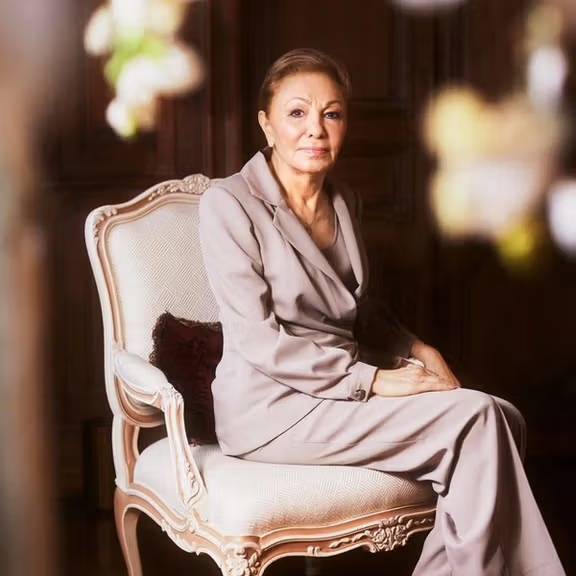

Exiled Queen Farah Pahlavi said on Thursday that this year’s Nowruz coincides with a “great awakening” to reclaim freedom and national dignity in Iran, following the state killings during recent unrest.
“This year’s Nowruz coincides with a great awakening to reclaim freedom and national pride… after the largest street killings by a regressive regime that took thousands of young Iranians from their families,” she said in a message on X.
Pahlavi expressed sympathy for families of those killed, saying she shares “the grief of the survivors” and wished them patience and peace.
She said she hopes Iranians can focus on rebuilding the country and restoring its standing, adding she wishes to see “a free and proud Iran” soon.




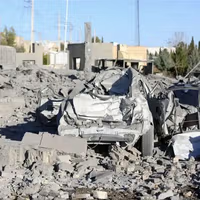
Explosions, air activity and security measures were reported in several parts of Iran from late Wednesday into early Thursday, according to eyewitness accounts sent to Iran International.
The southwestern city of Ahvaz, the main city in Khuzestan province, saw fighter jet activity at 5:53 a.m. followed by an explosion around 6:30 a.m. in the Golestan area.
In northern Iran, a strong blast was heard at 5:16 a.m. in Sari, the capital of Mazandaran province. The port city of Bandar Anzali was also hit by what was described as two drone attacks followed by heavy bombardment targeting naval units of the IRGC and the army. Reports said fuel storage sites were damaged and several warships were destroyed.
In central Iran, a police station in Shahin Shahr, near Isfahan, was reported hit on Wednesday evening. Separately, in the southern port city of Bandar Abbas, Basij forces were reported to have set up nighttime checkpoints in an area at the city’s entrance, with armed patrols causing traffic and fear.
Iran’s ambassador to the United Nations said in separate letters to the UN secretary-general and the Security Council president that Qatar, Kuwait and the United Arab Emirates had allowed their territory to be used for attacks against Iran, state media reported on Thursday.
Amir Saeid Iravani said in the letters that any military bases or facilities used to launch or support armed attacks on Iran could be considered legitimate military targets under its right to self-defense. He added that Iran reserved the right to take necessary measures to prevent further casualties and damage.
Iravani also wrote that the UAE’s alleged role in allowing US attacks from its territory had given rise to international responsibility and required reparations, including compensation for all material and moral damage inflicted on Iran.
Iranian Foreign Minister Abbas Araghchi accused French President Emmanuel Macron of failing to condemn US-Israeli strikes on Iran while voicing concern only after Tehran retaliated.
“His current ‘concern’ didn’t follow Israel’s attack on our gas facilities. It follows our retaliation. Sad!” the Iranian foreign minister wrote.
Macron said earlier that he spoke with Qatar’s Emir Sheikh Tamim bin Hamad Al Thani and US President Donald Trump after strikes hit gas production facilities in Iran and Qatar and called for an immediate halt to attacks on civilian infrastructure.
“It is in our common interest to implement, without delay, a moratorium on strikes targeting civilian infrastructure, particularly energy and water supply facilities,” the French president wrote on X.
The Trump administration has explored plans to require commercial vessels escorted by the US Navy through the Strait of Hormuz to buy US government-backed insurance, the Financial Times reported, citing people familiar with the discussions.
The proposal would link naval escorts to a program led by the US Development Finance Corporation in partnership with insurer Chubb, potentially requiring ships to obtain coverage for hull, machinery and cargo through the scheme rather than the private market, according to the report.
The discussions followed earlier plans to provide up to $20 billion in reinsurance as disruption linked to the Iran war pushed oil prices above $105 a barrel, though it remained unclear whether the insurance purchase would become mandatory.
Three protesters were executed in Iran on Thursday after being accused of killing two police officers during nationwide protests earlier this year, the judiciary-linked Mizan news agency reported.
Identified as Mehdi Ghasemi, Saleh Mohammadi and Saeed Davoudi, the three were accused of attacking two police officers with knives and swords during protests on January 8 in the holy city of Qom.
The authorities also accused them of acting on behalf of Israel and the United States, a frequent claim used by the Islamic Republic against protesters and dissidents.
The hangings were carried out after the case was approved by the Supreme Court, according to Mizan.
Iran also executed a Swedish-Iranian man identified as Kourosh Keyvani on Wednesday after convicting him of espionage for Israel, according to Mizan.
Swedish Foreign Minister Maria Malmer Stenergard later confirmed that a Swedish citizen had been executed, without naming him, and said the legal proceedings fell short of due process standards.