• العربية
  • فارسی
Brand
  • Iran Insight
  • Politics
  • Economy
  • Analysis
  • Special Report
  • Opinion
  • Podcast
  • Iran Insight
  • Politics
  • Economy
  • Analysis
  • Special Report
  • Opinion
  • Podcast
  • Theme
  • Language
    • العربية
    • فارسی
  • Iran Insight
  • Politics
  • Economy
  • Analysis
  • Special Report
  • Opinion
  • Podcast
All rights reserved for Volant Media UK Limited
volant media logo

Araghchi accuses Macron of ignoring strikes on Iran

Mar 19, 2026, 06:18 GMT+0

Iranian Foreign Minister Abbas Araghchi accused French President Emmanuel Macron of failing to condemn US-Israeli strikes on Iran while voicing concern only after Tehran retaliated.

“His current ‘concern’ didn’t follow Israel’s attack on our gas facilities. It follows our retaliation. Sad!” the Iranian foreign minister wrote.

Macron said earlier that he spoke with Qatar’s Emir Sheikh Tamim bin Hamad Al Thani and US President Donald Trump after strikes hit gas production facilities in Iran and Qatar and called for an immediate halt to attacks on civilian infrastructure.

“It is in our common interest to implement, without delay, a moratorium on strikes targeting civilian infrastructure, particularly energy and water supply facilities,” the French president wrote on X.

Most Viewed

Behind Tehran’s unity show: The secret letter to the shadow king
1
INSIGHT

Behind Tehran’s unity show: The secret letter to the shadow king

2
PODCAST

US should use Iran talks leverage to help Iranian people, veteran journalist says

3

Iran executes protester over January uprising

4

Iranian national charged in US over migrant smuggling scheme

5

Iran officials project unity after Trump leadership remarks

Banner
Banner

Spotlight

  • US should use Iran talks leverage to help Iranian people, veteran journalist says
    PODCAST

    US should use Iran talks leverage to help Iranian people, veteran journalist says

  • Iran’s economy after the March war: how bad can it get?
    ANALYSIS

    Iran’s economy after the March war: how bad can it get?

  • Behind Tehran’s unity show: The secret letter to the shadow king
    INSIGHT

    Behind Tehran’s unity show: The secret letter to the shadow king

  • Rapid deterioration of Iran-UAE ties threatens a critical trade lifeline
    ANALYSIS

    Rapid deterioration of Iran-UAE ties threatens a critical trade lifeline

  • Tehran stocks head for reopening, but it risks triggering a new crisis
    ANALYSIS

    Tehran stocks head for reopening, but it risks triggering a new crisis

  • Power vacuum in Tehran emboldens hardliners
    INSIGHT

    Power vacuum in Tehran emboldens hardliners

  • Inflation spikes, basic goods slip out of reach for Iranians, citizens say
    VOICES FROM IRAN

    Inflation spikes, basic goods slip out of reach for Iranians, citizens say

•
•
•

More Stories

US weighs insurance requirement for Hormuz escorts – Financial Times

Mar 19, 2026, 05:40 GMT+0

The Trump administration has explored plans to require commercial vessels escorted by the US Navy through the Strait of Hormuz to buy US government-backed insurance, the Financial Times reported, citing people familiar with the discussions.

The proposal would link naval escorts to a program led by the US Development Finance Corporation in partnership with insurer Chubb, potentially requiring ships to obtain coverage for hull, machinery and cargo through the scheme rather than the private market, according to the report.

The discussions followed earlier plans to provide up to $20 billion in reinsurance as disruption linked to the Iran war pushed oil prices above $105 a barrel, though it remained unclear whether the insurance purchase would become mandatory.

Three protesters executed in Iran after accusations of killing police officers

Mar 19, 2026, 05:18 GMT+0

Three protesters were executed in Iran on Thursday after being accused of killing two police officers during nationwide protests earlier this year, the judiciary-linked Mizan news agency reported.

Three protesters were executed in Iran on Thursday after being accused of killing two police officers during nationwide protests earlier this year, the judiciary-linked Mizan news agency reported.

Identified as Mehdi Ghasemi, Saleh Mohammadi and Saeed Davoudi, the three were accused of attacking two police officers with knives and swords during protests on January 8 in the holy city of Qom.

The authorities also accused them of acting on behalf of Israel and the United States, a frequent claim used by the Islamic Republic against protesters and dissidents.

The hangings were carried out after the case was approved by the Supreme Court, according to Mizan.

Iran also executed a Swedish-Iranian man identified as Kourosh Keyvani on Wednesday after convicting him of espionage for Israel, according to Mizan.

Swedish Foreign Minister Maria Malmer Stenergard later confirmed that a Swedish citizen had been executed, without naming him, and said the legal proceedings fell short of due process standards.

US Senate rejects war powers resolution on Iran conflict

Mar 19, 2026, 02:41 GMT+0

The US Senate voted 47–53 to reject a war powers resolution that sought to limit US military involvement in the conflict with Iran, blocking it from advancing to the floor, NBC News reported.

Senator John Fetterman was the only Democrat to vote against the measure, while Senator Rand Paul was the only Republican to support it, in a vote that largely followed party lines.

The resolution aimed to require the president to withdraw US armed forces from hostilities with Iran unless explicitly authorized by Congress.

Attack Qatar again and US will destroy entire Pars field, Trump warns Iran

Mar 19, 2026, 02:14 GMT+0

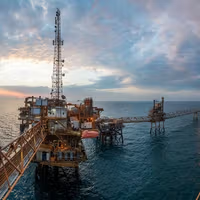
President Donald Trump said on Wednesday Israel struck a section of Iran's South Pars gas field in anger over Middle East events and the US had no prior knowledge, Qatar was uninvolved.

"NO MORE ATTACKS WILL BE MADE BY ISRAEL pertaining to this extremely important and valuable South Pars Field unless Iran unwisely decides to attack a very innocent, in this case, Qatar - In which instance the United States of America, with or without the help or consent of Israel, will massively blow up the entirety of the South Pars Gas Field at an amount of strength and power that Iran has never seen or witnessed before," Trump posted on Truth Social.

"I do not want to authorize this level of violence and destruction because of the long term implications that it will have on the future of Iran, but if Qatar’s LNG is again attacked, I will not hesitate to do so," he added.

How could the war with Iran end?

Mar 19, 2026, 02:08 GMT+0
•
Ata Mohamed Tabriz

US president Donald Trump suggested this week that the war with Iran could end soon, but few can say with confidence how it will.

Wars rarely end on political will alone, and this conflict is constrained by a dense web of strategic, economic and security pressures that neither side can easily escape.

What began with stated goals—containing Iran’s nuclear program, degrading its missile and regional capabilities, and “helping” the Iranian people—has hardened into a confrontation between objectives that are arguably incompatible.

As the conflict spreads into the arteries of the global economy, ending it will require more than a shift in rhetoric—or even policy. A durable ceasefire would depend on mediators capable of sequencing reciprocal steps and bridging fundamentally incompatible aims.

More likely, the war will end not through decisive victory, but at the point where continued fighting no longer improves either side’s position and the mutual threat environment begins to recede.

Incompatible endgames

For the United States and Israel, the conflict forms part of a broader attempt to reshape the Middle East’s security architecture. Since October 7, Benjamin Netanyahu has repeatedly invoked a “new Middle East” in which Iran’s regional reach is sharply curtailed.

Drawing on past confrontations, including the 12-day war of June 2025, Washington and Tel Aviv appear to be seeking tangible outcomes: dismantling key military capabilities and preventing their reconstruction—an objective that may prove harder than the initial blow.

Iran’s logic is different. Tehran is pursuing what might be called coercive endurance: safeguarding regime survival while preserving deterrence by imposing high costs on its adversaries. Its demands—compensation and assurances against renewed war—serve not only strategic ends but domestic ones, helping sustain elite cohesion and legitimacy.

Regional actors, particularly Persian Gulf Arab states, and external powers with major energy interests remain cautious, oscillating between defensive positioning and watchful restraint. For now, mediation remains peripheral. The war is being shaped less in diplomatic forums than under fire.

A war of arteries

The Strait of Hormuz has evolved from a geographic chokepoint into a central strategic lever. Iran’s approach rests on the premise that disrupting this vital waterway transforms a bilateral confrontation into a global economic crisis.

Energy prices become not just an indicator but a weapon, intended to erode political will in Washington and its allies by destabilizing markets and raising costs worldwide.

Washington, in turn, has focused on Kharg Island—Iran’s primary oil export terminal and the loading point for roughly 90 percent of its crude exports. The threat to Kharg is a direct counter to Tehran’s Hormuz leverage. If Hormuz raises global costs, Kharg raises the cost of survival for Iran itself.

This duel points to a central constraint: the war will move toward closure only when both sides conclude that choking each other’s economic lifelines yields diminishing returns compared with the systemic risks to global energy markets.

Any durable settlement would therefore require a new security arrangement that guarantees safe passage through Hormuz while removing the threat to Iran’s export infrastructure.

Question of authority

The killing of senior political figures, including Ali Larijani, has raised concerns about gaps in coordination at the center of power. The question is whether an institutional structure still exists capable of accepting defeat—or even signing a ceasefire.

Yet the continuation of Iranian strikes suggests the system’s resilience does not rest on individuals alone. Tehran’s military order, shaped by a doctrine of decentralized “mosaic” defense, appears to have maintained operational coherence.

That resilience, however, raises doubts about whether a ceasefire could produce lasting stability while the machinery of war remains intact.

Inside Iran, external attacks appear to have strengthened nationalist sentiment among parts of society, yet leadership losses could also trigger fissures within the security establishment or embolden dissent. The balance between cohesion and fracture remains unclear.

For now, political and military leadership appear aligned in their belief that the situation remains manageable.

Some in Washington therefore see a more realistic objective not as immediate regime collapse but as forcing Tehran into a form of strategic accommodation—perhaps through the rise of more pragmatic figures capable of imposing restraint on military actors.

Such an outcome could allow Tehran to concede in practice while presenting the result domestically as survival or even victory.

Whether that path is viable remains uncertain. Internal purges, factional tensions and competing strategic visions continue to complicate any transition, even as some voices within Iran’s security establishment advocate widening the conflict.

Ultimately, how the war ends will depend not only on economic and regional pressures but on a deeper unknown: how much organizational capacity, military discipline and political authority remain in Tehran to accept a new strategic order.

Wars of this kind end when exhaustion converges with recognition. The decisive question is whether there remains a clear address in Tehran capable of signing—and enforcing—a ceasefire, and what form that political will ultimately takes.