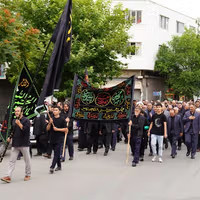
Attack on Basij checkpoints in Tehran continue, Israel Ambassador says
Israeli Ambassador to the United States, Yechiel (Michael) Leiter said on Thursday Israeli and allied forces struck Basij checkpoints in Tehran and will continue to attack proxy Hezbollah in Lebanon.
"The cracks in the Iranian regime are widening: officials, stationed aoutside of Iran are abandoning their posts and asking for asylum in various countries," Leiter posted on X.
"One of the two American aircraft involved in the accident over Iraq landed safely in Israel. Our Airforce chief was debriefed by the AFCENT commander on the initial details of the event," he added. "Our strikes on Iran and its proxies continue: today we hit Basij forces and roadblocks in Tehran, who were restricting the movement of locals. We also struck Hezbollah command centers and launchers across Lebanon."
The Chehel Sotun (40 Columns), a 17th century pavilion and garden in Iran's historic city of Isfahan, was damaged in US-Israeli strikes, March 9, 2026
Airstrikes in Iran have damaged several historic landmarks, including UNESCO-listed sites, raising concern among cultural experts and officials about the protection of heritage during the conflict.
UNESCO’s World Heritage Centre has confirmed damage to several sites on its global heritage list, though the full extent remains unclear, its director Lazare Eloundou Assomo said.
Several of the affected buildings carried the Blue Shield emblem, an international symbol used to identify protected cultural heritage sites under international law and often described as the “Red Cross for cultural heritage.”
Iran’s Foreign Minister Abbas Araghchi later criticized UNESCO’s response. “It's natural that a regime that won't last a century hates nations with ancient pasts. But where's UNESCO? Its silence is unacceptable,” he wrote on X.
Among the sites affected is the historic Golestan Palace, a Qajar-era complex in central Tehran added to the UNESCO list in 2013.
According to Afarin Emami, director of the Golestan Palace World Heritage complex, blast waves from airstrikes on March 1 shattered windows and damaged delicate mirrorwork in several halls.
Debris spread around in a hall at Tehran's historic Golestan Palace, after a US-Israeli strike, March 1, 2026
Images published by Iranian media show damaged crystal chandeliers and wooden doors and windows torn from their frames.
Emami said museum objects inside the palace were not harmed because they had been moved to secure storage after earlier tensions raised concerns about possible escalation.
The nearby Grand Bazaar of Tehran, a vast network of corridors forming a key part of the capital’s historic fabric, also sustained damage. Other buildings affected in Tehran include the former Senate Palace and the historic former Police Headquarters.
Several days later, further blast waves reportedly caused damage in Isfahan, one of Iran’s most important historic cities.
Images circulating online show shattered windows, cracked walls and fallen mirrorwork at multiple sites, including the Safavid-era Chehel Sotoun Palace and the Ali Qapu Palace in the Naqsh-e Jahan area.
The primary target appeared to be the provincial governor’s office building in the nearby Rashk-e Jahan complex, which was reportedly directly bombed. Ashraf Hall, a Safavid structure known for its gold-decorated ceilings, sustained significant damage, with photographs showing fallen tiles scattered among office furniture.
Governor's office (Rashk-e Janan Palace) in Isfahan after bombing
Elsewhere, Iranian media reported damage in Sanandaj, where several historic mansions lost sections of plaster decoration, mirrorwork and wooden doors. In northern Iran, reports suggest the Safavid-era Safi Abad Palace in Behshahr may have been affected by nearby strikes targeting a military radar facility, though no confirmed photographs have been released.
Near the historic Falak-ol-Aflak Castle in western Iran, the provincial cultural heritage office located within the castle’s protected zone was destroyed and five staff members and heritage protection personnel were reportedly injured. The fortress itself was not damaged.
The incidents have triggered heated debate among Iranian social media users, with some criticizing the government’s own handling of cultural heritage protection.
One user wrote on X: “At least write that the Islamic Republic should not build military bases next to heritage sites when you write that a historic monument was damaged by Israeli or US attacks.”
Others argued the destruction must be viewed in the broader context of the conflict. “We can rebuild buildings,” one commenter wrote. “Save your tears for the 40,000 people who were killed.”
Some groups, including the Jurists’ Council for a Democratic Iran, have called on all sides to respect international conventions protecting cultural heritage during armed conflict.
Saudi Arabia’s Ministry of Defense spokesperson said on Thursday six drones were intercepted and destroyed in the Eastern Region, highlighting the kingdom’s continued vigilance against aerial threats.
French President Emmanuel Macron on Thursday confirmed that Chief Warrant Officer Arnaud Frion was killed and several soldiers wounded in an attack in Iraq’s Erbil region, calling the strike “unacceptable.”
“To his family, to his brothers in arms, I want to express all the affection and solidarity of the Nation,” Macron posted on X. “Several of our soldiers have been wounded. France stands by their side and with their loved ones."
“Their presence in Iraq is part of the strict framework of the fight against terrorism. The war in Iran cannot justify such attacks,” Macron said.
White House Deputy Chief of Staff Stephen Miller told Fox News on Thursday that Operation Epic Fury has been “an unprecedented military success” against Iran’s regime, highlighting the operation’s achievements and its impact on Tehran’s military capabilities.