• العربية
  • فارسی
Brand
  • Iran Insight
  • Politics
  • Economy
  • Analysis
  • Special Report
  • Opinion
  • Podcast
  • Iran Insight
  • Politics
  • Economy
  • Analysis
  • Special Report
  • Opinion
  • Podcast
  • Theme
  • Language
    • العربية
    • فارسی
  • Iran Insight
  • Politics
  • Economy
  • Analysis
  • Special Report
  • Opinion
  • Podcast
All rights reserved for Volant Media UK Limited
volant media logo

Trump hints at killing Iran’s next supreme leader

Mar 4, 2026, 20:27 GMT+0Updated: 00:00 GMT+0

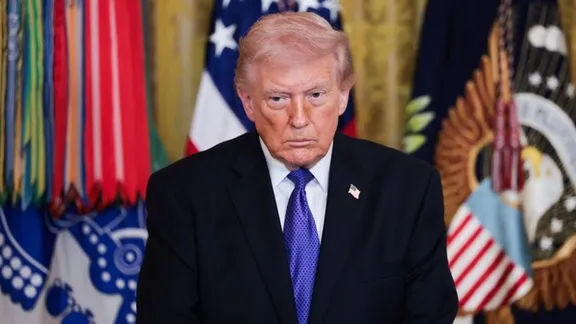
US President Donald Trump hinted that Ali Khamenei’s potential successors will be killed as the conflict with Iran escalates.

“Their leadership is just rapidly going. Everybody that seems to want to be a leader, they end up dead,” Trump said on Wednesday.

Trump said the United States was in a “very strong position” in the conflict and praised the country’s military strength. “Somebody said on a scale of 10, where would you rate it? I said about a 15,” he said.

“We have the greatest military in the world by far,” Trump added. “So we’re in a very strong position now.”

Most Viewed

Iran International says it won’t be silenced after London arson attack
1

Iran International says it won’t be silenced after London arson attack

2
VOICES FROM IRAN

Hope and anger in Iran as fragile ceasefire persists

3

State media slam Araghchi's Hormuz tweet, say it let Trump claim victory

4
INSIGHT

How Tehran bends its own red lines to boost state rallies

5

Iran halts petrochemical exports to supply domestic market

Banner
Banner

Spotlight

  • Too early to tell who is winning Iran war, experts say
    PODCAST

    Too early to tell who is winning Iran war, experts say

  • How Tehran bends its own red lines to boost state rallies
    INSIGHT

    How Tehran bends its own red lines to boost state rallies

  • Iran blackout cripples freelancer, small business incomes
    VOICES FROM IRAN

    Iran blackout cripples freelancer, small business incomes

  • Ideology may be fading in Iran, but not in Kashmir's ‘Mini Iran'
    INSIGHT

    Ideology may be fading in Iran, but not in Kashmir's ‘Mini Iran'

  • US blockade enters murky phase as tankers spoof signals and buyers hesitate
    ANALYSIS

    US blockade enters murky phase as tankers spoof signals and buyers hesitate

  • Why the $100 billion Hormuz toll revenue is a myth
    ANALYSIS

    Why the $100 billion Hormuz toll revenue is a myth

•
•
•

More Stories

Iran’s invisible 'First Lady': who was Khamenei’s wife?

Mar 4, 2026, 20:10 GMT+0
•
Behrouz Turani

For decades, the wife of Iran’s former Supreme Leader Ali Khamenei lived almost entirely outside public view. Even her death was reported reluctantly, as though she had never been there at all.

Mansoureh Khojasteh Bagherzadeh died one day after her husband. She spent her final day in a coma at a hospital near their residence on Pasteur Avenue in central Tehran, a compound long guarded by the Revolutionary Guards but now destroyed.

Born into a religious family in Mashhad, she married Khamenei in 1964 in a traditional family-arranged ceremony.

The couple had six children: four sons born before the 1979 Revolution and two daughters born afterward. One daughter, Hoda, was killed in the same attack that targeted Khamenei’s home and office.

A life lived in the shadows

Throughout her life, Mansoureh remained one of the most private figures in Iran’s ruling elite. Her public presence was far more limited than that of Fakhr Iran Saghafi, the wife of Ruhollah Khomeini, or Effat Marashi, the wife of the late Akbar Hashemi Rafsanjani.

So little was publicly known about her that when news of her death spread, Iranian media initially struggled to locate a reliable photograph. Some outlets mistakenly published a picture of Ategheh Rajai, the outspoken wife of another late president, Mohammad-Ali Rajai.

Her public voice survives almost entirely through two interviews: one with Mahjoubah magazine in the early 1990s and another with Jomhouri Eslami in 1983, shortly after Khamenei survived an assassination attempt. Most quotations attributed to her in later years originate from these two sources.

“It was not a romantic thing,” she said of their union. “His grandmother came to our house to propose.”

She portrayed her main role as maintaining a stable home life while her husband pursued political and religious work, stressing that she considered full hijab the appropriate attire outside the home, while dress inside could be more flexible but still follow Islamic principles.

Why she remained invisible

Her absence from public life reflected not only personal preference but also the political culture surrounding Iran’s leadership.

Khamenei largely kept his family out of public view for a mixture of religious, cultural, and security reasons. A deeply traditional cleric, he rarely allowed his wife or daughters to appear publicly, and even his sons were long shielded from public scrutiny.

Although she was never formally described as Iran’s “First Lady,” the symbolic status of the Supreme Leader’s spouse occasionally surfaced in public debate.

When Jamileh Alamolhoda, the wife of the late president Ebrahim Raisi, briefly used the title in a television interview, Iranian media reported that the description was later clarified after criticism from conservative circles that the title belonged to the Supreme Leader’s household.

She will be buried beside her husband at the Imam Reza Shrine in Mashhad, according to state media reports.

Schumer says Senate will vote on Trump’s Iran war today

Mar 4, 2026, 19:59 GMT+0

Senate Democratic leader Chuck Schumer said lawmakers are headed toward a vote on President Donald Trump’s decision to enter the war against Iran, warning that every senator will have to take a clear position.

“Today every senator–every single one–will pick a side,” Schumer said in a floor speech. “Do you stand with the American people who are exhausted with forever wars in the Middle East, or stand with Donald Trump and Pete Hegseth as they bumble us headfirst into another war?”

The vote will be on a war powers resolution that would require congressional approval before any further US attacks on Iran.

The measure, and a similar bill expected in the House later this week, faces long odds in the Republican-controlled Congress and would likely be vetoed by Trump even if it passed.

Spain denies White House brief over cooperation in Iran war

Mar 4, 2026, 19:44 GMT+0

Spain’s government has denied cooperating with US military operations in the Middle East, contradicting comments made earlier by the White House.

White House press secretary Karoline Leavitt had said Spain agreed to assist US military operations in the region after President Donald Trump threatened to cut off trade with Madrid.

But Spanish Foreign Minister José Manuel Albares rejected that claim in an interview with Cadena SER radio.

“The Spanish Government’s position regarding the war in the Middle East and the bombings in Iran, regarding the use of our bases, has not changed by a single comma,” he said.

US military seeks boost in critical minerals supply amid Iran war

Mar 4, 2026, 19:14 GMT+0

The US military has asked mining companies to help expand domestic supplies of 13 critical minerals used in semiconductors, weapons and other defense technologies, according to a document reviewed by Reuters.

The request was sent Friday to members of the Defense Industrial Base Consortium, a network of more than 1,500 companies, universities and organizations that supply the Pentagon.

The document asked for proposals by March 20 for projects that could mine, process or recycle the minerals, which include arsenic, bismuth, germanium, graphite, hafnium, nickel and tungsten among others.

The request came a day before the United States and Israel launched strikes on Iran, though there was no immediate indication the timing was coordinated with the start of the military campaign.

Netanyahu asks White House if Trump officials spoke with Iran - Axios

Mar 4, 2026, 18:43 GMT+0

Israeli Prime Minister Benjamin Netanyahu asked the White House for clarification this week after Israeli intelligence suggested the Trump administration might have been communicating with Iranian officials, Axios reported.

Citing two sources familiar with the issue, the outlet said Netanyahu called White House officials on Monday to ask whether contacts or message exchanges had taken place regarding a possible ceasefire.

One source said the White House told him the administration was not speaking to Iranian officials “behind his back.”