• العربية
  • فارسی
Brand
  • Iran Insight
  • Politics
  • Economy
  • Analysis
  • Special Report
  • Opinion
  • Podcast
  • Iran Insight
  • Politics
  • Economy
  • Analysis
  • Special Report
  • Opinion
  • Podcast
  • Theme
  • Language
    • العربية
    • فارسی
  • Iran Insight
  • Politics
  • Economy
  • Analysis
  • Special Report
  • Opinion
  • Podcast
All rights reserved for Volant Media UK Limited
volant media logo
INSIGHT

'Deal would be a miracle': US military buildup fuels uncertainty in Tehran

Maryam Sinaiee
Maryam Sinaiee

Iran International

Feb 20, 2026, 10:41 GMT

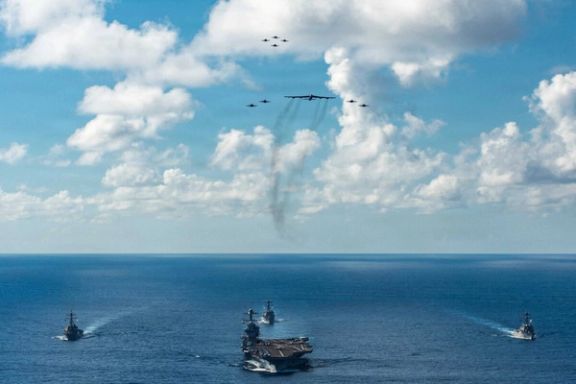
A sharp increase in US military deployments to the Middle East has intensified uncertainty in Tehran, where analysts and officials are debating whether the buildup signals imminent conflict or a bid to gain leverage in nuclear negotiations.

Multiple US outlets reported on Thursday that national security officials have informed President Donald Trump that the military has positioned the necessary air and naval assets in the region to carry out a strike “within days,” potentially even by the end of this week.

In Tehran, some analysts cautioned that the military moves could signal genuine escalation rather than routine pressure.

Political analyst Mohammad Soltaninejad told Entekhab: “If the negotiations fail or the US position changes—as happened before the 12-day war and in the middle of negotiations—it is possible that war could break out.”

Jalal Sadatian, a former Iranian ambassador to the United Kingdom, said in an interview with ILNA that war remains an unattractive option for regional states, particularly given the risk of US bases in those countries being targeted.

“The balance is still tilted somewhat more toward negotiation than toward war,” he said, arguing that Trump appears to be “more focused on threats and exercising pressure.”

‘Real’ prospect of war

The military buildup follows the second round of nuclear talks between Iran and the United States, which ended Tuesday in Geneva without tangible results. Cautious optimism expressed by Foreign Minister Abbas Araghchi has not translated into broad confidence in Tehran.

Financial markets have reacted nervously. Iran’s currency weakened nearly one percent in a single day, with the dollar rising toward 1,630,000 rials, reflecting broader concerns about the risk of escalation.

Prominent economic outlet Eco Iran ran an editorial on Thursday titled Diplomacy Under the Shadow of Military Movements, arguing that US deployments are not merely a show of power but “a sign of maintaining operational readiness in case tensions escalate.”

International relations professor Gholamreza Haddad told Eco Iran that talks proceeding to a third round is not necessarily a positive sign. He said the scale of US deployments suggests “real preparedness for military conflict,” rather than merely a threat intended to extract concessions from Tehran.

Agreement ‘a miracle’

Nour News, a site close to senior security official Ali Shamkhani, went further, suggesting that Washington might opt for a limited, symbolic action to demonstrate readiness without entering full-scale war.

“This scenario would symbolically test Iran’s deterrence and demonstrate America’s power,” the editorial said, warning that “the scene stands on the brink of crisis.”

Iran has also demonstrated heightened military activity. Over the past two days, it has conducted exercises in the Persian Gulf and the Sea of Oman, and a notice to airmen (NOTAM) was issued for a missile test in southern Iran scheduled for Thursday.

US affairs analyst Amir Abolfath delivered one of the more pointed warnings, calling a potential agreement “a miracle” and cautioning that sustaining any deal may prove even more difficult than reaching one.

“We may end up in war,” he told moderate outlet Khabar Online. “And even in the event of war, the problem may not be resolved.”

Most Viewed

US terminates green cards of 3 Iranians tied to Islamic Republic
1

US terminates green cards of 3 Iranians tied to Islamic Republic

2
PODCAST

Worst outcome is Islamic Republic’s survival, ex-CIA official says

3
ANALYSIS

Iran brings unusually broad team to US talks to blunt future blame

4
INSIGHT

Tehran sends tough message but keeps diplomacy door open

5

Zoroastrian religious figure arrested in Iran

Banner
Banner

Spotlight

  • Tehran sends tough message but keeps diplomacy door open
    INSIGHT

    Tehran sends tough message but keeps diplomacy door open

  • Worst outcome is Islamic Republic’s survival, ex-CIA official says
    PODCAST

    Worst outcome is Islamic Republic’s survival, ex-CIA official says

  • Why the Iran-US truce is more likely to buy time than peace
    ANALYSIS

    Why the Iran-US truce is more likely to buy time than peace

  • Engaged but uncommitted: China watches Iran and US fight and talk
    ANALYSIS

    Engaged but uncommitted: China watches Iran and US fight and talk

  • A truce for the world, a reckoning for Iran’s economy
    ANALYSIS

    A truce for the world, a reckoning for Iran’s economy

  • Why the world failed to bypass the Strait of Hormuz
    ANALYSIS

    Why the world failed to bypass the Strait of Hormuz

•
•
•

More Stories

Trump signals Iran deal deadline as reports point to limited strike plans

Feb 20, 2026, 02:07 GMT

US President Donald Trump on Thursday warned Iran it must reach a meaningful nuclear agreement with the United States within two weeks or face consequences, as reports indicate Washington is considering limited strikes to force a deal.

Speaking at the inaugural meeting of his Board of Peace initiative in Washington, Trump hinted at a narrow timeframe for progress and reiterated US demands on Tehran’s nuclear program.

“It’s proven to be, over the years, not easy to make a meaningful deal with Iran. We have to make a meaningful deal; otherwise, bad things happen,” Trump said. “And you’re going to be finding out over the next probably 10 days.”

He added that Iran “cannot have a nuclear weapon” and must halt actions Washington views as threatening to regional stability, suggesting that military measures could follow if diplomacy fails.

The Wall Street Journal reported that Trump is weighing an initial, limited strike on Iran as leverage to compel Tehran to accept US conditions in nuclear talks.

The report said Trump is reviewing targeted military options that could be executed within days if Iran refuses to halt enrichment activity, with the aim of strengthening US negotiating leverage without immediately triggering a broader conflict.

Also on Thursday, US Ambassador to the United Nations Michael Waltz doubled down on Washington’s pressure campaign in media appearances, accusing Tehran of stalling negotiations and saying that economic sanctions have strained the Iranian leadership.

“Even in the face of world condemnation over the killing of somewhere between 18,000 and 40,000 of their own people — an industrial-sized massacre,” Waltz said in an interview with Fox News.

Waltz said sustained pressure would continue even as diplomatic engagement moves forward.

'Obvious gap remains'

The head of the UN nuclear watchdog, IAEA Director General Rafael Grossi, said on Thursday that an “obvious” gap remains between the United States and Iran over uranium enrichment after attending talks in Geneva on Tuesday.

“It is clear that there is, there is this gap which is, which is obvious, between the position of the United States, which is demanding… no enrichment at all, and what Iran would like to continue to be doing,” Grossi told CNN. He added that while the agency has been allowed back into Iran, inspectors have not been granted access to the nuclear sites targeted in US-Israeli airstrikes in June.

Grossi said he believes the 400 kg of enriched uranium remains “where it was” before the bombings and has not been moved.

IRGC moves to tighten internet controls after protest crackdown

Feb 20, 2026, 01:31 GMT
•
Behrouz Turani

Iran’s Revolutionary Guards intelligence chief has confirmed he is driving efforts to tighten restrictions on social media, linking the initiative directly to the country’s security apparatus and the expansion of the so-called “national internet.”

Majid Khademi, head of intelligence for the Islamic Revolutionary Guard Corps (IRGC), said in an interview published on February 19 that a total ban on foreign social media platforms is intended to “prevent enemy plots and immunize Iranians against them.”

He also revealed that Supreme Leader Ali Khamenei had tasked him with overseeing the expansion of Iran’s domestic intranet, often referred to as the “national internet,” and stressed the importance of what he described as “proper governance of the Internet.”

“Sianat”—meaning protection—is the term Iranian officials use to describe legislation aimed at restricting social media under the stated goal of shielding citizens from perceived dangers.

The original proposal, often referred to as Sianat-1, was approved by parliament in March 2022 but implementation was halted shortly afterward amid concerns among senior officials that sweeping restrictions could provoke public backlash.

Since then, the bill has remained under discussion among parliament, the Guardian Council and the Supreme National Security Council.

Targeting platforms

Despite the absence of a comprehensive ban, access to major platforms remains restricted, with most users relying on virtual private networks (VPNs). Recent media reports suggest that WhatsApp, which had previously been accessible, has faced renewed restrictions, while authorities continue expanding policies granting limited access to selected users.

In recent weeks, Iranian media outlets have reported renewed efforts to advance what has been informally described as “Sianat-2,” a broader initiative aimed at strengthening state oversight of online activity and expanding domestic internet infrastructure.

Leaked information cited by Iranian media suggests audiovisual content on platforms such as Instagram, YouTube and Telegram could face tighter regulation, potentially placing greater authority in the hands of state institutions including the Islamic Republic of Iran Broadcasting (IRIB), which holds a legal monopoly over broadcasting.

‘Urban terrorism’

Authorities imposed a near-total internet blackout during the widespread protests of January 8 and 9, cutting off access to global platforms and isolating much of the country digitally.

The shutdown coincided with a violent crackdown in which human rights organizations and independent media reported large numbers of protesters killed, injured and detained.

Khademi framed such measures as necessary to counter foreign threats. He accused outside actors of attempting to spread instability, encourage “urban terrorism,” and undermine public trust in the government, though he did not provide evidence.

“These platforms are used to organize and guide hostile activities,” he said, adding that Khamenei had instructed him: “Do not forget the proper governance of the Internet.”

The blackout in January highlighted the central role of internet controls in Iran’s response to political unrest—a strategy that officials have increasingly framed as a matter of national security.

Khademi’s confirmation of the IRGC’s leadership role underscores the extent to which internet governance has become integrated into Iran’s broader security strategy.

Experts say Iran entering era of constant unrest

Feb 19, 2026, 17:10 GMT

Iran is entering a phase of persistent unrest, driven by decentralized “minor triggers” and deepening economic and legitimacy pressures that repression alone may no longer contain, senior analysts said at Iran International's townhall in Washington DC.

Iran International's Bozorgmehr Sharafeddin and Mohammad Machine-chian, alongside political scientist Mohammad Ghaedi said the scale, persistence and decentralization of the unrest signal a structural rupture between state and society - one repression alone may no longer be able to contain.

Click here to read more.

Experts say Iran entering era of constant unrest

Feb 19, 2026, 16:56 GMT

Iran is entering a phase of persistent unrest, driven by decentralized “minor triggers” and deepening economic and legitimacy pressures that repression alone may no longer contain, senior analysts said at Iran International's townhall in Washington DC.

Iran experienced in January its most widespread and sustained unrest since the founding of the Islamic Republic, as protests spread across cities and provinces and authorities responded with an escalating crackdown that analysts say reflects a deepening crisis of legitimacy at the core of the state.

Speaking during a special Iran International Insight town hall on Wednesday, experts said the scale, persistence and decentralization of the unrest signal a structural rupture between state and society - one repression alone may no longer be able to contain.

In what participants described as one of the harshest security responses in recent years, tens of thousands have been killed, detained or interrogated. Rather than restoring order, panelists argued, the severity of the crackdown underscores mounting anxiety within the leadership about the durability of its authority.

A widening legitimacy gap

Political scientist Mohammad Ghaedi said each protest cycle deepens what he described as a structural legitimacy deficit.

“In democracies, when we ask why leaders should rule, the answer is because they are elected by the nation,” he said. “But if you ask that question of Iranians, there is no clear answer — because 47 years ago, Ayatollah Khomeini deceived the nation.”

According to Ghaedi, the leadership is fully aware of this vulnerability.

“They have to respond in a way that makes the nation unwilling to protest again. That explains the brutality of the repression,” he said.

From mega-triggers to permanent volatility

Bozorgmehr Sharafedin, a senior Iran analyst and Head of Digital at Iran International, said the protest landscape has fundamentally shifted.

“Iranian society has wisely moved from demonstrations triggered by mega-triggers to minor triggers,” he told the panel moderated by Gelareh Hon. “Minor triggers are very difficult for the government to contain because they're not centralized, they're unpredictable and they're emotionally charged.”

Instead of singular catalytic events driving nationwide mobilization, grievances now simmer across economic, social and political spheres — producing recurring, localized flare-ups that strain security forces and steadily erode the state’s ability to project control.

Sharafedin framed the crisis around three central actors: Ali Khamenei, Donald Trump and the Iranian public.

“The social contract between Khamenei and the people has expired,” he said. “Either the Supreme Leader reaches a deal with Trump at the expense of the people, or Trump sides with the people against the Islamic Republic. In both scenarios, Khamenei loses,”

Economic hardship and ideological erosion

Mohammad Machine-Chian, a senior journalist at Iran International and a former researcher at the University of Pittsburgh, argued that the unrest reflects both deep economic distress and mounting ideological rejection.

“Demanding a normal material life is in and of itself a rejection of Khomeinism — the whole ideology of the Islamic Republic, which prescribes abandonment of material life and demands sacrifice for the state” he said.

He cited soaring prices as a daily pressure reshaping public sentiment.

“Inflation is nearly 60%. Food inflation is about 72%. If we go deeper, it gets uglier — cooking oil around 200%, and red meat over 100%. This is the reality people are dealing with.”

Beyond inflation, he said, the regime’s traditional pillars are weakening. The Islamic Republic was historically sustained by an alliance between the bazaar and the mosques — institutions that once anchored its social legitimacy.

“The bazaar is finally breaking completely with the Islamic Republic,” he said. “Mosques now have detention centers. They no longer serve a social or civil purpose in Iranian society.”

Panelists also highlighted what they described as a significant psychological shift within society: foreign assistance, once politically taboo, is now openly debated.

Audience questions addressed policy trade-offs in the United States, concerns in Turkey over possible regional escalation, and the apparent weakening of Tehran’s regional proxy network.

The town hall concluded that the Islamic Republic faces converging pressures — eroded legitimacy, weakened institutions, economic deterioration and a society increasingly detached from the ideological foundations of the state. While repression may buy the leadership time, panelists said it no longer restores authority or rebuilds public consent.

Iran fortifies sites as nuclear talks stall and US tensions rise

Feb 19, 2026, 02:00 GMT

Satellite images published by Reuters on Wednesday show Iran repairing and reinforcing key military and nuclear‑linked sites amid stalled nuclear negotiations with the United States and an expanding US military presence in the region.

The imagery shows a new facility at the Parchin military complex covered with a concrete shield and soil, while tunnel entrances at the Isfahan nuclear site have been backfilled.

Tunnel access at Natanz and missile bases damaged during last June’s 12‑day conflict with Israel have also been strengthened.

The reconstruction appears designed to address weaknesses exposed during the brief war, when Israeli strikes targeted Iranian nuclear and military infrastructure and Tehran responded with missiles and drones.

The United States held five rounds of negotiations with Iran over its disputed nuclear program last year, for which Trump set a 60-day deadline.

When no agreement was reached by the 61st day on June 13, Israel launched a surprise military offensive, followed by US strikes on June 22 targeting key nuclear facilities in Isfahan, Natanz and Fordow.

Satellite images show the Parchin military complex before Israeli strikes in October 2024 (left) and the site covered with concrete in January 2026 (right). Planet Labs PBC/Handout via REUTERS
100%
Satellite images show the Parchin military complex before Israeli strikes in October 2024 (left) and the site covered with concrete in January 2026 (right). Planet Labs PBC/Handout via REUTERS

The fortification work comes as indirect nuclear talks in Geneva remain unresolved. Iran is preparing a written proposal to address US concerns, while Washington has reinforced its regional military posture, including carrier strike groups and additional naval assets, amid concerns that diplomacy could stall.

Satellite images show a building at Iran’s Qom missile base with roof damage on July 16, 2025 (top), and the same site with a new roof on Feb. 1, 2026 (bottom). Planet Labs PBC/Handout via REUTERS
100%
Satellite images show a building at Iran’s Qom missile base with roof damage on July 16, 2025 (top), and the same site with a new roof on Feb. 1, 2026 (bottom). Planet Labs PBC/Handout via REUTERS

The Reuters report said the combination of hardened facilities, ongoing military readiness, and persistent diplomatic negotiations reflects Tehran’s dual strategy of safeguarding strategic infrastructure while keeping open the possibility of a negotiated settlement.

Satellite images show Iran’s Shiraz South missile base before reconstruction on July 3, 2025 (right), and after repair and clearance work on Jan. 30, 2026 (left). Planet Labs PBC/Handout via REUTERS
100%
Satellite images show Iran’s Shiraz South missile base before reconstruction on July 3, 2025 (right), and after repair and clearance work on Jan. 30, 2026 (left). Planet Labs PBC/Handout via REUTERS

The United States has long insisted that Iran must completely halt its uranium enrichment program, stop supporting its armed allies in the Middle East and accept restrictions on its ballistic missile program.

Iran’s Supreme Leader Ali Khamenei said on Monday the United States will never succeed in toppling the Islamic Republic and warned that even the world’s strongest military can suffer crippling blows.






