• العربية
  • فارسی
Brand
  • Iran Insight
  • Politics
  • Economy
  • Analysis
  • Special Report
  • Opinion
  • Podcast
  • Iran Insight
  • Politics
  • Economy
  • Analysis
  • Special Report
  • Opinion
  • Podcast
  • Theme
  • Language
    • العربية
    • فارسی
  • Iran Insight
  • Politics
  • Economy
  • Analysis
  • Special Report
  • Opinion
  • Podcast
All rights reserved for Volant Media UK Limited
volant media logo
INSIGHT

Experts say Iran entering era of constant unrest

Feb 19, 2026, 16:56 GMTUpdated: 20:05 GMT

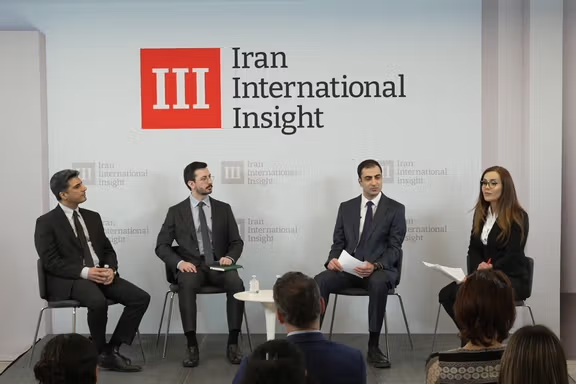
Iran is entering a phase of persistent unrest, driven by decentralized “minor triggers” and deepening economic and legitimacy pressures that repression alone may no longer contain, senior analysts said at Iran International's townhall in Washington DC.

Iran experienced in January its most widespread and sustained unrest since the founding of the Islamic Republic, as protests spread across cities and provinces and authorities responded with an escalating crackdown that analysts say reflects a deepening crisis of legitimacy at the core of the state.

Speaking during a special Iran International Insight town hall on Wednesday, experts said the scale, persistence and decentralization of the unrest signal a structural rupture between state and society - one repression alone may no longer be able to contain.

In what participants described as one of the harshest security responses in recent years, tens of thousands have been killed, detained or interrogated. Rather than restoring order, panelists argued, the severity of the crackdown underscores mounting anxiety within the leadership about the durability of its authority.

A widening legitimacy gap

Political scientist Mohammad Ghaedi said each protest cycle deepens what he described as a structural legitimacy deficit.

“In democracies, when we ask why leaders should rule, the answer is because they are elected by the nation,” he said. “But if you ask that question of Iranians, there is no clear answer — because 47 years ago, Ayatollah Khomeini deceived the nation.”

According to Ghaedi, the leadership is fully aware of this vulnerability.

“They have to respond in a way that makes the nation unwilling to protest again. That explains the brutality of the repression,” he said.

From mega-triggers to permanent volatility

Bozorgmehr Sharafedin, a senior Iran analyst and Head of Digital at Iran International, said the protest landscape has fundamentally shifted.

“Iranian society has wisely moved from demonstrations triggered by mega-triggers to minor triggers,” he told the panel moderated by Gelareh Hon. “Minor triggers are very difficult for the government to contain because they're not centralized, they're unpredictable and they're emotionally charged.”

Instead of singular catalytic events driving nationwide mobilization, grievances now simmer across economic, social and political spheres — producing recurring, localized flare-ups that strain security forces and steadily erode the state’s ability to project control.

Sharafedin framed the crisis around three central actors: Ali Khamenei, Donald Trump and the Iranian public.

“The social contract between Khamenei and the people has expired,” he said. “Either the Supreme Leader reaches a deal with Trump at the expense of the people, or Trump sides with the people against the Islamic Republic. In both scenarios, Khamenei loses,”

Economic hardship and ideological erosion

Mohammad Machine-Chian, a senior journalist at Iran International and a former researcher at the University of Pittsburgh, argued that the unrest reflects both deep economic distress and mounting ideological rejection.

“Demanding a normal material life is in and of itself a rejection of Khomeinism — the whole ideology of the Islamic Republic, which prescribes abandonment of material life and demands sacrifice for the state” he said.

He cited soaring prices as a daily pressure reshaping public sentiment.

“Inflation is nearly 60%. Food inflation is about 72%. If we go deeper, it gets uglier — cooking oil around 200%, and red meat over 100%. This is the reality people are dealing with.”

Beyond inflation, he said, the regime’s traditional pillars are weakening. The Islamic Republic was historically sustained by an alliance between the bazaar and the mosques — institutions that once anchored its social legitimacy.

“The bazaar is finally breaking completely with the Islamic Republic,” he said. “Mosques now have detention centers. They no longer serve a social or civil purpose in Iranian society.”

Panelists also highlighted what they described as a significant psychological shift within society: foreign assistance, once politically taboo, is now openly debated.

Audience questions addressed policy trade-offs in the United States, concerns in Turkey over possible regional escalation, and the apparent weakening of Tehran’s regional proxy network.

The town hall concluded that the Islamic Republic faces converging pressures — eroded legitimacy, weakened institutions, economic deterioration and a society increasingly detached from the ideological foundations of the state. While repression may buy the leadership time, panelists said it no longer restores authority or rebuilds public consent.
Most Viewed

Worst outcome is Islamic Republic’s survival, ex-CIA official says
1
PODCAST

Worst outcome is Islamic Republic’s survival, ex-CIA official says

2
ANALYSIS

Iran brings unusually broad team to US talks to blunt future blame

3
INSIGHT

Tehran sends tough message but keeps diplomacy door open

4

Zoroastrian religious figure arrested in Iran

Banner
Banner

Spotlight

  • What the US naval blockade would mean for Iran’s economy
    INSIGHT

    What the US naval blockade would mean for Iran’s economy

  • Tehran sends tough message but keeps diplomacy door open
    INSIGHT

    Tehran sends tough message but keeps diplomacy door open

  • Worst outcome is Islamic Republic’s survival, ex-CIA official says
    PODCAST

    Worst outcome is Islamic Republic’s survival, ex-CIA official says

  • Why the Iran-US truce is more likely to buy time than peace
    ANALYSIS

    Why the Iran-US truce is more likely to buy time than peace

  • Engaged but uncommitted: China watches Iran and US fight and talk
    ANALYSIS

    Engaged but uncommitted: China watches Iran and US fight and talk

  • A truce for the world, a reckoning for Iran’s economy
    ANALYSIS

    A truce for the world, a reckoning for Iran’s economy

•
•
•

More Stories

Iran jail terms for Christians top 280 years as arrests nearly doubled

Feb 19, 2026, 13:50 GMT
•
Niloufar Goudarzi

Iranian courts sentenced Christians to more than 280 years in prison in 2025, according to a joint report by four rights groups, in what advocates describe as a widening use of national security laws to suppress religious dissent.

The findings reveal a sharp escalation in repression as authorities increasingly label those who leave Islam as "security threats" and "Mossad mercenaries" following regional conflicts.

The report, titled "Scapegoats" and released on Thursday, documents 254 arrests in 2025, nearly double the number recorded the previous year. Rights advocates say the surge reflects a strategic shift by the Islamic Republic to use national security frameworks to crush religious dissent.

"The Islamic Republic is a religious apartheid state where non-recognized minorities like Christian converts are not considered citizens but just 'ghosts' in the eyes of the regime," said Fred Petrossian, an Iranian-Armenian researcher and journalist specializing in religious minorities, based in Brussels, who collaborates with Article 18.

The study was a collaborative effort by Article 18, Open Doors, Middle East Concern (MEC), and Christian Solidarity Worldwide (CSW).

100%

Regional tensions fuel domestic raids

The report describes the 12-day war with Israel in June 2025 as a "pivotal moment" for domestic targeting. In the single month following the June 24 ceasefire, at least 54 Christians were detained across 19 cities.

Petrossian told Iran International that the state has moved to "choke the freedoms" of converts by framing their faith as an extension of foreign hostility.

"A religious holiday becomes criminalized when it represents both faith and collective identity outside state-approved boundaries," Petrossian said.

He pointed specifically to Christmas, which in recent years has gained wide popularity among ordinary Iranians despite official disapproval from clerics.

Shops in major cities openly sell Christmas trees and decorations, cafés display festive themes, and large crowds, many of them Muslims, gather outside churches such as those in Tehran and Isfahan.

Authorities, however, often respond to private Christmas gatherings of converts with raids, arrests, and intimidation.

Petrossian added that the struggle for Christian freedom in Iran is inseparable from the broader fight for human rights and civil liberties for all citizens.

He said that at least 19 Christians have lost their lives in the recent violence and unrest, reflecting how deeply intertwined religious persecution is with the wider crackdown affecting the Iranian society.

Authorities have increasingly weaponized Article 500 bis of the penal code, which criminalizes "propaganda contrary to the holy religion of Islam". The report found that nearly 90% of all charges against Christians in 2025 were brought under this amended article, which carries sentences of up to 10 years.

Systematic mistreatment in detention

The report paints a horrifying picture of the conditions faced by converts in the Iranian prison system, including psychological torture and the deliberate denial of healthcare.

  • Narges Nasri: A pregnant convert sentenced to 16 years in prison on International Women’s Day for her faith and for supporting the "Woman, Life, Freedom" protest movement on social media.
  • Aida Najaflou: A convert who fractured her spine in a prison fall and only received surgery after fellow prisoners protested on her behalf. She was later returned to her cell prematurely despite being at risk of paralysis.
  • Nasser Navard Gol-Tapeh: A convert in his sixties who suffered a stroke while in solitary confinement and was returned to his cell after just two days of hospital treatment.
  • Christian convert broke spine, denied care in Iran prison - rights group

    Christian convert broke spine, denied care in Iran prison - rights group

  • Western charity scrutiny tests line between faith, foreign influence

    Western charity scrutiny tests line between faith, foreign influence

  • Iran's continued persecution of Christians raises alarm, says UN rapporteur

    Iran's continued persecution of Christians raises alarm, says UN rapporteur

The 'two-tier' propaganda machine

Petrossian pointed to a "two-tier" system where the state uses recognized ethnic Christians, such as those of Armenian or Assyrian descent, to project an image of tolerance while criminalizing the larger community of converts.

While ethnic Christians may worship in their own languages, they are strictly prohibited from preaching in Persian or welcoming converts.

"Recognition does not mean they have all rights," Petrossian said. "The moment members of these communities do not follow the state’s red line, they face repression similar to that experienced by converts."

The Islamic Revolutionary Guard Corps (IRGC) has taken an increasing role in these crackdowns, often acting with more brutality than traditional intelligence agencies.

In February, 20 plainclothes IRGC agents raided a gathering in Gatab – a town in Mazandaran province where they reportedly tore cross necklaces off several people and blocked emergency medical personnel from assisting the injured.

"IRGC agents go to homes without a legal warrant and arrest people. They say obscene and offensive things and insult and humiliate them," one convert testified in the report.

Petrossian added that the state’s efforts to control even personal life create a "dystopian system" where religious holidays like Christmas are criminalized because they represent a "collective identity outside state-approved boundaries".

The report concludes by calling on the international community to hold Iran accountable under Article 18 of the ICCPR, which guarantees the freedom to adopt and practice a faith of one's choosing.

US-Iran conflict fears lift oil, gold as investors brace for volatility

Feb 19, 2026, 08:54 GMT

Escalating tensions between the United States and Iran sent oil prices sharply higher and kept gold near record levels on Thursday, as investors weighed the risk of a prolonged conflict in the Middle East and its impact on global markets.

Brent crude rose to around $70.50 a barrel after surging more than 4% in the previous session, while US crude climbed above $65, as traders priced in the possibility of supply disruptions from the oil-producing region.

“The balance of risks now tilts to a US strike after market close Friday,” said Michael Every, senior global strategist at Rabobank, adding that any military action could last weeks rather than ending quickly.

European shares also edged 0.1% lower on Thursday after a mixed set of corporate results, with energy stocks rising alongside firmer oil prices as US-Iran tensions kept investors cautious.

Increased US military activity in the region has left markets on edge, despite diplomatic efforts in Geneva this week aimed at narrowing differences over Iran’s nuclear program.

  • Iran and US move forward in talks but tensions linger

    Iran and US move forward in talks but tensions linger

Safe-haven demand pushed spot gold up 0.5% to around $5,004 per ounce, after a more than 2% jump the previous day. US gold futures also edged higher.

“If there’s anything fundamental you could point to that would be supporting gold prices, it’s the prospect of conflict in the Middle East and the kind of safe-haven demand that goes along with it,” said Kyle Rodda, senior market analyst at Capital.com.

Gold has also drawn support from expectations that US interest rates could ease later this year, though minutes from the Federal Reserve’s January meeting showed policymakers were in no rush to cut rates and some remained open to further hikes if inflation stays elevated.

Asian equities were mixed, with gains in technology stocks offsetting caution over geopolitics. MSCI’s broadest index of Asia-Pacific shares outside Japan rose 0.4%, while Japan’s Nikkei gained 0.7%. South Korea’s Kospi jumped more than 3% to a record high, buoyed by renewed optimism over artificial intelligence-related shares.

Still, analysts said geopolitical risk was capping broader risk appetite.

“The two nations have long been at loggerheads over Iranian nuclear activity,” one market participant in Asia told Reuters, adding that any disruption to shipping routes or energy infrastructure could ripple through global supply chains.

For now, traders say oil and gold are likely to remain sensitive to headlines from Washington and Tehran, with volatility expected to persist as the prospect of military action looms.

Iran fortifies sites as nuclear talks stall and US tensions rise

Feb 19, 2026, 02:00 GMT

Satellite images published by Reuters on Wednesday show Iran repairing and reinforcing key military and nuclear‑linked sites amid stalled nuclear negotiations with the United States and an expanding US military presence in the region.

The imagery shows a new facility at the Parchin military complex covered with a concrete shield and soil, while tunnel entrances at the Isfahan nuclear site have been backfilled.

Tunnel access at Natanz and missile bases damaged during last June’s 12‑day conflict with Israel have also been strengthened.

The reconstruction appears designed to address weaknesses exposed during the brief war, when Israeli strikes targeted Iranian nuclear and military infrastructure and Tehran responded with missiles and drones.

The United States held five rounds of negotiations with Iran over its disputed nuclear program last year, for which Trump set a 60-day deadline.

When no agreement was reached by the 61st day on June 13, Israel launched a surprise military offensive, followed by US strikes on June 22 targeting key nuclear facilities in Isfahan, Natanz and Fordow.

Satellite images show the Parchin military complex before Israeli strikes in October 2024 (left) and the site covered with concrete in January 2026 (right). Planet Labs PBC/Handout via REUTERS
100%
Satellite images show the Parchin military complex before Israeli strikes in October 2024 (left) and the site covered with concrete in January 2026 (right). Planet Labs PBC/Handout via REUTERS

The fortification work comes as indirect nuclear talks in Geneva remain unresolved. Iran is preparing a written proposal to address US concerns, while Washington has reinforced its regional military posture, including carrier strike groups and additional naval assets, amid concerns that diplomacy could stall.

Satellite images show a building at Iran’s Qom missile base with roof damage on July 16, 2025 (top), and the same site with a new roof on Feb. 1, 2026 (bottom). Planet Labs PBC/Handout via REUTERS
100%
Satellite images show a building at Iran’s Qom missile base with roof damage on July 16, 2025 (top), and the same site with a new roof on Feb. 1, 2026 (bottom). Planet Labs PBC/Handout via REUTERS

The Reuters report said the combination of hardened facilities, ongoing military readiness, and persistent diplomatic negotiations reflects Tehran’s dual strategy of safeguarding strategic infrastructure while keeping open the possibility of a negotiated settlement.

Satellite images show Iran’s Shiraz South missile base before reconstruction on July 3, 2025 (right), and after repair and clearance work on Jan. 30, 2026 (left). Planet Labs PBC/Handout via REUTERS
100%
Satellite images show Iran’s Shiraz South missile base before reconstruction on July 3, 2025 (right), and after repair and clearance work on Jan. 30, 2026 (left). Planet Labs PBC/Handout via REUTERS

The United States has long insisted that Iran must completely halt its uranium enrichment program, stop supporting its armed allies in the Middle East and accept restrictions on its ballistic missile program.

Iran’s Supreme Leader Ali Khamenei said on Monday the United States will never succeed in toppling the Islamic Republic and warned that even the world’s strongest military can suffer crippling blows.

Student walkouts reflect continued political presence of Iran's Gen Z

Feb 18, 2026, 22:20 GMT
•
Behrouz Turani

Student walkouts at schools across Iran this week underscored the continuing political presence of a younger generation that has remained deeply engaged despite months of arrests and repression.

The action, observed in numerous high schools and junior-high schools, followed a call earlier in the week by the country’s teachers’ union—one of the few remaining independent professional bodies whose members and leaders repeatedly face summons, detention and imprisonment.

The union had urged students and educators to honor those killed during the January protests, many of whom were themselves teenagers or in their early twenties.

Human rights organizations and media reports indicate that young people made up a significant share of those killed, wounded or detained during the crackdown, reinforcing the central role of Generation Z in Iran’s protest movement.

Videos circulating online on Wednesday appeared to show students—many of them girls—refusing to attend classes and instead gathering in schoolyards to sing patriotic songs in apparent solidarity with the victims.

Justice Minister Amir Hossein Rahimi acknowledged this week that a number of minors remain in detention in connection with the protests, adding that authorities were working to secure the release of some underage detainees.

At the center of unrest

Iran’s Generation Z has played a visible role in successive waves of unrest, including the nationwide protests of recent years.

Lists compiled by human rights organizations indicate that a large share of those killed or arrested were under 30, including university students and minors.

The involvement of younger Iranians reflects both demographic realities and deeper social changes.

Iran’s Generation Z has grown up during a period defined by economic instability, international isolation and increasing social restrictions. These conditions have shaped their expectations and political outlook in ways that differ from earlier generations.

A distinct identity

In a recent commentary published in the reformist newspaper Etemad, political analyst Abbas Abdi argued that Iran’s younger generation faces “multiple layers of pressure,” reflecting economic hardship, social constraints and limited political representation.

He identified several sources of tension, including declining economic opportunities, widening gaps between official norms and social realities, and what he described as the political marginalization of younger citizens.

These pressures, he wrote, have contributed to a growing sense of disconnection between younger Iranians and the country’s political establishment.

Abdi also emphasized that Generation Z is the first generation in Iran to grow up fully connected to digital networks, with access to global information and alternative sources of identity formation.

This shift has altered traditional patterns of socialization and authority. Younger Iranians are often less receptive to hierarchical forms of political messaging and more inclined toward decentralized and informal forms of expression and mobilization.

The outlook

While the state retains significant coercive capacity, the persistence of youth participation in protests suggests that underlying social and generational tensions remain unresolved.

Abdi warned that failure to address these generational pressures could deepen long-term instability, arguing that sustainable political order ultimately depends on the ability of governing institutions to adapt to social change.

The student walkouts this week, though limited in scope, reflected the enduring political consciousness of a cohort that has come of age during one of the most turbulent periods in Iran’s recent history—and whose role is likely to remain central in shaping the country’s political trajectory.

Tehran media voice doubt over US seriousness after short Geneva talks

Feb 18, 2026, 19:35 GMT
•
Maryam Sinaiee

The second round of Iran–US nuclear talks was met with a muted and often critical reaction in Tehran, where official outlets questioned Washington’s commitment after American negotiators left Geneva within hours despite Iran’s offer to continue discussions.

Iran’s Foreign Minister Abbas Araghchi nonetheless described the talks as positive overall but cautioned that reaching a final agreement would take time. He said both sides agreed to begin drafting potential agreement texts, exchange documents and schedule a third round.

In Tehran, however, many voices sharply criticized what they portrayed as a lack of seriousness on the American side.

The government’s official daily, Iran, accused Washington of “part-time diplomacy,” arguing that the brief visit by US representatives Steve Witkoff and Jared Kushner suggested an oversimplified approach to Tehran’s nuclear file.

“That’s the challenge of negotiating with non-diplomatic figures,” the paper wrote in an editorial, adding that if diplomacy is to replace pressure and tension, it must rely on “a clear and durable decision at the highest political levels.”

‘Side job for businessmen’

Commentators linked the criticism in part to the Americans’ decision to leave Geneva for separate negotiations related to the war in Ukraine, contrasting it with Tehran’s readiness for prolonged talks backed by a large expert team.

Reza Nasri, an analyst close to Iran’s foreign ministry, echoed the criticism on X, writing: “Witkoff and Kushner are treating Geneva like a diplomatic fast-food restaurant… Global stability is not fast food. Serious diplomacy requires focus and real intent, not a side job for businessmen.”

The website Nour News, close to senior security official Ali Shamkhani, also questioned Washington’s priorities in an article titled “Where is the real time-wasting?” It argued that accusations of stalling better applied to the US, which it said relied heavily on media optics and insufficiently specialized envoys.

The diplomatic exchanges unfolded amid heightened rhetoric and military signaling. Ahead of the Geneva meeting, Iran’s Supreme Leader Ayatollah Ali Khamenei reiterated his hardline stance, invoking a historical Shiite reference to stress resistance to US pressure.

Tehran media also highlighted an Islamic Revolutionary Guard Corps (IRGC) naval exercise in the Persian Gulf, describing it as a deterrent message coinciding with nuclear diplomacy.

Iran’s financial markets reacted negatively to the Geneva talks, partly influenced by reports of an increased US military posture in the region. On Wednesday, the Iranian rial weakened again, with the dollar rising nearly 1.2 percent to around 1,630,000 rials.

Risk of talks collapsing

Political analyst Mohammad Soltaninejad cautioned that drafting preliminary texts does not signal a final deal is near.

“Even if agreement is reached on some issues, that does not necessarily mean the US will act accordingly,” he told the news outlet Entekhab.

Soltaninejad said Iran is seeking tangible sanctions relief, while the US may prefer to maintain economic pressure to gain leverage on Tehran’s missile program, raising questions about whether the sides can easily align their economic and security interests.

Another analyst, Mostafa Najafi, said in an online interview that the risk of negotiations collapsing appears higher than scenarios involving even a limited agreement to manage tensions.

Moderate journalist Ahmad Zeidabadi offered a more optimistic assessment, writing on his Telegram channel that the talks still have a chance of success.

He warned, however, that fear of domestic hardliners in Iran or pressure from supporters of Israeli Prime Minister Benjamin Netanyahu in the US could derail a potentially beneficial agreement for both sides.