• العربية
  • فارسی
Brand
  • Iran Insight
  • Politics
  • Economy
  • Analysis
  • Special Report
  • Opinion
  • Podcast
  • Iran Insight
  • Politics
  • Economy
  • Analysis
  • Special Report
  • Opinion
  • Podcast
  • Theme
  • Language
    • العربية
    • فارسی
  • Iran Insight
  • Politics
  • Economy
  • Analysis
  • Special Report
  • Opinion
  • Podcast
All rights reserved for Volant Media UK Limited
volant media logo

US-Iran conflict fears lift oil, gold as investors brace for volatility

Feb 19, 2026, 08:54 GMT+0
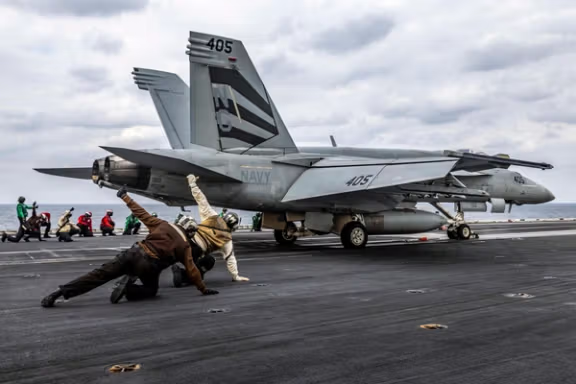
An F/A-18E Super Hornet, attached to Strike Fighter Squadron 151, launches from the flight deck of the USS Abraham Lincoln (CVN 72) while conducting routine flight operations in the Arabian Sea.

Escalating tensions between the United States and Iran sent oil prices sharply higher and kept gold near record levels on Thursday, as investors weighed the risk of a prolonged conflict in the Middle East and its impact on global markets.

Brent crude rose to around $70.50 a barrel after surging more than 4% in the previous session, while US crude climbed above $65, as traders priced in the possibility of supply disruptions from the oil-producing region.

“The balance of risks now tilts to a US strike after market close Friday,” said Michael Every, senior global strategist at Rabobank, adding that any military action could last weeks rather than ending quickly.

European shares also edged 0.1% lower on Thursday after a mixed set of corporate results, with energy stocks rising alongside firmer oil prices as US-Iran tensions kept investors cautious.

Increased US military activity in the region has left markets on edge, despite diplomatic efforts in Geneva this week aimed at narrowing differences over Iran’s nuclear program.

Safe-haven demand pushed spot gold up 0.5% to around $5,004 per ounce, after a more than 2% jump the previous day. US gold futures also edged higher.

“If there’s anything fundamental you could point to that would be supporting gold prices, it’s the prospect of conflict in the Middle East and the kind of safe-haven demand that goes along with it,” said Kyle Rodda, senior market analyst at Capital.com.

Gold has also drawn support from expectations that US interest rates could ease later this year, though minutes from the Federal Reserve’s January meeting showed policymakers were in no rush to cut rates and some remained open to further hikes if inflation stays elevated.

Asian equities were mixed, with gains in technology stocks offsetting caution over geopolitics. MSCI’s broadest index of Asia-Pacific shares outside Japan rose 0.4%, while Japan’s Nikkei gained 0.7%. South Korea’s Kospi jumped more than 3% to a record high, buoyed by renewed optimism over artificial intelligence-related shares.

Still, analysts said geopolitical risk was capping broader risk appetite.

“The two nations have long been at loggerheads over Iranian nuclear activity,” one market participant in Asia told Reuters, adding that any disruption to shipping routes or energy infrastructure could ripple through global supply chains.

For now, traders say oil and gold are likely to remain sensitive to headlines from Washington and Tehran, with volatility expected to persist as the prospect of military action looms.

Most Viewed

Iran negotiators ordered to return after internal rift over Islamabad talks
1
EXCLUSIVE

Iran negotiators ordered to return after internal rift over Islamabad talks

2
INSIGHT

What the US naval blockade would mean for Iran’s economy

3
EXCLUSIVE

Iran’s central bank warns economy may take 12 years to rebuild after war

4
INSIGHT

Iran's digital economy battered by prolonged blackout

5
PODCAST

Iran-US ceasefire nudges sidelined Arab states toward Israel, expert says

Banner
Banner

Spotlight

  • War damage amounts to $3,000 per Iranian, with blockade set to add to losses
    INSIGHT

    War damage amounts to $3,000 per Iranian, with blockade set to add to losses

  • Why the $100 billion Hormuz toll revenue is a myth
    ANALYSIS

    Why the $100 billion Hormuz toll revenue is a myth

  • US blockade targets Iran oil boom amid regional disruption
    ANALYSIS

    US blockade targets Iran oil boom amid regional disruption

  • Iran's digital economy battered by prolonged blackout
    INSIGHT

    Iran's digital economy battered by prolonged blackout

  • Iran-US ceasefire nudges sidelined Arab states toward Israel, expert says
    PODCAST

    Iran-US ceasefire nudges sidelined Arab states toward Israel, expert says

  • What the US naval blockade would mean for Iran’s economy
    INSIGHT

    What the US naval blockade would mean for Iran’s economy

  • Iran and US move forward in talks but tensions linger

    Iran and US move forward in talks but tensions linger

•
•
•

More Stories

Iran fortifies sites as nuclear talks stall and US tensions rise

Feb 19, 2026, 02:00 GMT+0

Satellite images published by Reuters on Wednesday show Iran repairing and reinforcing key military and nuclear‑linked sites amid stalled nuclear negotiations with the United States and an expanding US military presence in the region.

The imagery shows a new facility at the Parchin military complex covered with a concrete shield and soil, while tunnel entrances at the Isfahan nuclear site have been backfilled.

Tunnel access at Natanz and missile bases damaged during last June’s 12‑day conflict with Israel have also been strengthened.

The reconstruction appears designed to address weaknesses exposed during the brief war, when Israeli strikes targeted Iranian nuclear and military infrastructure and Tehran responded with missiles and drones.

The United States held five rounds of negotiations with Iran over its disputed nuclear program last year, for which Trump set a 60-day deadline.

When no agreement was reached by the 61st day on June 13, Israel launched a surprise military offensive, followed by US strikes on June 22 targeting key nuclear facilities in Isfahan, Natanz and Fordow.

Satellite images show the Parchin military complex before Israeli strikes in October 2024 (left) and the site covered with concrete in January 2026 (right). Planet Labs PBC/Handout via REUTERS
100%
Satellite images show the Parchin military complex before Israeli strikes in October 2024 (left) and the site covered with concrete in January 2026 (right). Planet Labs PBC/Handout via REUTERS

The fortification work comes as indirect nuclear talks in Geneva remain unresolved. Iran is preparing a written proposal to address US concerns, while Washington has reinforced its regional military posture, including carrier strike groups and additional naval assets, amid concerns that diplomacy could stall.

Satellite images show a building at Iran’s Qom missile base with roof damage on July 16, 2025 (top), and the same site with a new roof on Feb. 1, 2026 (bottom). Planet Labs PBC/Handout via REUTERS
100%
Satellite images show a building at Iran’s Qom missile base with roof damage on July 16, 2025 (top), and the same site with a new roof on Feb. 1, 2026 (bottom). Planet Labs PBC/Handout via REUTERS

The Reuters report said the combination of hardened facilities, ongoing military readiness, and persistent diplomatic negotiations reflects Tehran’s dual strategy of safeguarding strategic infrastructure while keeping open the possibility of a negotiated settlement.

Satellite images show Iran’s Shiraz South missile base before reconstruction on July 3, 2025 (right), and after repair and clearance work on Jan. 30, 2026 (left). Planet Labs PBC/Handout via REUTERS
100%
Satellite images show Iran’s Shiraz South missile base before reconstruction on July 3, 2025 (right), and after repair and clearance work on Jan. 30, 2026 (left). Planet Labs PBC/Handout via REUTERS

The United States has long insisted that Iran must completely halt its uranium enrichment program, stop supporting its armed allies in the Middle East and accept restrictions on its ballistic missile program.

Iran’s Supreme Leader Ali Khamenei said on Monday the United States will never succeed in toppling the Islamic Republic and warned that even the world’s strongest military can suffer crippling blows.

Money is leaving Iran faster as oil income falls and uncertainty mounts

Feb 18, 2026, 16:50 GMT+0
•
Dalga Khatinoglu

Capital flight from Iran is accelerating just as oil revenues decline, according to new data from the Central Bank of Iran—a convergence that helps explain the sharp fall of the national currency in recent months.

Central bank (CBI) figures show that, even before accounting for sanctions-evasion costs or discounts offered to Chinese buyers, the nominal value of Iran’s oil exports fell about 10 percent to $30.7 billion in the first half of the current Iranian fiscal year, which began on March 21, 2025.

Additional CBI data show that the nominal value of Iran’s total exports—including oil, non-oil goods and services—reached about $59 billion in the first six months of the fiscal year, while imports totaled roughly $48 billion.

On paper, that left a trade surplus of $11 billion. Yet during the same period, nearly $15 billion in capital left the country. That’s a record outflow that more than offset the surplus.

The outflows appear to be intensifying as Iran remains suspended between uncertain nuclear negotiations and the persistent risk of military escalation.

Earlier this month, US Treasury Secretary Scott Bessent said Iranian leaders were “wiring money out of the country like crazy,” but did not offer any more details.

CBI does not specify how much revenue was lost through sanctions circumvention. But a member of parliament’s Budget and Planning Commission recently said Iran earned only $20 billion from oil exports in the first eight months of the fiscal year—far below the nominal value of shipments.

Put simply, Iran’s actual oil income over eight months was substantially lower than the nominal value of exports recorded over six months, pointing to significant losses through price discounts and restricted access to proceeds.

Even those reduced revenues have not fully reached the government. Last month, Gholamreza Tajgardoon, head of parliament’s Joint Budget Commission, said only $13 billion of the $20 billion in oil export earnings had actually been received.

The figures underscore a dual constraint: Iran is not only earning less from its oil exports but is also struggling to access the revenue it does generate, limiting its ability to finance imports or stabilize domestic markets.

The gap has forced the government to rely increasingly on domestic borrowing.

Central bank data show that by November 2025, government debt to the banking system had risen 41 percent from a year earlier, while its debt to the central bank surged 68 percent. Commercial banks’ own borrowing from the central bank rose 63 percent over the same period.

In effect, the state has compensated for lost oil income by drawing on the banking system and expanding the money supply. Liquidity—a key driver of inflation and currency depreciation—rose more than 40 percent in November 2025 compared with a year earlier.

The consequences are visible in the exchange rate. The rial has depreciated roughly 75 percent since February last year.

Taken together, declining oil revenues, restricted access to export proceeds, record capital flight and rapid monetary expansion are reinforcing one another.

The prolonged state of geopolitical limbo appears to be amplifying those pressures, encouraging businesses and elites alike to move assets abroad and leaving the economy increasingly exposed to further instability.

Why regional powers are pushing to prevent a US-Iran war

Feb 18, 2026, 01:19 GMT+0
•
Ata Mohamed Tabriz

The latest round of Iran-US talks in Geneva on Tuesday would likely not have taken place without sustained pressure from regional powers that leveraged their close relations with Washington to help avert a wider war.

From Riyadh to Ankara and Doha, governments across the Middle East have moved with unusual urgency to contain the confrontation.

Their motives are not driven by abstract appeals for peace, but by hard calculation: war between Iran and the United States would expose their territory, economies and political stability to immediate risk.

This emerging consensus reflects a simple conclusion shaped by a decade of upheaval: a controlled crisis can be managed; a war cannot.

Turkey, Oman, Qatar, Saudi Arabia and Egypt have taken active diplomatic roles, encouraging negotiations and warning against escalation.

Iran, for its part, has sought to use these fears to its advantage, signaling that any US strike could trigger a broader regional conflict and effectively drawing its neighbors into the role of intermediaries.

Most of these states maintain closer ties with Washington than with Tehran. Yet their opposition to war is rooted less in sympathy for Iran than in their own vulnerability.

Mediators and stakeholders

Oman has played the most visible mediating role, hosting talks and serving as a trusted channel between the two sides. Muscat has repeatedly warned of the dangers to Persian Gulf security and maritime traffic, emphasizing diplomacy as the only viable path forward.

Qatar occupies a similarly delicate position. It hosts Al Udeid Air Base, the largest US military installation in the region, while maintaining functional ties with Tehran. Qatari officials have warned that any war would be “catastrophic,” and Doha’s dependence on uninterrupted gas exports makes it especially exposed to disruption.

Saudi Arabia, after years of confrontation with Iran, has adopted a more cautious posture. Crown Prince Mohammed bin Salman has emphasized avoiding escalation in contacts with both Tehran and Washington.

Saudi officials have also publicly supported diplomacy, reflecting concern that another regional war could threaten the kingdom’s economic transformation plans and expose its oil infrastructure to attack, as seen in the 2019 strikes on Aramco facilities.

Egypt, though geographically further removed, faces its own vulnerabilities. The security of the Suez Canal and Red Sea shipping lanes is critical to its economy, and Cairo fears a conflict could disrupt trade routes and deepen economic strain.

Turkey’s balancing act

Turkey, which shares a border with Iran and maintains deep economic ties with its neighbor, has intensified diplomatic efforts to prevent escalation.

President Recep Tayyip Erdoğan has repeatedly said Ankara does not want another war in the Middle East, while Foreign Minister Hakan Fidan has warned that military strikes would neither topple Iran’s leadership nor resolve the nuclear dispute.

War could trigger refugee flows, destabilize border regions and inflame ethnic tensions, particularly in Kurdish areas.

Yet Turkey’s NATO membership and longstanding security relationship with Washington limit its room for maneuver. In a conflict, Ankara would likely seek formal neutrality while quietly maintaining limited cooperation and positioning itself as a mediator.

Oppose war, prepare for it

Across the region, governments face a difficult reality: they depend on the United States for security while remaining exposed to Iran’s missiles, drones and allied militias.

This dual vulnerability explains their approach. They oppose war and are working to prevent it—but are also preparing for the possibility that diplomacy fails.

War could drive up oil prices, offering short-term gains for producers like Saudi Arabia and Qatar. But those benefits would be outweighed by the risks: attacks on infrastructure, disruption of shipping through the Strait of Hormuz or Suez Canal, and capital flight.

Their mediation efforts have helped create the conditions for talks in Muscat and Geneva. But their calculations remain shaped by geography and alliances.

If war breaks out, most would seek to avoid direct involvement while quietly aligning with Washington’s security framework to protect their territory and long-term interests.
Families across Iran defy pressure to honour January protest victims

Feb 17, 2026, 18:08 GMT+0

Memorial ceremonies marking 40 days since the killing of protesters were held across Iran this week despite a heavy security presence, with mourners gathering at gravesides, performing traditional rituals and often chanting against the country’s rulers.

Families of those killed in the January 8 and 9 crackdown had called for commemorations from Monday through Wednesday. Exiled prince Reza Pahlavi had also urged supporters to attend.

In the days leading up to the memorials, families reported calls from security agencies warning against gatherings. There were reports of cemetery closures in Arak and a heavy security presence at Tehran’s Behesht Zahra cemetery.

Videos sent to Iran International showed military vehicles and motorcycle patrols deployed in cities including Sanandaj in Kurdestan province and Chamestan in Mazandaran province.

Despite the restrictions, mourners gathered in multiple cities, applauding the slain, performing the “dance of grief” and chanting slogans.

In Abdanan in Ilam province, residents gathered in the streets ahead of ceremonies for local victims including Alireza Seidi and Yasin Elahi, chanting anti-government slogans including “Death to Khamenei,” according to videos and local sources.

Internet disruptions were reported in the area.

In Zanjan, attendees at the 40th-day ceremony for 17-year-old Mohammad Mahdi Ganjdanesh stood and applauded at his graveside. He was killed on January 8 after being shot in the head, according to people familiar with the case.

In Kermanshah, the family of 25-year-old Erfan Jamehshourani mourned at his grave during a ceremony on Monday. He was killed during the January crackdown, according to relatives.

Similar scenes were reported across central and northern Iran.

In Shahin Shahr in Isfahan province, mourners performed the dance of grief at the grave of 18-year-old Mohammadreza Ghorbani, whose father identified his body days later by recognizing a tattoo on his hand.

In Bandar Anzali, participants dressed in white and gathered for 29-year-old Milad Mianehkhah Monfared, a former youth player for Malavan football club who was killed on January 9. The ritual has become a symbol of mourning for those killed in the unrest.

In Noorabad Mamasani in Fars province, mourners sang at the grave of 64-year-old Abdolsadat Shamseddini, who was shot on January 10. In Baharestan in Isfahan province, relatives of 42-year-old Farhad Pourkaveh said his death would not be forgotten.

In Tehran, families marked the day by preparing and distributing traditional mourning foods such as saffron pudding and halva. At the grave of 24-year-old Mehdi Sepehran, a musician played handpan as mourners gathered.

At another ceremony, relatives released white doves in memory of Somayeh Yousefi, who was killed during the unrest.

The exact number of children killed remains unclear. The Coordination Council of Iranian Teachers’ Trade Associations has said at least 200 students were among the dead, highlighting the heavy toll among young people.

Some outlets inside Iran acknowledged the broader impact.

The moderate Rouydad24 news website wrote that the fortieth day had arrived “despite the deep wound left on society and public trust,” and noted that no meaningful effort had been made by authorities to address it.

At the same time, the government held its own ceremony in Tehran attended by senior officials including Vice President Mohammad Reza Aref and IRGC Quds Force commander Esmail Qaani, blaming what it described as terrorist elements for the violence—a stark contrast to the grassroots mourning taking place across the country.

US, Iran hold talks in Geneva under shadow of military threats

Feb 17, 2026, 07:56 GMT+0

The United States and Iran have begun indirect talks in Geneva on Tuesday under Omani mediation, with the threat of military action hanging over diplomacy and both sides still far apart on uranium enrichment and missiles.

The negotiations, mediated by Omani Foreign Minister Sayyid Badr Albusaidi, bring together US envoys Steve Witkoff and Jared Kushner and an Iranian delegation led by Foreign Minister Abbas Araghchi. The talks are expected to focus on uranium enrichment levels, sanctions relief and the economic benefits Iran seeks in return.

US President Donald Trump said he would be involved “indirectly” and signaled that Tehran may be open to a deal.

“I don’t think they want the consequences of not making a deal,” Trump told reporters aboard Air Force One on Monday, referring to previous US B-2 bomber strikes on Iranian nuclear targets last year. “We could have had a deal instead of sending the B-2s in.”

Yet even as diplomacy proceeds, the Pentagon is preparing for the possibility of weeks-long military operations should Trump order an attack, two US officials told Reuters.

Iran began military drills in the Strait of Hormuz on Monday, signaling the risk of confrontation in one of the world’s most critical oil shipping lanes.

The talks follow a failed attempt to revive negotiations last June that collapsed after Israel launched an air campaign against Iran, later joined by US strikes on nuclear facilities. Tehran says it has since halted uranium enrichment, though Western powers remain skeptical.

Iran enters the talks weakened by months of anti-government protests, suppressed at the cost of tens of thousands of lives, and by a sanctions-driven economic crisis that has sharply reduced oil revenues.

At the same time, Washington has deployed what Trump has described as a “massive” naval presence in the region.

Iran insists the negotiations must remain strictly nuclear in scope and has ruled out discussing its ballistic missile program, its support for regional militia groups or abandoning enrichment entirely. US officials have sought to broaden the agenda beyond nuclear issues.

On Monday, Araghchi met International Atomic Energy Agency chief Rafael Grossi in Geneva to discuss cooperation with the UN watchdog and technical aspects of the talks.

Iran says full sanctions relief is an essential component of any agreement, and the presence of economic and technical advisers in its delegation reflects that priority.