• العربية
  • فارسی
Brand
  • Iran Insight
  • Politics
  • Economy
  • Analysis
  • Special Report
  • Opinion
  • Podcast
  • Iran Insight
  • Politics
  • Economy
  • Analysis
  • Special Report
  • Opinion
  • Podcast
  • Theme
  • Language
    • العربية
    • فارسی
  • Iran Insight
  • Politics
  • Economy
  • Analysis
  • Special Report
  • Opinion
  • Podcast
All rights reserved for Volant Media UK Limited
volant media logo
ANALYSIS

Why regional powers are pushing to prevent a US-Iran war

Ata Mohamed Tabriz
Ata Mohamed Tabriz

Iran analyst

Feb 18, 2026, 01:19 GMT+0
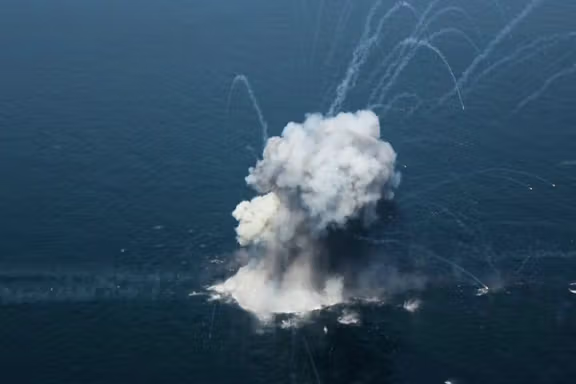
An explosion during an exercise in southern Iran, in this handout image obtained on February 17, 2026.

The latest round of Iran-US talks in Geneva on Tuesday would likely not have taken place without sustained pressure from regional powers that leveraged their close relations with Washington to help avert a wider war.

From Riyadh to Ankara and Doha, governments across the Middle East have moved with unusual urgency to contain the confrontation.

Their motives are not driven by abstract appeals for peace, but by hard calculation: war between Iran and the United States would expose their territory, economies and political stability to immediate risk.

This emerging consensus reflects a simple conclusion shaped by a decade of upheaval: a controlled crisis can be managed; a war cannot.

Turkey, Oman, Qatar, Saudi Arabia and Egypt have taken active diplomatic roles, encouraging negotiations and warning against escalation.

Iran, for its part, has sought to use these fears to its advantage, signaling that any US strike could trigger a broader regional conflict and effectively drawing its neighbors into the role of intermediaries.

Most of these states maintain closer ties with Washington than with Tehran. Yet their opposition to war is rooted less in sympathy for Iran than in their own vulnerability.

Mediators and stakeholders

Oman has played the most visible mediating role, hosting talks and serving as a trusted channel between the two sides. Muscat has repeatedly warned of the dangers to Persian Gulf security and maritime traffic, emphasizing diplomacy as the only viable path forward.

Qatar occupies a similarly delicate position. It hosts Al Udeid Air Base, the largest US military installation in the region, while maintaining functional ties with Tehran. Qatari officials have warned that any war would be “catastrophic,” and Doha’s dependence on uninterrupted gas exports makes it especially exposed to disruption.

Saudi Arabia, after years of confrontation with Iran, has adopted a more cautious posture. Crown Prince Mohammed bin Salman has emphasized avoiding escalation in contacts with both Tehran and Washington.

Saudi officials have also publicly supported diplomacy, reflecting concern that another regional war could threaten the kingdom’s economic transformation plans and expose its oil infrastructure to attack, as seen in the 2019 strikes on Aramco facilities.

Egypt, though geographically further removed, faces its own vulnerabilities. The security of the Suez Canal and Red Sea shipping lanes is critical to its economy, and Cairo fears a conflict could disrupt trade routes and deepen economic strain.

Turkey’s balancing act

Turkey, which shares a border with Iran and maintains deep economic ties with its neighbor, has intensified diplomatic efforts to prevent escalation.

President Recep Tayyip Erdoğan has repeatedly said Ankara does not want another war in the Middle East, while Foreign Minister Hakan Fidan has warned that military strikes would neither topple Iran’s leadership nor resolve the nuclear dispute.

War could trigger refugee flows, destabilize border regions and inflame ethnic tensions, particularly in Kurdish areas.

Yet Turkey’s NATO membership and longstanding security relationship with Washington limit its room for maneuver. In a conflict, Ankara would likely seek formal neutrality while quietly maintaining limited cooperation and positioning itself as a mediator.

Oppose war, prepare for it

Across the region, governments face a difficult reality: they depend on the United States for security while remaining exposed to Iran’s missiles, drones and allied militias.

This dual vulnerability explains their approach. They oppose war and are working to prevent it—but are also preparing for the possibility that diplomacy fails.

War could drive up oil prices, offering short-term gains for producers like Saudi Arabia and Qatar. But those benefits would be outweighed by the risks: attacks on infrastructure, disruption of shipping through the Strait of Hormuz or Suez Canal, and capital flight.

Their mediation efforts have helped create the conditions for talks in Muscat and Geneva. But their calculations remain shaped by geography and alliances.

If war breaks out, most would seek to avoid direct involvement while quietly aligning with Washington’s security framework to protect their territory and long-term interests.

Most Viewed

Iran negotiators ordered to return after internal rift over Islamabad talks
1
EXCLUSIVE

Iran negotiators ordered to return after internal rift over Islamabad talks

2
INSIGHT

What the US naval blockade would mean for Iran’s economy

3
EXCLUSIVE

Iran’s central bank warns economy may take 12 years to rebuild after war

4
INSIGHT

Iran's digital economy battered by prolonged blackout

5
PODCAST

Iran-US ceasefire nudges sidelined Arab states toward Israel, expert says

Banner
Banner

Spotlight

  • War damage amounts to $3,000 per Iranian, with blockade set to add to losses
    INSIGHT

    War damage amounts to $3,000 per Iranian, with blockade set to add to losses

  • Why the $100 billion Hormuz toll revenue is a myth
    ANALYSIS

    Why the $100 billion Hormuz toll revenue is a myth

  • US blockade targets Iran oil boom amid regional disruption
    ANALYSIS

    US blockade targets Iran oil boom amid regional disruption

  • Iran's digital economy battered by prolonged blackout
    INSIGHT

    Iran's digital economy battered by prolonged blackout

  • Iran-US ceasefire nudges sidelined Arab states toward Israel, expert says
    PODCAST

    Iran-US ceasefire nudges sidelined Arab states toward Israel, expert says

  • What the US naval blockade would mean for Iran’s economy
    INSIGHT

    What the US naval blockade would mean for Iran’s economy

•
•
•

More Stories

Iran and US move forward in talks but tensions linger

Feb 17, 2026, 16:20 GMT+0

Iran, the United States and their Omani mediators struck cautiously optimistic notes on Tuesday after a second round of nuclear talks in Geneva, with officials on all sides pointing to progress while emphasizing that significant hurdles remain.

Iran’s foreign minister, Abbas Araghchi, said the negotiations had produced “good progress” and opened a potential path toward a future agreement. But he also warned that diplomacy could not advance under military pressure, calling on Washington to desist from threats of force.

“Different ideas have been presented, these ideas have been seriously discussed,” Araghchi told Iranian media after the talks. He said the two sides had reached a general understanding on key “guiding principles” and now intended to begin working on the text of a potential agreement.

Oman’s foreign minister said there was “much work yet to be done,” but that both sides had left Geneva with “clear next steps” ahead of the next round of negotiations.

Axios quoted an unnamed US official as saying the talks had gone largely as expected, and that Iranian negotiators said they would return within two weeks with proposals aimed at addressing some of the gaps between the two sides.

The negotiations come amid persistent tensions and military signaling. The United States has bolstered its military presence in the Middle East in recent weeks, while President Donald Trump has warned of severe consequences if Iran fails to reach an agreement.

'Slap' against US military

Iran’s Supreme Leader Ali Khamenei struck a defiant tone as the talks unfolded, saying the United States would never succeed in toppling the Islamic Republic.

“The US president said in one of his recent remarks that for 47 years America has been unable to eliminate the Islamic Republic,” Khamenei said Tuesday. “I say: You, too, will not be able to do this.” He added that even “the strongest army in the world may at times receive such a slap that it cannot rise.”

Despite those pressures, Araghchi said a “new window of opportunity” had opened and expressed hope the talks could lead to a sustainable solution that recognizes Iran’s rights while addressing concerns over its nuclear program.

Still, fundamental differences remain.

Washington has been pushing to broaden discussions beyond Tehran’s nuclear activities to include its missile program, but Iranian officials say they are willing to negotiate only limits on nuclear work in exchange for sanctions relief.

Iran insists its nuclear program is peaceful, though it has enriched uranium far beyond levels needed for civilian power. The United States and its allies believe Iran is seeking the capability to build nuclear weapons, a charge Tehran denies.

Both sides are expected to exchange documents in the coming weeks before scheduling the next round of talks, with officials emphasizing that any final agreement remains uncertain.

US, Iran hold talks in Geneva under shadow of military threats

Feb 17, 2026, 07:56 GMT+0

The United States and Iran have begun indirect talks in Geneva on Tuesday under Omani mediation, with the threat of military action hanging over diplomacy and both sides still far apart on uranium enrichment and missiles.

The negotiations, mediated by Omani Foreign Minister Sayyid Badr Albusaidi, bring together US envoys Steve Witkoff and Jared Kushner and an Iranian delegation led by Foreign Minister Abbas Araghchi. The talks are expected to focus on uranium enrichment levels, sanctions relief and the economic benefits Iran seeks in return.

US President Donald Trump said he would be involved “indirectly” and signaled that Tehran may be open to a deal.

“I don’t think they want the consequences of not making a deal,” Trump told reporters aboard Air Force One on Monday, referring to previous US B-2 bomber strikes on Iranian nuclear targets last year. “We could have had a deal instead of sending the B-2s in.”

Yet even as diplomacy proceeds, the Pentagon is preparing for the possibility of weeks-long military operations should Trump order an attack, two US officials told Reuters.

Iran began military drills in the Strait of Hormuz on Monday, signaling the risk of confrontation in one of the world’s most critical oil shipping lanes.

The talks follow a failed attempt to revive negotiations last June that collapsed after Israel launched an air campaign against Iran, later joined by US strikes on nuclear facilities. Tehran says it has since halted uranium enrichment, though Western powers remain skeptical.

Iran enters the talks weakened by months of anti-government protests, suppressed at the cost of tens of thousands of lives, and by a sanctions-driven economic crisis that has sharply reduced oil revenues.

At the same time, Washington has deployed what Trump has described as a “massive” naval presence in the region.

Iran insists the negotiations must remain strictly nuclear in scope and has ruled out discussing its ballistic missile program, its support for regional militia groups or abandoning enrichment entirely. US officials have sought to broaden the agenda beyond nuclear issues.

On Monday, Araghchi met International Atomic Energy Agency chief Rafael Grossi in Geneva to discuss cooperation with the UN watchdog and technical aspects of the talks.

Iran says full sanctions relief is an essential component of any agreement, and the presence of economic and technical advisers in its delegation reflects that priority.

What would happen to Iran after the Islamic Republic?

Feb 16, 2026, 12:06 GMT+0
•
Amirhadi Anvari

Two competing futures are being sketched for Iran: a bleak “Syria-style” slide into chaos, or a more optimistic path grounded in economic research and detailed transition planning by the Iran Prosperity Project, tailored to the country’s specific realities.

To understand what could follow the Islamic Republic, it helps to start with where Iran stands now. As of February 2026, with the Islamic Republic still in power, tens of thousands of Iranians have been killed.

Inflation has surged: year-on-year inflation hit 60% in January, with annual inflation hovering at 45%. By comparison, Iraq’s inflation rate in 2002 – before Saddam Hussein was toppled – was around 19%, although Iraq had already lived through a severe five-year crisis from 1991 to 1995.

Years of politically mandated lending and the rapid expansion of private banks have pushed Iran into an acute banking crisis. Bank Ayandeh has collapsed, and by the Central Bank’s own criteria only nine banks in the country are not considered insolvent. The strain has now reached Bank Sepah, which pays the salaries of Iran’s military – an institution that itself was once created through mergers of military-linked banks to avert systemic failure.

Civilian deaths in the US-led invasion of Iraq to remove Saddam are widely estimated at roughly 7,000. In Iran, by contrast, at least 36,500 citizens were killed over two days and a matter of hours in what was described as a massacre – without any foreign military intervention – exceeding the toll of some of the largest wars and crackdowns in modern history over a comparable timeframe.

The economic disruption is already visible in daily life. In 2024, the state’s inability to supply gas in winter and electricity in summer meant at least one province was effectively shut for 72 of 291 working days. A survey by Iran’s Chamber of Commerce of more than 3,000 businesses found firms were operating at just 39% of capacity in autumn 2025.

Taken together, the figures suggest that even before the national uprising began in January 2026, Iran was already exhibiting the hallmarks of a country battered by war.

  • 36,500 deaths in context: How Iran’s toll compares with wars and crackdowns

    36,500 deaths in context: How Iran’s toll compares with wars and crackdowns

  • Iran crossed point of no return as protests collide with economic exhaustion

    Iran crossed point of no return as protests collide with economic exhaustion

Pessimistic scenarios

Since the mid-2010s – especially after the civil wars in Syria and Lebanon – much of the media conversation about a post-Islamic Republic Iran has centered on worst-case outcomes. Those arguments have resurfaced again in recent months. The main scenarios typically cited are:

War and foreign intervention: In a central power vacuum, neighboring states could intervene directly or back separatist groups. Yet after the fall of Iraq’s Baathist regime and the Taliban in Afghanistan, regime collapse did not automatically trigger large-scale foreign invasions.

The challenge of post-collapse security, the argument goes, is likely to be as much political as military.

The Iran Prosperity Project, launched in 2025 as a transition-era economic and governance blueprint supported by exiled Prince Reza Pahlavi, sets out an “emergency phase” handbook that urges early outreach to neighbors – particularly Pakistan, Saudi Arabia and Turkey – as a way to contain spillover risks and reduce the chances of destabilization after a collapse.

Fragmentation and civil war: Another fear is a spiral into armed conflict – either from forces loyal to the Islamic Republic resisting change, or from ideological and ethnic fighting on the model of Syria, Libya or Yemen – creating space for extremist groups such as ISIS and driving insecurity along Iran’s borders. Supporters of this view point to the danger of militia-style violence and state breakdown.

At the same time, the reported entry of at least 5,000 Iraqi mercenaries during the January crackdown could be read as a sign of uncertainty about the reliability of domestic forces.

And during the January uprising, the same pro-monarchy slogans were heard from Kurdish-majority Kermanshah to Turkish-dominant Tabriz and Baluch-majority Zahedan – alongside Tehran and Fars – without clear evidence of widespread ethnic or sectarian fracture, even as the risk is still seen as latent.

A rebranded Revolutionary Guard dictatorship: In this scenario, the Islamic Revolutionary Guard Corps (IRGC) fills the vacuum, consolidating power with a less overtly religious posture.

But the IRGC’s reach is already a central driver of international pressure on the current system, making it unlikely – under this reading – that foreign powers would accept its continued dominance after a collapse.

A drawn-out transition: A slower-motion breakdown is another widely cited possibility: deepening economic isolation, accelerating brain drain, sharp declines in production, rolling protests and a society worn down by exhaustion and uncertainty.

Disillusionment with transitional justice and a revival of the Islamic Republic: A further risk is political backlash if accountability is perceived as weak. Public anger over mass killings and systemic corruption could turn against a transitional administration if leading perpetrators are not quickly brought to justice and if assets transferred abroad – an outflow US Treasury Secretary Scott Bessent pointed to in January – cannot be traced and seized. In that climate, loyalist networks could regroup, backed by money moved offshore.

Planning for transition

By most economic and statistical measures, Iran under the Islamic Republic already bears the hallmarks of a war-damaged state. The January killings were unprecedented in scale over such a short period.

In recent years, the Iran Prosperity Project – backed by Prince Reza Pahlavi and affiliated with advocacy organization the National Union for Democracy in Iran – has developed an extensive policy framework for a post-Islamic Republic transition.

A series of white papers published on the project’s website address governance, energy, foreign policy, healthcare, industry and macroeconomic stabilization.

From these documents, the authors compiled an “Emergency Period Handbook” outlining how to manage the interval between regime collapse and the installation of a new government.

The latest version, released in summer 2025, spans 15 chapters and focuses on the first 100 to 180 days after the fall of the Islamic Republic.

Supporters describe it as the only fully structured opposition blueprint for the immediate post-collapse period, drafted by a 26-member team of specialists with input from additional unnamed advisers inside and outside Iran, whose identities are withheld for security reasons.

The plan assumes the absence of civil war and broad public backing for Prince Pahlavi during the transition.

Preventing famine and securing essential goods

One of the first challenges in any transition would be stabilizing supply chains.

Mohammadreza Jahanparvar, an economist involved in the project, told Iran International that financing essential imports would not be the primary obstacle.

“Funding essential goods is not particularly difficult,” he said. “The greater challenge is restoring communication and negotiation with suppliers. Iran has never been sanctioned on food.”

According to Jahanparvar, supplier countries have been identified and preliminary discussions held to allow imports to resume immediately after regime collapse.

Security, however, poses a parallel challenge. Control over ports, customs terminals and transportation corridors would be critical to prevent disruption. The handbook’s section on “Maintaining Core Functions” prioritizes the rapid restoration and protection of vital systems, including food production and healthcare, from day one through the first three months.

Maintaining uninterrupted flows of energy and water is another pillar. In its “Seize and Stabilize” section, the plan calls for securing key infrastructure – energy facilities, oil and gas installations, water systems and power plants – using vetted army units to deter sabotage. The criteria for vetting are not publicly detailed, likely for security reasons.

A related initiative, known as “National Cooperation,” was launched in July 2025. It invited civil servants, security personnel and members of the armed forces to signal their willingness to cooperate in a future transition by scanning a QR code broadcast during a live Iran International program. In August, Prince Pahlavi said 50,000 individuals had responded. Iran’s armed forces are estimated to number roughly 640,000.

  • Iran International message tool beams comfort to loved ones past net blackout

    Iran International message tool beams comfort to loved ones past net blackout

Financing the transition

Tehran’s draft budget for the next Iranian year (starting on March 21) projects total expenditures of 401,740 billion tomans (or 4,017.4 trillion rials) approximately $25 billion at an exchange rate of 1,620,000 rials to the dollar – equivalent to about $2 billion per month simply to sustain current operations.

Sanctions have frozen substantial Iranian assets abroad while also limiting the country’s external borrowing.

Jahanparvar estimates that between $100 billion and $200 billion in Iranian assets could potentially be recovered.

By comparison, oil export revenue in 2025 was estimated at between $30 billion and $60 billion, meaning recoverable assets could equal two to seven years of oil income.

Sanctions nonetheless pose a practical hurdle. Even if assets exist overseas, access would not be automatic during a transition. Jahanparvar argues that the US president could grant temporary three-month waivers, with comparable measures potentially adopted by European governments.

“Based on precedents in other sanctioned countries,” he said, “short-term exemptions pending formal legal review are both feasible and common.”

Other stopgap measures could include securing a modest loan from the United States – not primarily for its size, but for the signal it would send to global financial markets. Even if frozen assets remain temporarily inaccessible, they could serve as collateral to unlock short-term international financing.

“Iran has not drawn on its IMF quota since the 1960s,” Jahanparvar noted. “With the political constraints associated with the Islamic Republic removed, those channels could reopen.”

Pessimism or optimism?

All of these measures relate to the emergency phase immediately following a collapse.

If the more dire scenarios fail to materialize, the subsequent stabilization phase could see the return of thousands of Iranian entrepreneurs and professionals. With at least nine million Iranians living abroad, the diaspora represents a significant pool of capital, expertise and investment potential. During the national uprising, many demonstrated continued ties to their homeland.

The future remains uncertain and dependent on both internal dynamics and external actors. Yet one variable, proponents argue, lies largely in the hands of Iranians themselves: national cohesion.

Until 24 hours before the January 8-9 uprising, some questioned whether Prince Pahlavi commanded broad public backing. Then the largest street protests in the Islamic Republic’s history erupted.

For years, the Islamic Republic has invoked worst-case scenarios – “Syrianization,” lack of alternatives, war and insecurity – to discourage defections and blunt support for change.

Yet Iran’s economic indicators already resemble those of a country at war, and the two-day massacre exceeded even the Islamic Republic’s own official tally of 276 civilian deaths from Israel’s 12-day full-scale attack.

Iranian society and political actors may need to prepare for pessimistic outcomes. But at pivotal moments, the country’s recent history suggests, the public has shown an ability to defy the expectations of analysts.

Tehran’s oil lifeline shows signs of strain under tightening sanctions

Feb 16, 2026, 01:00 GMT+0
•
Dalga Khatinoglu

Iran’s oil exports declined sharply at the start of 2026, new tanker-tracking data show, raising fresh questions about the durability of Tehran’s most important economic lifeline under renewed US sanctions pressure.

Crude oil loadings from Iran’s Persian Gulf terminals fell to below 1.39 million barrels per day in January, a 26 percent drop from a year earlier, according to data from commodity intelligence firm Kpler reviewed by Iran International.

The decline extends a steady downward trend since October, suggesting sustained pressure rather than a temporary disruption.

The slowdown is most visible in China, Iran’s primary—and effectively only—major oil buyer under sanctions. Daily discharges of Iranian crude at Chinese ports fell to 1.13 million barrels per day last month, down from an average of around 1.4 million barrels per day in 2025.

Unsold Iranian crude is also accumulating at sea. The volume of oil stored on tankers has nearly tripled over the past year to more than 170 million barrels, a sign that shipments are becoming harder to sell or deliver.

Keeping that oil afloat is costly. Chartering a Very Large Crude Carrier typically costs more than $100,000 per day, and tankers carrying sanctioned Iranian oil command even higher rates due to legal and insurance risks. Analysts estimate that roughly one-fifth of Iran’s oil revenue is effectively consumed by these transport and storage costs.

Much of the oil remains stranded in Asian waters. About one-third of Iranian tankers are anchored offshore, while others move continuously or conduct ship-to-ship transfers to evade sanctions enforcement—tactics that have become standard within Iran’s so-called shadow fleet.

Sanctions are increasingly targeting those networks. According to Kpler, 86 percent of the tankers transporting Iranian oil over the past year have themselves been sanctioned by the United States, highlighting the expanding scope of enforcement.

The pressure has forced Iran to offer steep discounts to maintain sales. Iranian crude is currently priced about $11 to $12 per barrel below comparable benchmarks, up from a discount of roughly $3 per barrel early last year, significantly reducing Tehran’s net income.

The decline extends beyond crude oil. Exports of petroleum products such as fuel oil fell to about 350,000 barrels per day in January, down from 410,000 barrels per day a year earlier, with China and the United Arab Emirates among the main buyers.

Additional pressure may be coming. President Donald Trump recently signed an executive order imposing a 25 percent tariff on trade partners of Iran, a measure that could further deter companies and countries from handling Iranian oil.

The mounting economic strain provides important context for renewed indirect talks between Washington and Tehran.

For Iran’s leadership, easing sanctions remains the most direct path to stabilizing oil revenues and relieving fiscal pressure. But deep differences over Iran’s nuclear program, missile development, and regional activities make an agreement unlikely unless one side decides to compromise on core demands.

Taken together, the data suggest that Iran’s ability to sustain oil exports under sanctions—long a cornerstone of its economic resilience—is becoming more constrained.

Netanyahu orders steps to revoke citizenship of Israelis convicted of spying for Iran

Feb 15, 2026, 12:17 GMT+0

Israeli Prime Minister Benjamin Netanyahu has ordered legal proceedings to begin to revoke the citizenship of Israelis convicted of serious espionage on behalf of Iran, officials said, in what they described as an unprecedented move.

The directive, issued with the backing of Attorney-General Gali Baharav-Miara, instructs authorities to pursue revocation only after a final, binding conviction for severe espionage offenses linked to the Islamic Republic.

Netanyahu told a closed-door meeting that spying against Israel constituted “a fundamental breach of trust,” according to officials familiar with the discussion, Israeli media reported.

Under Israel’s Citizenship Law, nationality can be revoked for a breach of loyalty, including espionage or treason. The provision has rarely been used and was previously considered mainly in terrorism-related cases.

Officials said that in practical terms, individuals stripped of citizenship who hold no other nationality would retain permanent residency and could continue living in Israel, though they would lose civil rights such as voting.

Over the past two years, around 40 indictments have been filed against about 60 suspects accused of being recruited by Iran, according to officials. Israel’s Shin Bet security service has warned of a rise in Iranian efforts to recruit Israeli citizens, describing it as a growing national security threat.