• العربية
  • فارسی
Brand
  • Iran Insight
  • Politics
  • Economy
  • Analysis
  • Special Report
  • Opinion
  • Podcast
  • Iran Insight
  • Politics
  • Economy
  • Analysis
  • Special Report
  • Opinion
  • Podcast
  • Theme
  • Language
    • العربية
    • فارسی
  • Iran Insight
  • Politics
  • Economy
  • Analysis
  • Special Report
  • Opinion
  • Podcast
All rights reserved for Volant Media UK Limited
volant media logo
EXCLUSIVE

From call-up to cleanup: An operative’s insider account of Tehran’s killing nights

Shahed Alavi
Shahed Alavi

Iran International

Feb 18, 2026, 11:36 GMTUpdated: 19:54 GMT

A man who says he was deployed during Tehran’s January crackdown describes watching protesters shot and helping load bodies into refrigerated trucks, including a little girl whose earrings had been taken before her body was thrown inside.

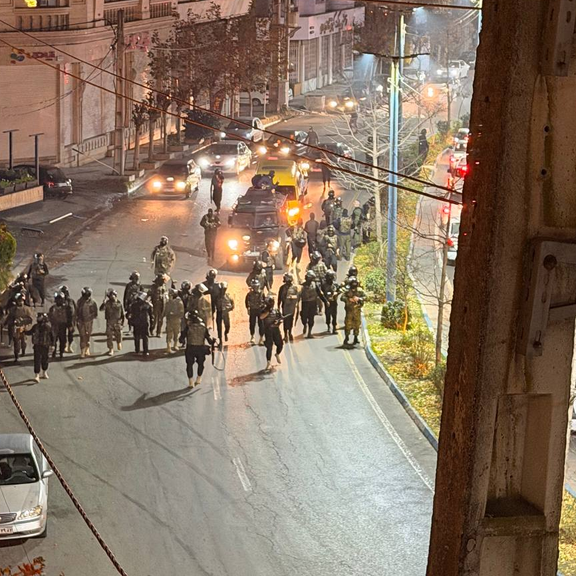
Kazem, a 40-year-old Tehran resident, says he was present as part of the state’s repression apparatus during two nights of mass violence, January 8 and 9.

He says he had previously spent a relatively long time in detention by the IRGC Intelligence Organization and was released after promising cooperation. He maintains that he did not kill anyone and that he fired only into the air.

His account, given in an extended interview, offers a detailed insider description of how forces were assembled, armed and deployed.

Certain personal and operational details are not being published for security reasons.

The call-up

Kazem says that on the afternoon of January 7, while returning home from work, he received a call from a security contact instructing him to report to the IRGC’s Vali-e Asr garrison at 10 a.m. the next morning.

The compound houses intelligence operations for Tehran province and coordinates deployments of security and plainclothes forces across the capital.

“I assumed it was related to Pahlavi’s call for January 8 and 9,” he said.

He says dozens of men were present when he arrived, some of whom he had seen during previous security mobilizations.

“There were two types of people,” he said. “Some looked like office employees or shopkeepers – probably like me, under their knife – and others looked like thugs and hooligans. Those were especially violent.”

Roughly 50 to 60 men were taken into a hall, he says, where an intelligence official outlined the “possibility of unrest” and said they would assist in “controlling riots.”

Those without firearms experience received brief weapons instruction. Pre-prepared authorizations were distributed for Kalashnikov rifles, handguns and ammunition.

“The document I received was a temporary mission order,” he said, “on the letterhead of the Mohammad Rasoulallah Corps” – the IRGC’s main Tehran command, responsible for coordinating IRGC Ground Forces and Basij operations in the capital – signed by a senior operations official at the Imam Ali headquarters, a Basij-affiliated security structure created to respond to street protests and internal unrest.

“I received a weapon from the armory and was told to report at 5 p.m. to the Qods Basij Resistance Base in Jannat Abad, northwestern Tehran”

From there, he says, groups were assigned geographic zones. Some moved two by two on motorcycles; others in Toyota Hilux or Peugeot vehicles. He says he was deployed to western Tehran before 8 p.m.

Hunting leaders and death ambushes

Kazem describes Sadeghieh, a bustling northwestern neighborhood of the capital, as one of the primary confrontation zones.

He says he observed what he calls two distinct operational patterns.

The first he describes as “hunting leaders.”

According to Kazem, experienced intelligence operatives infiltrated protest crowds while appearing to join demonstrators. Their task, he says, was to identify individuals perceived as organizers or focal points – often those who appeared physically fit or athletic.

“After identifying targets, at an opportune moment – such as in dark streets where lights had been cut – they would shoot them from behind at close range with handguns,” he said. “Or they would communicate with snipers stationed on nearby rooftops, giving descriptions of clothing so the target could be shot.”

He says rooftop snipers were positioned on multiple buildings in the area.

The second pattern, he says, involved steering crowds into enclosed spaces.

“They would drive and direct frightened people into dead-end alleys or places already under control,” he said. “This pattern was repeated many times Friday night in the part of Tehran where I was. The goal was to kill as many as possible. No one was meant to be arrested there. Many fell into ambushes and were killed.”

Multiple videos sent to Iran International, along with documented reports published by outlets including Reuters and verified by Amnesty International, indicate that snipers were positioned on rooftops – including on top of a police station – and fired at protesters’ heads and upper bodies.

One eyewitness told Iran International that on Sunday morning, January 11, even after municipal water trucks had washed the streets, blood traces were still visible along Ashrafi Esfahani Street in Sadeghieh.

According to information shared with Iran International, during an emergency meeting with Tehran medical officials on the morning of January 9, a senior health official said that aggregated figures from the city’s treatment centers up to that point showed at least 1,800 people had been killed in the crackdown on the evening of January 8.

Finishing shots

Kazem describes encountering injured protesters in southern Tehran in the early hours.

In one instance, he says, he approached a man who had lost a significant amount of blood.

“He pleaded, ‘I have a small child, don’t shoot,’” Kazem recalled.

“I told him to pretend to be dead so they wouldn’t give him a coup de grâce,” he said.

Minutes later, he says, a motorcycle stopped beside the wounded man.

“The officer kicked him to confirm he was alive, then shot him in the head at close range.”

Killing children and refrigerated trucks

Kazem says children were among those killed. Based on what he says he personally observed in Sadeghieh and in one southern Tehran district, he estimates that at least 200 children died over the two nights.

He says bodies were collected using refrigerated trucks belonging to the Mihan ice cream company, similar to methods he says were used during earlier protests.

“Like in the 2022 protests, refrigerated Mihan ice cream trucks were used,” he said. “I personally helped load corpses.”

According to Kazem, the trucks were used to remove bodies from streets and transport them to undisclosed locations.

He describes a scene that remains vivid to him.

“We were loading bodies into a Mihan truck when I saw the man next to me tear the necklace and earrings off a 9- or 10-year-old dead girl before throwing her into the truck. I looked at him in fear.”

Kazem says he did not intervene and continued loading bodies.

Reports suggest the removal operation was systematic.

Iran Human Rights said in a report published on February 3 that, citing an eyewitness in Lorestan province, security forces transported the bodies of those killed in refrigerated Mihan ice cream trucks to the courtyard of a hospital in the province.

Iran International contacted Mihan to ask whether the company’s trucks were used to move bodies during the January 8-9 protests and whether the company confirmed the account. No response had been received by the time of publication.

France 24 and Amnesty International’s Switzerland office have also reported the use of food transport vehicles and containers to move the bodies of those killed.

Burning property and foreign forces

Kazem says he personally witnessed security personnel setting fire to banks and mosques after first clearing valuables.

“They would first evacuate valuables before burning the site,” he said. “I personally witnessed instructions to remove valuable items from a mosque before it was set on fire.”

He also says he saw a small number of fighters affiliated with Iraq’s Popular Mobilization Forces in Sadeghieh on the first night.

“The absolute majority were IRGC, plainclothes, Basij and security forces,” he said. “But I did see a small number of Hashd al-Shaabi.”

In the areas where he was present, he says regular police and special units appeared less directly engaged in lethal force.

“I think they weren’t prepared for killing on that scale,” he said.

Media reports have confirmed a limited presence of Hashd al-Shaabi forces in some areas during the crackdown. Videos from inside Iran also suggest that damage to public property was carried out by security forces footage – that several outlets, including Le Monde, have verified.

Payment for the dead

Kazem says he returned his weapon to the Vali-e Asr garrison on Saturday morning and was no longer required.

He says that afterward he heard from contacts that families seeking the bodies of loved ones were sometimes required to pay money, calculated according to neighborhood and reported property damage.

“They couldn’t charge everyone for bullets,” he said. “But when they did, it was based on how much damage the neighborhood had suffered.”

Iran International has documented in multiple reports that authorities extorted money from bereaved families in exchange for returning the bodies of their loved ones.

Kazem’s narrative adds another piece to the picture: January 8 and 9 were not reactive policing, but a coordinated, military-style campaign designed to crush protests with deadly force.

Most Viewed

Worst outcome is Islamic Republic’s survival, ex-CIA official says
1
PODCAST

Worst outcome is Islamic Republic’s survival, ex-CIA official says

2
ANALYSIS

Iran brings unusually broad team to US talks to blunt future blame

3
INSIGHT

Tehran sends tough message but keeps diplomacy door open

4

Zoroastrian religious figure arrested in Iran

Banner
Banner

Spotlight

  • What the US naval blockade would mean for Iran’s economy
    INSIGHT

    What the US naval blockade would mean for Iran’s economy

  • Tehran sends tough message but keeps diplomacy door open
    INSIGHT

    Tehran sends tough message but keeps diplomacy door open

  • Worst outcome is Islamic Republic’s survival, ex-CIA official says
    PODCAST

    Worst outcome is Islamic Republic’s survival, ex-CIA official says

  • Why the Iran-US truce is more likely to buy time than peace
    ANALYSIS

    Why the Iran-US truce is more likely to buy time than peace

  • Engaged but uncommitted: China watches Iran and US fight and talk
    ANALYSIS

    Engaged but uncommitted: China watches Iran and US fight and talk

  • A truce for the world, a reckoning for Iran’s economy
    ANALYSIS

    A truce for the world, a reckoning for Iran’s economy

  • Targeting children: injured teen shot during protest, killed after arrest

    Targeting children: injured teen shot during protest, killed after arrest

  • 'Finish the job': accounts point to Iran's executions of injured protesters

    'Finish the job': accounts point to Iran's executions of injured protesters

  • Pay for bullets: How Iran pressures families after killing protesters

    Pay for bullets: How Iran pressures families after killing protesters

  • Who was behind Iran’s deadly crackdown?

    Who was behind Iran’s deadly crackdown?

•
•
•

More Stories

Security forces open fire as Iranians mark 40 days since crackdown

Feb 17, 2026, 21:29 GMT
•
Maryam Sinaiee

Iranians and the government held rival ceremonies Tuesday marking the 40th day after the January 8–9 protest killings, with families staging independent memorials as officials organized a state event critics called an attempt to “appropriate” the victims.

Security forces opened fire and imposed internet disruptions as Iranians held ceremonies marking 40 days since the January protest killings, while officials organized state-led commemorations for those they described as “martyrs.”

In the Kurdish town of Abdanan in Ilam province, activists and witnesses said security forces fired live rounds to disperse hundreds of mourners gathered at a cemetery.

Videos and accounts shared online appeared to show people fleeing as gunfire rang out during chants of “Death to Khamenei.”

Unconfirmed reports said several participants were seriously injured and that a 22-year-old man, Saeed-Reza Naseri, had been killed.

Reports of clashes and gunfire also emerged from Mashhad, where social media users said security forces confronted mourners.

Internet access was severely disrupted in both cities, according to users and monitoring accounts, continuing a pattern seen during previous periods of unrest.

At the same time, the government organized its own official ceremonies, including a state event Tuesday at Tehran’s Imam Khomeini Prayer Grounds attended by senior officials such as First Vice President Mohammad Reza Aref, government spokesperson Fatemeh Mohajerani and Esmail Qaani, commander of the Islamic Revolutionary Guard Corps’ Quds Force.

A parallel ceremony was held at the Imam Reza shrine in Mashhad.

State media and senior officials have described the January unrest as an “American-Zionist sedition.” Participants at the official ceremony chanted “Death to America” and “Death to Israel,” and the event featured Quran recitations, religious eulogies and official tributes.

The official commemorations contrasted sharply with independent ceremonies held by families, which often included music, clapping and traditional mourning rituals.

Others questioned official claims that “terrorists” were responsible for the deaths, pointing to continued security pressure on families attempting to hold independent memorials.

Online, many Iranians accused authorities of attempting to control the narrative of the killings. “They kill and then send text messages inviting people to attend a 40th-day ceremony,” one user wrote on social media.

Despite the pressure, families of those killed held independent memorials in cemeteries across Tehran and dozens of other cities and towns. Participants in several locations chanted slogans including “Death to the dictator” and carried photos of victims, many of them young.

In Najafabad in Isfahan province, a large crowd marched toward a cemetery holding portraits of those killed. Demonstrators chanted: “We didn’t surrender lives to compromise, or to praise a murderous leader,” according to videos circulating online.

Users reported a heavy security presence at cemeteries nationwide, and in some cases closures intended to prevent crowds from assembling.

Rights groups and social media accounts said families faced pressure from security agencies to limit gatherings or avoid overtly political messaging.

The parallel ceremonies underscored the continuing divide between the state’s portrayal of the unrest and the experience of families and communities still mourning those killed.

Forty days on, even insiders question Tehran’s protest narrative

Feb 17, 2026, 19:23 GMT
•
Behrouz Turani

Forty days after Iran’s deadly January crackdown, senior officials repeated claims of foreign influence while some insiders—even from the hardline camp—offered sharply different explanations.

The fortieth day after a death carries special significance in Shiite tradition, often marking a moment of collective mourning and reflection.

Families of those killed in the January 8 and 9 crackdown marked the occasion this week with memorial ceremonies across the country, even as authorities maintained a heavy security presence.

On February 17, Supreme Leader Ali Khamenei, President Massoud Pezeshkian and Parliament Speaker Mohammad Bagher Ghalibaf repeated the government’s longstanding assertion that foreign forces played a decisive role in fueling the protests.

At the same time, officials acknowledged that some of those killed were “innocent,” drawing a distinction that appeared intended to preserve the official narrative while recognizing the scale of the bloodshed.

Yet beneath that public consensus, alternative interpretations are emerging—even from figures long associated with the system.

Hassan Beyadi, a hardliner and secretary-general of the Abadgaran (Developers) Party, which helped propel Mahmoud Ahmadinejad to the presidency in 2005, offered a starkly different assessment in an interview with Khabar Online.

“People came to the streets because their dignity was trampled by politicians,” Beyadi said, describing the unrest as a reaction to corruption, discrimination and violations of basic citizenship rights.

Only “essential changes in the structure of the system and its economic policies” could restore public trust, he added.

A more conservative but still revealing analysis came from Abbas Ghaemi, a director at the Social Analysis Center of Imam Sadeq University, an institution closely tied to the Islamic Republic’s political elite.

Ghaemi argued that many participants in the January protests had already been shaped by previous waves of unrest, including the 2009 Green Movement, the 2018 and 2019 economic protests and the 2022 Women, Life, Freedom uprising.

“We are facing a society that has tried many different ways without achieving results,” he said.

Ghaemi emphasized the need for dialogue between society and the political system, an idea that has surfaced periodically within establishment circles but has rarely translated into sustained engagement.

Iran’s Supreme Leader, who holds ultimate authority over state policy, has never granted a media interview during his more than three decades in power.

Analyses published in Iranian media since the crackdown point to broader structural concerns, with some commentators describing a society marked by declining trust, growing anger and widening distance between the state and its citizens.

Former government spokesman Ali Rabiei, writing in the reformist-leaning newspaper Etemad, warned against attempts to channel public anger into state-controlled expressions of mourning.

“Looking at the frosty streets of Iran in Winter 2026,” he wrote, “it is clear that turning angry protesters into mourning protesters and vice versa reflects the inefficiency of a policy that will lead to one crisis after another if the system remains unreformed.”

Such warnings suggest the state may be struggling to fully impose its narrative of the unrest, even within establishment circles.

Families across Iran defy pressure to honour January protest victims

Feb 17, 2026, 18:08 GMT

Memorial ceremonies marking 40 days since the killing of protesters were held across Iran this week despite a heavy security presence, with mourners gathering at gravesides, performing traditional rituals and often chanting against the country’s rulers.

Families of those killed in the January 8 and 9 crackdown had called for commemorations from Monday through Wednesday. Exiled prince Reza Pahlavi had also urged supporters to attend.

In the days leading up to the memorials, families reported calls from security agencies warning against gatherings. There were reports of cemetery closures in Arak and a heavy security presence at Tehran’s Behesht Zahra cemetery.

Videos sent to Iran International showed military vehicles and motorcycle patrols deployed in cities including Sanandaj in Kurdestan province and Chamestan in Mazandaran province.

Despite the restrictions, mourners gathered in multiple cities, applauding the slain, performing the “dance of grief” and chanting slogans.

In Abdanan in Ilam province, residents gathered in the streets ahead of ceremonies for local victims including Alireza Seidi and Yasin Elahi, chanting anti-government slogans including “Death to Khamenei,” according to videos and local sources.

Internet disruptions were reported in the area.

In Zanjan, attendees at the 40th-day ceremony for 17-year-old Mohammad Mahdi Ganjdanesh stood and applauded at his graveside. He was killed on January 8 after being shot in the head, according to people familiar with the case.

In Kermanshah, the family of 25-year-old Erfan Jamehshourani mourned at his grave during a ceremony on Monday. He was killed during the January crackdown, according to relatives.

Similar scenes were reported across central and northern Iran.

In Shahin Shahr in Isfahan province, mourners performed the dance of grief at the grave of 18-year-old Mohammadreza Ghorbani, whose father identified his body days later by recognizing a tattoo on his hand.

In Bandar Anzali, participants dressed in white and gathered for 29-year-old Milad Mianehkhah Monfared, a former youth player for Malavan football club who was killed on January 9. The ritual has become a symbol of mourning for those killed in the unrest.

In Noorabad Mamasani in Fars province, mourners sang at the grave of 64-year-old Abdolsadat Shamseddini, who was shot on January 10. In Baharestan in Isfahan province, relatives of 42-year-old Farhad Pourkaveh said his death would not be forgotten.

In Tehran, families marked the day by preparing and distributing traditional mourning foods such as saffron pudding and halva. At the grave of 24-year-old Mehdi Sepehran, a musician played handpan as mourners gathered.

At another ceremony, relatives released white doves in memory of Somayeh Yousefi, who was killed during the unrest.

The exact number of children killed remains unclear. The Coordination Council of Iranian Teachers’ Trade Associations has said at least 200 students were among the dead, highlighting the heavy toll among young people.

Some outlets inside Iran acknowledged the broader impact.

The moderate Rouydad24 news website wrote that the fortieth day had arrived “despite the deep wound left on society and public trust,” and noted that no meaningful effort had been made by authorities to address it.

At the same time, the government held its own ceremony in Tehran attended by senior officials including Vice President Mohammad Reza Aref and IRGC Quds Force commander Esmail Qaani, blaming what it described as terrorist elements for the violence—a stark contrast to the grassroots mourning taking place across the country.

Iran’s probe into protest violence struggles to gain credibility

Feb 17, 2026, 17:09 GMT
•
Maryam Sinaiee

Tehran's decision to form a committee to investigate violence during January protests has been met with widespread skepticism, including from some moderate voice inside Iran who say only an independent investigation can establish credibility.

The administration of President Masoud Pezeshkian announced on January 21 that it had created a committee to examine the causes and consequences of the unrest. Government spokesperson Fatemeh Mohajerani said the body is collecting documents and testimony related to the violence.

Critics across Iran’s political spectrum have questioned whether a government-appointed panel can impartially investigate events in which state institutions themselves are accused of involvement.

The United Nations Human Rights Council has already mandated an independent fact-finding mission to investigate alleged serious rights violations linked to the protests.

Established after the 2022 “Woman, Life, Freedom” uprising and extended in January 2026, the mission has never been permitted to enter Iran. Tehran has refused to cooperate with the UN inquiry, dismissing it as politically motivated.

Even moderate commentators—who typically favor gradual change within the system—have questioned the credibility of the government’s initiative.

The reformist newspaper Tose’e Irani wrote that rebuilding public trust would require participation from figures independent of the state.

“For the report of the committee investigating the January events to be credible,” it said, it must include “independent lawyers, human rights activists and even prominent Iranian academics living abroad.”

Journalist Ahmad Zeidabadi similarly warned that any internal investigation would face deep public suspicion.

“What is the problem with inviting the UN High Commissioner for Human Rights to send a professional team to investigate?” he wrote, arguing that “only a credible international report can end the conflict of narratives.”

Lawyer and political activist Hassan Younesi urged the president to pursue a genuinely independent inquiry, while journalist Hossein Yazdi wrote that a committee would be trusted only if formed by individuals “not themselves accused.”

Public distrust reflects a broader history of disputed official investigations.

Many Iranians have cited previous cases—including the 1999 attack on Tehran University dormitories, the 2020 downing of a Ukrainian passenger plane that killed 176 people, and the death of Mahsa Amini in morality police custody—as examples where official explanations were widely contested.

Iran’s presidential office says 3,117 people died in the January unrest, including more than 2,400 civilians and security personnel whom authorities say were killed by “foreign enemy agents.”

That figure has been widely challenged. Human rights groups and independent media have reported far higher death tolls. Iran International has reviewed leaked internal government documents indicating the toll may be as high as 36,500.

Allegations from within Iran’s own political establishment have further fueled skepticism.

In a leaked audio recording, reformist politician Ali Shakouri-Rad said security institutions had “deliberately injected violence into the scene” to justify a sweeping crackdown, describing such conduct as “systematic” in Iran’s security policies.

Former president Mahmoud Ahmadinejad has made similar claims, saying forces within the state were responsible for protest deaths.

Pezeshkian initially dismissed Shakouri-Rad’s remarks as “unfair,” but later softened his position, saying he had ordered further investigation into the allegations and authorized additional review through relevant officials.

For many critics, the central question remains whether institutions accused of responsibility for violence can credibly investigate themselves, especially while Tehran rejects all international scrutiny, even refusing to recognise the UN investigators’ mandate.

Iran says parts of Strait of Hormuz shut briefly during Guards drills

Feb 17, 2026, 13:16 GMT

Iran’s Revolutionary Guards carried out naval drills in and around the Strait of Hormuz on Tuesday and said parts of the strategic waterway were closed for several hours, as Iran and the United States held indirect nuclear talks in Geneva.

Iranian media said the temporary restriction was linked to the “Smart Control of the Strait of Hormuz” exercise and was aimed at ensuring safety and navigation principles during the drill.

Tehran has repeatedly warned in the past that it could close the strait if attacked, a step that would disrupt one of the world’s most vital oil export routes.

Guards navy commander Alireza Tangsiri said Iran’s forces were ready to shut the strait if ordered by the country’s leadership.

“The decision to close the Strait of Hormuz rests with the senior leaders, and as a soldier I say we are ready to carry it out whenever our leaders say,” Tangsiri was quoted as saying while overseeing the main phase of the exercise.

100%

Tangsiri said the weapons used in wartime could differ from those displayed in drills. “The weapons that enter the field on the day of war are not necessarily the same as the equipment used in exercises,” he said, signaling that Iran’s operational capabilities extend beyond what is shown publicly.

Iranian outlets described the drills as a combined exercise involving Guards naval combat and rapid-reaction units, with a range of offensive and defensive systems deployed. They reported that missiles were fired toward designated targets and that drone units carried out reconnaissance and attack missions under conditions of signal jamming.

The exercise began from Iran’s Persian Gulf islands – including Abu Musa, Greater Tunb, Lesser Tunb and Sirri – which Iranian media described as key positions for overseeing shipping there and the western approaches to the Strait of Hormuz. The reports said the drill included elements of electronic warfare and simultaneous launches from land and sea.

Iran’s Supreme Leader Ali Khamenei, referring to US naval deployments, was quoted as saying that an American aircraft carrier was dangerous but that “more dangerous than it is the weapon that can send it to the bottom of the sea.”