• العربية
  • فارسی
Brand
  • Iran Insight
  • Politics
  • Economy
  • Analysis
  • Special Report
  • Opinion
  • Podcast
  • Iran Insight
  • Politics
  • Economy
  • Analysis
  • Special Report
  • Opinion
  • Podcast
  • Theme
  • Language
    • العربية
    • فارسی
  • Iran Insight
  • Politics
  • Economy
  • Analysis
  • Special Report
  • Opinion
  • Podcast
All rights reserved for Volant Media UK Limited
volant media logo

Targeting children: injured teen shot during protest, killed after arrest

Negar Mojtahedi
Negar Mojtahedi

Iran International

Feb 17, 2026, 00:27 GMT+0
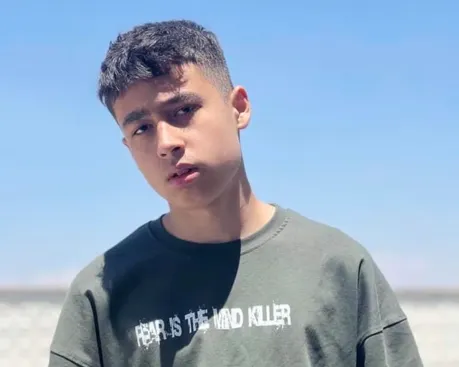
Sam Afshari, 17, was wounded during nationwide protests in Iran and taken away alive by security forces before later being shot and killed, according to human rights investigators.

A 17-year-old protester wounded during Iran’s January protests was later killed after being taken into custody by security forces, according to testimony and forensic analysis gathered by the Iran Human Rights Documentation Center (IHRDC).

Human rights investigators say evidence indicates Sam Afshari was alive when security forces detained him in the city of Karaj, but was later killed by a gunshot wound to the head consistent with an execution carried out after his arrest.

“The bullet entered through the back of his head and exited through his face," Shahin Milani, IHRDC Executive Director told Iran International.

"The injury he sustained during the protests was not the shot that killed him,” Milani said.

Before leaving to join the protests, Sam sent a final message to his father on Jan 7.

“Dad, don’t tell mom anything. I’m going to fight for my rights. Iran is in danger. Please don’t tell my mother.”

His father, Parviz Afshari, who lives in Germany, would spend days searching for answers after his son disappeared.

According to Milani, testimony gathered from the family indicates that Sam’s initial injury during the protests was not fatal.

Residents living nearby Taleghani Square in Karaj saw that Sam had been wounded and attempted to bring him inside to help. Before they could do so, security forces arrived and dragged him away while he was still alive, according to his father’s account.

"The inhuman repressive forces dragged my son," Parviz told IRHDC in a video recording.

After that, he vanished.

“When his family eventually recovered his body, it was clear he had been shot again,” Milani said.

Where the fatal shooting occurred remains unclear. Sam’s father received conflicting accounts — one suggesting it may have happened at a medical facility and another claiming detainees were shot while being transported. Investigators say those details cannot yet be independently confirmed, but the available evidence indicates he was killed after arrest.

Sam's father described him as an exceptionally talented teenager — a computer science prodigy, a competitive swimming champion and fluent in multiple languages.

100%

Milani said interviewing the father was deeply personal, underscoring how the profile of victims in Iran has changed over time.

“The father is nearly my age,” Milani said. “It forces you to realize that the young people being killed today are children who could have been our own.”

Sam Afshari’s case is part of a broader pattern emerging from Iran’s January crackdown, during which students and minors were among those killed. An Iranian teachers’ union has published the names of roughly 200 students killed during the protests, describing the list as both a record of loss and a demand for accountability.

At least 24 children, including a three-year-old, were killed by direct fire from security forces during Iran’s nationwide protests, according to the HANA Human Rights Organization. The group said it confirmed the identities of the children through on-the-ground research and cross-checking multiple sources.

HANA said the shooting of children was not an isolated incident but part of a systematic pattern, with gunfire in many documented cases directed at vital parts of the body.

For Sam's father - the loss is already painfully clear — a teenager who left home believing he was fighting for his future and never returned.

Sam had been preparing to join him in Germany later this year — a plan that ended before it could begin.

100%

Most Viewed

US blockade enters murky phase as tankers spoof signals and buyers hesitate
1
ANALYSIS

US blockade enters murky phase as tankers spoof signals and buyers hesitate

2

US tightens financial squeeze on Iran, warns banks over oil money flows

3
INSIGHT

Ideology may be fading in Iran, but not in Kashmir's ‘Mini Iran'

4
INSIGHT

Hardliners push Hormuz ‘red line’ as US blockade tests Iran’s leverage

5
VOICES FROM IRAN

Hope and anger in Iran as fragile ceasefire persists

Banner
Banner

Spotlight

  • Hardliners push Hormuz ‘red line’ as US blockade tests Iran’s leverage
    INSIGHT

    Hardliners push Hormuz ‘red line’ as US blockade tests Iran’s leverage

  • Ideology may be fading in Iran, but not in Kashmir's ‘Mini Iran'
    INSIGHT

    Ideology may be fading in Iran, but not in Kashmir's ‘Mini Iran'

  • War damage amounts to $3,000 per Iranian, with blockade set to add to losses
    INSIGHT

    War damage amounts to $3,000 per Iranian, with blockade set to add to losses

  • Why the $100 billion Hormuz toll revenue is a myth
    ANALYSIS

    Why the $100 billion Hormuz toll revenue is a myth

  • US blockade targets Iran oil boom amid regional disruption
    ANALYSIS

    US blockade targets Iran oil boom amid regional disruption

  • Iran's digital economy battered by prolonged blackout
    INSIGHT

    Iran's digital economy battered by prolonged blackout

•
•
•

More Stories

New accounts detail mass killing at Soleimani statue protest in Iran

Feb 16, 2026, 20:56 GMT+0
•
Masoud Kazemi

New details from eyewitnesses and medical staff in Iran’s southeastern city of Kerman indicate that security forces opened fire and killed dozens of protesters attempting to reach a statue of slain IRGC commander Qassem Soleimani in early January.

Witnesses said the violence unfolded on the evening of January 8 around Azadi Square, where one of the country’s most prominent monuments to Soleimani stood.

Protests in Kerman had begun days earlier with small, scattered gatherings around the city’s bazaar and residential neighborhoods, residents said. But by late afternoon on January 8, significantly larger crowds, including families, were moving toward the square.

One resident said Azadi Square had gradually become a focal point for protesters in the preceding days, despite the absence of formal calls to gather. Videos reviewed by Iran International show the Soleimani statue set on fire during the unrest.

According to a member of the medical staff at a Kerman treatment center, at least 70 protester deaths were registered in the city’s hospitals. He said the figure included only those formally recorded in medical facilities and did not capture all fatalities.

Iran’s government has not provided city-level breakdowns of protest deaths but leaked documents obtained and reviewed by. Iran International shows up to 36,500 people were killed across the country on those two days.

Witnesses said security forces had deployed in force around Azadi Square before peak gathering hours, blocking roads with vehicles and personnel to prevent crowds from reaching the monument. Protesters instead gathered along surrounding streets, including Jomhouri Boulevard, Khajoo intersection, and Bahmanyar and Esteghlal streets.

One protester said security forces initially used tear gas, pellet fire and warning shots. Drones were visible overhead between roughly 7:00 and 8:00 p.m. By around 8:00 p.m., he said, live ammunition was being fired directly at crowds.

He said some of the heaviest clashes occurred near Khajoo intersection and along Jomhouri Boulevard, where large crowds had formed. Witnesses also reported gunfire from elevated positions on nearby buildings, though this could not be independently verified.

Because of the concentration of hospitals, clinics and medical complexes near Azadi Square, many wounded protesters were able to reach treatment facilities quickly. Medical staff described treating gunshot wounds, severe bleeding and respiratory injuries caused by tear gas exposure.

In the days that followed, security forces detained medical personnel who had assisted protesters, according to a healthcare worker familiar with the arrests. He said at least 10 doctors in Kerman had been detained, though only two—Amir Shafiei and Saman Salari—have been publicly identified.

Witnesses said the scale of the January 8 turnout had been significantly larger than previous protests in the city. Some participants said the presence of families and older residents created a false sense of safety, leading many to underestimate the likelihood of lethal force.

A woman who took part in the protests said clashes continued across multiple neighborhoods late into the night and into the following day. Tear gas and gunfire affected large areas of the city, forcing residents indoors.

She also described the sudden appearance of motorcyclists who vandalized banks and government buildings while security forces present at the scene did not intervene. After the motorcyclists left, she said, security forces moved against protesters. The identities and affiliations of the motorcyclists could not be independently confirmed.

The crackdown was followed by widespread arrests and legal action, according to a lawyer in Kerman familiar with the cases. He said detainees were frequently moved between facilities, making it difficult for families to determine their whereabouts.

The lawyer said at least 30 detainees have been charged with “moharebeh,” or waging war against God, a capital offense under Iranian law. He also reported that approximately 500 detainees had received prison sentences, including medical staff and young protesters, while many others remained in legal limbo.

These figures could not be independently verified.

Families have often been reluctant to publicize arrests or disappearances, he said, citing fear of retaliation and reports of abuse in detention.

Among those whose deaths have been publicly confirmed were Mehdi Khosravi, 24, who was shot on January 8, and Ehsan Jafari, a university student who died weeks later after being wounded during the protests. Other victims included students, teachers and residents from across Kerman province.

The protests in Kerman focused in part on the Soleimani statue, which has become a symbol of state authority in the city where the general is buried.

Residents said many protesters viewed the monument as a representation of the political system itself. Their attempt to topple it was met by a brutal force that turned the surrounding streets into one of the deadliest flashpoints of unrest in the city.

The full death toll in Kerman remains unknown.

Death sentences issued for at least 14 detained in Iran protests

Feb 16, 2026, 19:26 GMT+0

Iran has sentenced at least 14 protesters to death in group online trials, people familiar with the matter told Iran International, with additional indictments accusing detainees of acting against the country’s security on calls from the US president and Israel.

The trials were presided over by Judge Abolghasem Salavati, head of Branch 15 of Tehran’s Revolutionary Court, who is widely known for handing down severe sentences in protest-related and political cases, the sources said.

Salavati has been holding simultaneous virtual hearings in which detainees are tried in groups of 14, according to the sources.

Among those sentenced is Abolfazl Karimi, a detained protester who the sources said had told his family in a phone call that he had been subjected to forced confessions under beatings and torture.

Karimi is the father of a young child and previously worked as a motorcycle courier in eastern Tehran.

He was arrested on January 6 while returning from work in Tehran’s Hengam neighborhood, where he encountered two injured women whose legs had been hit by gunfire from security forces, the sources said.

When he went to assist them, officers shot his leg with pellet rounds and arrested him along with the two wounded women, the sources added.

After about a month in detention in Greater Tehran Prison, he was recently transferred along with around 50 other protesters to Ghezel Hesar Prison, the sources said.

In a later phone call, Karimi told his family he had been tortured without medical treatment for his wounds and, while blindfolded, was forced to sign papers containing confessions against himself, according to the sources.

100%

In recent days, Iran’s judiciary has intensified the process of trying protesters detained during the nationwide protests and issuing death sentences, the sources said.

On Monday Tehran Revolutionary Court, also presided over by Salavati, sentenced 19-year-old Mohammadamin Biglari to death on the charge of “enmity against God,” and the case has been referred to the Supreme Court, the sources said.

Biglari was arrested on January 8 on Tehran’s Damavand Street.

His mother is deceased, and his father was unaware of his fate for weeks, searching for him among bodies in Kahrizak before authorities informed him after three weeks that his son had been detained, the sources said.

Separately, on Sunday, the judiciary announced the first hearing session for three detained protesters—Ehsan Hosseinipour Hesarloo, Matin Mohammadi and Erfan Amiri—on charges including allegedly setting fire to Seyed al-Shohada Mosque in Pakdasht and alleged participation in murder.

Other charges against the three were announced as “assembly and collusion to appear and act against the country’s internal security following calls on hostile social media, particularly the US president and the Zionist regime (Israel)…” according to the judiciary-affiliated Mizan News Agency.

Norway-based rights group Hengaw said the case against the three was marred by due process violations.

"The hearing was held despite reports that the detainees have been denied basic rights since their arrest, including access to a lawyer of their choice and contact with their families. They were subjected to intense pressure and torture during detention and compelled to provide forced confessions," Hengaw said.

Tens of thousands of people have been arrested during the nationwide protests, many facing heavy charges, the sources said.

Some families have reported being pressured by security bodies to refrain from speaking to media or publicly discussing the cases of detained relatives, the sources added.

Security forces raid western Iran village, arrest hundreds

Feb 16, 2026, 17:22 GMT+0

Security forces raided the village of Chenar in Asadabad county, Hamedan province, arresting hundreds of residents after surrounding the area early Monday, people familiar with the matter told Iran International.

The raid began at around 4:30 a.m., involving dozens of armored vehicles as well as several minibuses and vans, sources said. Forces also deployed four DShK heavy machine guns on the rooftops of some homes across the village.

Sources said detained residents were paraded through the city in vehicles fitted with cage bars before being transferred to the Asadabad police station.

Several villagers were injured during the mass arrests and some detainees were severely beaten by officers, sources said.

Residents who gathered outside the police station seeking information about those detained reported hearing shouting and cries from inside the building, sources added.

A source familiar with the matter said Chenar residents had been highly active during the nationwide protests in December and January and that the slogan “Khamenei the murderer — dream on” was first chanted in the village.

The source added that villagers had drawn attention during demonstrations by carrying Iran’s pre-1979 Lion and Sun flag.

According to the source, residents buried slain protesters without ritual washing, departing from Islamic burial rites, and recited passages from the Persian epic Shahnameh at their funerals.

Sources also said the area’s Friday prayer leader had told village elders they would be “disciplined” over their role in the protests.

Previous videos published by Iran International showed Chenar residents carrying Lion and Sun flags and chanting “Reza Shah, rest in peace,” as well as a chant directed at Iran’s Supreme Leader — roughly translates as “what a futile delusion” or “dream on” — at earlier protests.

The phrase “dream on” drew wider attention after Elon Musk used it in response to a post by Iran’s Supreme Leader Ali Khamenei on X about not surrendering.

The mass arrests and lack of clear information about the number and condition of detainees have sparked concern among families and residents, sources said.

The raid comes amid broader reports by rights groups of widespread arrests across Iran in recent weeks, with tens of thousands detained nationwide since the start of the protests in late December.

Iran court issues death sentences to 14 protesters in online proceedings

Feb 16, 2026, 13:39 GMT+0

A court in Iran has issued death sentences to 14 protesters who took part in the recent unrest, holding the proceedings online, sources familiar with the matter told Iran International.

The virtual sessions were convened by Judge Abolghasem Salavati, head of Branch 15 of Iran’s Revolutionary Court, the sources said.

They said Salavati heard cases in groups of 14 defendants at the same time.

US President Donald Trump said in January that he halted a planned mass execution of 800 prisoners, a claim for which no corresponding evidence has appeared in Iranian official announcements or domestic reporting.

One of the defendants who was handed a death sentence on Monday was Abolfazl Karimi, 35, who was shot and arrested after trying to help two injured protesters in Tehran on January 6.

Karimi, who is father of a young child and works as a motorbike courier in eastern Tehran, was returning from work when he encountered the two women wounded by security forces’ gunfire on Hengam street.

On Sunday, Judge Salavati, who has been sanctioned by the United States for his role in human rights abuses, also issued a death sentence to Mohammadamin Biglari, a 19-year-old detained during protests.

X strips Iranian officials’ blue ticks, spurring wave of parody accounts

Feb 16, 2026, 13:36 GMT+0

Social media platform X removed premium verification badges from senior Islamic Republic officials, triggering a surge of blue-ticked parody accounts that impersonate them and blurring the line between official statements and satire.

Within hours of the badges disappearing, accounts styled as satirical versions of Foreign Minister Abbas Araghchi and senior official Ali Larijani began drawing thousands of views and followers.

One parody account using Larijani’s name published a post arguing that anyone who believes a meaningful agreement can be reached with the Islamic Republic is naïve.

Another account in Araghchi’s name, which was suspended later, published the monarchist slogan “Long live the King.”

X also removed blue ticks from accounts attributed to Judiciary chief Gholamhossein Mohseni Ejei and parliament speaker Mohammad Bagher Ghalibaf, according to a review of the platform.

An account using the name of Supreme Leader Ali Khamenei posted a message suggesting he seek refuge with the Taliban. “If our friendly neighboring brothers, the Taliban, kindly issue six-month tourist visas, the situation is dire,” the post read.

100%

Separately, parody accounts posing as parliament speaker Mohammad Bagher Ghalibaf and late Quds Force commander Qassem Soleimani posted mocking replies in comment threads.

One fake Ghalibaf account warned the United States that if it repeated a hostile act “once more, it will become twice,” mimicking official rhetoric in an exaggerated, satirical tone.

A parody account impersonating former president Ebrahim Raisi posted a Valentine’s Day message lamenting that “no one sent us a teddy bear,” while another billed itself as “the first president in Iran’s history to be eaten by a bear” – a darkly comic nod to the online satire that has persisted around his death.

100%

Most of the new profiles visibly carry the label “Parody account,” a designation that appears when a user identifies their profile as satirical.

Under X rules, accounts that present themselves as real individuals without clearly disclosing their unofficial nature can face suspension, prompting many users to add the parody label to reduce the risk of removal.

A parody account created in Khamenei’s name drew nearly 9,000 followers within hours. Similar accounts impersonating Araghchi and Larijani quickly grew to more than 20,000 and about 12,000 followers, respectively.

Official silence, media warning

Islamic Republic officials have not formally addressed the wave of impersonations. The Guards-linked Tasnim website wrote that following the removal of blue verification badges, several fake accounts misusing Larijani’s name and image had become active.

The episode follows earlier disputes between Iranian authorities and the platform. In November, X introduced a location feature showing the approximate origin of posts.

The update exposed numerous pro-government figures and individuals tied to the Islamic Republic posting from inside Iran, enjoying a tiered, privileged internet, where most users must bypass state restrictions on social media through tools such as VPNs.

  • New X location feature fuels dispute over unequal internet access in Iran

    New X location feature fuels dispute over unequal internet access in Iran

  • US slams Iran for giving unrestricted internet to officials and loyalists

    US slams Iran for giving unrestricted internet to officials and loyalists

The platform also replaced the Islamic Republic flag emoji with the pre-1979 Lion and Sun emblem for accounts set to Iran, prompting criticism from pro-government users and praise from some opposition voices.