• العربية
  • فارسی
Brand
  • Iran Insight
  • Politics
  • Economy
  • Analysis
  • Special Report
  • Opinion
  • Podcast
  • Iran Insight
  • Politics
  • Economy
  • Analysis
  • Special Report
  • Opinion
  • Podcast
  • Theme
  • Language
    • العربية
    • فارسی
  • Iran Insight
  • Politics
  • Economy
  • Analysis
  • Special Report
  • Opinion
  • Podcast
All rights reserved for Volant Media UK Limited
volant media logo

Canadian activists urge probe into Iranian expats linked to repression

Negar Mojtahedi
Negar Mojtahedi

Iran International

Feb 4, 2026, 15:05 GMT+0
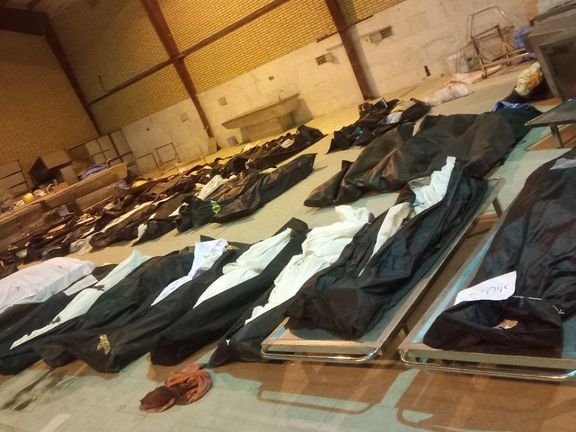
Bodies of Iranians killed during the protest in early January

Human rights advocates in Canada are urging the country’s national police to gather evidence on Canadians linked to Iran’s repression apparatus after thousands of protesters were killed in January.

The call is directed at the Royal Canadian Mounted Police (RCMP) and centers on what is known as a “structural investigation,” an evidence-gathering process that could help lay the groundwork for future prosecutions of individuals linked to crimes against humanity.

“We know that there are a number of IRGC officials in Canada, and also a very large Iranian diaspora with substantial evidence they can provide to the RCMP,” said Brandon Silver, an international human rights lawyer and founding director of policy and projects at the Raoul Wallenberg Centre for Human Rights.

“The RCMP can initiate what’s called a structural investigation into crimes against humanity,”

The push comes amid mounting demands for accountability after Iran International’s Editorial Board confirmed that more than 36,500 Iranians were killed by security forces during the January 8–9 crackdown, the deadliest two-day protest massacre in history.

Advocates say Canada must ensure perpetrators cannot find refuge abroad — and that Iranian Canadians have a direct avenue to report evidence.

Nazanin Afshin-Jam, a member of the Iranian Justice Collective, said structural investigations would give Iranian Canadians a concrete pathway to come forward and begin the accountability process.

Calls from Parliament Hill

The renewed push followed a day of meetings and testimony in Ottawa, where Afshin-Jam appeared before the House of Commons Subcommittee on International Human Rights.

“Yesterday I was invited to testify before the subcommittee on international human rights to give an update on the human rights situation in Iran and to also provide some recommendations,” she said.

Afshin-Jam said the aim was to press Canada to move beyond statements of condemnation toward tangible action.

Pressure on the IRGC

Silver also urged Ottawa to expand sanctions against senior officials directing the repression.

“Sanction the architects of this repression, starting with the Ayatollah,” he said.

He argued that Canada should coordinate closely with allies as international pressure mounts on the Islamic Revolutionary Guard Corps.

Afshin-Jam said Canada has already taken significant steps in the past — including listing the IRGC and closing its embassy in Tehran — and should again lead among Western democracies.

Advocates said they were encouraged by signs of cross-party engagement in Parliament but stressed that the next step must be follow-through: evidence collection, sanctions enforcement, and coordinated international action.

Most Viewed

Ghalibaf defends Iran-US talks amid hardline backlash
1
INSIGHT

Ghalibaf defends Iran-US talks amid hardline backlash

2
INSIGHT

Iran diplomacy wobbles as factions compete to avoid looking soft on US

3
VOICES FROM IRAN

Bread shortages, soaring prices strain households in Iran, residents say

4
ANALYSIS

The politics of pink: how Iran uses cuteness to rebrand violence

5

Scam messages seek crypto for ships’ safe passage through Hormuz, firm warns

Banner
Banner

Spotlight

  • Opposition to US talks grows in Tehran as ceasefire deadline nears
    INSIGHT

    Opposition to US talks grows in Tehran as ceasefire deadline nears

  • Tehran moderates see ‘no deal–no war’ limbo as worst outcome
    INSIGHT

    Tehran moderates see ‘no deal–no war’ limbo as worst outcome

  • The future has been switched off here
    TEHRAN INSIDER

    The future has been switched off here

  • Lights out, then gunfire: Witnesses recount Mashhad protest crackdown
    VOICES FROM IRAN

    Lights out, then gunfire: Witnesses recount Mashhad protest crackdown

  • Family told missing teen was alive, then received his body 60 days later
    EXCLUSIVE

    Family told missing teen was alive, then received his body 60 days later

  • Is Iran entering its Gorbachev moment?
    INSIGHT

    Is Iran entering its Gorbachev moment?

•
•
•

More Stories

For Iranians abroad, Iran's blackout turned fear into trauma

Feb 4, 2026, 07:38 GMT+0
•
Maryam Sinaiee

The killing of thousands of protesters in Iran last month was followed by a near-total internet and phone blackout, leaving millions of Iranians abroad trapped in prolonged fear, trauma, and emotional paralysis.

For nearly three weeks, millions inside Iran were cut off from the outside world as authorities imposed sweeping restrictions on internet access and international phone lines after the violent suppression of protests. For Iranians in the diaspora, the silence was devastating.

Many describe days and nights spent refreshing news feeds, replaying worst-case scenarios, and bracing for phone calls that never came. Even when limited connections were restored, the anxiety did not ease.

“Psychologically, not knowing what is happening—or whether family members are safe—keeps the body and mind in a prolonged state of stress,” Canadian-Iranian clinical counsellor Farnaz Farrokhi told Iran International.

A state of constant alarm

Farrokhi says many in the diaspora are experiencing “constant anxiety, compulsive news checking, feelings of helplessness and guilt, and emotional disconnection from loved ones.”

“What I’m seeing is the continuation of collective trauma, layered on top of long-standing emotional wounds from years of instability, loss, and fear,” she said, adding that many are also grappling with survivor’s guilt—being physically safe while loved ones are not.

For Narges, an IT specialist living in the Netherlands, the days of disconnection were unbearable.

“At work, my colleagues’ laughter and jokes were painful,” she said. “But I couldn’t—and didn’t have the right to—transfer my anxiety to them. I couldn’t interact the way I normally do.”

She took two days off, hoping rest would help. It did not.

“At home it was no better. Every time the phone rang, the doorbell sounded, or even a small object fell, I jumped. My heart would start racing.”

Trauma spilling into family life

For Taraneh, an Iranian living in Italy, the emotional toll extended to her six-year-old son.

“I try very hard not to let my son see the painful images—bodies piled together in black bags,” she said. “But sometimes I can’t hide my grief or my tears.”

Her son keeps asking why she is crying.

“I don’t have an answer that makes sense to him,” she said. “And not being able to explain my feelings makes me feel even worse.”

Even after limited international calls were allowed, communication remained fragile. Calls were brief, unstable, and often cut off without warning. Some families waited days for a single connection.

Fear of surveillance shaped many conversations. Families resorted to coded language, wary that saying too much could endanger loved ones.

“When my parents finally called, we could only cry. We didn’t know what to say to each other,” said Leila, a London-based Iranian expat. “We both knew about the massacre, but we couldn’t talk about it because there was every reason to believe our conversation wouldn’t stay private.”

“My mum said it had rained a lot there,” Leila recalled. “I knew she meant the bloodshed—not rain. It hadn’t rained at all.”

An open wound

For some, reconnection brought devastating news: learning days—or even weeks—later that relatives or friends had been killed, injured, or arrested.

“Today I saw the father of one of my child’s classmates at the school gate,” Germany-based mother Neda Soltani wrote on X. “He looked stunned. He burst into tears and said his cousin in Tehran had been killed—and he had only found out this morning.”

“Two Iranians stood there crying at the school gate,” she added. “Others just walked past.”

Farrokhi warns that without acknowledgement, safety, and the restoration of trust and communication, the psychological toll on the diaspora will continue to deepen.

“This is not just about grief,” she said. “It’s about living in a constant state of alarm—never knowing when the next rupture will come.”

'Help is on the way': to whom?

Feb 4, 2026, 00:30 GMT+0
•
Barry Rosen, John Limbert

The Islamic Republic was bad news in 1979 and it is bad news in 2026, sending security forces to beat and murder peaceful protesters. Deporting Iranians to a country gripped by violent repression is hardly the ‘help’ the United States promised.

Over four decades ago, we spent 444 days as prisoners in Iran for the crime of being American diplomats. One of us, Barry Rosen, was compelled at gunpoint to provide a “confession.” The captors kept John Limbert in solitary confinement for nine months and threatened him with a trial before a revolutionary kangaroo court.

We know firsthand how a terrified regime mistreats human beings it brands as “terrorists,” “enemies,” or “foreign agents,” in a never-ending effort to hold on to power at all costs. We witness daily tragedy for our Iranian friends and recall our own experience forty-seven years ago with Iran’s self-serving rulers.

Can the American government help Iranians face down the thousands of armed forces on the streets? Can we help without repeating the costly tragedies of Iraq and Afghanistan?

The president has promised Iranians that “help is on the way.” What help? What form of American support would allow Iranians to breathe after forty-seven years of theocratic authoritarianism? And what help would keep the country from descending into anarchy, as happened in Iraq in 2003, or falling victim to a new and more brutal regime, as happened in Iran after 1979?

As Americans, we should be proud of our record of providing a haven to those fleeing persecution. We have seen how Iranian-American friends and relatives were forced to flee their beloved homeland and become refugees in search of safety. Many of these same Iranian refugees have become outstanding scientists, physicians, lawyers, teachers, artists, and entrepreneurs in their adopted country.

We are alarmed by reports that the Trump administration is now deporting Iranian asylum seekers and other vulnerable Iranian nationals in ways that evade scrutiny, placing them on charter flights from the United States to Qatar or Kuwait and then sent onward to Tehran.

This dubious action is a strategic and moral blunder of the highest order. If we want to help, we must stop the deportations and show that we support those brave Iranians confronting their brutal rulers.

For decades, the United States has recognized a core principle of refugee protection rooted in both domestic law and the post-World War II international order it helped build: we do not return people to countries where they face persecution, torture, or death. When the destination is the Islamic Republic of Iran, the risk is not theoretical. It is profound and well documented.

The US State Department has designated Iran a state sponsor of terrorism. The Islamic Republic has a long record of arbitrary detention, coerced confessions, and political punishment of ethnic and religious minorities, journalists, lawyers, writers, musicians, students, filmmakers, women’s rights activists, and anyone else who asks inconvenient questions.

Returning people to that system does not send help to those fighting a murderous regime. It hands Tehran an unearned victory, supplying leverage, propaganda, and human capital to a government that has perfected the use of hostages and forced confessions as instruments of state power.

Supporters of these removals argue that deportation is simply the execution of US immigration law. But asylum seekers are, by definition, telling US authorities that they fear their own government. In Iran, an asylum claim can be interpreted as collaboration with foreign enemies, propaganda against the state, spying, apostasy, acting against national security, or the catch-all charge of “making war against God.”

Iranians have been imprisoned, tortured, or killed for all these accusations—and often for nothing at all.

History offers sobering parallels. In the 1980s, the United States returned Salvadoran and Guatemalan asylum seekers to governments engaged in widespread political violence and death-squad activity. Many deportees were later killed or disappeared. Officials at the time rationalized these deportations as “lawful and necessary.” They were neither and are now broadly recognized as grave moral and strategic failures that damaged US credibility.

The United Kingdom made a similar mistake in the early 2000s when it cooperated with Muammar Gaddafi’s Libya to deport dissidents. British officials relied on diplomatic assurances that returnees would be treated humanely. Instead, some were imprisoned and tortured. Years later, British courts ruled the practice unlawful, and the government was forced to reckon publicly with the consequences of secrecy and misplaced trust in an authoritarian regime.

The scale of the current situation also matters. Initial reporting referenced roughly 400 individuals identified for removal; subsequent reporting suggests the number at risk could be significantly higher.

Meanwhile, independent estimates indicate that thousands have been killed in Iran in recent months. Whatever the precise number of deportees, the precedent being set is appalling. Normalizing indirect removals to Tehran through US allies in the region signals that the United States is willing to look away from what happens next.

Most troubling is how little information is available. Basic questions remain unanswered, including who, precisely, our government is deporting, what screening standards are being applied, what access to legal counsel exists, and what assurances, if any, have been received from Iran or third countries.

That organizations such as the Iranian American Legal Defense Fund have had to resort to Freedom of Information Act requests simply to understand the contours of this policy underscores the secrecy involved. And secrecy is where abuse takes root.

Our argument is for moral clarity and strategic seriousness.

A government that encourages Iranian protesters and warns Americans about Iran’s hostage-taking and coercion cannot, at the same time, deliver vulnerable people into the machinery of repression. A nation that still remembers 1979 and what followed should not supply the Islamic Republic with a new pool of captives, especially people who came here believing their search for safety would be handled with care and compassion.

Congress should demand immediate answers, and the administration should halt removals to Iran and allow transparent review. Our government must keep its promises, observe both law and morality, and guarantee meaningful access to asylum and withholding protections. What appears to be an arbitrary and cruel process should be subject to immediate, independent oversight.

The United States is strongest when it refuses to outsource its conscience to regimes that have none.

Grassroots ‘Red Lion and Sun' network emerges in Iran after crackdown

Feb 3, 2026, 14:35 GMT+0

A newly announced grassroots network of Iranian doctors, nurses, paramedics and volunteers says it will provide safe medical relief and neighborhood support amid what it describes as a deepening humanitarian emergency after the crackdown that followed nationwide protests.

The group, calling itself the “People’s Red Lion and Sun Groups of Iran,” issued its founding statement on Tuesday, nearly a month after demonstrations erupted across the country and the subsequent violence that has left more than 36,500 people dead, with tens of thousands more suffering physical injuries and profound psychological trauma.

“We speak in days when Iran is wounded,” the statement said. “The people of Iran are mourning and angry because of losing at least thirty thousand of their best sons and daughters.”

The initiative says many of the wounded have been pushed into hiding, unable to seek treatment openly for fear of arrest or retaliation.

“Reports show that many of the wounded are forced to be treated at home and in hiding,” it said, warning that others have been deprived of medical care altogether because they cannot safely access trusted doctors or secure facilities. The statement adds that some remain in critical condition.

The group also raised alarm over reports of security forces entering hospitals and detaining injured people. “Reports indicate that Revolutionary Guard suppression forces have gone to hospitals, taken the wounded with them, or arrested citizens at home by reviewing patient lists,” it said.

According to the organizers, attacks on medical centers, intimidation of healthcare workers, and the removal of patients from hospitals have created what they describe as “a national humanitarian and emergency crisis.”

Many, they warned, are now at risk behind closed doors. “If urgent help does not arrive, some will die, and others will face irreversible physical and psychological consequences,” the statement said.

The founders present the network as a strictly humanitarian effort rather than a political organization, emphasizing that its purpose is to protect lives and reduce suffering.

“Our identity is human and relief-based, not political,” the statement declared. “We have been formed to save human lives and reduce the suffering of families.”

“We are not a political organization, not an instrument of power competition,” it added. “We are a grassroots network of relief and resilience.”

The group’s name and symbol deliberately revive the Red Lion and Sun, a historic emblem associated with humanitarian aid in Iran before the 1979 Islamic Revolution.

By restoring it, the organizers say they seek to highlight “heritage, humanity, and collective responsibility,” while committing themselves to what they call non-negotiable principles centered on saving lives.

“Saving human lives is our absolute priority,” the statement said, adding that citizen safety and privacy would be treated as red lines.

“The safety of citizens and their privacy are our red lines. We will have no mechanism for registration, list-making, or traceable recruitment.”

Instead, the initiative describes itself as an educational and resilience-based network built around decentralized neighborhood cells rather than centralized leadership.

“Our work is education, not organization,” it said. “All local cells will be independent and self-governed.”

The structure, according to the statement, is designed to allow rapid and secure assistance under conditions of surveillance and insecurity. Each unit would consist of only three to five people, formed exclusively among long-time friends, family members or trusted neighbors.

“There is no headquarters and no internal hierarchy,” the group explained. “Each cell is an island of resilience.”

The organizers say the model draws on international crisis-preparedness approaches focused on empowering communities when trust in official institutions collapses or when access to formal emergency services becomes impossible.

The mission of the Red Lion and Sun Groups, they said, is practical and urgent: ensuring safe medical treatment for wounded citizens, connecting patients with volunteer doctors and nurses, and preventing injuries from going untreated because of fear or blocked access.

“No wounded person should remain untreated because of fear or lack of access,” the statement said, outlining a vision of neighborhood-based first response so that vital hours are not lost in moments of crisis.

Beyond medical care, the group said it aims to provide emergency support to families facing severe shortages, supply disruptions, or siege-like conditions, including food, medicine, and essential goods.

It also plans to publish short educational materials that can be stored and used even during communication blackouts, covering first aid, trauma care, psychological support, and basic crisis survival.

The statement places particular emphasis on psychological first aid, including reducing panic, supporting children and the elderly, and strengthening social resilience alongside physical rescue and safety measures.

The announcement comes as the group describes a volatile national environment, warning that the scale of violence and the Iranian authorities’ confrontational posture internationally have heightened fears of further escalation and instability.

In closing, the organizers framed their initiative as a covenant of solidarity with ordinary people, urging citizens to form small trusted neighborhood circles to help one another when institutions fail.

“We make a covenant with the people that, within our capacity, knowledge, and means, we will stand beside them,” the statement said.

“If an incident happens in your area, if an injured person seeks help, if treatment arrives too late… this time, the people will not be alone.”

The group ended with a call for readiness and mutual support. “Be ready,” it said. “To save Iranian lives. To save Iran.”

Iran crypto volumes draw US probes into sanctions evasion - Reuters

Feb 3, 2026, 13:32 GMT+0

US investigators are examining whether cryptocurrency platforms were used to help Iranian officials and state-linked actors evade sanctions, a blockchain researcher told Reuters, as crypto use rose sharply in Iran amid currency weakness and political unrest.

Ari Redbord, global head of policy at TRM Labs, said the US Treasury is reviewing whether platforms allowed state-linked players to move money abroad, access hard currency or buy restricted goods.

Estimates of Iran’s crypto activity vary. TRM Labs estimated roughly $10 billion in Iran-linked crypto activity in 2025, compared with $11.4 billion in 2024. Chainalysis said Iranian wallets received a record $7.8 billion in 2025, up from $7.4 billion in 2024 and $3.17 billion in 2023. Researchers cautioned that crypto’s pseudonymous nature makes precise attribution difficult and limits the ability to form a complete picture.

Chainalysis estimated that about half of Iran’s 2025 crypto activity was linked to the Islamic Revolutionary Guard Corps (IRGC). TRM Labs said it has identified more than 5,000 addresses it labels as IRGC-linked and estimates the Guards have moved about $3 billion worth of crypto since 2023.

Iran’s largest exchange, Nobitex, told Reuters that around 15 million people in Iran have some crypto exposure, with many using digital assets as a store of value as the rial depreciates. Analysts said funds can be moved off Iranian exchanges to wallets and platforms elsewhere, complicating enforcement for US authorities.

In September, the US Treasury Department’s Office of Foreign Assets Control (OFAC) sanctioned two Iranian financial facilitators and more than a dozen individuals and entities based in Hong Kong and the United Arab Emirates for helping coordinate money transfers — including proceeds from Iranian oil sales — that it said benefited the IRGC-Quds Force and Iran’s ministry of defense.

“Iranian ‘shadow banking’ networks like these—run by trusted illicit financial facilitators—abuse the international financial system, and evade sanctions by laundering money through overseas front companies and cryptocurrency,” read the statement.

Australia hits Iran with new sanctions over protest crackdown

Feb 3, 2026, 10:28 GMT+0

Australia imposed new sanctions on 20 individuals and three entities linked to Iran’s Islamic Revolutionary Guard Corps, accusing them of involvement in a violent crackdown on protests.

“The Australian Government is today imposing further targeted financial sanctions on Iran in response to the regime’s horrific use of violence against its own people,” read a government media release on Tuesday.

The Australian government said those sanctioned include senior IRGC officials and entities that violently suppress domestic protests and threaten lives inside and outside Iran.

Among those named are Iran’s national police chief Ahmad-Reza Radan, who has been a central figure in directing street-level repression, mass arrests and the use of force against protesters.

Intelligence Minister Esmail Khatib was also on the list. He oversees the security and intelligence apparatus responsible for surveillance, detentions and interrogations of activists and dissidents.

Ali Fazli, a senior IRGC commander and former Basij chief, who has long been associated with suppressing protests and coordinating paramilitary forces against demonstrators, was also sanctioned by Canberra.

Other notable names on the list included Mohammad Reza Fallahzadeh, a senior commander in the IRGC’s Quds Force, Mohammad Saleh Jokar, a former commander of student Basij forces, and Yahya Hosseini Panjaki, the intelligence ministry's deputy for domestic security.

Canberra’s sanctions also targeted the IRGC Cyber Defense Command, involved in online surveillance and information control; IRGC Quds Force Unit 840, a covert unit accused of planning operations against dissidents and foreign targets; and the IRGC Intelligence Organization, which oversees domestic intelligence, arrests and interrogations and plays a central role in suppressing protests inside Iran.

The Australian government said the new measures build on earlier step of listing the IRGC as a state sponsor of terrorism and its existing sanctions framework on Iran.

Australia officially designated IRGC as a state sponsor of terrorism in November after intelligence linked the group to attacks on Jewish centers in Sydney and Melbourne.

The Guards, who have been designated a terrorist organization by the United States since 2019, were also put on the EU’s terrorist list in late January.

The Albanese government has so far sanctioned more than 200 Iranian individuals and entities, including more than 100 linked to the IRGC.