• العربية
  • فارسی
Brand
  • Iran Insight
  • Politics
  • Economy
  • Analysis
  • Special Report
  • Opinion
  • Podcast
  • Iran Insight
  • Politics
  • Economy
  • Analysis
  • Special Report
  • Opinion
  • Podcast
  • Theme
  • Language
    • العربية
    • فارسی
  • Iran Insight
  • Politics
  • Economy
  • Analysis
  • Special Report
  • Opinion
  • Podcast
All rights reserved for Volant Media UK Limited
volant media logo
INSIGHT

For Iranians abroad, Iran's blackout turned fear into trauma

Maryam Sinaiee
Maryam Sinaiee

Iran International

Feb 4, 2026, 07:38 GMT+0
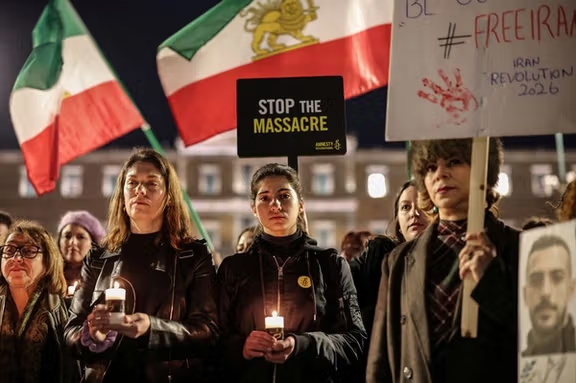
Iranian expats hold a night time vigil with candles and signs against the deadly crackdown in Iran

The killing of thousands of protesters in Iran last month was followed by a near-total internet and phone blackout, leaving millions of Iranians abroad trapped in prolonged fear, trauma, and emotional paralysis.

For nearly three weeks, millions inside Iran were cut off from the outside world as authorities imposed sweeping restrictions on internet access and international phone lines after the violent suppression of protests. For Iranians in the diaspora, the silence was devastating.

Many describe days and nights spent refreshing news feeds, replaying worst-case scenarios, and bracing for phone calls that never came. Even when limited connections were restored, the anxiety did not ease.

“Psychologically, not knowing what is happening—or whether family members are safe—keeps the body and mind in a prolonged state of stress,” Canadian-Iranian clinical counsellor Farnaz Farrokhi told Iran International.

A state of constant alarm

Farrokhi says many in the diaspora are experiencing “constant anxiety, compulsive news checking, feelings of helplessness and guilt, and emotional disconnection from loved ones.”

“What I’m seeing is the continuation of collective trauma, layered on top of long-standing emotional wounds from years of instability, loss, and fear,” she said, adding that many are also grappling with survivor’s guilt—being physically safe while loved ones are not.

For Narges, an IT specialist living in the Netherlands, the days of disconnection were unbearable.

“At work, my colleagues’ laughter and jokes were painful,” she said. “But I couldn’t—and didn’t have the right to—transfer my anxiety to them. I couldn’t interact the way I normally do.”

She took two days off, hoping rest would help. It did not.

“At home it was no better. Every time the phone rang, the doorbell sounded, or even a small object fell, I jumped. My heart would start racing.”

Trauma spilling into family life

For Taraneh, an Iranian living in Italy, the emotional toll extended to her six-year-old son.

“I try very hard not to let my son see the painful images—bodies piled together in black bags,” she said. “But sometimes I can’t hide my grief or my tears.”

Her son keeps asking why she is crying.

“I don’t have an answer that makes sense to him,” she said. “And not being able to explain my feelings makes me feel even worse.”

Even after limited international calls were allowed, communication remained fragile. Calls were brief, unstable, and often cut off without warning. Some families waited days for a single connection.

Fear of surveillance shaped many conversations. Families resorted to coded language, wary that saying too much could endanger loved ones.

“When my parents finally called, we could only cry. We didn’t know what to say to each other,” said Leila, a London-based Iranian expat. “We both knew about the massacre, but we couldn’t talk about it because there was every reason to believe our conversation wouldn’t stay private.”

“My mum said it had rained a lot there,” Leila recalled. “I knew she meant the bloodshed—not rain. It hadn’t rained at all.”

An open wound

For some, reconnection brought devastating news: learning days—or even weeks—later that relatives or friends had been killed, injured, or arrested.

“Today I saw the father of one of my child’s classmates at the school gate,” Germany-based mother Neda Soltani wrote on X. “He looked stunned. He burst into tears and said his cousin in Tehran had been killed—and he had only found out this morning.”

“Two Iranians stood there crying at the school gate,” she added. “Others just walked past.”

Farrokhi warns that without acknowledgement, safety, and the restoration of trust and communication, the psychological toll on the diaspora will continue to deepen.

“This is not just about grief,” she said. “It’s about living in a constant state of alarm—never knowing when the next rupture will come.”

Most Viewed

Ghalibaf defends Iran-US talks amid hardline backlash
1
INSIGHT

Ghalibaf defends Iran-US talks amid hardline backlash

2
INSIGHT

A nation in limbo: 100 days after the massacre, has the world moved on?

3
ANALYSIS

From instability to influence: Pakistan’s pivotal role in US-Iran diplomacy

4
ANALYSIS

100 days on: why Iran’s January protests spread across social classes

5

War-hit homeowners feel abandoned as Iran’s reconstruction aid fades

Banner
Banner

Spotlight

  • War-hit homeowners feel abandoned as Iran’s reconstruction aid fades

    War-hit homeowners feel abandoned as Iran’s reconstruction aid fades

  • 100 days on: the anatomy of Iran’s January crackdown
    INSIGHT

    100 days on: the anatomy of Iran’s January crackdown

  • Ghalibaf defends Iran-US talks amid hardline backlash
    INSIGHT

    Ghalibaf defends Iran-US talks amid hardline backlash

  • 100 days on: why Iran’s January protests spread across social classes
    ANALYSIS

    100 days on: why Iran’s January protests spread across social classes

  • From instability to influence: Pakistan’s pivotal role in US-Iran diplomacy
    ANALYSIS

    From instability to influence: Pakistan’s pivotal role in US-Iran diplomacy

  • A nation in limbo: 100 days after the massacre, has the world moved on?
    INSIGHT

    A nation in limbo: 100 days after the massacre, has the world moved on?

•
•
•

More Stories

Strategy or paralysis? Tehran sends mixed signals on war and diplomacy

Feb 3, 2026, 16:40 GMT+0
•
Behrouz Turani

Conflicting voices in Tehran on the competing prospects of war and diplomacy with Washington may be deliberate, but they more likely reflect an absence of consensus at the top.

A quick look at the main headlines on the IRGC-linked Tasnim News Agency on Monday captured the mood in Tehran: “Possibility of Iran–US Negotiations Confirmed,” “Implications for America if War Spreads Across the Region,” and “With Trump’s Conditions, There Will Be No Negotiations.”

Together, they betray a system simultaneously preparing for talks, threatening escalation, and insisting negotiations are impossible.

Despite the government’s efforts to project calm beneath Tehran’s smog-covered skyline, a speech on Sunday by Supreme Leader Ali Khamenei only deepened the sense of foreboding.

Khamenei recounted a joke from his native province of Khorasan about a man boasting of how close he was to marrying the woman he loved. “Only two steps remain,” the man says. “I ask her father for her hand, and he replies: ‘How dare you!’”

Those seated around Khamenei, including his financial confidant Mohammad Mokhber, smiled uncertainly—perhaps only gradually realizing that, in Khamenei’s telling, the hopeful suitor was US President Donald Trump, and the disapproving father was Khamenei himself.

‘American graveyard’

For opportunistic politicians and commentators in Tehran, the message was unmistakable: recent claims by Foreign Minister Abbas Araghchi and security chief Ali Larijani about ongoing negotiations with Washington mattered far less than the Supreme Leader’s evident reluctance to engage.

On the central question—whether Iran is prepared to make concessions—Khamenei remains firmly unwilling to yield.

Hardliners, who had briefly lowered their volume in anticipation of a possible diplomatic opening, appeared to have received the memo and quickly returned to form.

In parliament, the cleric Mohammad Taghi Naghdali declared that Iran should not only close the Strait of Hormuz but also disrupt Europe’s shipping routes and gas export networks, while calling for reduced cooperation with the International Atomic Energy Agency.

The rhetoric soon veered into the absurd. The managing director of Tehran’s main cemetery, Behesht-e Zahra, claimed he had prepared 5,000 graves for US soldiers he believed would be killed on the first day of a war with Iran.

The statement was swiftly refuted by Tehran city councillor Jafar Tashakori, who warned that reckless remarks could trigger crises “far beyond domestic politics.”

Vested interests

Even seasoned analysts struggled to impose coherence on the moment. Political commentator Ali Bigdeli said no one could say with certainty whether war was coming, arguing that Iran’s only viable path forward lay in direct talks with the United States.

While Iran’s official position, articulated by Araghchi, is that any talks must be confined to the nuclear file, Bigdeli cautioned that Washington’s ambitions extend to Tehran’s missile program and its regional allies.

“Trump is not interested in a direct war with Iran,” Bigdeli told the moderate outlet Khabar Online. “But he is unlikely to leave the region with his armada without achieving something.”

Ebrahim Rezai, spokesperson for parliament’s National Security Committee, cited a briefing by IRGC Aerospace Force commanders to assert that any US attack would trap American forces in a regional war.

Yet another conservative figure, Hossein Naghavi Hosseini, cautioned that those beating the drums of war in Tehran were playing into Israel’s hands.

Taken together, the cacophony points less to confidence than to paralysis: a system torn between waiting for a signal from the top and being pulled in opposing directions by vested interests, each pressing for the outcome it prefers.

Grassroots ‘Red Lion and Sun' network emerges in Iran after crackdown

Feb 3, 2026, 14:35 GMT+0

A newly announced grassroots network of Iranian doctors, nurses, paramedics and volunteers says it will provide safe medical relief and neighborhood support amid what it describes as a deepening humanitarian emergency after the crackdown that followed nationwide protests.

The group, calling itself the “People’s Red Lion and Sun Groups of Iran,” issued its founding statement on Tuesday, nearly a month after demonstrations erupted across the country and the subsequent violence that has left more than 36,500 people dead, with tens of thousands more suffering physical injuries and profound psychological trauma.

“We speak in days when Iran is wounded,” the statement said. “The people of Iran are mourning and angry because of losing at least thirty thousand of their best sons and daughters.”

The initiative says many of the wounded have been pushed into hiding, unable to seek treatment openly for fear of arrest or retaliation.

“Reports show that many of the wounded are forced to be treated at home and in hiding,” it said, warning that others have been deprived of medical care altogether because they cannot safely access trusted doctors or secure facilities. The statement adds that some remain in critical condition.

The group also raised alarm over reports of security forces entering hospitals and detaining injured people. “Reports indicate that Revolutionary Guard suppression forces have gone to hospitals, taken the wounded with them, or arrested citizens at home by reviewing patient lists,” it said.

According to the organizers, attacks on medical centers, intimidation of healthcare workers, and the removal of patients from hospitals have created what they describe as “a national humanitarian and emergency crisis.”

Many, they warned, are now at risk behind closed doors. “If urgent help does not arrive, some will die, and others will face irreversible physical and psychological consequences,” the statement said.

The founders present the network as a strictly humanitarian effort rather than a political organization, emphasizing that its purpose is to protect lives and reduce suffering.

“Our identity is human and relief-based, not political,” the statement declared. “We have been formed to save human lives and reduce the suffering of families.”

“We are not a political organization, not an instrument of power competition,” it added. “We are a grassroots network of relief and resilience.”

The group’s name and symbol deliberately revive the Red Lion and Sun, a historic emblem associated with humanitarian aid in Iran before the 1979 Islamic Revolution.

By restoring it, the organizers say they seek to highlight “heritage, humanity, and collective responsibility,” while committing themselves to what they call non-negotiable principles centered on saving lives.

“Saving human lives is our absolute priority,” the statement said, adding that citizen safety and privacy would be treated as red lines.

“The safety of citizens and their privacy are our red lines. We will have no mechanism for registration, list-making, or traceable recruitment.”

Instead, the initiative describes itself as an educational and resilience-based network built around decentralized neighborhood cells rather than centralized leadership.

“Our work is education, not organization,” it said. “All local cells will be independent and self-governed.”

The structure, according to the statement, is designed to allow rapid and secure assistance under conditions of surveillance and insecurity. Each unit would consist of only three to five people, formed exclusively among long-time friends, family members or trusted neighbors.

“There is no headquarters and no internal hierarchy,” the group explained. “Each cell is an island of resilience.”

The organizers say the model draws on international crisis-preparedness approaches focused on empowering communities when trust in official institutions collapses or when access to formal emergency services becomes impossible.

The mission of the Red Lion and Sun Groups, they said, is practical and urgent: ensuring safe medical treatment for wounded citizens, connecting patients with volunteer doctors and nurses, and preventing injuries from going untreated because of fear or blocked access.

“No wounded person should remain untreated because of fear or lack of access,” the statement said, outlining a vision of neighborhood-based first response so that vital hours are not lost in moments of crisis.

Beyond medical care, the group said it aims to provide emergency support to families facing severe shortages, supply disruptions, or siege-like conditions, including food, medicine, and essential goods.

It also plans to publish short educational materials that can be stored and used even during communication blackouts, covering first aid, trauma care, psychological support, and basic crisis survival.

The statement places particular emphasis on psychological first aid, including reducing panic, supporting children and the elderly, and strengthening social resilience alongside physical rescue and safety measures.

The announcement comes as the group describes a volatile national environment, warning that the scale of violence and the Iranian authorities’ confrontational posture internationally have heightened fears of further escalation and instability.

In closing, the organizers framed their initiative as a covenant of solidarity with ordinary people, urging citizens to form small trusted neighborhood circles to help one another when institutions fail.

“We make a covenant with the people that, within our capacity, knowledge, and means, we will stand beside them,” the statement said.

“If an incident happens in your area, if an injured person seeks help, if treatment arrives too late… this time, the people will not be alone.”

The group ended with a call for readiness and mutual support. “Be ready,” it said. “To save Iranian lives. To save Iran.”

Australia hits Iran with new sanctions over protest crackdown

Feb 3, 2026, 10:28 GMT+0

Australia imposed new sanctions on 20 individuals and three entities linked to Iran’s Islamic Revolutionary Guard Corps, accusing them of involvement in a violent crackdown on protests.

“The Australian Government is today imposing further targeted financial sanctions on Iran in response to the regime’s horrific use of violence against its own people,” read a government media release on Tuesday.

The Australian government said those sanctioned include senior IRGC officials and entities that violently suppress domestic protests and threaten lives inside and outside Iran.

Among those named are Iran’s national police chief Ahmad-Reza Radan, who has been a central figure in directing street-level repression, mass arrests and the use of force against protesters.

Intelligence Minister Esmail Khatib was also on the list. He oversees the security and intelligence apparatus responsible for surveillance, detentions and interrogations of activists and dissidents.

Ali Fazli, a senior IRGC commander and former Basij chief, who has long been associated with suppressing protests and coordinating paramilitary forces against demonstrators, was also sanctioned by Canberra.

Other notable names on the list included Mohammad Reza Fallahzadeh, a senior commander in the IRGC’s Quds Force, Mohammad Saleh Jokar, a former commander of student Basij forces, and Yahya Hosseini Panjaki, the intelligence ministry's deputy for domestic security.

Canberra’s sanctions also targeted the IRGC Cyber Defense Command, involved in online surveillance and information control; IRGC Quds Force Unit 840, a covert unit accused of planning operations against dissidents and foreign targets; and the IRGC Intelligence Organization, which oversees domestic intelligence, arrests and interrogations and plays a central role in suppressing protests inside Iran.

The Australian government said the new measures build on earlier step of listing the IRGC as a state sponsor of terrorism and its existing sanctions framework on Iran.

Australia officially designated IRGC as a state sponsor of terrorism in November after intelligence linked the group to attacks on Jewish centers in Sydney and Melbourne.

The Guards, who have been designated a terrorist organization by the United States since 2019, were also put on the EU’s terrorist list in late January.

The Albanese government has so far sanctioned more than 200 Iranian individuals and entities, including more than 100 linked to the IRGC.

What Iranians taught me while I spoke to them from Israel

Feb 3, 2026, 08:35 GMT+0
•
Tamar Schwarzbard

Israelis and Iranians have been cast as enemies for so long, but during Iran’s uprisings their voices tell a different story as Iranians drew a line between themselves and the Islamic Republic.

In late September 2022, when a young Iranian woman named Mahsa Amini was killed for showing her hair, Iran erupted. Millions of brave Iranians, women and men, young and old, took to the streets.

What followed was not just a protest against compulsory hijab laws, but one of the clearest rejections of the Islamic Republic since 1979: Woman. Life. Freedom.

At the time, I was head of digital operations at the Israel ministry of foreign affairs, leading Israel’s public diplomacy online in six languages, including Persian.

From the start, we distinguished between the Islamic Republic and the Iranian people. That distinction guided everything we did. We launched one of the only official digital campaigns anywhere in direct solidarity with Mahsa Amini and the protesters, including a filter viewed more than a million times.

Our Israel in Persian accounts exploded. Posts expressing support reached millions. Every day, we received thousands of messages from inside Iran: “Thank you for seeing us,” they said, “be our voice.”

In January 2026, they did the same.

For more than four decades, the Islamic Republic has insisted that hatred of Israel is central to Iranian identity. But millions of Iranians have told us otherwise.

A GAMAAN survey published in 2025 found that roughly two thirds of Iranians said the government should stop its “destroy Israel” rhetoric, and a similar majority viewed the recent 12 day conflict as between the Iranian regime and Israel, not between Israel and ordinary Iranians.

Loyal supporters of Iran's theocratic rule, the same voices that celebrated October 7, want you to believe Iranians hate Israel and that the protests are foreign engineered fantasies.

They flood social media with trolls, lies, and fake AI videos. But the people have already spoken. Across ideology and geography, they are saying the same thing: Not death to Israel. Not death to America. Death to the Islamic Republic.

Hundreds of thousands of Iranian Jews live around the world today, many still speaking Persian, cooking Iranian food, and aching for the country they were forced to leave.

People hold a banner, as Israelis rally in support of the nationwide protests happening in Iran, in Holon, Israel, January 14, 2026.
100%
People hold a banner, as Israelis rally in support of the nationwide protests happening in Iran, in Holon, Israel, January 14, 2026.

Israel is home to about 200,000 Iranian Jews. Long before modern politics, Cyrus the Great liberated the Jews from exile and allowed them to return to Jerusalem, an event recorded in both Jewish and Persian history.

That shared past still lives between our peoples. And it lives in everyday encounters.

Every Iranian I have ever met has responded to me as a Jewish Israeli with warmth, curiosity, and respect. Never hatred.

Israelis are taught that Iran wants them wiped off the map. Iranians are taught that Israel is satanic and responsible for their suffering. But we both know the truth. It is the Islamic Republic that threatens both of us.

The rulers in Tehran have destroyed Iran’s economy, murdered teenagers for defying religious rule, and crushed dissent. They send money to their armed allies in the region while ordinary Iranians struggle to afford food and medicine.

Inside Iran, protesters chant, “Not Gaza, not Lebanon, my life for Iran.”

For Israelis, the danger is existential. The same regime that brutalizes its citizens openly calls for Israel’s destruction and races toward nuclear capability.

Israelis and Iranians do not need permission to recognize each other. Beneath decades of forced slogans lies something older and stronger than propaganda.

When Iranians rose up, Israelis didn’t see enemies in the streets of Tehran. We saw courage. And just as Iranians amplified Israeli voices after October 7, we understand that now it is our turn to speak for them.

This is not a Zionist conspiracy. It is human beings standing up for human beings.

The Islamic Republic fears that if Israelis and Iranians ever meet as people rather than caricatures, its mythology would collapse. So we stand with our Iranian brothers and sisters as allies, determined to answer their call for help.

For Jews, “Next year in Jerusalem” is a prayer for freedom. Today, that prayer has an echo: Next year in Tehran.

Iranian protester found dead with bullet wounds after days missing

Feb 2, 2026, 20:42 GMT+0
•
Azadeh Akbari

Reza Bahmani Alijanvand, a 34-year-old Iranian protester, disappeared after attending protests in the central Iranian city of Shahin Shahr on January 8, and was later found dead in the cold storage of a cemetery, people familiar with the matter told Iran International.

The sources said Alijanvand was shot by security forces with two live rounds, one striking his lower back and another his abdomen. His family spent five days searching hospitals, police stations and prisons across Isfahan province before identifying his body in the cold storage at Bagh-e Rezvan cemetery on January 13, the sources said.

According to the sources, Alijanvand's body was transferred later that night, on January 13, to Shahin Shahr's morgue.

Authorities initially refused to hand over the body and sought to have Alijanvand declared a “martyr,” a condition the family rejected, which would have required them to accept the state’s official account of the death rather than acknowledge that he was killed by state security forces.

Alijanvand was eventually buried under heavy security at around 4 a.m. on January 15, in a tightly controlled ceremony at Behesht-e Zahra Chaharbisheh cemetery in his hometown of Masjed Soleyman in southwestern Iran, with only five family members present and several plainclothes agents in attendance, the sources said.

Alijanvand was married and worked as a forklift driver at a brick factory, according to the people familiar with the matter.

“Reza worked from morning until night. He was deeply patriotic and hopeful for Iran’s freedom,” the source said, adding that Alijanvand believed Iran’s exiled prince Reza Pahlavi would return to the country.

Last month, Iran International reported that more than 36,500 Iranians were killed by security forces during the January 8-9 crackdown on nationwide protests, making it the deadliest two-day protest massacre in history.

100%