• العربية
  • فارسی
Brand
  • Iran Insight
  • Politics
  • Economy
  • Analysis
  • Special Report
  • Opinion
  • Podcast
  • Iran Insight
  • Politics
  • Economy
  • Analysis
  • Special Report
  • Opinion
  • Podcast
  • Theme
  • Language
    • العربية
    • فارسی
  • Iran Insight
  • Politics
  • Economy
  • Analysis
  • Special Report
  • Opinion
  • Podcast
All rights reserved for Volant Media UK Limited
volant media logo

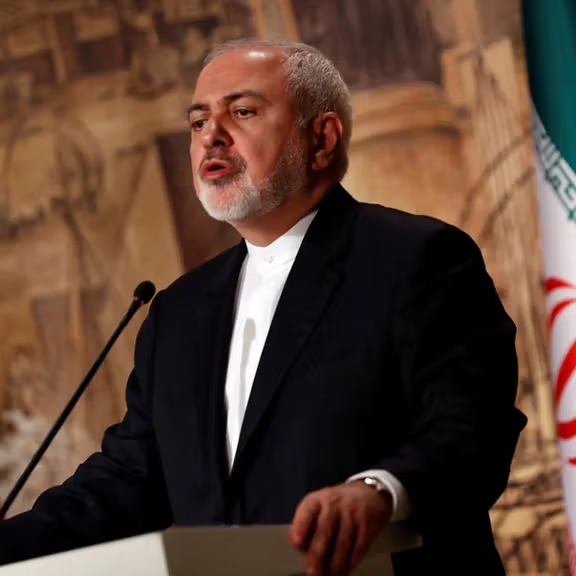
Zarif warns regime change in Iran could have unpredictable Mideast fallout

Jan 30, 2026, 19:05 GMT+0

Former Iranian Foreign Minister Mohammad Javad Zarif warned that the collapse of the Islamic Republic will have "unpredictable consequences" for the wider Middle East.

Zarif said in an interview published on Friday that Iran's neighbors and other regional actors are mainly concerned with preventing instability or collapse inside Iran.

While regional states prioritize Iran’s stability, the United States and Israel pursue differing strategic objectives, Zarif said, highlighting divisions that he argued could shape diplomacy and regional dynamics.

He said the US is pursuing a strategy focused on weakening Iran, while Israel favors Iran’s collapse.

Zarif said these differing objectives create a space in which Iran could manage external pressures, emphasizing the role of careful foreign policy and diplomatic engagement.

He also highlighted the long-term social and psychological effects of sanctions, arguing that they can erode social cohesion, national confidence, and dignity, even when their economic impact is partially mitigated.

Drawing on Iraq’s experience under years of UN sanctions followed by military intervention, Zarif said that punitive measures often fail to achieve stated political goals while portraying targeted countries as security threats in the eyes of the international community.

He also referenced Iran’s own history, including the negotiations that led to UN Security Council Resolution 598 at the end of the Iran-Iraq War, which he described as an example of coordinated national decision-making and unity allowing Iran to engage diplomatically from a position of cohesion.

Zarif added that lessons from this period remain relevant for managing contemporary regional and international tensions.

Most Viewed

Iran diplomacy wobbles as factions compete to avoid looking soft on US
1
INSIGHT

Iran diplomacy wobbles as factions compete to avoid looking soft on US

2

IRGC-linked media hints at threat to Persian Gulf undersea internet cables

3
ANALYSIS

The politics of pink: how Iran uses cuteness to rebrand violence

4

Iran Guards say two ships seized in Hormuz after ceasefire extension

5

Scam messages seek crypto for ships’ safe passage through Hormuz, firm warns

Banner
Banner

Spotlight

  • As Tehran digs in, ordinary Iranians pay the price
    INSIGHT

    As Tehran digs in, ordinary Iranians pay the price

  • Internet Pro or Censor Pro? Iran rolls out a new service
    ANALYSIS

    Internet Pro or Censor Pro? Iran rolls out a new service

  • Strikes on petrochemical hubs leave Iran short of plastics
    EXCLUSIVE

    Strikes on petrochemical hubs leave Iran short of plastics

  • Diplomacy tolls at Hormuz as conflict returns to its doorstep
    OPINION

    Diplomacy tolls at Hormuz as conflict returns to its doorstep

  • Opposition to US talks grows in Tehran as ceasefire deadline nears
    INSIGHT

    Opposition to US talks grows in Tehran as ceasefire deadline nears

  • The future has been switched off here
    TEHRAN INSIDER

    The future has been switched off here

•
•
•

More Stories

Iranians launch campaign to boycott Huda Beauty products over protest post

Jan 30, 2026, 18:54 GMT+0

An Instagram story posted by Huda Beauty sparked huge backlash among Iranians, leading to a boycott campaign against her cosmetic products.

Many Iranians accused her of ignoring the blood of tens of thousands killed during the recent massacre.

Huda finally issued an apology.

Trump says he directly conveyed deal deadline to Iran

Jan 30, 2026, 18:18 GMT+0

US President Donald Trump said on Friday that he had directly communicated a deadline to Iran for reaching a deal with the United States.

“Only they know about the deadline for sure,” he told reporters.

The June attacks on Iran were carried out shortly after the expiration of Trump’s 60-day deadline to Tehran.

Trump says will 'see what happens' if no deal reached with Iran

Jan 30, 2026, 17:19 GMT+0

US President Donal Trump said on Friday "we're now sending actually a larger number of ships to Iran. And hopefully we'll make a deal. If we do make a deal, that's good."

"If we don't make a deal, we'll see what happens. But this is going to be exciting."

"We'll see how it all works out. They (US warships) have to float someplace. They might as well float near Iran. But it's a rough situation going in," he said.

"I can say this, they do want to make a deal."

Iran officials 'frantically' wiring funds abroad, US Treasury Secretary says

Jan 30, 2026, 16:31 GMT+0

"Like rats on a sinking ship, the regime is frantically wiring funds stolen from Iranian families to banks and financial institutions around the world," US Treasury Secretary Scott Bessent said on Friday. "Rest assured, Treasury will act."

"President Trump stands with the people of Iran and has ordered Treasury to sanction members of the regime,"

"Treasury will continue to target Iranian networks and corrupt elites that enrich themselves at the expense of the Iranian people. This includes the regime's attempts to exploit digital assets to evade sanctions and finance cybercriminal operations."

Bessent said "rather than build a prosperous Iran, the regime has chosen to squander what remains of the nation's oil revenues on nuclear weapons development, missiles, and terrorist proxies around the world."

How Tehran tried to control the story after January’s bloodshed

Jan 30, 2026, 15:45 GMT+0
•
Behrouz Turani

Tehran’s violent mid-January crackdown was accompanied by a quieter but sweeping campaign to silence the press and control information about the killings.

Following the bloodshed of January 8 and 9, Iranian authorities imposed the harshest media restrictions in decades, shutting down newspapers and severely limiting internet access in an effort to conceal the scale of repression.

After about a week, officials appeared to conclude that a total blackout was counterproductive: the absence of newspapers made it harder to project an image of normal life. Editors were summoned back to newsrooms, even though most journalists still lacked internet access.

With little they could do, many reporters went home, a journalist at the moderate daily Shargh later recalled in an Instagram post. Hours later, they were called back. “You must publish a newspaper tomorrow morning,” authorities told editors, “even if it is only one page.”

The papers that followed were thin and tightly controlled. Many carried only a handful of short items drawn from state-approved agencies, alongside recycled material from months or even years earlier.

At the same time, the government shifted its internet controls from broad blacklisting to a strict whitelisting system, allowing access only to approved users and outlets.

For nearly two weeks, outlets affiliated with the Revolutionary Guards — primarily Tasnim and Fars — dominated the limited online output, carrying statements from commanders and hardline officials and promoting the narrative that the unrest was “foreign-backed terrorism.”

When Fars opened its comment sections earlier this week, readers flooded the site with angry and often derogatory remarks aimed at the government. Moderators removed posts and blocked users, but commenters returned under new identities.

Critical comments often remained visible for minutes before deletion. Within days, Fars shut down comments entirely.

Khabar Online, one of the first websites permitted to resume limited updates as part of efforts to “normalize” the situation, encountered a similar problem. Reader comments quickly overwhelmed official narratives, prompting tighter controls.

By January 27, several newspapers and websites had cautiously resumed publication, avoiding any reference to the true death toll.

One exception was Etemad, whose managing editor, Elias Hazrati—also head of President Masoud Pezeshkian’s advisory public-relations board—published casualty figures approved by authorities, widely seen as a fraction of the real numbers.

Internet access has since been partially restored, but remains unpredictable. Some businesses are granted just 30 minutes of access per day at designated government offices after signing pledges not to cross official “red lines.” Their online activity is monitored.

Messaging platforms such as WhatsApp and Telegram function intermittently through VPNs. Even when messages are sent, replies often fail to arrive. Platforms commonly used for political communication, especially X, remain largely inaccessible.

Authorities say YouTube access has been restored at universities, and some pre-protest interviews have reappeared online.

The YouTube-based news program Hasht-e Shab (8 PM) resumed after a three-week suspension. In its first broadcast, it reported that the brother of one staff member had been shot dead during the protests.

With senior officials avoiding public appearances, the program interviewed its own managing editor, Ali Mazinani, who said internet access had become “critical” even for media outlets, particularly as Iran faces heightened external threats.

He said journalists are now barred from government offices they once covered and criticized the lack of transparency surrounding the crackdown and casualty figures.

The restrictions appear to have achieved their aim, narrowing what can be reported and publicly discussed about the crackdown—for now.