• العربية
  • فارسی
Brand
  • Iran Insight
  • Politics
  • Economy
  • Analysis
  • Special Report
  • Opinion
  • Podcast
  • Iran Insight
  • Politics
  • Economy
  • Analysis
  • Special Report
  • Opinion
  • Podcast
  • Theme
  • Language
    • العربية
    • فارسی
  • Iran Insight
  • Politics
  • Economy
  • Analysis
  • Special Report
  • Opinion
  • Podcast
All rights reserved for Volant Media UK Limited
volant media logo
INSIGHT

Is the Trump-Khamenei feud nearing endgame?

Behrouz Turani
Behrouz Turani

Iran International

Jan 21, 2026, 08:17 GMT+0
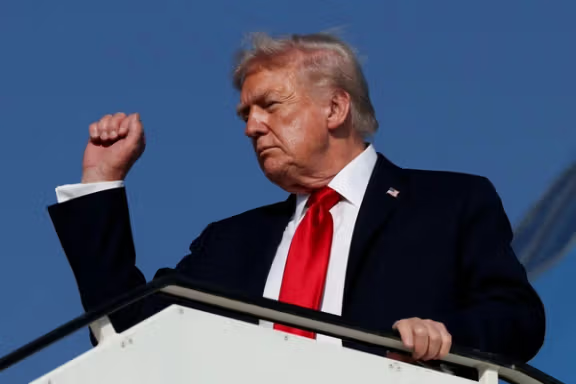
US President Donald Trump gestures as he boards Air Force One, October 13, 2025

The public rancor between US President Donald Trump and Iranian Supreme Leader Ali Khamenei has gotten increasingly personal, suggesting that a standoff once mediated through proxies and carefully coded threats may be approaching a finale.

That escalation was on display last week when Trump openly questioned Khamenei’s right to rule and called him a “sick man” who kills his own people.

“It’s time to look for new leadership in Iran,” the president was quoted as saying by Politico. His blistering rhetorical intervention came after one of Khamenei's most strident speeches yet in which he, uncharacteristically, acknowledged thousands had been killed in the state's crackdown on protests this month.

"We consider the US president criminal for the casualties, damages and slander he inflicted on the Iranian nation," Khamenei said.

Iranian officials denounced Trump’s language as “offensive” and “unacceptable,” with president Masoud Pezeshkian warning that any move against Khamenei would trigger an all-out war.

The latest public spat followed widespread protests inside Iran, which were quelled through the unprecedented use of force. Speaking about the unrest last week, Khamenei once again blamed Israel and the United States for incitement, accusing Washington of fomenting terrorism and sabotage.

'The most wretched of humankind'

While the language has grown sharper, the confrontation itself is not new.

The personal animosity between Trump and Khamenei reached a decisive turning point in January 2020, when a US drone strike in Baghdad ordered by Trump killed Qassem Soleimani, the commander of Iran’s Quds Force and one of the most powerful figures in the Islamic Republic.

Khamenei described those responsible as “the most wretched of humankind” and vowed revenge. The killing transformed what had been a strategic rivalry into a deeply personal feud—one infused with symbolism, grievance, and a sense of irreversibility.

In the years that followed, Khamenei increasingly personalized his attacks on Trump. He portrayed the US president as the embodiment of American arrogance and decay, at one point calling him a “clown.”

Still, the veteran theocrat most abstained from uttering the name of his nemesis, out of contempt. Trump has done largely likewise.

'Ultimately responsible'

Even before Soleimani’s death, the two leaders had traded insults during Trump’s first term.

In June 2019, Trump imposed sanctions on Khamenei, calling him “ultimately responsible” for Tehran’s conduct. Iran’s then president, Hassan Rouhani, responded by calling the White House “mentally disabled,” a remark later endorsed by Khamenei’s office.

Trump dismissed the response as “ignorant and insulting,” saying Iran’s leaders “do not understand reality.”

A year later, when Japan’s then prime minister Shinzo Abe attempted to deliver a message from Trump to Khamenei, the Iranian leader publicly refused to accept it, telling Abe that he did not believe Trump was “worthy” of receiving a message.

Footage later showed Abe awkwardly folding the envelope away—an episode widely read as a calculated public snub.

One last dance?

Since Trump’s return to office, the exchanges have become more frequent and more explicit, often coinciding with moments of heightened tension, not least the June war between Iran and Israel.

On June 17, Trump took to social media for a rare direct attack.

“We know exactly where the so-called ‘Supreme Leader’ is hiding,” he wrote. “He is an easy target, but is safe there—we are not going to take him out, at least not for now.”

In October 2025, Khamenei described the United States under Trump as “a true manifestation of terrorism.” He compared Trump to figures such as Pharaoh and Nimrod, warning that “tyrants fall at the height of their arrogance.”

What distinguishes the current phase of their feud is not merely its volume, but its direction.

Earlier exchanges left room for ambiguity, intermediaries, or eventual de-escalation. The present rhetoric increasingly dispenses with those buffers, with Trump now speaking openly of replacement.

Whether this marks the final chapter of the confrontation remains uncertain. What is clear is that the US-Iran conflict now includes a personal clash between two leaders loath to compromise, despite the asymmetry of power between them.

Most Viewed

IRGC-linked media hints at threat to Persian Gulf undersea internet cables
1

IRGC-linked media hints at threat to Persian Gulf undersea internet cables

2

Iran Guards say two ships seized in Hormuz after ceasefire extension

3
EXCLUSIVE

Strikes on petrochemical hubs leave Iran short of plastics

4

Scam messages seek crypto for ships’ safe passage through Hormuz, firm warns

5
EXCLUSIVE

Family told missing teen was alive, then received his body 60 days later

Banner
Banner

Spotlight

  • As Tehran digs in, ordinary Iranians pay the price
    INSIGHT

    As Tehran digs in, ordinary Iranians pay the price

  • Internet Pro or Censor Pro? Iran rolls out a new service
    ANALYSIS

    Internet Pro or Censor Pro? Iran rolls out a new service

  • Strikes on petrochemical hubs leave Iran short of plastics
    EXCLUSIVE

    Strikes on petrochemical hubs leave Iran short of plastics

  • Diplomacy tolls at Hormuz as conflict returns to its doorstep
    OPINION

    Diplomacy tolls at Hormuz as conflict returns to its doorstep

  • Opposition to US talks grows in Tehran as ceasefire deadline nears
    INSIGHT

    Opposition to US talks grows in Tehran as ceasefire deadline nears

  • The future has been switched off here
    TEHRAN INSIDER

    The future has been switched off here

•
•
•

More Stories

Iran after the crackdown: serenity on screens, grief on the streets

Jan 21, 2026, 01:58 GMT+0
•
Maryam Sinaiee

After the January 8-9 mass killing of protestors in Iran, state media broadcasts fresh snow falls and other serene scenes bearing little resemblance to the agony of many Iranians reeling from the historic violence.

Official outlets show bundled up children frolicking and families shopping, suggesting normal life restored. Eyewitness accounts from inside Iran and testimony from those who have recently left describe instead a country gripped by grief, fear and economic paralysis.

Prominent journalist Elaheh Mohammadi—whose report about Mahsa Amini, a young woman who died in morality police custody, helped trigger the widespread protests of 2022—described the mood.

“For the past day or two, our VPNs have been working only sporadically—maybe for half an hour to an hour each day—allowing us brief access to the internet. We use that time to let people know we’re still alive,” she said on X.

“The city smells of death. In all my life, I have never seen snow fall in Tehran without anyone even smiling,” she added. “Everyone is in shock; the entire country is in mourning.”

For nearly two weeks, Iran’s internet has been almost entirely shut down, with little sign it will be soon restored. Aside from a handful of government-affiliated outlets and state television, access to news has been virtually nonexistent.

Fleeing the tragedy

Those who have managed to leave Iran by land or air have become key sources of information. Yet many say that once across the border, they too fall into an information vacuum, cut off from reliable updates from home.

Mortaza, who left Iran for a neighboring country several days after the killings, says satellite television has become the primary source of news for many inside the country. Even those broadcasts, he adds, are intermittently disrupted by jamming.

Without exception, those interviewed say the scale of the killings far exceeded what many had anticipated. Violence was so widespread, they say, that almost everyone knows at least one of the dead personally.

Across neighborhoods, families and friends have erected traditional mourning displays—hejleh—decorated with flowers, candles, mirrors, lights and framed photographs of young victims.

The structures resemble wedding canopies, symbolizing lives cut short before marriage.

Banners announcing the victims’ “passing,” often accompanied by poetry or phrases such as “martyr of the homeland,” are visible throughout cities.

What tragedy?

News programs on the state broadcaster repeatedly air footage of vehicles and buildings allegedly set ablaze by protesters—now described not merely as “rioters,” but as “US- and Israel-backed terrorists.”

These segments are interspersed with televised interrogations and forced confessions of individuals who have not appeared in court, alongside images of daily life and repeated claims that foreign-backed "terrorist" plots have been thwarted.

In recent days, the judiciary has issued repeated warnings promising harsh punishment and “no leniency” for those accused of participating in the unrest.

Continued repression

The crackdown has extended well beyond those who took part in protests.

Mohammad Saedi-Nia, a prominent investor and owner of the Saeedi-Nia café chain, was arrested after closing his cafés during calls to protest by exiled Prince Reza Pahlavi. His businesses—along with those of former national footballer Voria Ghafouri—were shut down for supporting protesters.

Saeedi-Nia’s assets, estimated at around $20 million, have reportedly been confiscated.

Dozens of athletes, artists and intellectuals who expressed support for the demonstrations have also had cases opened against them; some have been detained.

The judiciary says assets have been seized to ensure that, if convictions follow, alleged damage to public or private property can be recovered.

Mostafa, who communicated with Iran International via Starlink from his workplace, says traffic in Tehran is unusually light. Only a small number of street-facing shops have opened, he said, and the gold market remains shut.

Economic standstill

Most universities are closed, with final exams moved online. Many businesses are effectively dormant: transactions have stalled because prices depend on the dollar, and the currency market has frozen without a clear exchange rate.

Eyewitnesses also report growing shortages of basic goods. Cooking oil is scarce and selling at several times its previous price when available.

Prices of staples such as rice, eggs, chicken and meat have surged, while consumers limit purchases to essentials and shopkeepers hesitate to sell non-perishable goods.

State media deny that conditions resemble martial law, but eyewitnesses insist otherwise.

Many people have deleted photos and videos of protests from their phones, fearing random stops and searches by security forces.

Some witnesses say young people have been forced to expose their bodies in public to show they bear no marks from pellet guns or rubber bullets—signs authorities use to identify those who took part in demonstrations.

Eyewitness lives to tell tale of 'next-level brave' Iran protests

Jan 20, 2026, 17:33 GMT+0
•
Negar Mojtahedi

After returning from Iran to Canada, Mona Bolouri said the unity and size of protests she witnessed firsthand convinced her that the Islamic Republic was doomed after she left the country a day before a deadly crackdown.

“I know it’s over,” Bolouri said, referring to the Islamic Republic. “I’m not afraid to say this openly, because I believe the regime will be a different regime.”

Bolouri, a 40-year-old Iranian Canadian, traveled to Iran in late December to visit family and was in Mashhad as protests erupted on January 8.

What she witnessed, she said, was unlike anything she had seen during earlier protest waves.

“It was the most magnificent thing I’ve ever seen,” Bolouri said. “The crowd was so huge that I couldn’t even get to the front line.”

She described Vekilabad Boulevard, one of Mashhad’s largest and most prominent central avenues, filled shoulder to shoulder with demonstrators chanting slogans against Supreme Leader Ali Khamenei and calling for the return of Reza Pahlavi, the son of Iran’s deposed Shah.

The scale of the turnout initially made her feel safe, she said, despite the city’s reputation as a conservative stronghold and its symbolic closeness to Khamenei’s power base.

That sense of safety quickly evaporated as security forces moved in. Live gunfire and tear gas intensified as protesters pushed forward, with the gas becoming so thick it left people disoriented and unable to see.

She recalled being helped away by strangers after losing her vision and struggling to breathe amid the chaos.

What struck her most, she said, was the bravery of younger protesters who repeatedly surged toward security forces even as shots rang out.

“I am a brave person, but they are on a next-level brave,” she said. “Aren’t they afraid of their lives?”

As night fell, Iran’s internet was cut, severing communication and access to the outside world. Bolouri said she realized her messages were no longer sending and feared her parents would be unable to reach her.

“It’s a different city now,” she recalled telling her family once she was back home.

She described streets stripped of traffic signs and surveillance cameras, pulled down by protesters to block motorcycle units and avoid identification. Fires burned at sites linked to the security apparatus, including banks associated with the Islamic Revolutionary Guard Corps.

The damage, she said, was deliberate and defensive rather than random.

One moment, she said, stayed with her. An ambulance drove toward the crowd—the only vehicle moving against the flow. At first, she thought it was responding to a medical emergency.

“I was like, why is it coming this way?” Bolouri said. “Why wouldn’t it go around? The other streets were still open for cars.”

She soon realized that ambulances were being used to transport security forces. “That’s when it made sense,” she said.

Although she did not personally witness fatalities, Bolouri said she saw multiple injured protesters being carried away as gunfire flashed through clouds of tear gas.

She later learned from relatives that the violence intensified the following night.

Her uncle, who remained in Mashhad, told her that from early evening until nearly midnight, the sound of continuous gunfire echoed through residential neighborhoods.

“They were crying at home,” she said, describing how older family members panicked simply from the noise, aware that something terrible was unfolding outside.

Bolouri’s flight out of Iran was canceled, but she managed to leave via a domestic route to Istanbul. Her family believed she might not survive if she stayed another night.

Now back in Canada, she says the experience has left her unexpectedly hopeful. Comparing the protests she witnessed in Iran with rallies abroad, Bolouri said what stood out inside the country was unity and certainty.

“In Iran, there was no hesitation,” she said. “Everybody was on the same page.”

Despite the violence and mass killings, she believes the uprising marked a turning point.

The scale of participation, the open calls for regime change, and the willingness of protesters to face live fire convinced her that this movement had gone beyond anything she had previously witnessed.

Bolouri said she would normally avoid speaking publicly about her experience, out of concern for being able to return to Iran, but decided to speak out because she firmly believes the Islamic Republic is finished.

Brutal protest crackdown marks Tehran's death throes, ex-CIA chief says

Jan 19, 2026, 19:17 GMT+0

The Islamic Republic's resort to the deadliest crackdown on protestors in its history signals endgame for the theocracy, retired US Army General and ex-CIA director David Petraeus told Iran International Insight, the channel's town hall held in Washington DC.

“This regime is dying. Essentially it’s fighting, it’s killing again, but it is also dying," said Petraeus, a retired four-star Army general who now runs the Middle East business of US private equity firm KKR.

“I think it signals enormous questions about the regime's ability to sustain the situation,” he said, arguing Tehran is under more pressure now than at almost any point since the Iran-Iraq war.

Speaking to host Farzin Nadimi, a senior fellow at the Washington Institute, Petraeus painted a stark picture of the clerical establishment facing simultaneous existential challenges at home and abroad.

“Iran is essentially defenseless at this point,” Petraeus said, referring to the destruction of air and ballistic missile defense systems early in a June conflict with Israel and the United States.

The veteran commander, who led the so-called "surge" of US forces aimed at defeating an insurgency at the height of the US war in Iraq, said the scale of violence used against demonstrators reflects fear rather than control by Iran's leaders.

While he acknowledged the Islamic Republic may be able to suppress unrest in the short term, he warned that flooding cities and towns with security forces may not buy authorities a lasting reprieve from popular anger.

“This regime has lost legitimacy. The problem is it hasn’t lost the capability to kill.”

His assessment comes as Iran grapples with sustained nationwide unrest that began on December 28 among electronics and cellphone merchants at Tehran’s bazaar and quickly escalated into a nationwide uprising against the Islamic Republic.

At least 12,000 people were killed in just two days, according to medics and Iranian officials speaking to Iran International.

With the Iranian currency cratering, inflation climbing and purchasing power collapsing, Petraeus said Iran no longer has the financial tools it once used to calm the streets.

“At this time, there's not much Iran can do about it. They have very little capacity."

Asked about Trump's mooted pledge to intervene militarily to defend protestors, Petraeus stopped short of assessing the efficacy of any US attack but said the move would be well received and not bolster the leadership.

“I think we could take action against the regime and it would be applauded … not be a rallying cry for them.”

Iran envoy warns escalation could engulf region as Arab states step up contacts

Jan 19, 2026, 13:58 GMT+0

Any flare-up of tensions, even a conflict targeting a single country, would have serious consequences for the entire Middle East, Iran’s ambassador to Saudi Arabia warned, as Tehran said it has held intensified contacts with Arab states to prevent a wider confrontation.

Alireza Enayati said in an interview with the Saudi newspaper Okaz that Iran believed dialogue and joint regional action were the most effective ways to preserve stability and avoid broader conflict.

“In recent days, we have witnessed contacts from Arab countries,” Enayati said, adding that foreign ministers from Saudi Arabia, Qatar and Oman had been in close communication with Tehran, alongside a recent visit by Oman’s foreign minister.

“These efforts are aimed at regional stability and strengthening security,” he said, adding that Iran welcomed initiatives to prevent escalation but warned that “the ignition of any tension, even a conflict targeting one specific country, would have serious consequences for the entire region.”

Enayati said Iran remained committed to peaceful solutions for regional crises and viewed dialogue as the only way to address even the most complex issues, while accusing other parties of opting for confrontation instead.

He warned against what he described as plans aimed at weakening countries in the region and said the real threat was Israel’s growing influence in the Middle East.

Iran's state media projects calm as crackdown, blackout persist

Jan 18, 2026, 08:57 GMT+0
•
Behrouz Turani

After Tehran's deadliest crackdown on dissidents in decades and with broad domestic security mobilization and sweeping internet blackout still in place, Tehran now tries to project an image of calm.

That effort is being carried out through the handful of government-owned media outlets still permitted to operate, and increasingly through individuals granted internet access via so-called “white SIM cards,” who portray a peaceful, orderly Iran.

As of midday January 16, state television’s rolling news channel, IRINN, had aired more than two dozen times an old video showing families visiting a ski resort in Chaharmahal and Bakhtiari province near Isfahan. “People are enjoying the beautiful snowfall,” the narrator says.

Continue reading...