• العربية
  • فارسی
Brand
  • Iran Insight
  • Politics
  • Economy
  • Analysis
  • Special Report
  • Opinion
  • Podcast
  • Iran Insight
  • Politics
  • Economy
  • Analysis
  • Special Report
  • Opinion
  • Podcast
  • Theme
  • Language
    • العربية
    • فارسی
  • Iran Insight
  • Politics
  • Economy
  • Analysis
  • Special Report
  • Opinion
  • Podcast
All rights reserved for Volant Media UK Limited
volant media logo

US levies new sanctions on Iran oil trade after protest crackdown

Jan 23, 2026, 16:29 GMT+0
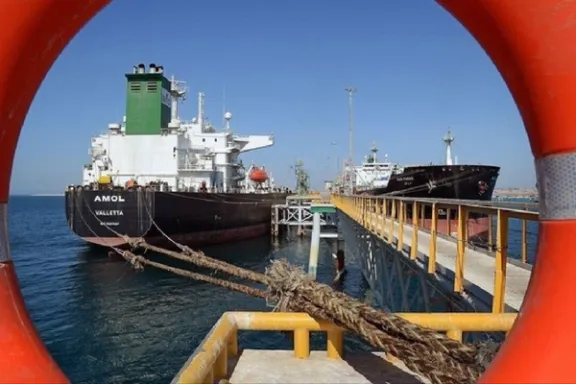
An oil tanker docks at an Iranian port in this file photo.

The US Treasury on Friday slapped new sanctions on ships and their owners it accuses of enriching the Iranian state and fueling its repression following mass killings of protestors earlier this month.

The measures targeting nine vessels from what the United States dubs Iran's "shadow fleet", their owners and management firms, saying their activities have together exported hundreds of millions of dollars’ worth of Iranian oil and petroleum products.

“The Iranian regime is engaged in a ritual of economic self-immolation—a process that has been accelerated by President Trump’s maximum pressure campaign. Tehran’s decision to support terrorists over its own people has caused Iran's currency and living conditions to be in free fall,” US Treasury Secretary Scott Bessent was quoted as saying in a statement.

“Today’s sanctions target a critical component of how Iran generates the funds used to repress its own people. As previously outlined, Treasury will continue to track the tens of millions of dollars that the regime has stolen and is desperately attempting to wire to banks outside of Iran."

The new US sanctions come after the treasury last week announced sanctions on several top Iranian commanders and the country's powerful security chief Ali Larijani, whom it accused of being "architects" of the violence.

Iranian security forces opened fired on protestors nationwide in violence that culminated on Jan. 8-9 this month which medics and government sources told Iran International claimed the lives of at least 12,000 people.

The number may be more than 20,000, the UN special rapporteur on human rights in Iran said Thursday, citing reports from doctors inside the country.

Most Viewed

Ghalibaf defends Iran-US talks amid hardline backlash
1
INSIGHT

Ghalibaf defends Iran-US talks amid hardline backlash

2
INSIGHT

100 days after carnage: Iran economy reels from war, inflation, unemployment

3
INSIGHT

A nation in limbo: 100 days after the massacre, has the world moved on?

4
ANALYSIS

From instability to influence: Pakistan’s pivotal role in US-Iran diplomacy

5
ANALYSIS

100 days on: why Iran’s January protests spread across social classes

Banner
Banner

Spotlight

  • War-hit homeowners feel abandoned as Iran’s reconstruction aid fades

    War-hit homeowners feel abandoned as Iran’s reconstruction aid fades

  • 100 days on: the anatomy of Iran’s January crackdown
    INSIGHT

    100 days on: the anatomy of Iran’s January crackdown

  • Ghalibaf defends Iran-US talks amid hardline backlash
    INSIGHT

    Ghalibaf defends Iran-US talks amid hardline backlash

  • 100 days on: why Iran’s January protests spread across social classes
    ANALYSIS

    100 days on: why Iran’s January protests spread across social classes

  • From instability to influence: Pakistan’s pivotal role in US-Iran diplomacy
    ANALYSIS

    From instability to influence: Pakistan’s pivotal role in US-Iran diplomacy

  • A nation in limbo: 100 days after the massacre, has the world moved on?
    INSIGHT

    A nation in limbo: 100 days after the massacre, has the world moved on?

•
•
•

More Stories

Iran's energy trade defies year of US maximum pressure sanctions

Jan 23, 2026, 08:29 GMT+0
•
Dalga Khatinoglu

One year after US President Donald Trump returned to the White House and revived the "maximum pressure" sanctions on Iran from his first term, available data show the country’s energy exports remain largely intact.

Data from the commodity intelligence firm Kpler, seen by Iran International, show that in 2025 Iran delivered an average of 1.38 million barrels per day (bpd) of crude oil and gas condensate to China—a decline of just 7 percent compared with 2024.

After Iranian oil exports to Syria halted in December 2024, China effectively remained Tehran’s sole buyer of crude oil over the past year.

Unlike crude oil, Iran’s petroleum product exports—fuel oil (mazut), naphtha and liquefied petroleum gas (LPG)—are relatively diversified, with shipments mainly destined for China, the United Arab Emirates, Malaysia and Singapore.

According to Kpler, Iran exported an average of 190,000 bpd of naphtha and 256,000 bpd of fuel oil last year, a combined decline of about 13 percent compared with 2024.

The drop, however, was driven not by tighter US sanctions but by Iran’s worsening domestic gas shortages, which forced power plants and industrial facilities to burn more fuel oil, reducing volumes available for export.

Data from tanker-tracking firms Kpler and Vortexa show that the modest decline in crude oil exports was offset by increased shipments of natural gas and LPG.

Iran has also continued exporting natural gas to Turkey and Iraq.

Tehran and Baghdad don’t publish official figures, but data from Turkey’s energy ministry indicate that natural gas imports from Iran increased about 9 percent during the first 11 months of last year compared with the same period in 2024.

One reason US sanctions have struggled to significantly curb Iran’s energy exports has been the continued operation of the so-called shadow fleet—a network of oil tankers that transport sanctioned crude through flag changes, disabled tracking systems, ship-to-ship transfers, and opaque ownership structures.

According to estimates by TankerTrackers, roughly 1,500 oil tankers worldwide were involved in shadow fleet activity last year, with nearly 40 percent linked to Iranian oil shipments.

Although the United States stepped up sanctions on such tankers in 2025, existing data suggests that hundreds of non-sanctioned vessels remain active in transporting Iranian oil through opaque trading routes and intermediary networks, undermining the enforcement capacity of US measures.

Further data from Kpler indicate that widespread domestic protests in Iran in recent weeks have had no noticeable impact on the country’s oil and petroleum product export volumes.

While China has remained the sole buyer of Iranian crude oil and condensate, the United Arab Emirates—one of Washington’s closest regional allies—has emerged as the largest importer of Iranian fuel oil, accounting for nearly 70 percent of those exports.

Estimates by Iran International put the total value of Iran’s exports of crude oil, petroleum products, and natural gas last year—excluding discounts and the costs of sanctions evasion—at roughly $60 billion.

The figure highlights the gap between early US projections that Iran’s oil exports would collapse by as much as 90 percent and the far more limited impact visible in the data so far.
Iran vows mass retaliation to attack, taunts Europe over US Greenland push

Jan 21, 2026, 15:45 GMT+0

Iran's foreign minister said the country was prepared to show no restraint in retaliating to any military attack and mocked Europe about its standoff with the United States over President Donald Trump's push to control Greenland.

Tensions between Tehran and Washington have flared in the wake of the deadliest crackdown on protests in the history of the Islamic Republic earlier this month.

Trump warned Iran not to kill protestors and vowed in a social media post the "help is on the way," in comments which heartened demonstrators and appeared to signal readiness for a military intervention which has yet to materialize.

"Unlike the restraint Iran showed in June 2025, our powerful armed forces have no qualms about firing back with everything we have if we come under renewed attack," Araghchi said in an editorial in the Wall Street Journal, referring to a 12-day war with Israel and the United States.

At least 12,000 protestors were killed by security forces, according to medics and government sources speaking to Iran International.

The veteran diplomat and strident defender of Tehran's crushing of the nationwide demonstrations had his invitation to the World Economic Forum in Davos, Switzerland revoked this week.

"An all-out confrontation will certainly be ferocious and drag on far, far longer than the fantasy timelines that Israel and its proxies are trying to peddle to the White House," he added. "It will certainly engulf the wider region and have an impact on ordinary people around the globe."

Trump is weighing "decisive" military options toward Iran in the wake of the mass killing of demonstrators, the same newspaper reported on Tuesday, as a US carrier strike group steams toward the region.

Meanwhile the United States has ramped up its bid to lay claim to Greenland, a part of Denmark, citing Arctic and world security in a diplomatic drama which is opposed by the European Union and is straining the nearly 80-year-old NATO alliance.

Araghchi cited what he called Europe's support for Trump's move to exit an international deal over Iran's disputed nuclear program in his first term, saying the United States was behaving in a unilateral way which challenged global order.

"Sadly for Europe, its current conundrum is the very definition of 'blowback'. The E3/EU faithfully obeyed and even abetted President Trump when he unilaterally abrogated the Iran Nuclear Deal," he wrote on X.

"Mr. Trump's threat to take over Greenland by any means—unlawful as it is under any conception of international law or even a 'rules-based order'—could not happen to a more deserving continent," he added.

Iranian lawmakers call Trump ‘Pharaoh,’ cast Khamenei as 'Moses'

Jan 19, 2026, 08:20 GMT+0

Iranian lawmakers on Monday likened US President Donald Trump to the biblical Pharaoh and praised Supreme Leader Ali Khamenei as Moses, in rhetoric aired during a parliamentary session amid heightened tensions with Washington.

In a statement read aloud in Iran’s parliament, lawmakers said Khamenei would “make Trump and his allies taste humiliation.”

Addressing Trump directly, the statement said Iran’s leader would “drown you in the sea of the anger of believers and the oppressed of the world, to serve as a lesson for the world of arrogance.”

Parliament Speaker Mohammad Bagher Ghalibaf later described Trump as “disrespectful” following a closed-door session of lawmakers, saying Khamenei had set the country’s course without fear of the US president.

“Khamenei has spent his life confronting corrupt arrogant powers such as Trump,” Ghalibaf said.

He also described the ongoing protests in Iran as an American-Israeli plot, adding that the United States had once again failed and that Trump was “desperate” and showing contradictory behavior.

He said actions taken by the United States against Iran over the past two weeks would constitute “clear crimes” in any fair international court, comparing recent developments to the pager operation in Lebanon. In September 2024, thousands of electronic devices intended for use by Hezbollah members exploded simultaneously in two separate events across Lebanon and Syria.

Iranian officials have repeatedly accused the United States and Israel of fomenting unrest inside the country, allegations denied by Western governments.

Tensions between Tehran and Washington have risen sharply in recent weeks, as Iran faces widespread protests at home and renewed international pressure over its internal security crackdown.

Khamenei blames protest casualties on Trump, calls him a criminal

Jan 17, 2026, 11:32 GMT+0

Iran’s supreme leader accused the US president of orchestrating unrest and committing crimes against the Iranian nation, escalating his rhetoric against Washington as authorities continue to frame recent protests as a foreign-backed plot.

Ali Khamenei in his Saturday speech blamed the United States for casualties, damage and what he described as slander against Iran, directly targeting President Donald Trump for encouraging unrest and promising support to protesters.

“We consider the US president a criminal for the casualties, damages, and the slander he inflicted on the Iranian nation,” Khamenei said. He further described the recent protests as “an American plot” and accused Washington of seeking to “devour Iran.”

Supreme leader links unrest to Washington

Trump, Khamenei said, had personally intervened, accusing him of making statements that emboldened demonstrators and pledging military backing. “Trump himself intervened in this unrest, made statements, encouraged the rioters, and said we will provide military support,” he added.

100%

The events, he said, were planned by Americans with the aim of asserting control over Iran, repeating a long-standing narrative that external forces are behind domestic dissent. He also accused the US president of misrepresenting those involved in the unrest, saying Trump portrayed “vandals” as the Iranian nation.

At least 12,000 people have been killed in Iran in the largest killing in the country's contemporary history, much of it carried out on January 8 and 9 during an ongoing internet shutdown, according to senior government and security sources speaking to Iran International.

The killing was carried out on the direct order of Supreme Leader Ali Khamenei, with the explicit knowledge and approval of the heads of all three branches of government, and with an order for live fire issued by the Supreme National Security Council, Iran International has learned.

Warning to protesters and alleged backers

Khamenei issued a warning that extended beyond street protests to those he described as "instigators" at home and abroad.

The leader of the Islamic Republic said he does not intend to steer the country toward war but will not let "domestic criminals" go, while also acknowledging that “several thousand people” were killed during widespread protests across Iran.

“The Iranian nation, just as it broke the back of the riot, must also break the back of those who instigated it.”

Authorities and society, he added, would not relent in pursuing those blamed for the unrest. “The Iranian nation will not let go of the domestic and international criminals behind this unrest,” Khamenei said.

New US sanctions target Iran's security chief, upping diplomatic ante

Jan 15, 2026, 16:38 GMT+0

The United States sanctioned Iran's influential security chief on Thursday along with top military officers it accused of being behind a deadly crackdown on protests, ramping up Washington's standoff with Tehran as it weighs a potential attack.

The designation of Larijani cites his affiliation to the Iranian Supreme Leader Ali Khamenei. Elevated to leadership of Iran's Supreme National Security Council last year, he is a veteran security and political insider of the theocracy.

Larijani, the treasury said in a statement, was "one of the first Iranian leaders to call for violence in response to the legitimate demands of the Iranian people."

"LARIJANI, Ali (Arabic: علی لاریجانی) (a.k.a. LARIJANI, Ali Ardeshir), Tehran, Iran; DOB 03 Jun 1958; POB Najaf, Iraq; nationality Iran; Additional Sanctions Information - Subject to Secondary Sanctions; Gender Male; Passport D10010646 (Iran) expires 05 Sep 2027 (individual) [IRAN-EO13876] (Linked To: KHAMENEI, Ali Husseini)," the entry on the US Treasury Department's website read.

Other sanctions targeted top officers in Iran's Islamic Revolutionary Guard Corps including provincial commanders.

The Treasury also added 13 entities to its Specially Designated Nationals (SDN) list, including Fardis Prison and companies allegedly linked to US-sanctioned Iranian trade in the United Arab Emirates, Singapore and the United Kingdom.

“The United States stands firmly behind the Iranian people in their call for freedom and justice,” said Secretary of the Treasury Scott Bessent said in a statement.

“At the direction of President Trump, the Treasury Department is sanctioning key Iranian leaders involved in the brutal crackdown against the Iranian people. Treasury will use every tool to target those behind the regime’s tyrannical oppression of human rights.”

The United States is moving a carrier strike group toward the Persian Gulf as President Trump has mooted attacking the country for its killing of protestors.

At least 12,000 people have been killed in Iran in the largest killing in the country's contemporary history, much of it carried out on January 8-9 during an ongoing internet shutdown, senior government and security sources told Iran International.

"Elements of Iran’s Islamic Revolutionary Guard Corps (IRGC) have even attacked wounded protesters in one hospital in Ilam Province, firing tear gas and metal pellets into the hospital grounds and assaulting patients, family members, and medical workers," the treasury added.

"The officials sanctioned today—and their organizations—bear responsibility for the thousands of deaths and injuries of their fellow citizens as protests erupted in each of these provinces."