• العربية
  • فارسی
Brand
  • Iran Insight
  • Politics
  • Economy
  • Analysis
  • Special Report
  • Opinion
  • Podcast
  • Iran Insight
  • Politics
  • Economy
  • Analysis
  • Special Report
  • Opinion
  • Podcast
  • Theme
  • Language
    • العربية
    • فارسی
  • Iran Insight
  • Politics
  • Economy
  • Analysis
  • Special Report
  • Opinion
  • Podcast
All rights reserved for Volant Media UK Limited
volant media logo
INSIGHT

Iran’s hardliners take aim at booming café culture

Maryam Sinaiee
Maryam Sinaiee

Iran International

Dec 26, 2025, 02:30 GMT+0Updated: 22:29 GMT+0

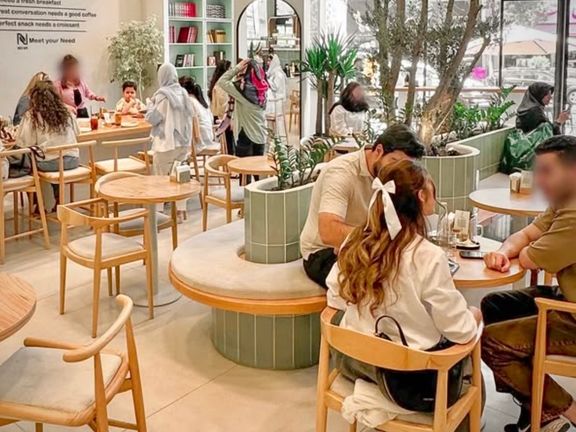
Cafés—and the social life that has grown around them—have become the latest battleground for Iran’s hardliners, who increasingly see their control over everyday behavior slipping out of reach.

That tension was on display this week when Saeed Jalili, a leading figure of Iran’s ultra-hardline camp, attacked café culture as a Western plot designed to undermine the family.

“They define three spaces: the dormitory, the workplace, and a ‘third space,’ like a café, to escape loneliness,” Jalili said. “In this paradigm, the family loses meaning. This stands in opposition to Islam’s philosophy of marriage.”

For conservative factions that have long insisted on strict gender segregation and rigid enforcement of compulsory hijab, the spread of cafés represents more than a shift in leisure habits—it signals a loss of authority over how people socialize and occupy public space.

Even in religious strongholds

People who have recently visited Iran report a striking expansion of café culture, including in religious centers such as Qom, long seen as resistant to such social change. Analysts note that the trend reflects not only generational preferences but also economic pressure.

“At a time when many traditional forms of leisure have been eliminated due to economic hardship, cafés are the only place left that can fill the recreational void for young people,” the news website Jaryan24 wrote, describing the phenomenon as a version of the “lipstick effect.”

The spread of cafés in cities like Qom and Mashhad has been particularly alarming to ultra-hardliners.

In September, Mannan Raisi, a hardline lawmaker representing Qom, condemned the opening of a new café in the city and warned that “the people themselves” would intervene.

Videos circulating from the event showed young men and women socializing at a DJ-led gathering—images that drew outrage from conservatives in a city that hosts Iran’s most influential Shiite seminaries.

The café was shut down within a day. Shortly afterward, a member of Qom’s city council announced that the owner’s business license had been revoked and that criminal charges had been filed for allegedly promoting “moral corruption.”

That anxiety has been sharpened by what hardliners view as the authorities’ retreat from enforcing a stringent hijab law passed by parliament in 2023 but later shelved by the Supreme National Security Council for fear of public backlash.

‘Society has moved on’

Jalili’s remarks triggered a broad backlash across Iranian media and social platforms. Critics argued that his comments revealed a widening gap between hardline ideology and everyday social realities.

Seyed-Ali Pourtabatabaei, a former editor at Qom News, described café culture as “the new nightmare of Saeed Jalili and his supporters.”

“Jalili does not fear cafés because he believes the West is destroying the family,” Pourtabatabaei argued. “He fears them because cafés symbolize a society that no longer needs him or his ideology—and does not vote for it.”

Legal scholar Mohsen Borhani went further, writing that such thinking “places no value on citizens’ freedom of choice,” adding that even authoritarian systems of the past did not seek to regulate cafés.

What the debate reveals is less about coffee than about power. As traditional mechanisms of control weaken, seemingly ordinary spaces have taken on political meaning—becoming sites where the struggle over Iran’s social future is quietly, and visibly, playing out.

Most Viewed

State media slam Araghchi's Hormuz tweet, say it let Trump claim victory
1

State media slam Araghchi's Hormuz tweet, say it let Trump claim victory

2
OPINION

The Hormuz get out of jail card turned to a grave

3
INSIGHT

How Tehran bends its own red lines to boost state rallies

4

Iran International says it won’t be silenced after London arson attack

5
VOICES FROM IRAN

Iran blackout cripples freelancer, small business incomes

Banner
Banner

Spotlight

  • Too early to tell who is winning Iran war, experts say
    PODCAST

    Too early to tell who is winning Iran war, experts say

  • How Tehran bends its own red lines to boost state rallies
    INSIGHT

    How Tehran bends its own red lines to boost state rallies

  • Iran blackout cripples freelancer, small business incomes
    VOICES FROM IRAN

    Iran blackout cripples freelancer, small business incomes

  • Ideology may be fading in Iran, but not in Kashmir's ‘Mini Iran'
    INSIGHT

    Ideology may be fading in Iran, but not in Kashmir's ‘Mini Iran'

  • US blockade enters murky phase as tankers spoof signals and buyers hesitate
    ANALYSIS

    US blockade enters murky phase as tankers spoof signals and buyers hesitate

  • Why the $100 billion Hormuz toll revenue is a myth
    ANALYSIS

    Why the $100 billion Hormuz toll revenue is a myth

•
•
•

More Stories

Tehran commentariat seek to calm war fears as markets jitter

Dec 25, 2025, 00:55 GMT+0
•
Behrouz Turani

A cluster of former officials and pundits in Tehran has sought to downplay the likelihood of a US-backed Israeli strike on Iran, arguing that Washington has little appetite for such military action.

The claims have circulated amid growing public anxiety about escalation—concerns that have begun to ripple through Iran’s currency and gold markets.

“Trump is no longer interested in playing Netanyahu’s game,” Nameh News, a conservative outlet widely seen as close to Iran’s intelligence community, quoted Heshmatollah Falahatpisheh, the former head of parliament’s national security committee, as saying.

Falahatpisheh offered little evidence for the assertion, suggesting only that “all of Trump’s attention is currently focused on the Western hemisphere.”

Those assurances stand in contrast to remarks on Wednesday by Israeli Prime Minister Benjamin Netanyahu, who said Israel still needed to “settle accounts” with Iran, adding that while Israel did not seek confrontation, it remained alert to “every possible danger.”

Meeting in Mar-a-Lago

Netanyahu is set to meet Donald Trump next week, primarily to discuss the next phase of the Gaza conflict but also Iran’s nuclear standoff.

Nameh News introduced the interview by citing the upcoming meeting, asserting that it would have no impact on Tehran’s determination to pursue its nuclear and missile programs.

Falahatpisheh further argued that the Trump–Netanyahu meeting was intended mainly to shield Israel from broader US national security priorities, claiming Washington was no longer willing to spend resources on military operations outside the Western hemisphere.

As support, he cited US national security documents, noting that Iran was mentioned 17 times in 2024 but only three times in 2025.

‘US not interested’

The same day, the outlet quoted foreign policy analyst Ali Bigdeli, who echoed Falahatpisheh’s assessment almost verbatim.

“I do not assume that the United States is likely to enter an action against Iran to assist Israel,” Bigdeli said, while maintaining that the Trump–Netanyahu meeting would indeed focus on Iran. He warned of the possibility of a “surprise military attack” but concluded that a broader conflict between Israel and Iran remained unlikely.

A similar argument appeared in the reformist daily Arman Melli, which published an interview that day with political commentator Hassan Hanizadeh.

Hanizadeh said the United States was “not interested in taking part in a new war against Iran” and accused Netanyahu and Israeli media of amplifying regional instability for domestic political reasons.

Taken together, the remarks suggest a coordinated effort to reassure domestic audiences that war is unlikely, even as official rhetoric remains confrontational. Whether such messaging can ease public anxiety—and calm markets in Iran—remains an open question.

When Iran’s economic reality slipped onto state TV

Dec 23, 2025, 21:49 GMT+0
•
Behrouz Turani

A rare on-air admission of economic collapse by a senior Iranian official this week briefly pierced the state’s carefully managed narrative—only to be reinforced hours later by leaked budget talks revealing how little financial room the government actually has.

The moment came during a live appearance by Vice President Jafar Ghaempanah on IRINN, Iran’s state television news channel.

Pressed repeatedly on the economy, Ghaempanah acknowledged that a roughly 30 percent decline in oil revenues, compounded by chronic energy shortages and the continued impact of sanctions, had sharply reduced government resources and damaged livelihoods.

Since the start of President Masoud Pezeshkian’s administration, he said, falling oil income had cut into production, deepened the budget deficit and left the state with far less room to maneuver.

The interview quickly drew attention online—not only for its substance, but for what appeared to be visible strain. Ghaempanah stumbled over basic facts, briefly referring to the June conflict with Israel as the “11-day war” and seeming uncertain about its timing, while at several points losing his temper as the interviewer pressed for specifics he struggled to provide.

Budget behind closed doors

The significance of the appearance became clearer the next day, when the government presented its annual budget bill to parliament in a closed-door session from which leaks soon emerged.

According to multiple reports—some echoed by state television itself—Hamid Pourmohammadi, head of the Planning and Budget Organization, told lawmakers that the government currently has no foreign-currency resources to support the proposed budget, sparking heated exchanges with MPs.

Leaked details indicate that next year’s budget will be around five percent smaller than the current one, an unusual move for a system long accustomed to expanding nominal spending even in difficult times.

That picture sits uneasily alongside public assurances from Economy Minister Ali Madanizadeh, who has claimed the draft was prepared with a near-zero deficit.

Crisis in plain sight

For years, large portions of Iran’s budget have been directed toward ideological and propaganda bodies, as well as institutions linked to powerful security organizations, even as basic services and productive investment have suffered.

Mehdi Pazouki told the reformist Rouydad24 website that budget deficits lie at the heart of Iran’s chronic economic instability. Inflation, he argued, is not a temporary shock but the outcome of sustained mismanagement.

Pazouki urged the government to privatize state- and military-owned companies and to halt the practice of allocating oil to military bodies to sell on the state’s behalf—steps that would challenge entrenched interests.

With oil revenues shrinking, energy shortages worsening and sanctions continuing to restrict access to hard currency, the state faces mounting limits on its ability to cushion economic pain.

Ghaempanah’s faltering television appearance was less an isolated embarrassment than a revealing symptom—one that briefly aligned official rhetoric with the economic reality the system usually works to conceal.

Calculated break? Iran parliament speaker steps up attack on president

Dec 23, 2025, 17:52 GMT+0
•
Maryam Sinaiee

Parliament Speaker Mohammad Bagher Ghalibaf has sharply escalated his posture toward President Masoud Pezeshkian, openly floating the prospect of impeachments and implicitly questioning the government’s survival.

Speaking on Sunday, Ghalibaf warned that if the executive fails to address rising prices of basic goods, parliament would have a “duty” to take action.

But moderate voices in Tehran argue the episode is less about procedure than positioning.

“These remarks indicate a fundamental shift in relations between the presidency and parliament,” wrote the news website Rouydad24, arguing that Ghalibaf is recalibrating his role from co-manager of the system’s crises to its chief overseer.

By adopting an openly critical stance, the outlet said, Ghalibaf is seeking to distance himself from shared responsibility for deteriorating economic conditions while presenting parliament as an independent check on executive failure.

“If reshuffling occurs, parliament will claim victory; if not, impeachment becomes the ‘last unavoidable option,’” it wrote—placing political costs squarely on the government.

Moderate politician Hossein Nourani-Nejad said impeachment threats are being used to reshape the executive politically.

“The government is centrist, not reformist,” he said. “But the right is trying to gradually turn it into a conservative government.”

Parliament has already impeached and removed Economy Minister Abdolnaser Hemmati, with pressure building on ministers overseeing agriculture, roads and urban development, industry and trade, sports and welfare.

Parliamentary attacks have focused disproportionately on reformist or centrist ministers aligned with the government’s discourse.

Some lawmakers have gone further, openly calling for Pezeshkian’s resignation and even floating his impeachment on grounds of what they describe as “political incompetence.”

Most of those voices belong to the ultra-hardline Paydari Party and are closely aligned with Saeed Jalili, Pezeshkian’s rival in last year’s presidential election.

“That the head of another branch of power would threaten the president and government by invoking impeachment demands from a specific parliamentary minority is novel,” Esmail Gerami-Moghaddam of the Etemad-e Melli Party told Etemad.

By sharpening confrontation now, critics argue, Ghalibaf is seeking to shed collective responsibility for economic distress while signalling readiness for a future political contest—one in which blame, distance and “oversight” may matter as much as policy.

The backdrop is Ghalibaf’s own defeat to Pezeshkian in the last year’s presidential race—and widespread belief in Tehran that the coming years could bring major political shifts, creating incentives for senior figures to reposition early.

Deputy Speaker Ali Nikzad acknowledged the stakes, noting that if more than half the cabinet were removed or resigned, the government would lose its quorum.

He added, however, that “the position of the system”—a reference to Supreme Leader Ali Khamenei—is that the cabinet should complete its term.

Tehran moderates rail against president's 'one-way' reconciliation

Dec 22, 2025, 16:30 GMT+0
•
Behrouz Turani

President Massoud Pezeshkian’s call for “unity” and “national reconciliation” has collided with Iran’s power structure, becoming a one-way street in which concessions flow to hardliners while the president gains little in return.

Since taking office, Pezeshkian has softened his language, accommodated rivals in key appointments, and defended compromise as the price of stability. 

Hardliners, however, have treated reconciliation not as mutual restraint but as opportunity—using it to settle scores, reclaim positions, and advance policies that run directly against his campaign pledges.

That imbalance was underscored last week by reformist daily Sharq, which warned that Pezeshkian’s conciliatory posture had become “a one-way road" for his political rivals.

“In private, hardline MPs admit fuel prices must rise; in public, they posture as defenders of the poor,” the paper wrote, adding that critics who decry internet filtering or strict hijab enforcement often exploit the same issues for political gain.

Taking advantage

Pezeshkian’s invocation of vefaq—the Arabic term for unity or accord—was meant to signal cooperation with constructive actors. Moderates now argue it has been interpreted as surrender rather than partnership.

Even explicit backing from the Supreme Leader has done little to shield the government. 

According to Sharq, hardliners routinely reframe his remarks to suit their own narrative, while parliamentarians amplify public anxiety by exaggerating crises such as fuel price hikes, spreading unsubstantiated claims, and calling for prosecutions that weaken state institutions.

A review of daily statements published on parliament’s official website, icana.ir, shows a steady stream of alarmist rhetoric and political point-scoring, reinforcing the impression of a faction more invested in spectacle than governance.

Compromise or surrender?

Rouydad24 this week extended the critique to Pezeshkian himself, questioning his repeated claims that he is resisting hardliner pressure.

The outlet cited his appointment of Saghab Esfahani as vice president for energy consumption optimization as evidence of retreat. 

“A president who reached office by promising honesty and resilience,” it wrote, “now repeats the language of resistance while compromising his ideals simply to remain in office.”

For a society long scarred by unfulfilled promises, such language signals repetition, not resolve.

Hardliners, Sharq concluded, offer no credible solutions to Iran’s mounting crises. Their relevance is sustained through vendettas, institutional erosion, and the exploitation of public grievance. 

Columnist Zohreh Farahani argued in a December 16 commentary that real governance requires courage, accountability, and respect for the rule of law, suggesting that all were absent from the current administration in Tehran.

The result is a deepening political deadlock, he asserted. Reconciliation has moved in only one direction, leaving Pezeshkian weakened, moderates increasingly disillusioned, and Iran’s power balance as rigid as ever.

'Let 100 flowers bloom': what Mao, Khrushchev can tell us about Iran today

Dec 20, 2025, 22:00 GMT+0
•
Khosro Isfahani

Tehran’s recent gestures of apparent flexibility—from looser enforcement of the hijab to an embrace of nationalist symbolism—recall moments in Communist history when a brief opening exposed risks the system ultimately moved to contain.

In 1956, Soviet leader Nikita Khrushchev stunned the communist world by denouncing Joseph Stalin’s crimes in a closed-door speech at the Communist Party Congress.

The address, later leaked, raised expectations that the Soviet system might be capable of reform from within. Instead, it exposed pressures the leadership struggled to contain, contributing to unrest at home and rebellion abroad—notably in Hungary—and ultimately reinforcing the limits of permissible change.

That pattern—tactical relaxation under pressure, followed by retrenchment—offers a useful lens for understanding Iran’s current moment.

Since June’s 12-day war with Israel and the United States, the Islamic Republic has been navigating what officials privately describe as a convergence of external threat and internal fragility.

Internationally, Tehran faces deepening isolation and a US administration that has shown a willingness to use force. Domestically, the aftershocks of the 2022 Woman, Life, Freedom uprising continue to shape public behavior and elite anxiety.

Lifeline: patriotism

Against that backdrop, the state has adopted a dual strategy.

On one track, it has sought to soften flashpoints—particularly hijab enforcement—that could reignite street unrest. Police patrols have become less visible, enforcement more uneven, and officials have emphasized “cultural” rather than coercive methods.

On another track, the leadership has leaned into a form of state-sponsored nationalism that draws selectively on Iran’s pre-Islamic past.

Last month, authorities unveiled a statue in Tehran depicting the Roman Emperor Valerian kneeling before the Sassanid king Shapur I, commemorating a third-century Persian victory over Rome. The accompanying slogan—“You will kneel before Iran again”—was echoed in imagery portraying Israel’s prime minister in a similar posture.

Such symbolism would have been unthinkable for much of the theocracy’s history, when pre-Islamic iconography was treated with suspicion or outright hostility.

Supreme Leader Ali Khamenei reinforced this shift in July when, in his first public appearance after the war, he asked a religious eulogist to perform “Ey Iran,” a nationalist song associated with the pre-revolutionary era.

The gesture was widely read, both inside Iran and abroad, as an attempt to blur the line between religious authority and national identity—and by some, as a signal of potential recalibration.

‘Let a hundred flowers bloom’

History suggests caution. Authoritarian systems have often reached for controlled liberalization or symbolic inclusion during moments of acute stress, only to reverse course once the immediate danger recedes.

Mao Zedong’s 1957 “Hundred Flowers” campaign—launched in part to manage the fallout from Khrushchev’s de-Stalinization—famously invited criticism before giving way to a sweeping crackdown when dissent exceeded official expectations.

Iran’s trajectory over recent months has followed a similar arc.

Even as officials spoke of unity and restraint, legislation advanced to tighten restrictions on speech, expand capital punishment for acts of dissent, and broaden the security services’ remit online.

Arrests and executions have continued at a steady pace, and pressure on journalists, activists and minority communities has intensified.

Earlier this month, Khamenei dismissed criticism of hijab laws as part of a Western ideological campaign, warning domestic media against amplifying such views. The judiciary chief swiftly followed suit, announcing a more coordinated effort involving police and prosecutors—a signal less of retreat than of reorganization.

The episode underscores a recurring dynamic in the Islamic Republic’s history: moments of apparent opening that generate speculation about reform, followed by moves that reassert control once the boundaries of dissent become clearer.

As with Khrushchev’s speech nearly seven decades ago, the significance may lie less in the promise of change than in what the response reveals about the system’s underlying anxieties—and the limits it is ultimately prepared to enforce.