• العربية
  • فارسی
Brand
  • Iran Insight
  • Politics
  • Economy
  • Analysis
  • Special Report
  • Opinion
  • Podcast
  • Iran Insight
  • Politics
  • Economy
  • Analysis
  • Special Report
  • Opinion
  • Podcast
  • Theme
  • Language
    • العربية
    • فارسی
  • Iran Insight
  • Politics
  • Economy
  • Analysis
  • Special Report
  • Opinion
  • Podcast
All rights reserved for Volant Media UK Limited
volant media logo

Iran-linked hacker group offers $30,000 bounty for Israel's military info

Dec 16, 2025, 10:52 GMT+0
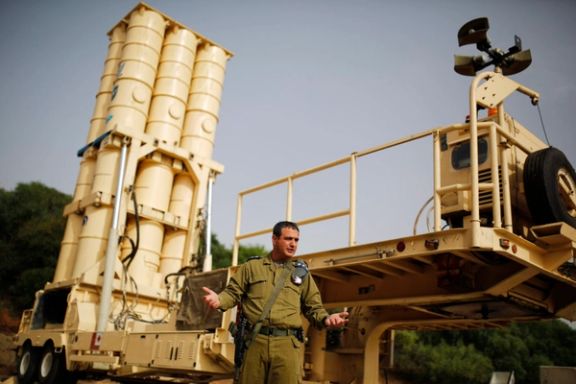
File photo of former Israel air defense forces commander Zvika Haimovich in front of an Arrow II missile defense battery.

An Iran-linked hacker group said it was offering a $30,000 reward for information related to Israel’s military sector after releasing material it said identified people involved in designing Israeli missile defense systems.

The group, known as Handala, said it had released information on 13 individuals it described as key designers of systems such as Arrow and David’s Sling.

The material published by the group included photos, names, professional credentials, email addresses, locations and phone numbers.

“These individuals, who were once thought to be hidden in the shadows, are now fully exposed to the world,” the group said in a statement carried by Iran’s ISNA news agency, adding that it would pay $30,000 for what it called valuable information.

Israeli media outlets, including the Jerusalem Post, have not confirmed whether the information released by the group is accurate.

Who is Handala?

Handala is widely described by cybersecurity researchers and Western officials as tied to Iran’s Ministry of Intelligence.

Researchers say the group operates as part of a broader cyber unit known as Banished Kitten, also referred to as Storm-0842 or Dune, which they link to the ministry’s Domestic Security Directorate.

The group has been linked to cyber operations against Israeli infrastructure and public institutions for around two years.

In January, it claimed responsibility for a cyberattack on Israeli kindergartens that disrupted public address systems at about 20 locations. In August, the group was linked to hacks targeting multiple Israeli entities, including academic institutions, technology firms, media outlets and industrial companies.

Handala has also been linked to cyber operations targeting Iran International, a London-based Persian-language broadcaster. In July, Iran International said leaked materials published by Iranian state outlets originated from earlier hacks carried out in the summer of 2024 and January 2025.

The broadcaster attributed those hacks to a broader cyber unit known as Banished Kitten. The channel said the hackers may have installed malware through compromised Telegram accounts. “These cyberattacks are part of a broader campaign of threats targeting Iran International, including physical threats against our staff,” it said.

Iran International said its journalists have faced sustained harassment since the channel was founded in 2017, including threats of assassination and kidnapping, physical assaults, online abuse and hacking.

Most Viewed

State media slam Araghchi's Hormuz tweet, say it let Trump claim victory
1

State media slam Araghchi's Hormuz tweet, say it let Trump claim victory

2
OPINION

The Hormuz get out of jail card turned to a grave

3
INSIGHT

How Tehran bends its own red lines to boost state rallies

4

Iran International says it won’t be silenced after London arson attack

5
VOICES FROM IRAN

Iran blackout cripples freelancer, small business incomes

Banner
Banner

Spotlight

  • Too early to tell who is winning Iran war, experts say
    PODCAST

    Too early to tell who is winning Iran war, experts say

  • How Tehran bends its own red lines to boost state rallies
    INSIGHT

    How Tehran bends its own red lines to boost state rallies

  • Iran blackout cripples freelancer, small business incomes
    VOICES FROM IRAN

    Iran blackout cripples freelancer, small business incomes

  • Ideology may be fading in Iran, but not in Kashmir's ‘Mini Iran'
    INSIGHT

    Ideology may be fading in Iran, but not in Kashmir's ‘Mini Iran'

  • US blockade enters murky phase as tankers spoof signals and buyers hesitate
    ANALYSIS

    US blockade enters murky phase as tankers spoof signals and buyers hesitate

  • Why the $100 billion Hormuz toll revenue is a myth
    ANALYSIS

    Why the $100 billion Hormuz toll revenue is a myth

•
•
•

More Stories

Two armed attacks hit Iranian forces in restive southeast

Dec 16, 2025, 08:59 GMT+0

Two separate armed attacks on Iranian security forces in the country’s restive southeast killed at least three police officers and a civilian on Monday night, the latest bout in a deteriorating security picture as militant groups regroup under a new umbrella outfit.

Iran’s Revolutionary Guards confirmed an armed clash on the Zahedan-Fahraj road, saying “three law enforcement personnel and one ordinary citizen” were killed.

In a statement issued early Tuesday, the Guards’ Qods Ground Forces headquarters said security and intelligence agencies were investigating the incident.

The IRGC headquarters for the southeast is one of ten regional commands and oversees the largest geographic area, covering the provinces of Sistan-Baluchestan and Kerman, and commanding multiple provincial Guards units and key combat brigades in the region.

The rights group Haalvsh, which monitors unrest in the region, earlier reported that the Fahraj incident occurred at a checkpoint in neighboring Kerman province and said four security personnel – two intelligence officers and two police – were killed, with several others wounded. The group published video footage showing injured officers and bodies being transferred from the scene.

At the same time, a second confrontation involving armed assailants and Iranian forces was reported in the city of Iranshahr, also in Sistan-Baluchestan province.

In Iranshahr, Haalvsh said gunmen targeted three military vehicles in the early hours of Tuesday, killing and wounding an unspecified number of security personnel.

The group cited local sources and said roads leading toward Zahedan were blocked by military forces, leaving travelers stranded with no indication of when routes would reopen.

Iranian authorities have not released casualty figures for the Iranshahr attack, nor have they commented on the identity or motives of the attackers. No group has officially claimed responsibility for either incident.

The attacks are the latest in a series of armed confrontations in Iran’s impoverished southeast, which borders Pakistan and Afghanistan and has long been plagued by violence involving Sunni Baluch militant groups and Iranian security forces.

  • Three IRGC members killed in southeast Iran border attack

    Three IRGC members killed in southeast Iran border attack

  • Armed group claims deadly attack on Guards members in southeast Iran

    Armed group claims deadly attack on Guards members in southeast Iran

Pattern of attacks and militant regrouping

In recent months, similar clashes have intensified. Last week, the Guards said four of their members were killed and three wounded in an attack by what they described as “terrorist and hostile groups” in the Lar area near Zahedan.

A day later, Haalvsh reported that a newly formed coalition calling itself the “Popular Fighters Front” claimed responsibility, saying it had ambushed a Guards convoy.

The Popular Fighters Front announced its formation earlier this month, presenting itself as a merger of several Baluch political and militant factions, including the PADA Baluch Movement, Harakat Nasr Balochistan, Jaish al-Adl, the Mohammad Rasulallah group led by Haji Vahed Bakhsh, and self-described “spontaneous Baluch fighters.”

In a video message posted online, a masked spokesman identified as Mahmoud Baluch said the coalition aimed to increase the effectiveness of resistance against what he described as oppression by Iran’s ruling system.

While the group’s manifesto emphasized civil, media and political action, it did not renounce armed operations and claimed responsibility for recent attacks.

Jaish al-Adl – designated a terrorist organization by both Iran and the United States – has emerged as the dominant force within the coalition, analysts say.

The group formed around 2012 after the execution of Abdelmalek Rigi, the leader of its predecessor, Jundullah, and has since carried out bombings, ambushes and suicide attacks against Iranian police, border guards and the Revolutionary Guards.

Iranian state-linked media have sought to downplay the significance of the merger, portraying it as a rebranding of weakened factions aimed at attracting foreign backing. Some outlets have alleged links to Israeli intelligence, a claim the groups deny.

  • Iran militant group Jaish al-Adl announces new strategy as attacks continue

    Iran militant group Jaish al-Adl announces new strategy as attacks continue

  • Khamenei advisor says southeast development key to blunting sanctions

    Khamenei advisor says southeast development key to blunting sanctions

Shift in strategy

Security analysts say the emergence of the Popular Fighters Front reflects an attempt by Baluch militants to broaden their appeal beyond a narrowly defined Sunni ethnic insurgency.

Recent statements from the group have adopted more inclusive language, addressing Kurds, Arabs, Turks and other minorities and framing their struggle in terms of shared political and economic marginalization.

The shift follows years of intensified counterinsurgency operations by Iranian forces in Sistan-Baluchestan, including arrests, cross-border pressure near Pakistan, and heightened surveillance. Despite this, militant groups have continued to demonstrate the capacity to stage deadly attacks.

Iran’s southeast remains one of the country’s poorest regions, with longstanding grievances over discrimination, underdevelopment and heavy-handed security policies.

These tensions flared during the nationwide protests of 2022, when security forces carried out lethal crackdowns in Baluch and Kurdish areas.

According to an article by US-based Al-Monitor news website this week, while transforming a Baluch-based insurgency into a national movement would require organizational depth and cross-ethnic networks that militant groups have historically lacked, the new coalition “adds a layer of political complexity” for Tehran.
Iran tourism officials stress reshaping global image after war

Dec 15, 2025, 11:26 GMT+0

Iranian tourism and media officials said reshaping the country’s international image, particularly after the 12-day war, has become a central challenge for the tourism sector, expressing the need for a coordinated and credible narrative to support recovery and growth.

The message emerged at a joint meeting between media and tourism officials hosted by the strategic council of Iran’s Ministry of Cultural Heritage, Tourism and Handicrafts and the media affairs department of the Ministry of Culture and Islamic Guidance, according to ISNA.

Participants said tourism increasingly depends on professional narrative-building to counter negative perceptions and present Iran’s security and cultural capacity to foreign audiences.

Officials argued that media should move beyond a passive role and become an active partner in promoting tourism and related industries.

  • Foreign tourist arrivals to Iran plummet 75% after 12-day war, minister says

    Foreign tourist arrivals to Iran plummet 75% after 12-day war, minister says

  • No solo travel: Iran now requires tourists to book via tours, report says

    No solo travel: Iran now requires tourists to book via tours, report says

Mohammadreza Norouzpour, deputy media affairs minister, said tourism cannot gain visibility without media engagement and that effective communication requires sustained, credible storytelling.

He said developing a participatory model between media and tourism actors was essential to reposition the sector domestically and internationally.

Speaking at the meeting, Mohsen Haji Saeid, head of the tourism working group and chairman of the national association of tour guides, said restoring Iran’s image abroad – especially following the recent conflict – was now the core issue facing the tourism industry.

He criticized traditional promotional approaches and called for a comprehensive information bank to present data on safety and tourism potential.

Other speakers emphasized the role of private-sector participation, health tourism, visual content, and the use of tour guides as cultural ambassadors.

Officials also discussed leveraging major international events, such as the World Cup, to amplify Iran’s narrative.

The meeting concluded with agreement to continue the tourism working group’s activities on a permanent, issue-driven basis, aimed at strengthening media-tourism coordination and improving perceptions of Iran among domestic and international audiences.

Iran replaces air defense commander in charge during June war

Dec 15, 2025, 10:03 GMT+0

Iran on Monday said it had replaced the commander of its army air defense force, state media reported, months after a punishing June war with Israel that drew widespread criticism of the Islamic Republic's air defense capabilities.

Iran appointed Brigadier General Alireza Elhami as commander of the army’s Air Defense Force, according to state media.

Elhami, who served as the force’s deputy commander since 2019, previously led the Air Defense University and held the post of deputy operations commander at the Khatam al-Anbia Air Defense Headquarters.

Brigadier General Alireza Elhami
100%
Brigadier General Alireza Elhami

He replaces Brigadier General Alireza Sabahi-Fard, who had been in charge of the Air Defense Force until the latest appointment. State media did not say why the change was made.

In February this year, then Chief of Staff of Iran’s Armed Forces Brigadier General Mohammad Bagheri, with the approval of Supreme Leader Ali Khamenei, appointed Sabahi-Fard to head the Khatam al-Anbiya Air Defense Base headquarters while he retained his role as the army’s air defense commander.

Bagheri was among around 20 senior Iranian military commanders killed in Israeli strikes during the 12-day war in June.

Israel said the strikes crippled much of Iran’s air defense network and damaged a significant portion of its ballistic missile arsenal.

According to Israeli military officials 120 air defense systems were destroyed or disabled since the first wave of attacks—around a third of Iran’s pre-war total. Long-range systems, including Russian-supplied S-300s and Iran’s Bavar-373 batteries, were among those targeted.

Iranian officialdom also acknowledged that some of its air defense systems were damaged but has said they were quickly replaced.

Before the war, Sabahi-Fard had repeatedly spoken of Iran’s air defense capabilities, saying the force was able to counter advanced fighter jets and monitor hostile aircraft from long distances.

In April this year, he described Iran as a “superior regional power” and praised the “significant improvement in the security of the country’s airspace” and the monitoring of “every enemy stealth aircraft from many miles away.”

Iran says IAEA has no right to inspect nuclear sites hit by attacks

Dec 15, 2025, 09:24 GMT+0

Iran’s nuclear chief on Monday said the UN atomic watchdog has no right to demand inspections of sites attacked by the United States and Israel in June, deepening the stalemate over Tehran's disputed nuclear program.

Mohammad Eslami, head of the Atomic Energy Organization of Iran, said Tehran had allowed inspections at nuclear sites that were not attacked but drew a distinction with facilities that sustained military strikes.

“There must be a protocol in place for inspections of nuclear sites that have been attacked before permission can be given,” he told reporters, according to ISNA.

“The agency, which neither condemned the attacks nor has any guideline for such situations, has no right to claim inspections,” Eslami said.

He added that pressure from three European countries, the United States and Israel “is not important to us and has no impact.”

Eslami said International Atomic Energy Agency Director General Rafael Grossi should be held accountable, adding that Iranian nuclear facilities had been under IAEA supervision before the June attacks.

“The director general must answer to the world,” he said, adding that attacks on safeguarded nuclear sites could happen to any country and that the agency should clarify what procedures it has in place in such circumstances.

The IAEA has said it is seeking access to key Iranian sites following recent military strikes, arguing that oversight is essential to verify nuclear material and equipment.

Iran has repeatedly said its nuclear program is peaceful and rejects accusations that it is seeking nuclear weapons.

Mideast lull fleeting as US-Iran impasse lingers, analyst says

Dec 14, 2025, 17:24 GMT+0
•
Kambiz Tavana

Heavy Israeli blows on Iran and its armed allies in two years of fighting after October 7, 2023 earned a fragile calm in the region, Mideast analyst Merissa Khurma told Iran International, but only US-Iran diplomacy can win peace.

"The one thing that could perhaps stop or delay the resurgence of Iranian proxies and further disruption of the peace process would be the restarting of negotiations between Iran and the United States, said Khurma, former director of the Middle East Program at the Wilson Center.

She added that Israel felt increasingly unrestrained in confronting adversaries but that the kaleidoscope of Iran-backed groups in the region was determined to fight back.

“Israel is going to preempt every threat they see as existential,” said Khurma, a longtime watcher of regional events and founder of Washington-based consulting firm AMENA Strategies.

The strikes have weakened Tehran’s network of allies, she said, but the calm is temporary. “Hamas was able to recruit and reboot. Similarly with Hezbollah. They have a recruiting strategy and resources,” Khurma said.

She said sanctions are putting pressure on Iran and have prompted outreach to US President Donald Trump.

“President Trump earlier said the Iranians asked whether US sanctions could be lifted. Also, Tehran appears willing to talk but insists Washington stop supporting Israel - a condition the United States is not prepared to meet."

Disarmament demands

Meanwhile a truce in Gaza clinched by US President Donald Trump in October appears to have stalled as Iran-backed Hamas militants have yet to disarm and Israeli attacks have killed hundreds despite a ceasefire.

“A US 20-point plan for Palestinian statehood could help curb militancy, but it requires steady pressure on Israel,” Khurma said. “Hamas should not be part of any future governance in Gaza.”

She addressed serious social challenged in the region as youth frustration and unemployment fuel discontent. She said joblessness has hit 45% in Jordan and 30% in Tunisia, while Moroccans are protesting poor governance.

“Democracy did not get me a job,” the analyst cited a young Tunisian as saying. US aid cuts, shed added, including an 83% reduction in USAID funding, have hampered Washington's ability to address the region's root problems.

“Yet online activism is growing. Afghan women teach despite Taliban bans and regional women’s groups are sustaining themselves, often inspired by Iran’s Woman, Life, Freedom movement,” Khurma said.

She called for a comprehensive US regional strategy that includes phased sanctions relief for Iran in exchange for concessions, investment to counter Iran-backed Iraqi militias and the safeguarding of Palestinian gains via leverage over Israel.

“Without such engagement, never-ending cycles of violence will radicalize youth. Saudi and Egyptian leaders support efforts to weaken extremists, and as Trump doubles down on America First, the region is watching for signs of dialogue over the stalemate,” Khurma said.