• العربية
  • فارسی
Brand
  • Iran Insight
  • Politics
  • Economy
  • Analysis
  • Special Report
  • Opinion
  • Podcast
  • Iran Insight
  • Politics
  • Economy
  • Analysis
  • Special Report
  • Opinion
  • Podcast
  • Theme
  • Language
    • العربية
    • فارسی
  • Iran Insight
  • Politics
  • Economy
  • Analysis
  • Special Report
  • Opinion
  • Podcast
All rights reserved for Volant Media UK Limited
volant media logo

Khamenei advisor says southeast development key to blunting sanctions

Dec 15, 2025, 08:44 GMT+0Updated: 11:44 GMT+0
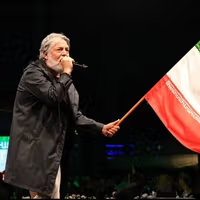
Major General Yahya Safavi, head of the Martyr Qassem Soleimani Research Center for Defense Sciences, during an event on December 15, 2025, on development and security in Iran’s southeast, held at the National Defense University in Tehran.

A senior adviser to Iran’s Supreme Leader said Iran is pushing a strategy to link security with economic development in its southeast, arguing that closer trade with neighboring countries will blunt the impact of US sanctions.

Major General Yahya Safavi, also head of the Sacred Defense Sciences and Teachings Research Institute, said a national conference focused on sustainable development and security in Iran’s southeast aims to produce an operational strategy for the region, which borders Afghanistan and Pakistan.

“The country’s southeast region is a hidden treasure... This region has unique capacities with geopolitical, geostrategic, and geocultural significance. It can develop economic potential that serves as an alternative to an oil-based economy.”

Safavi said the region, spanning parts of Sistan-Baluchistan, Kerman, Hormozgan and South Khorasan provinces, accounts for about one-fifth of Iran’s territory and around one-tenth of its population.

He said 64 academic centers and universities, along with armed forces institutions, are participating in the initiative.

“Security and development are interconnected and must be pursued together,” Safavi said, adding that security in the region is provided through coordination between the Revolutionary Guards, the army and other forces.

He said the southeast’s 1,400 km (870 miles) of shared borders with Pakistan and Afghanistan give it the potential to function as an economic corridor, noting that current trade with Pakistan totals about 2 million tons annually and that the capacity of Chabahar port runs into several million tons.

He called on state bodies and investors to focus on the Makran coast and surrounding areas, describing them as national assets requiring special attention, and said a proposed monitoring center would track economic and security indicators and report regularly to the public.

Referring to US sanctions, including those affecting Chabahar port, Safavi said Iran should deepen economic ties with its 15 neighbors.

“If we strengthen private-sector trade with neighboring countries, the Americans cannot control Iran’s economic relations,” he said, adding that despite US pressure, “they cannot stop us.”

Most Viewed

100 days after carnage: Iran economy reels from war, inflation, unemployment
1
INSIGHT

100 days after carnage: Iran economy reels from war, inflation, unemployment

2
INSIGHT

Ghalibaf defends Iran-US talks amid hardline backlash

3
INSIGHT

A nation in limbo: 100 days after the massacre, has the world moved on?

4
ANALYSIS

From instability to influence: Pakistan’s pivotal role in US-Iran diplomacy

5
ANALYSIS

100 days on: why Iran’s January protests spread across social classes

Banner
Banner

Spotlight

  • War-hit homeowners feel abandoned as Iran’s reconstruction aid fades

    War-hit homeowners feel abandoned as Iran’s reconstruction aid fades

  • 100 days on: the anatomy of Iran’s January crackdown
    INSIGHT

    100 days on: the anatomy of Iran’s January crackdown

  • Ghalibaf defends Iran-US talks amid hardline backlash
    INSIGHT

    Ghalibaf defends Iran-US talks amid hardline backlash

  • 100 days on: why Iran’s January protests spread across social classes
    ANALYSIS

    100 days on: why Iran’s January protests spread across social classes

  • From instability to influence: Pakistan’s pivotal role in US-Iran diplomacy
    ANALYSIS

    From instability to influence: Pakistan’s pivotal role in US-Iran diplomacy

  • A nation in limbo: 100 days after the massacre, has the world moved on?
    INSIGHT

    A nation in limbo: 100 days after the massacre, has the world moved on?

  • Iran says capital will move to Makran on southern coast

    Iran says capital will move to Makran on southern coast

  • US restores India waiver for operations at Iran’s Chabahar Port

    US restores India waiver for operations at Iran’s Chabahar Port

•
•
•

More Stories

Iran confirms envoy accreditation pending in Lebanon, plays down rift

Dec 14, 2025, 08:55 GMT+0

Iran said accreditation for its newly appointed ambassador to Lebanon remains pending and expects the process to proceed naturally, playing down talk of a diplomatic rift after reports about the Lebanese foreign minister delaying the file.

“We have accepted Lebanon’s new ambassador, and I hope the process of accepting our new ambassador in Lebanon will follow its natural course,” foreign ministry spokesperson Esmail Baghaei said during his weekly briefing on Sunday when asked about the reported suspension.

Baghaei rejected suggestions that diplomatic ties had been disrupted, saying relations between Iran and Lebanon were long-standing and ongoing.

Iran already has an ambassador in Beirut and that Lebanon’s new ambassador has recently taken up his post in Tehran, he added.

“The relevant process regarding Iran’s new ambassador in Lebanon has been underway for some time,” Baghaei said. “We hope this process will proceed in a normal manner in Lebanon as well, and that our new ambassador will be stationed there.”

  • Beirut delays processing credentials of new Iran envoy - Lebanese daily

    Beirut delays processing credentials of new Iran envoy - Lebanese daily

Lebanon’s foreign minister, Youssef Raji, has declined to advance the administrative steps required to approve Iran’s proposed ambassador, including submitting the credentials to the cabinet and presidency, the Lebanese pro-Hezbollah daily Al-Akhbar reported on Saturday.

Iran’s role in Lebanon and the wider region had fueled instability, Raji told Al Jazeera on Friday, saying Beirut remained open to dialogue if Tehran stopped supporting Hezbollah and ended what he described as interference in Lebanon’s internal affairs.

Iran's Foreign Ministry Spokesman Esmail Baghaei
100%
Iran's Foreign Ministry Spokesman Esmail Baghaei

“Iran’s role in Lebanon and the region has been very negative,” Raji said. “We have a problem with Iran, but we are open to dialogue, provided it stops interfering in our internal affairs and halts funding an illegal organization in Lebanon.”

Iran has long backed Hezbollah and has rejected international and domestic calls for the group to disarm, arguing that continued Israeli actions justify its armed presence.

The diplomatic dispute followed an exchange earlier this month in which Iranian Foreign Minister Abbas Araghchi invited Raji to visit Tehran. Raji declined, citing unfavorable conditions, and suggested meeting in a third country.

Baghaei dismisses Venezuela meddling

In the same briefing, Baghaei brushed off comments attributed to Venezuelan opposition figure María Corina Machado accusing Iran of interference in Venezuela’s internal affairs. He said the claims were politically motivated and unrelated to facts on the ground.

“It is not appropriate to respond to the remarks of someone who has shown no value or attachment to her own country,” Baghaei said.

On reports of Iranian interference in Caracas, he said: “These remarks are irrelevant. Venezuela, as a sovereign country, sets its foreign relations according to its national interests, engages with partners on the basis of mutual respect, and shapes its foreign policy accordingly.”

  • Iranian dissident meets Venezuelan Nobel laureate, cites shared struggle

    Iranian dissident meets Venezuelan Nobel laureate, cites shared struggle

US Secretary of State Marco Rubio this month cast Venezuela as a regional launchpad for Iranian influence, describing Maduro’s government as a narcotics transit hub that hosts Iran’s Revolutionary Guards and its Lebanese ally Hezbollah

Little public evidence exists about the security relationship Venezuela has with Iran or its armed allies. Tehran and Caracas boosted ties under Maduro's predecessor Hugo Chavez, who cast himself as a bulwark against what he called American imperialism.

Machado said on Wednesday that their influence in Venezuela amounted to an invasion while not directly addressing whether she supported stepped up US military attacks on the country to bring about Maduro's downfall.

“Venezuela has already been invaded,” she said at a news conference alongside the Norwegian Prime Minister Jonas Gahr Store on Thursday.

“We have the Russian agents, we have the Iranian agents, we have terrorist groups such as Hezbollah, Hamas, operating freely in accordance with the regime. We have the Colombian guerrillas, the drug cartels.”

Iran detains 18 crew members of tanker seized in Gulf of Oman

Dec 13, 2025, 07:50 GMT+0

Iranian authorities have detained 18 crew members of a foreign tanker seized in the Gulf of Oman, state media reported on Saturday, saying the vessel was carrying 6 million liters of smuggled fuel.

The detainees include the ship’s captain, Iranian media said, citing the judiciary in Hormozgan province. Authorities did not identify the tanker and said an investigation was underway. The semi-official Fars news agency later reported that the crew included nationals of India, Sri Lanka and Bangladesh.

Iranian officials said the tanker was seized on Friday after committing multiple violations, including ignoring stop orders, attempting to flee, and lacking navigation and cargo documentation.

The detention follows a series of vessel seizures announced by Iranian authorities in recent weeks. In mid-November, the Islamic Revolutionary Guard Corps Navy confirmed the seizure of a Marshall Islands-flagged tanker off Iran’s Makran coast. Later in November, the Guards said they seized an Eswatini-flagged vessel in the Persian Gulf carrying about 350,000 liters of smuggled gasoil.

Iran, which maintains low domestic fuel prices through subsidies and has seen its currency weaken sharply, regularly reports interceptions of vessels accused of moving fuel illegally by sea to its Persian Gulf neighbours and by land to neighboring countries.

The Gulf of Oman and the nearby Strait of Hormuz sit along a major route for global energy shipments, where Iranian forces and international shipping have faced repeated disruptions in recent years.

Lebanon urges Iran to halt interference as Israel escalation fears grow

Dec 12, 2025, 12:55 GMT+0

Lebanon’s foreign minister said Arab and international parties have warned Beirut that Israel is preparing a wide military operation, while accusing Iran of playing a destabilizing role in Lebanon and the wider region.

“We have received warnings from Arab and international parties that Israel is preparing for a wide military operation against Lebanon,” Foreign Minister Youssef Raji told Al Jazeera on Friday. He said Beirut was “intensifying diplomatic contacts to keep Lebanon and its facilities out of any Israeli strike.”

Raji said Hezbollah’s arsenal has failed to protect Lebanon or support Gaza, as the Lebanese state pushes to bring all weapons under national control.

“Hezbollah’s weapons have proven ineffective in supporting Gaza and defending Lebanon,” he said, adding that the government is in dialogue with the group to persuade it to hand over its arms. “But Hezbollah refuses,” he said.

Lebanon has tasked its army with extending state authority nationwide following a ceasefire with Israel that took effect in late 2024 after more than a year of cross-border fighting.

Iran ties and conditions for dialogue

Raji said Iran’s role in Lebanon and the wider region has fueled instability, while stressing that Beirut remains open to talks with Tehran under clear conditions.

“Iran’s role in Lebanon and the region has been very negative,” he said. “We have a problem with Iran, but we are open to dialogue, provided it stops interfering in our internal affairs and halts funding an illegal organization in Lebanon.”

Iran has long backed Hezbollah and has resisted international and domestic calls for the group to disarm, arguing that continued Israeli actions justify its armed presence.

Diplomatic exchange with Tehran

Raji’s remarks follow a diplomatic exchange with Iranian Foreign Minister Abbas Araghchi, who earlier this month invited his Lebanese counterpart to visit Tehran. Raji declined the invitation, citing unfavorable conditions, and proposed meeting in a neutral third country.

In response, Araghchi said he understood Lebanon’s position given ongoing Israeli actions and said he would accept an invitation to visit Beirut. He said Iran also seeks “a new chapter” in relations based on mutual respect and sovereignty.

Iran, Russia meet at rare Turkmenistan peace forum

Dec 12, 2025, 10:07 GMT+0

Leaders from Russia, Iran, Turkey other regional states gathered on Friday in Turkmenistan for a rare international summit marking the country’s 30 years of official neutrality, as diplomatic engagement across the region intensifies amid wider global strains.

Iranian President Masoud Pezeshkian and Russian President Vladimir Putin held talks on the sidelines of the International Forum for Peace and Trust in the capital Ashgabat, an unusual gathering in one of the world’s most closed states.

Putin said Moscow and Tehran remain in close contact on major international issues, including Iran’s nuclear program.

“We are in close contact on all key international issues, including all matters related to the Iranian nuclear program. You know our position: we support Iran at the UN,” Putin said, adding that the foreign ministers of the two countries are “in constant contact.”

He said Russia and Iran are negotiating cooperation in the gas and electricity sectors and will work together on energy transmission projects.

“We are holding talks in the gas and power sectors, and cooperation in energy transfer will take shape,” he said.

He added that relations between the two countries are expanding steadily. “Our relations are developing day by day,” Putin said, pointing to plans to advance the North–South transport corridor linking Russia to South Asia via Iran.

Putin also cited plans to expand cooperation at Iran’s Bushehr nuclear power plant, which was built by Russia.

100%

Broader strategic ties

The meeting comes as Tehran and Moscow deepen strategic cooperation under Western sanctions. Earlier this month, the two countries signed a new agreement covering artificial intelligence and cybersecurity, expanding collaboration in digital infrastructure, data transit and e-government.

Iran and Russia have also worked closely on space projects. Tehran has said three Iranian satellites will be launched aboard a Russian Soyuz rocket later this month, following earlier launches carried out with Russian support.

Iran is muddling through an economic mess but its luck may run out

Dec 11, 2025, 17:15 GMT+0
•
Shahram Kholdi

As diplomatic horizons narrow and domestic hardships mount, Iran appears to endure less through strategic vision than an ad hoc survival economy backed up by China, Russia and its armed allies abroad.

Its operating model is neither innovative nor cohesive, but a set of pragmatic mechanisms built on three pillars: sanctions-evasion finance, covert oil lifelines and proxy leverage.

Beneath these pillars sits a twin base: China, the economic enabler which buys its oil, and Russia, a fellow bearer of stiff sanctions whose alignment offers diplomatic cover but also commercial competition.

With the aid of these two powers, the Islamic Republic survives not through mastery but through continual manoeuvre.

Understanding this architecture matters because it now shapes a broader convergence in global security. As the United States expands its military buildup in the Caribbean, Iran faces the potential loss of a Western Hemisphere partner long utilised by the Revolutionary Guards Quds Force.

Should Washington succeed in pulling Caracas away from Tehran, one more long-alleged sanctions evasion route may be blocked.

Sanctions evasion

Tehran continues to move funds with notable agility despite the so-called snapback of UN sanctions triggered by Western Europe in October and successive US-led actions to interdict missile and drone procurement networks.

Dubai, Istanbul, Muscat and Baghdad have been named as transit points in US Treasury press releases. Exchange houses and front companies facilitate conversions that allow restricted revenues to re-enter circulation.

Some networks targeted by Western authorities are alleged to have funnelled substantial sums to Hezbollah through opaque trade and currency channels.

These mechanisms define the Islamic Republic’s financial landscape.

Even so, these flows are tributaries. The main current runs east.

Chinese lifeline

The economic centre of the Islamic Republic increasingly lies in Shandong, Shanghai and the harbors of southern China.

Analysts estimate that roughly 80–90 percent of Iranian crude exports ultimately land in China, often routed through ship-to-ship transfers, re-flagged vessels and blends labelled as Malaysian, Omani or others.

These operations appear in tanker-tracking data and in recent investigations highlighting the Revolutionary Guards tightening oversight of a global shadow fleet.

For Beijing, the rationale is straightforward: discounted supplies, insulation from Western price caps and evidence that sanctions enforcement is no longer uniform. For Tehran, the lifeline underscores deepening dependence on a far more powerful state.

Russia’s role differs. Also under sanctions, Moscow competes directly with Tehran for China’s crude demand while simultaneously normalising sanctions-defiance as a geopolitical posture.

Two sanctioned exporters move in parallel: rivals commercially, yet aligned in resisting Western leverage.

Armed allis

Armed groups in Iraq, Lebanon and Yemen remain central to Tehran’s deterrence and diplomacy. They function, in effect, as strategic currency.

Western intelligence assessments circulated this year suggest Tehran transferred around one billion dollars to Hezbollah—an unusually high figure under any sanctions regime.

While details of the financial conduits remain incomplete, defence officials say Hezbollah is rearming despite the 2024 ceasefire, while Lebanon’s armed forces lack the capacity to enforce disarmament provisions. This comes as Israel maintains outposts in the country and launches deadly air strikes it says target militants.

In this environment, Iranian support is not merely financial but structural.

The Houthis continue to grow more assertive. Their maritime disruptions and drone activity reflect a movement whose operational confidence increasingly exceeds Tehran’s ability to shape or restrain it.

Europe’s reassessment

Europe, long divided over Iran, has entered a period of strategic recalibration. Tehran’s supply of Shahed-series drones to Russia has shifted its significance from a regional issue to a European security concern.

Western officials now warn that such transfers pose direct risks to continental defence.

Germany’s deployment of the Arrow-3 air-defence system—developed jointly with Israel—reflects the jitters. Senior officials from Ukraine and Israel met last week to coordinate responses to Iran’s expanding missile and drone proliferation.

European scrutiny has also grown over Iranian cultural, religious and financial centres suspected of facilitating sanctions evasion or money-laundering.

What was once treated as a bilateral nuisance is now cast as a collective security challenge.

A strained machinery

Thus stands the Islamic Republic in 2025: its revenues routed through offshore channels, its diplomacy reinforced by Russia, its economy dependent on China, its proxies potent but increasingly difficult to manage, and its domestic legitimacy fragile.

It survives on a framework effective in the short term but vulnerable in the long run.

Historical parallels caution that states relying on improvised economic lifelines and brittle alliances can appear stable until stresses accumulate beyond what the system can absorb.

These comparisons do not determine Iran’s trajectory, but they underline that a state held together by constrained revenues and external dependence is off balance and inherently unstable.