• العربية
  • فارسی
Brand
  • Iran Insight
  • Politics
  • Economy
  • Analysis
  • Special Report
  • Opinion
  • Podcast
  • Iran Insight
  • Politics
  • Economy
  • Analysis
  • Special Report
  • Opinion
  • Podcast
  • Theme
  • Language
    • العربية
    • فارسی
  • Iran Insight
  • Politics
  • Economy
  • Analysis
  • Special Report
  • Opinion
  • Podcast
All rights reserved for Volant Media UK Limited
volant media logo
ANALYSIS

Iran is muddling through an economic mess but its luck may run out

Shahram Kholdi
Shahram Kholdi

International Security and Law Analyst

Dec 11, 2025, 17:15 GMT+0Updated: 22:47 GMT+0
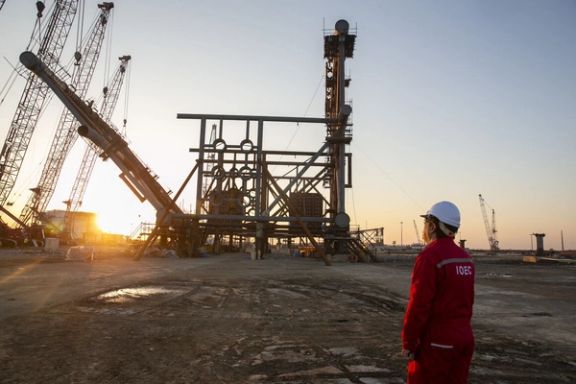
A worker looks on during the roll-up operation of the jacket for the Farzad-B joint Iranian-Saudi gas field platform, November 22, 2025

As diplomatic horizons narrow and domestic hardships mount, Iran appears to endure less through strategic vision than an ad hoc survival economy backed up by China, Russia and its armed allies abroad.

Its operating model is neither innovative nor cohesive, but a set of pragmatic mechanisms built on three pillars: sanctions-evasion finance, covert oil lifelines and proxy leverage.

Beneath these pillars sits a twin base: China, the economic enabler which buys its oil, and Russia, a fellow bearer of stiff sanctions whose alignment offers diplomatic cover but also commercial competition.

With the aid of these two powers, the Islamic Republic survives not through mastery but through continual manoeuvre.

Understanding this architecture matters because it now shapes a broader convergence in global security. As the United States expands its military buildup in the Caribbean, Iran faces the potential loss of a Western Hemisphere partner long utilised by the Revolutionary Guards Quds Force.

Should Washington succeed in pulling Caracas away from Tehran, one more long-alleged sanctions evasion route may be blocked.

Sanctions evasion

Tehran continues to move funds with notable agility despite the so-called snapback of UN sanctions triggered by Western Europe in October and successive US-led actions to interdict missile and drone procurement networks.

Dubai, Istanbul, Muscat and Baghdad have been named as transit points in US Treasury press releases. Exchange houses and front companies facilitate conversions that allow restricted revenues to re-enter circulation.

Some networks targeted by Western authorities are alleged to have funnelled substantial sums to Hezbollah through opaque trade and currency channels.

These mechanisms define the Islamic Republic’s financial landscape.

Even so, these flows are tributaries. The main current runs east.

Chinese lifeline

The economic centre of the Islamic Republic increasingly lies in Shandong, Shanghai and the harbors of southern China.

Analysts estimate that roughly 80–90 percent of Iranian crude exports ultimately land in China, often routed through ship-to-ship transfers, re-flagged vessels and blends labelled as Malaysian, Omani or others.

These operations appear in tanker-tracking data and in recent investigations highlighting the Revolutionary Guards tightening oversight of a global shadow fleet.

For Beijing, the rationale is straightforward: discounted supplies, insulation from Western price caps and evidence that sanctions enforcement is no longer uniform. For Tehran, the lifeline underscores deepening dependence on a far more powerful state.

Russia’s role differs. Also under sanctions, Moscow competes directly with Tehran for China’s crude demand while simultaneously normalising sanctions-defiance as a geopolitical posture.

Two sanctioned exporters move in parallel: rivals commercially, yet aligned in resisting Western leverage.

Armed allis

Armed groups in Iraq, Lebanon and Yemen remain central to Tehran’s deterrence and diplomacy. They function, in effect, as strategic currency.

Western intelligence assessments circulated this year suggest Tehran transferred around one billion dollars to Hezbollah—an unusually high figure under any sanctions regime.

While details of the financial conduits remain incomplete, defence officials say Hezbollah is rearming despite the 2024 ceasefire, while Lebanon’s armed forces lack the capacity to enforce disarmament provisions. This comes as Israel maintains outposts in the country and launches deadly air strikes it says target militants.

In this environment, Iranian support is not merely financial but structural.

The Houthis continue to grow more assertive. Their maritime disruptions and drone activity reflect a movement whose operational confidence increasingly exceeds Tehran’s ability to shape or restrain it.

Europe’s reassessment

Europe, long divided over Iran, has entered a period of strategic recalibration. Tehran’s supply of Shahed-series drones to Russia has shifted its significance from a regional issue to a European security concern.

Western officials now warn that such transfers pose direct risks to continental defence.

Germany’s deployment of the Arrow-3 air-defence system—developed jointly with Israel—reflects the jitters. Senior officials from Ukraine and Israel met last week to coordinate responses to Iran’s expanding missile and drone proliferation.

European scrutiny has also grown over Iranian cultural, religious and financial centres suspected of facilitating sanctions evasion or money-laundering.

What was once treated as a bilateral nuisance is now cast as a collective security challenge.

A strained machinery

Thus stands the Islamic Republic in 2025: its revenues routed through offshore channels, its diplomacy reinforced by Russia, its economy dependent on China, its proxies potent but increasingly difficult to manage, and its domestic legitimacy fragile.

It survives on a framework effective in the short term but vulnerable in the long run.

Historical parallels caution that states relying on improvised economic lifelines and brittle alliances can appear stable until stresses accumulate beyond what the system can absorb.

These comparisons do not determine Iran’s trajectory, but they underline that a state held together by constrained revenues and external dependence is off balance and inherently unstable.

Most Viewed

100 days after carnage: Iran economy reels from war, inflation, unemployment
1
INSIGHT

100 days after carnage: Iran economy reels from war, inflation, unemployment

2
INSIGHT

Ghalibaf defends Iran-US talks amid hardline backlash

3
INSIGHT

A nation in limbo: 100 days after the massacre, has the world moved on?

4
ANALYSIS

From instability to influence: Pakistan’s pivotal role in US-Iran diplomacy

5
ANALYSIS

100 days on: why Iran’s January protests spread across social classes

Banner
Banner

Spotlight

  • War-hit homeowners feel abandoned as Iran’s reconstruction aid fades

    War-hit homeowners feel abandoned as Iran’s reconstruction aid fades

  • 100 days on: the anatomy of Iran’s January crackdown
    INSIGHT

    100 days on: the anatomy of Iran’s January crackdown

  • Ghalibaf defends Iran-US talks amid hardline backlash
    INSIGHT

    Ghalibaf defends Iran-US talks amid hardline backlash

  • 100 days on: why Iran’s January protests spread across social classes
    ANALYSIS

    100 days on: why Iran’s January protests spread across social classes

  • From instability to influence: Pakistan’s pivotal role in US-Iran diplomacy
    ANALYSIS

    From instability to influence: Pakistan’s pivotal role in US-Iran diplomacy

  • A nation in limbo: 100 days after the massacre, has the world moved on?
    INSIGHT

    A nation in limbo: 100 days after the massacre, has the world moved on?

•
•
•

More Stories

Iran's Khamenei suggests US moves on Venezuela aim at oil, land grab

Dec 11, 2025, 13:06 GMT+0

Iran’s Supreme Leader Ali Khamenei on Wednesday suggested a US pressure campaign on Venezuela aimed to seize its territory and oil wealth in lengthy diatribe against hegemony of Western countries.

The 86-year-old theocrat styles himself a divinely-appointed protector of the oppressed worldwide and his remarks were couched as a general description of how weaker nations are usurped by more powerful ones led by the United States.

Speaking at a ceremony marking the birth anniversary of Fatemeh Zahra — the daughter of the Prophet Mohammad and a revered figure in Shia Islam — Khamenei said the motives behind what he called hegemonic pressure differ across regions.

“Sometimes it is about expanding territory,” he said, pointing to “what the Americans are doing with some Latin American countries.”

Western designs can also aim at extracting commodities," he said. “They apply pressure so they can take a country’s underground resources — its oil, for example."

Iran's relationship with Washington and Western Europe is at a low ebb since the United States joined a surprise Israeli military offensive against the country in June.

Britain, France and Germany then triggered the reimposition of international sanctions which have throttled Iran's already ailing economy.

Khamenei’s remarks came a day after the United States seized a Venezuela-linked tanker accused of transporting sanctioned Iranian and Venezuelan oil.

Washington says the tanker was part of a network tied to Hezbollah and Iran’s Revolutionary Guards.

Iran’s embassy in Caracas condemned the operation as an illegal act, calling it “robbery in the Caribbean Sea” and a violation of international maritime law.

US forces have mounted the largest buildup of forces in the Caribbean since the 1962 Cuban missile crisis and President Donald Trump has suggested the policy aims at the removal of leftist populist President Nicolas Maduro and has vowed attacks on land.

US air strikes on alleged drug boats in the region have killed at least 87 people.

'Hearts and minds'

Khamenei added that Western states also push to “reshape cultural and religious life,” often by influencing lifestyles and social norms through media. “They try to change how people live, think and believe,” he said.

But he said the most consequential objective is what he described as an engineered identity transformation. “More fundamental than all of these is the effort to change a nation’s identity,” he said.

Iranian officials accuse the West of seeking to foment sedition and rebellion in the country including by fomenting opposition to mandatory veiling laws for women.

The death of a young woman, Mahsa Amini, in morality police custody in 2022 led to nationwide protests dubbed the Woman, Life, Freedom movement which were quashed with deadly force.

Khamenei added that attempts to alter Iran’s cultural and religious foundations stretch back a century. “For a hundred years they have tried to rewrite who we are — our religion, our history, our culture,” he said. “The Islamic Revolution cleared that away, but the pressure continues. And resisting this pressure is essential.”

Khamenei said Iran is progressing despite economic and political pressures. “By God’s grace, the Islamic Republic is moving forward,” he told the audience of religious reciters. He said Iranians continue to show the world that Islam stands for “steadfastness, strength, honesty and justice.”

He also said the country faces a sustained “media and propaganda war” aimed at undermining public morale. “The enemy learned it cannot gain this land through military pressure,” he said. “So it turned to changing hearts and minds. We are standing firm, but the threat is real.”

Armed group claims deadly attack on Guards members in southeast Iran

Dec 11, 2025, 09:08 GMT+0

A Baluch armed group said it carried out an attack on Iran's Revolutionary Guards personnel near Zahedan, a day after Iranian state media reported that several members had been killed during a border security mission in the restive southeast.

Haalvsh, a rights group that documents abuses and unrest in Sistan-Baluchestan, said the Jebhe-ye Mobaarezin-e Mardomi (People’s Fighters Front) claimed responsibility in a statement posted overnight. The group said it targeted a convoy of the IRGC’s Imam Hossein battalion, part of the Salman Brigade, in the Lar district on Wednesday.

A spokesman for the group said the attack was meant as retaliation for what it described as the role of security forces in suppressing residents in Sistan-Baluchestan. He said a vehicle carrying the unit’s commander was struck and that four members were killed and several others wounded.

State-linked media initially reported three dead and three wounded but later said the death toll had risen to four. Haalvsh cited local sources as saying the gunfire occurred as several IRGC vehicles were heading toward their base in the Lar area.

Iran’s southeast, bordering Pakistan and Afghanistan, has long experienced armed attacks on security forces and government sites. The region has seen repeated incidents this year, including a major assault on a courthouse in Zahedan earlier in which nine people were killed. A separate Baluch Sunni militant group, Jaish al-Adl, claimed responsibility for that attack.

Authorities said pursuit operations were underway following Wednesday’s shooting, but have released few details so far.

US Senator Fetterman backs strikes on Iran if it resumes enrichment

Dec 11, 2025, 03:05 GMT+0

US Senator John Fetterman advocated attacking Iran again if it resumes uranium enrichment, aligning himself with President Donald Trump and cementing his status as a leading foreign policy hawk among Democrats.

Speaking at The Jerusalem Post Conference in Washington DC on Wednesday, Fetterman questioned Iran’s official line that its nuclear program is entirely peaceful.

“There is no peaceful purpose for ninety percent enriched uranium,” he said. “If Iran continues, I will consistently support attacking and destroying those facilities.”

The UN nuclear watchdog has not reported such levels of enrichment, though its experts warned this year that Iran’s stockpile of 60 percent material can be further purified to weapons grade with relative ease.

Fetterman’s remarks come months after surprise US strikes on three Iranian nuclear sites on June 22, which Trump says “obliterated” its enrichment capability. Trump has vowed to attack Iran again should it revive nuclear activity.

Iranian officials have also confirmed damage to the facilities but the extent of damage has not been independently assessed and some Democratic members of Congress have challenged Trump’s assertion.

Fetterman described the strikes as necessary deterrence against the United States’ arch-foe in the region.

“I was the only Democrat calling to bomb the nuclear facilities as well,” he added.

‘All in’

Elsewhere in his interview, Fetterman reiterated his unyielding support for Israel, especially after the October 7, 2023 Hamas-led attack which he called a defining moment.

“If the shit hits the fan,” he said, “I would go all in with Israel. And I meant it.”

The Pennsylvania senator, who was honored this year by the World Jewish Congress for his support of Israel, has often faced criticism from within the Democratic Party which has been divided over policy on Israel.

He hit back at colleagues who refused to attend Prime Minister Benjamin Netanyahu’s speech to Congress earlier this year.

“When the prime minister spoke to Congress and people turned their backs on him, that was astonishing,” he said. “That was outlandish.”

US says tanker it seized had shipped oil from Venezuela and Iran

Dec 10, 2025, 22:55 GMT+0

Attorney General Pam Bondi announced on Wednesday that US forces had seized a tanker for shipping oil from Venezuela and Iran, publishing footage of troops rappelling onto the vessel by helicopter.

"Today, the Federal Bureau of Investigation, Homeland Security Investigations, and the United States Coast Guard, with support from the Department of War, executed a seizure warrant for a crude oil tanker used to transport sanctioned oil from Venezuela and Iran," Bondi posted on X.

"For multiple years, the oil tanker has been sanctioned by the United States due to its involvement in an illicit oil shipping network supporting foreign terrorist organizations, she added.

The vessel, is called Skipper but had previously gone by the name Adisa, British maritime risk management group Vanguard reported.

"This seizure, completed off the coast of Venezuela, was conducted safely and securely—and our investigation alongside the Department of Homeland Security to prevent the transport of sanctioned oil continues," Bondi said.

A 2022 US Treasury sanctions notice said a Gulf-based businessman, Viktor Artemov along with other individuals were involved in a network "to illegally transport Iranian oil abroad and procure funds on behalf of Hizballah and the IRGC-QF," referring to the Islamic Revolutionary Guards and its external branch, the Quds Force.

The Adisa was listed among the vessels controlled by Artemov under a front company in which the Treasury said he had a 50% stake, Petro Naviero.

"Artemov used his companies to buy and sell oil tankers that were then used to transport blended Iranian oil on behalf of the oil smuggling network," the Treasury said.

The United States has ramped up a military deployment in the Caribbean as part of a pressure campaign on Venezuela and its leader Nicolas Maduro. US attacks on alleged drug boats there and in the Pacific have killed at least 87 people, in attacks which Democratic opponents and rights groups say violate the laws of war.

US Secretary of State Marco Rubio last week cast Venezuela as a regional platform for Iranian influence, describing Maduro’s government as a narcotics transit hub that hosts Iran’s Revolutionary Guards and its Lebanese ally Hezbollah.

Maduro has rejected US accusations that he runs a narco-terrorist cartel and dismisses the largest American military buildup in the region in decades as an attempt to impose Washington's will on his oil-rich country.

Senior IRGC commander says Trump and Netanyahu backed Iran coup

Dec 10, 2025, 21:29 GMT+0

A senior Islamic Revolutionary Guard Corps (IRGC) commander said on Wednesday that US President Donald Trump and Israeli Prime Minister Benjamin Netanyahu blessed an elaborate plot to overthrow the Islamic Republic during a June war.

"On June 14, a meeting was held in one of the European countries—I won’t name it. The meeting lasted 12 hours. All anti-revolutionary elements, agents of American and Israeli services and leaders of the opposition—including separatists, monarchists, and even Islamic State leaders—were present," Major General Ebrahim Jabari, an adviser to the IRGC Commander-in-Chief, told a Tehran conference on Tuesday.

"Under the guidance of Trump and Netanyahu, they planned that if an attack began, these elements would enter our country from various points along the borders," he added, saying the gathering aimed to form "a government-in-exile."

The United States held five rounds of negotiations with Tehran over its disputed nuclear program earlier this year, for which President Donald Trump set a 60-day ultimatum.

When no agreement was reached by the 61st day, Israel launched a surprise military offensive on June 13, followed by US strikes on June 22 targeting key nuclear facilities in Isfahan, Natanz and Fordow.

'Monarchists arrested'

Jabari referred to cases of military defections and said those involved in “running and operating” the plot had been detained.

“Iranian intelligence arrested around 123 ringleaders of a monarchist group called the ‘Javidan Guard' (Immortal Guard). Authorities also detained Christian convert leaders previously recruited by foreign services,” Jabari said.

The Javidan Guard was one of the most elite military units of the ousted Pahlavi dynasty responsible for protecting the Shah, the royal family and major palaces, particularly the Niavaran Palace complex.

Its name was inspired by the Achaemenid-era Immortals, a military grouping which ancient chronicles credit with strength and courage on the battlefield.

In the final months of the monarchy, the Javidan Guard was deployed against protesters amid escalating revolutionary unrest but ultimately was unable to prevent the collapse in 1979 and the victory of the Islamic Revolution.

“The plot is part of a long-term plan by the US and Israel. Preparations began 22 years ago and intensified eight years ago through recruitment of domestic rabble,” Jabari said.

Videos circulating last month on social media showed a man introducing himself as Colonel Ebrahim Aghaei Kamazani, delivering a speech to the people of Iran and calling on them to overthrow their leaders.

“We too are playing a role in the country's destruction through our indifference. Rise up on November 25. People, hear your son's voice. Long live the Shah; long live Iran,” he said. It was not clear if the appeal was new or he was a genuine military officer.

‘Recruiting thugs’

Jabari said agents were recruited inside Iran after training abroad before returning as operational agents.

“These individuals were taken to Turkey, Dubai, Qatar and other countries for political courses and training costing up to $25,000 per person, with corruption and immorality used as bait,” he asserted.

“Israel previously assassinated Iranian nuclear scientists directly but now uses Iranian ‘thugs’ trained abroad.”

Since at least 2010, Israel has allegedly conducted dozens of attacks inside Iran, targeting sensitive nuclear and military installations and carrying out assassinations of individuals deemed a threat.

These attacks intensified after July 2020, when an explosion at the Natanz uranium enrichment site destroyed a building.

In November that year, Mohsen Fakhrizadeh, a key figure in Iran’s nuclear program, was assassinated in a roadside attack near Tehran.

Western and Israeli intelligence had long suspected Fakhrizadeh of being the architect of Iran’s covert nuclear weapons program.

Israeli attacks in June killed over 20 senior commanders, including Mohammad Bagheri, Chief of Staff of Iran's Armed Forces; Hossein Salami, Islamic Revolutionary Guards Corps (IRGC) Commander-in-chief; and Gholamali Rashid, Head of Khatam al-Anbiya Central Headquarters.

Along with hundreds of military personnel killed, the Israeli strikes killed hundreds of civilians. Iranian counterattacks killed 32 Israeli civilians and an off-duty soldier.