• العربية
  • فارسی
Brand
  • Iran Insight
  • Politics
  • Economy
  • Analysis
  • Special Report
  • Opinion
  • Podcast
  • Iran Insight
  • Politics
  • Economy
  • Analysis
  • Special Report
  • Opinion
  • Podcast
  • Theme
  • Language
    • العربية
    • فارسی
  • Iran Insight
  • Politics
  • Economy
  • Analysis
  • Special Report
  • Opinion
  • Podcast
All rights reserved for Volant Media UK Limited
volant media logo

Iran, Egypt protest Seattle’s ‘Pride Match’ branding for 2026 World Cup game

Dec 9, 2025, 20:00 GMT+0Updated: 23:12 GMT+0
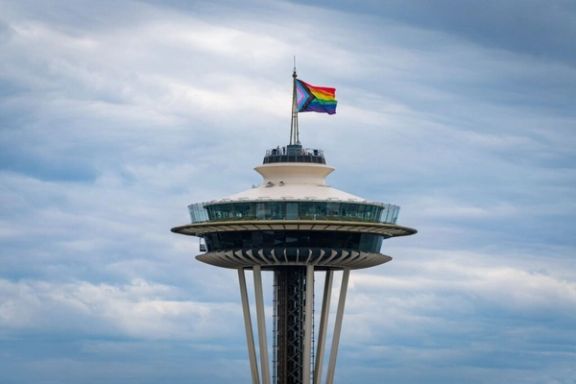
Seattle's iconic Space Needle flies the LGBTQ+ flag in this file photo.

Iran and Egypt have lodged formal protests with FIFA after Seattle designated their 2026 World Cup group-stage game as a “Pride Match,” triggering a diplomatic and cultural backlash from two countries where homosexuality is criminalized.

The decision had been announced previously by Seattle’s local organizing committee as part of the host city’s Pride weekend celebrations long before match dates and venues were assigned.

When FIFA released the official schedule on Saturday, it confirmed that the June 26 Group G match would be between Iran and Egypt at Lumen Field falls on Seattle’s annual Pride weekend, during which the city traditionally holds public events and art displays honoring the LGBTQ+ community.

In an interview with state TV, Iranian Football Federation President Mehdi Taj condemned the move as “unreasonable conduct that supports a specific group,” adding that both Tehran and Cairo have communicated their objections to FIFA.

Iranian media reported on Tuesday that Taj, a member of Organizing Committee for FIFA Competitions, plans to raise the issue with FIFA’s competitions committee, while Egyptian football authorities have sent an official letter refusing any LGBTQ-themed activities during the match.

The Egyptian Football Association sent an official letter to FIFA Secretary-General Mattias Grafström saying it rejects any initiatives “related to supporting homosexuality” during the fixture, citing cultural, religious and social sensitivities shared by fans of both countries.

It added that such events contravene FIFA’s own statutes, including Article 4, which calls for neutrality in political and social matters, and the disciplinary code’s requirement that World Cup events remain free of actions that could provoke tension among supporters.

Iran has issued a similar warning, arguing that designating the game as a Pride Match violates FIFA rules prohibiting political, religious or ideological messaging inside stadiums.

According to state media, Iranian officials say the federation intends to formally notify FIFA of the “consequences” of proceeding with LGBTQ-themed celebrations linked to the fixture.

Seattle organizers, for their part, insist the city’s Pride programming is not aimed at any participating nation. Hanna Tadesse of the Seattle World Cup committee told Germany’s DPA news agency that LGBTQ+ culture is “an integral part” of the city’s identity and confirmed that celebrations will go ahead as planned.

The controversy echoes the 2022 World Cup dispute in Qatar, when FIFA banned the “OneLove” armband intended as a symbol against discrimination.

Germany's players stoked controversy in Qatar by posing for a picture with their hands over their mouths in a symbol of stifled expression in protest of the ban and laws in the conservative Islamic country criminalizing LGBTQ+ activity.

Most Viewed

IRGC-linked media hints at threat to Persian Gulf undersea internet cables
1

IRGC-linked media hints at threat to Persian Gulf undersea internet cables

2

Iran Guards say two ships seized in Hormuz after ceasefire extension

3

Iran executes former atomic agency employee over alleged spying for Israel

4
EXCLUSIVE

Disputes within Iran leadership blocked negotiators’ trip to Islamabad

5
ANALYSIS

Internet Pro or Censor Pro? Iran rolls out a new service

Banner
Banner

Spotlight

  • Tehran stocks head for reopening, but it risks triggering a new crisis
    ANALYSIS

    Tehran stocks head for reopening, but it risks triggering a new crisis

  • Power vacuum in Tehran emboldens hardliners
    INSIGHT

    Power vacuum in Tehran emboldens hardliners

  • Inflation spikes, basic goods slip out of reach for Iranians, citizens say
    VOICES FROM IRAN

    Inflation spikes, basic goods slip out of reach for Iranians, citizens say

  • Iran turns to citizenship and assets as tools of pressure beyond its borders

    Iran turns to citizenship and assets as tools of pressure beyond its borders

  • Who backs war now? Tehran flips the script
    INSIGHT

    Who backs war now? Tehran flips the script

  • As Tehran digs in, ordinary Iranians pay the price
    INSIGHT

    As Tehran digs in, ordinary Iranians pay the price

•
•
•

More Stories

Iran hosts trilateral meeting with China and Saudi Arabia

Dec 9, 2025, 11:18 GMT+0

Iran, China and Saudi Arabia held a trilateral meeting in Tehran on Tuesday, the third since their 2023 normalization agreement brokered in Beijing, state media reported.

Deputy Foreign Minister Majid Takht-Ravanchi headed the Iranian delegation. A preparatory session with diplomats and experts from the three countries was held on Monday, according to ISNA.

The meeting reviewed progress in implementing the Beijing accord, which restored diplomatic relations between Tehran and Riyadh after a seven-year rift and set out commitments to reopen embassies and expand political and economic ties.

According to China’s foreign ministry, the three sides called for an immediate halt to Israeli actions against Palestine, Lebanon, and Syria, and condemned violations of Iran’s national sovereignty and territorial integrity. The statement also said the parties look forward to expanding cooperation in various fields, including economics and politics.

The previous rounds of the trilateral committee were held in Beijing and Riyadh, where the sides reaffirmed respect for sovereignty and non-interference and welcomed China’s continued mediation to support regional dialogue.

Regional visits to Tehran

The Tehran meeting followed a flurry of recent diplomatic activity involving Iran and its regional neighbors. Last month, senior officials from Turkey and Saudi Arabia also visited Tehran for high-level talks widely seen as efforts to manage regional tensions through dialogue.

At the same time, new reports shed light on broader diplomatic exchanges behind the scenes.

According to an exclusive report by Iran International, the Trump administration responded to a message from Iranian President Masoud Pezeshkian, conveyed through Saudi Crown Prince Mohammed bin Salman, by reaffirming its three preconditions for any talks with Tehran: a halt to uranium enrichment, an end to Iran’s support for regional armed groups, and restrictions on its ballistic missile program.

Reuters earlier reported that Pezeshkian’s letter to the crown prince, sent before his late-November visit to Washington, said Iran “does not seek confrontation” and remains open to diplomacy if its rights are guaranteed.

During that trip, US President Donald Trump said he was “open” to a new deal with Tehran, while Mohammed bin Salman pledged to “do our best to help reach a deal between America and Iran.”

Supreme Leader Ali Khamenei later dismissed reports of Iranian outreach via Riyadh as “pure lies,” though it remains unclear whether he was briefed on the exchange or if Tehran chose to deny it after the US response.

Tehran confirms US arrest and deportation of 55 more Iranian nationals

Dec 7, 2025, 21:08 GMT+0

Iran’s foreign ministry on Sunday confirmed that 55 Iranian nationals have been detained and are being deported from the United States, marking the second group expelled in recent months under President Donald Trump’s tightened immigration policies.

The group of Iranian deportees is being returned to Iran, Mojtaba Shasti Karimi, director-general of consular affairs at the Iranian foreign ministry, told the judiciary's Mizan News Agency.

According to Karimi, the individuals had over recent months completed “legal and administrative procedures” through Iran’s Interests Section in Washington DC.

He added that instructions were issued to Iranian diplomatic missions in transit countries to ensure “proper and humane” treatment of the 55 nationals during their transfer.

The report did not identify any of the deportees or specify when they will arrive in Iran.

The announcement followed a December 5 report by BBC that said US authorities planned to deport more than 50 Iranians within 48 hours.

According to the BBC, the group was being held at an Immigration and Customs Enforcement (ICE) facility in Arizona and was scheduled to be flown on December 6 to Egypt before continuing to Iran via Kuwait.

In an interview with CNN, one Iranian who said he was slated to be on the charter flight said returning to Iran would place his life in danger.

The man, who requested anonymity out of fear of retaliation, said he had fled Iran because of his sexual orientation. Homosexuality is punishable by death in Iran.

CNN reported it could not independently verify the man’s account. He said he had applied for asylum in the United States, though the status of his claim remained unclear. “Certainly, if I go back to my country, my life will be in danger."

On September 29, a plane carrying 120 Iranians including three women landed in Iran, an Iranian expelled from the United States told Iran International, adding that detainees had faced mistreatment in US facilities and that force was used during their transfer.

The individual said a charter flight carried the first group of deportees back to Iran under security escort.

Hossein Noushabadi, a senior parliamentary and consular official at Iran’s foreign ministry, said at the time US immigration authorities intended to deport nearly 400 Iranians in total.

Three-way regional chess: Tehran, Ankara, Riyadh seek stability amid crisis

Dec 6, 2025, 20:33 GMT+0
•
Maryam Sinaiee

Simultaneous visits by senior Turkish and Saudi officials to Tehran last weekend were widely seen as a move by the two US allies to explore new channels to manage rising regional tensions through dialogue with Iran.

Turkish Foreign Minister Hakan Fidan’s visit was particularly notable. He met not only with Foreign Minister Abbas Araghchi but also with Iran’s president, the parliamentary speaker, and the secretary of the Supreme National Security Council.

Saudi deputy foreign minister Saud bin Mohammed Al Sati also held separate talks with Iran’s foreign minister and senior officials.

Expanded diplomatic engagement signals strategic intent

The scope of these engagements suggested that the trips were not ceremonial visits but part of a deeper, multilayered conversation on regional security and economic dynamics, reinforcing the perception that both Ankara and Riyadh sought structured dialogue with Tehran at a moment of heightened regional uncertainty.

Iranian media argue that overlapping crises—ranging from concerns of a new military confrontation between Iran and Israel to instability in Syria—has compelled major Middle Eastern actors to search behind closed doors for common ground and shared strategies.

Yet, not all experts believe these visits will produce breakthroughs. “The trips by Turkish and Saudi officials resemble goodwill gestures and attempts to assert regional roles more than representing practical solutions,” international affairs analyst Ali Bigdeli wrote in the reformist Sazandegi newspaper.

Syria’s central role

Ankara, Riyadh, and Tehran view Syria as a critical arena where their security interests and regional influence intersect, pushing them toward cautious coordination despite deep differences. Accordingly, Syria appears to have featured prominently in the Tehran talks on Sunday.

“Iran, Turkey, and Saudi Arabia each have their own priorities regarding Syria and Syria’s strategic weight makes it impossible for any of them to overlook or bypass it,” a commentary in Donya-ye Eghtesad argued.

“Even so, all three have come to recognize the need for a workable common ground—one that allows cooperation to persist, preserves regional stability, and keeps diplomatic channels open,” the commentary added.

Jaafar Haghpanah, a university professor and Turkey specialist, told Khabar Online: “In Syria, a shared concern for both countries is preventing it from becoming an arena for Israeli influence. Both also fear Syria turning into a failed state and a haven for extremist movements.”

Rising anxiety over a renewed Israel–Iran clash

Concerns about a potential new round of hostilities between Iran and Israel have intensified and prospects of nuclear talks with Washington currently seem slim.

Meanwhile, Israel’s state radio reported last week that Tehran was accelerating preparations for a potential confrontation and Israeli fighter jets reportedly conducted threatening flights over Iraq close to Iran’s borders.

Such developments have contributed to anxiety in the region and further market instability in Iran. The rial has weakened more against the US dollar in recent days, a shift widely interpreted as reflecting fears of possible military escalation.

Ankara and Riyadh acting as intermediaries?

The combination of military activity and sensitive diplomatic exchanges has fueled debate that Turkey and Saudi Arabia may be exploring a mediatory role or delivered messages from the US government.

Foreign Ministry spokesperson Esmail Baghaei categorically denied the claim on Monday, saying reports of message-passing from the American president were “not accurate.”

However, Ahmad Bakhshayesh Ardestani, a member of Iran’s National Security and Foreign Policy Committee, said it was “not impossible” that the visitors carried messages from Washington. He argued that Iran would not accept the reported US conditions for renewed talks.

According to lawmaker Mojtaba Zolnouri these conditions were “zero enrichment, ending cooperation with resistance groups in the region, and reducing Iran’s missile range.”

Sources in Washington told Iran International last week that Washington reaffirmed these three conditions in response to a letter allegedly sent by President Massoud Pezeshkian through Saudi channels requesting mediation for renewed dialogue.

Saudi and Turkish officials have not commented on the issue.
Iran-linked network in Chad trained Africans to target Israelis - Infobae

Dec 6, 2025, 19:30 GMT+0

Interrogations of rebels detained in Chad uncovered an Iran-backed network recruiting and training Africans to target Western and Israeli interests, Argentina's Infobae online newspaper reported citing Chadian officials.

Chad dismantled two networks accused of being tied to Iran, the report said quoting Chadian security forces.

Officials described a strategy of infiltration, indoctrination and promises of support for coups aimed at expanding Tehran’s influence in Africa.

According to Infobae, the interrogations detailed how the Revolutionary Guard's Quds Force and Iran’s Ministry of Intelligence and Security (MOIS) allegedly recruit and train African citizens for operations targeting Western and Israeli interests.

In 2023, Israel asked visiting Chadian President Mahamat Deby to reduce the influence of Iran and Hezbollah in Africa’s Sahel region, four years after the Muslim-majority country in central Africa restored its relations with the Jewish State.

Déby visited Israel to open Chad’s new embassy in the country, where he also made a rare stop at Mossad headquarters, a signal that the renewed ties carry national-security weight.

The alleged push for influence in Chad is not an isolated case, as Iran has been reportedly sending military equipment to Chad's eastern neighbor Sudan whose army is fighting against the UAE-backed Rapid Support Forces.

Iran's alleged recruitments in Chad

The Infobae report says one of those detained by Chadian authorities admitted to investigators that he had been recruited by Iran's intelligence ministry. The detaine, identified as Ali Abdoulaye Mahamat, said the process began after studying at the Al-Mustafa International University in Iran's Qom.

Mahamat told authorities he met Iranian intelligence officers in hotels in 2022 and 2023. He said he was instructed to identify American, Israeli and French activity, recruit new members and map links between local rebel groups and Iranian handlers, according to the report.

He also described an intelligence officer named Karim, who he said escorted him to hotels, restaurants and secret locations and confiscated his phone. Mahamat told officials Karim demanded detailed information on foreign military movements and intelligence services operating in Chad.

Pressed by his handlers, Mahamat said he eventually provided names of Chadian intelligence officers and individuals allegedly in contact with Israelis.

Chad’s authorities say another detainee, Abdoulaye Ahmat Sheikh Alamine, confessed to being recruited by the Quds Force. During his interrogation, he said the cell he belonged to was directed by Department 400, which operates in Iraq, Africa and other regions.

He told investigators he received weapons training — including Kalashnikovs, RPGs and KFX systems — and traveled to Iraq under the guise of religious trips, where the group met Iranian contacts and trained alongside Shia militias, according to the report.

Mahamat also told investigators that MOIS officers posing as Iranian Foreign Ministry representatives instructed him to collect information on international presence in Chad, recruit assets for military training and assess the needs of rebel groups such as FACT.

According to Infobae, Chad’s security services say the revelations show a coordinated Iranian approach combining religious indoctrination, military training and promises of political power in exchange for attacks on Western and Israeli interests.

Chadian officials told the outlet their operations disrupted, at least temporarily, what they describe as Tehran’s efforts to expand influence and destabilize the region.

Last month, Iran International revealed an alleged Iranian plot targeting the Israeli embassy in Senegal and Israeli personnel in Uganda, which were thwarted by Mossad.

The operation was directed by the Quds Force, the IRGC’s overseas arm, which relied on a proxy network of Pakistani and Bangladeshi nationals based in Iran, alongside locally recruited operatives in Africa — many of whom were said to have been enlisted through social media.

GCC chief urges Iran to build trust, not destabilize Mideast

Dec 6, 2025, 14:09 GMT+0

Gulf Cooperation Council Secretary-General Jasem Mohamed Albudaiwi urged Iran to take to build trust with its neighbors and stop policies that undermine stability in the Middle East.

“Nobody in the GCC wants Iran to go down the drain,” Albudaiwi said at a panel titled Iran and the Changing Regional Security Environment during the Doha Forum 2025.

“We are here to talk about the present and the future – how to make our region as peaceful, as stable, as prosperous as possible along with our brothers and sisters in Iran.”

He said the GCC seeks a cooperative relationship with Iran based on dialogue, respect for the UN Charter, and non-interference in regional affairs. “We need to take the right steps towards trust-building measures,” he said.

“But there are really serious measures that we would like our brothers in Iran to take. The policies that Iran sometimes take really shake the stability of the region.”

Albudaiwi cited Iran’s support for Yemen’s Houthi group as an example of destabilizing activity and said Arab states astride the Persian Gulf had already taken steps toward de-escalation, including Saudi Arabia’s 2023 normalization agreement with Tehran and mediation efforts by Oman.

“We have put the right steps toward Iran,” he said. “What the GCC wants from Iran is simple and basic – like any normal neighborhood.”

He described Iran as part of the region’s shared culture and history but said progress required concrete change. “Iran is our neighbor, our history, our culture,” Albudaiwi said. “We have so much to share with Iran. It’s the present and the future that we should concentrate on.”

Meanwhile former Iranian foreign minister Mohammad Javad Zarif said Iran remains resilient despite recent challenges, stressing that the country has endured hardship throughout its history.

“We’ve had our ups, and certainly today is not one of our ups,” Zarif said at the Doha Forum. “Iran has gone through storms for almost seven millennia – we’ve been invaded, we’ve been occupied, but we never went down the drain. We are still standing up and we will continue to stand up.”







