• العربية
  • فارسی
Brand
  • Iran Insight
  • Politics
  • Economy
  • Analysis
  • Special Report
  • Opinion
  • Podcast
  • Iran Insight
  • Politics
  • Economy
  • Analysis
  • Special Report
  • Opinion
  • Podcast
  • Theme
  • Language
    • العربية
    • فارسی
  • Iran Insight
  • Politics
  • Economy
  • Analysis
  • Special Report
  • Opinion
  • Podcast
All rights reserved for Volant Media UK Limited
volant media logo
PODCAST

Rebellion tamed: why Iran is turning rap into a controlled industry

Negar Mojtahedi
Negar Mojtahedi

Iran International

Dec 8, 2025, 19:18 GMT+0Updated: 23:12 GMT+0
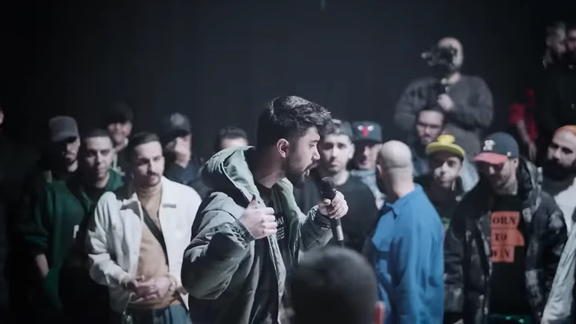
A freestyle hip-hop live performance in Tehran

Rap has moved from the margins to the spotlight in Iran, where it is being promoted on streaming platforms, entertainment shows and Instagram feeds tied to state interests and seen by millions.

To many viewers it looks like a cultural opening: a genre long associated with underground resistance now visible on mainstream screens.

But researcher and artist Siavash Rokni, a postdoctoral fellow at McGill University in Montreal who studies Iranian youth culture, pop music and the communication dynamics of social movements, argues that that the reality is more complicated.

“It is a public relations performance,” he said. “It is fooling a lot of people, and we need to stop being fooled by it.”

Rokni has followed the evolution of Iran’s rap scene across five generations. He sees the new appetite for rap not as legalization but domestication, turning underground culture into something profitable and controllable.

Entertainment shows and “normal” rappers

One of the most watched programs in this space is BaZia, hosted by a former Iranian state television personality now living in Turkey. According to Rokni, the show’s guest selection and narratives suggest an ongoing connection with Iran.

“Technically speaking, he is no longer connected to the system,” Rokni said. “But the way he chooses his guests shows there is a connection.”

The rappers appearing on BaZia help normalize a particular type of rap that is not inclusive of all aspects of this cultural practice. Many of the same rappers featured on BaZia are now set to appear in a new rap-themed program hosted by him called GANG. Rokni says it shows how this was part of a larger plan to create momentum for the new show while normalizing a particular narrative of regime approved rap.

The narrative, Rokni said, “comes very slowly” through a sequence of interviews. Artists describe performing abroad but wanting to return. Producers talk about the economic advantage of bringing rap back while being able to control the content.

Money, control and aesthetics

Much of Iran’s music economy is in the hands of a profit-minded clique, Rokni said.

“The people who are running this oligarchical capitalism are connected to the Islamic Republic,” he said. “They just want to make cash.”

He stressed that the motivation is not necessarily ideological. Many simply benefit from the system’s structures.

The appearance of rap on screens has been accompanied by pressure and arrests behind the scenes. In early October at least five rappers and a composer were detained in Tehran and Shiraz, according to the Center for Human Rights in Iran.

Security forces raided homes, seized phones and recording equipment and transferred the men to detention.

Within days videos appeared on their Instagram accounts with shaved heads and visible tattoos, apologizing on camera. Lawyers told CHRI the accounts had been taken over by cyber police.

One of the most high profile cases remains Toomaj Salehi, whose lyrics became an anthem of the Women Life Freedom movement.

He was arrested, abused in detention, sentenced to death, released on bail and then rearrested after publicly describing his treatment. Supporters say he is targeted because he refuses to leave Iran or be silent.

Female rappers face even greater constraints. Iran bans solo female singers from performing publicly or releasing their own vocals, forcing artists into exile or underground spaces. Studios refused to record them and venues were raided for illegal performances.

Why normalize rap at all?

Rokni traces the logic back to then Iranian president Mohammad Khatami era when the government offered small cultural openings to create a sense of possibility.

“You free some cultural restrictions and reconcile with the people,” he said. “You give hope. And that can be taken away very easily.”

He called this strategy dishonest. Licensing and televised satire, he said, do not signal reform. They are tools for narrative management.

Oppression, he argued, is often brief.

“They put a lid on it,” he said. “But the program starts after that.”

The backlash against licensed rappers, especially those connected to the Woman, Life, Freedom movement, has been emotional. Some consider state approved albums a betrayal. Others see economic survival.

Rokni believes the solution is parallel economies, enabling musicians to make money without going through state linked producers or licensing offices.

“Do it yourself,” he said. He pointed to artists who built audiences through Instagram and streaming platforms.

In today’s Iran rap carries two meanings. One version is polished, licensed and safe. The other remains underground created by musicians who refuse to compromise.

Both exist at once but only one is protected.

Most Viewed

Ghalibaf defends Iran-US talks amid hardline backlash
1
INSIGHT

Ghalibaf defends Iran-US talks amid hardline backlash

2
VOICES FROM IRAN

Bread shortages, soaring prices strain households in Iran, residents say

3
ANALYSIS

From instability to influence: Pakistan’s pivotal role in US-Iran diplomacy

4
ANALYSIS

100 days on: why Iran’s January protests spread across social classes

5

War-hit homeowners feel abandoned as Iran’s reconstruction aid fades

Banner
Banner

Spotlight

  • Iran crackdown reaches cemeteries as graves of slain protesters defaced
    EXCLUSIVE

    Iran crackdown reaches cemeteries as graves of slain protesters defaced

  • Iran diplomacy wobbles as factions compete to avoid looking soft on US
    INSIGHT

    Iran diplomacy wobbles as factions compete to avoid looking soft on US

  • The politics of pink: how Iran uses cuteness to rebrand violence
    ANALYSIS

    The politics of pink: how Iran uses cuteness to rebrand violence

  • Bread shortages, soaring prices strain households in Iran, residents say
    VOICES FROM IRAN

    Bread shortages, soaring prices strain households in Iran, residents say

  • 100 days on: the anatomy of Iran’s January crackdown
    INSIGHT

    100 days on: the anatomy of Iran’s January crackdown

  • Ghalibaf defends Iran-US talks amid hardline backlash
    INSIGHT

    Ghalibaf defends Iran-US talks amid hardline backlash

•
•
•

More Stories

Holy irony: how a theocracy secularized Iran

Dec 8, 2025, 17:25 GMT+0
•
Naeimeh Doostdar

Half a century of rule built on clerical authority has secularized Iran, available data suggests, with most still believing in God but not in the theocracy.

The story is not the “death of religion,” as it may appear from social media snippets depicting once unheard of public concerts and women spurning the mandatory hijab, but a fundamental reordering of how Iranians relate to faith.

Recent surveys by the Netherlands-based Group for Analyzing and Measuring Attitudes in Iran (GAMAAN) found 68% oppose the continuation of the Islamic Republic. Support for its leader and revolutionary principles fell from 18% to 11% between 2022 and 2024.

A leaked culture ministry survey reported that 73% favor separating religion and state. A peer-reviewed article by Ali Sarihan of Maryland's St. Mary's College, published in the journal Religions puts support for a secular system at around 70%.

Yet other indicators show Iran is not secular in the familiar Western sense. The World Values Survey (WVS) still finds 96% identify as Muslim and only 1.3% as atheist.

Faith endures, it seems. It is political Islam that is losing ground.

Hidden secularism

Classic secularization theory imagined that modernization would push religion out of public life. Iran shows something more layered: personal belief can survive even as the political project built around it collapses.

Sociologist Asef Bayat has called this “post-Islamism”—a phase in which political Islam has exhausted its appeal, even as many Iranians retain some form of private faith.

Iran is not “non-religious,” Bayat argues. It is post-theocratic in its political aspirations.

Religious practice has thinned markedly.

Sarihan's study also suggests that the share of Iranians who “always or often” pray fell from 78% in 2015 to 55% in 2023—a steady decline shaped, and likely accelerated in recent years, by repression and economic crisis.

The WVS relies on face-to-face interviews, which in a country like Iran give respondents every incentive to conceal dissent or non-conformity.

Belief recast

Religious rituals remain part of everyday life.

The Shi'ite religious holy days of Muharram and Arbaeen still draw large crowds especially outside major cities, and shrines remain busy.

But for younger Iranians, who express the highest levels of political dissatisfaction, religion no longer aligns with state intrusion into private life.

The compulsory hijab, morality policing and the regulation of personal behavior have turned religion, for many, into a vehicle of control.

The widespread protests of 2022, known by their rallying cry of Woman, Life, Freedom, exposed this rupture. The slogans were never an assault on faith itself but on the state’s claim to define and enforce it.

On social media, hashtags rejecting the Islamic Republic sit comfortably alongside posts defending personal belief. The distinction between faith and religious governance has become unmistakable.

Coercion to choice

Iran’s path to secularization is unusual because it runs in two directions at once: from above and from below.

Heavy-handed enforcement—from hijab rules to cultural censorship—has alienated generations and inadvertently strengthened the case for separating religion and power.

GAMAAN’s highest recorded opposition to the theocratic system came at the height of the 2022 protests, when women’s bodily autonomy became the central battleground: four out of five respondents said they would vote “no” to an Islamic Republic in a hypothetical referendum.

Meanwhile, everyday acts of defiance are reshaping religious life from the ground up.

Women walk unveiled. Families who still value faith increasingly bypass official religious bodies. Younger Iranians look for ethics and spirituality beyond state-sanctioned channels.

God versus government

Two caricatures usually obscure the real picture. Iran is not a “godless society”: personal belief, ritual and religious meaning remain widespread. But nor is it the devout political community the state insists it governs.

The Islamic Republic’s project of political Islam has lost its authority, and most Iranians now prefer a secular political order.

The theocracy has produced one of the region’s strongest secularizing shifts—not through reform but through coercion. The more it has enforced religious rule, the more clearly Iranians have separated faith from the state.

Iran today stands between private, chosen belief and state-imposed religion.

The secularization of politics is now a structural threat to Islamic rule—one that often goes unnoticed amid a myriad of more immediate, louder crises.

Jafar Panahi’s latest drama earns four Golden Globe nominations

Dec 8, 2025, 16:30 GMT+0

Iranian filmmaker Jafar Panahi’s clandestinely filmed It Was Just an Accident was shortlisted on Monday for four major Golden Globe awards, even as he faces a new prison sentence in Iran after being convicted in absentia by a Revolutionary Court.

After winning the prestigious Palme d'Or at this year's Cannes Film Festival, Panahi’s film has now been nominated for Best Motion Picture (Drama), Best Non-English Language Film, Best Director and Best Screenplay at the Golden Globes 2026.

Panahi’s film will compete in the Best Motion Picture (Drama) category alongside Frankenstein, Hamnet, The Secret Agent, Sentimental Value, and Sinners.

In the Best Director category, he is nominated alongside Paul Thomas Anderson for One Battle After Another, Ryan Coogler for Sinners, Guillermo del Toro for Frankenstein, Joachim Trier for Sentimental Value and Chloé Zhao for Hamnet.

Shot secretly in Tehran, the film has already been selected by France as its official submission to the 2026 Oscars and will also represent France at the Golden Globes.

Last week, Iranian lawyer Mostafa Nili announced that Branch 26 of the Revolutionary Court in Tehran sentenced Panahi in absentia to one year in prison.

The verdict cited “propaganda against the state” and imposed a two-year travel ban and a ban on political or social group membership.

Panahi, a long-time critic of the Islamic Republic, said he plans to return to Iran despite the new ruling. The filmmaker has previously been detained and restricted from travel but continued to make movies that later received major awards at Cannes, Berlin and Venice.

The production was carried out under tight constraints inside the capital, continuing Panahi’s long pattern of making films despite restrictions, surveillance and repeated bans on his professional activity.

It Was Just an Accident follows Panahi’s established cinematic approach—minimalist storytelling, non-professional actors and a blend of documentary and fiction.

His earlier works, including Taxi and No Bears, were also created while he was banned from filmmaking and travel, drawing international support for his case.

Iran tries unnamed dual national on Israel spying allegations

Dec 8, 2025, 10:59 GMT+0

Iran’s judiciary opened proceedings against an unnamed Iranian dual national charged with spying for Israel, local media reported on Monday.

Mizan, the judiciary’s outlet quoted the chief justice of Alborz province, Hossein Fazeli Herikandi as saying that the defendant, who is a European country resident, allegedly held “multiple meetings with Mossad officers during a visit to Israel.”

Harikandi provided no evidence supporting the accusation and did not disclose the suspect’s identity – a pattern seen in past espionage cases brought by the Islamic Republic, many of which have later been discredited.

Rights groups note that Iran has repeatedly detained, prosecuted and even executed individuals on espionage charges without presenting verifiable proof.

One of the most prominent examples is the case of Mazyar Ebrahimi, arrested in 2012 and tortured into confessing to assassinating nuclear scientists – a claim he later exposed as fabricated.

Arrest during the 12-day war

Intelligence agents of the Islamic Revolutionary Guard Corps, Mizan said, arrested the dual national on the fourth day of the 12-day war between Iran and Israel.

“Complex espionage and intelligence equipment” was found at his residence, the report said, but did not specify what those items were or whether the defendant has had access to independent legal counsel.

Following the war, Iran’s judiciary has accelerated arrests and prosecutions on charges of “espionage” or “collaboration with Israel.” In October, political prisoner Javad Naeimi was executed in Qom on such charges.

Pattern of politically driven arrests

Over recent years, the Islamic Republic has detained dozens of foreign and dual nationals, often accusing them of spying or security offenses. Human-rights groups describe the practice as “state hostage-taking,” arguing Tehran uses detainees to pressure Western governments and extract concessions.

International monitors have repeatedly cited Iran’s judiciary for due-process violations, noting that many political defendants are denied independent lawyers and face opaque trials.

Iran judiciary targets environmentalist over missile comments

Dec 8, 2025, 10:39 GMT+0

Iran’s judiciary says it has filed a case against a veteran ecologist and former adviser to the Department of Environment, after he said the government could fix Iran’s high-pollution mazut fuel with the cost of developing ten missiles.

Iranian media on Monday described the charges against Esmail Kahrom as relating to making “false statements” and actions “against national security.”

Prosecutors also opened a case against the editor-in-chief of the Jamaran news site, which published Kahrom’s interview.

In the November 30 conversation, Kahrom said that each missile costs roughly two million dollars and argued that if public health mattered to officials, they could redirect the equivalent of 10 missiles to upgrade fuel standards. He said authorities refused because “their priorities lie elsewhere.”

Iran, one of the largest oil and gas producers in the world, is facing a severe natural gas shortage. That shortage has prompted refineries to bulk out the fuel's volume with other substances, like mazut which environmentalists believe has played a major role in Iran's worsening air pollution.

Kahrom warned that the mazut used in Iran contains sulfur levels “seven times the global standard,” and that domestic fuel quality is also inadequate. His comments triggered sharp pushback from state-affiliated outlets.

Veteran ecologist and former adviser to the Department of Environment,  Esmail Kahrom (Undated)
100%
Veteran ecologist and former adviser to the Department of Environment, Esmail Kahrom

Mazut, the non-standard gasoline contains harmful additives and has significantly contributed to the air pollution crisis in the country.

The use of the low-grade fuel mazut by power plants in Iran has been linked to severe harm to public health and even fatalities, with Iranians frequently expressing frustration over the worsening air quality and pollution in many cities.

State media dismiss environmental concerns

Young Journalists Club, tied to state broadcaster IRIB, wrote that “certain groups believe defense budgets should be spent on the environment,” calling national security a nonnegotiable necessity and portraying environmental debates as a distraction.

Farhikhtegan, a newspaper affiliated with the state-run Islamic Azad University, similarly argued – referencing the 12-day war with Israel – that critics forget “without deterrence, the cost of war would far outweigh any air pollution.”

Environmental warnings have frequently been downplayed or mocked by officials and pro-government media. Past concerns over water scarcity, energy crises, deforestation and land subsidence have met similar resistance.

A prominent example was the campaign against hydrologist Kaveh Madani, who faced accusations of espionage after warning of impending water collapse and ultimately left the country.

Iran has faced worsening air pollution in recent years alongside severe water and energy shortages, with experts tracing the crisis to aging infrastructure, poor fuel quality and policy inaction.

Iran executed at least 24 people over the weekend, rights groups say

Dec 8, 2025, 07:42 GMT+0

Iranian authorities executed at least 24 people across the country on Saturday and Sunday, underscoring what monitors describe as a rapid escalation in the use of capital punishment, human rights groups reported.

The figures indicate an average of 12 executions per day – roughly one every two hours.

The executions took place in prisons in different cities across Iran, reports from the US-based Human Rights Activists News Agency (HRANA) and the Oslo-based Iran Human Rights (IHR) said. Iranian state media acknowledged only one case.

According to the groups, 23 of those executed had been convicted on murder or drug-related charges, while one person was hanged in connection with an economic case. The judiciary confirmed the latter, describing the individual as a business owner accused of “economic corruption.”

Rights groups warn the real toll is higher

Activists said the announced figure reflects only confirmed cases. Many executions in Iran are carried out in secrecy, and details often reach human-rights organizations weeks or months later due to what monitors call systemic opacity within the judiciary.

The Oslo-based Iran Human Rights said on December 4 that at least 152 people – including five women and several foreign nationals – were executed in November. At least 1,426 people had been executed in the first 11 months of 2025, a 70-percent increase over the same period last year, the organization reported. HRANA has documented more than 1,500 executions between October 2024 and October 2025.

Growing international criticism

The surge has drawn condemnation from foreign governments and international bodies. The UK Foreign Office last month urged Iran to halt executions immediately. Days earlier, the UN General Assembly’s Third Committee passed a resolution condemning the Islamic Republic’s human-rights record, citing the rising number of executions, violations of women’s rights, repression of protesters and cross-border intimidation.

Rights organizations continue to call for stronger international pressure, warning that Iran’s accelerating execution rate reflects what they view as a deepening crisis in due process and the protection of fundamental rights.