• العربية
  • فارسی
Brand
  • Iran Insight
  • Politics
  • Economy
  • Analysis
  • Special Report
  • Opinion
  • Podcast
  • Iran Insight
  • Politics
  • Economy
  • Analysis
  • Special Report
  • Opinion
  • Podcast
  • Theme
  • Language
    • العربية
    • فارسی
  • Iran Insight
  • Politics
  • Economy
  • Analysis
  • Special Report
  • Opinion
  • Podcast
All rights reserved for Volant Media UK Limited
volant media logo
ANALYSIS

Holy irony: how a theocracy secularized Iran

Naeimeh Doostdar
Naeimeh Doostdar

Journalist and Iran analyst
Dec 8, 2025, 17:25 GMT+0Updated: 23:12 GMT+0
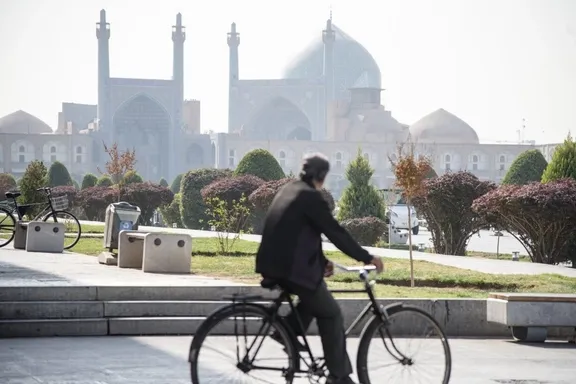
A man riding a bicycle stares at the grand mosque (known both as the Shah Mosque and the Imam Mosque), in Isfahan's historic Naqsh-e Jahan square, Iran, November 2025

Half a century of rule built on clerical authority has secularized Iran, available data suggests, with most still believing in God but not in the theocracy.

The story is not the “death of religion,” as it may appear from social media snippets depicting once unheard of public concerts and women spurning the mandatory hijab, but a fundamental reordering of how Iranians relate to faith.

Recent surveys by the Netherlands-based Group for Analyzing and Measuring Attitudes in Iran (GAMAAN) found 68% oppose the continuation of the Islamic Republic. Support for its leader and revolutionary principles fell from 18% to 11% between 2022 and 2024.

A leaked culture ministry survey reported that 73% favor separating religion and state. A peer-reviewed article by Ali Sarihan of Maryland's St. Mary's College, published in the journal Religions puts support for a secular system at around 70%.

Yet other indicators show Iran is not secular in the familiar Western sense. The World Values Survey (WVS) still finds 96% identify as Muslim and only 1.3% as atheist.

Faith endures, it seems. It is political Islam that is losing ground.

Hidden secularism

Classic secularization theory imagined that modernization would push religion out of public life. Iran shows something more layered: personal belief can survive even as the political project built around it collapses.

Sociologist Asef Bayat has called this “post-Islamism”—a phase in which political Islam has exhausted its appeal, even as many Iranians retain some form of private faith.

Iran is not “non-religious,” Bayat argues. It is post-theocratic in its political aspirations.

Religious practice has thinned markedly.

Sarihan's study also suggests that the share of Iranians who “always or often” pray fell from 78% in 2015 to 55% in 2023—a steady decline shaped, and likely accelerated in recent years, by repression and economic crisis.

The WVS relies on face-to-face interviews, which in a country like Iran give respondents every incentive to conceal dissent or non-conformity.

Belief recast

Religious rituals remain part of everyday life.

The Shi'ite religious holy days of Muharram and Arbaeen still draw large crowds especially outside major cities, and shrines remain busy.

But for younger Iranians, who express the highest levels of political dissatisfaction, religion no longer aligns with state intrusion into private life.

The compulsory hijab, morality policing and the regulation of personal behavior have turned religion, for many, into a vehicle of control.

The widespread protests of 2022, known by their rallying cry of Woman, Life, Freedom, exposed this rupture. The slogans were never an assault on faith itself but on the state’s claim to define and enforce it.

On social media, hashtags rejecting the Islamic Republic sit comfortably alongside posts defending personal belief. The distinction between faith and religious governance has become unmistakable.

Coercion to choice

Iran’s path to secularization is unusual because it runs in two directions at once: from above and from below.

Heavy-handed enforcement—from hijab rules to cultural censorship—has alienated generations and inadvertently strengthened the case for separating religion and power.

GAMAAN’s highest recorded opposition to the theocratic system came at the height of the 2022 protests, when women’s bodily autonomy became the central battleground: four out of five respondents said they would vote “no” to an Islamic Republic in a hypothetical referendum.

Meanwhile, everyday acts of defiance are reshaping religious life from the ground up.

Women walk unveiled. Families who still value faith increasingly bypass official religious bodies. Younger Iranians look for ethics and spirituality beyond state-sanctioned channels.

God versus government

Two caricatures usually obscure the real picture. Iran is not a “godless society”: personal belief, ritual and religious meaning remain widespread. But nor is it the devout political community the state insists it governs.

The Islamic Republic’s project of political Islam has lost its authority, and most Iranians now prefer a secular political order.

The theocracy has produced one of the region’s strongest secularizing shifts—not through reform but through coercion. The more it has enforced religious rule, the more clearly Iranians have separated faith from the state.

Iran today stands between private, chosen belief and state-imposed religion.

The secularization of politics is now a structural threat to Islamic rule—one that often goes unnoticed amid a myriad of more immediate, louder crises.


Most Viewed

Iran diplomacy wobbles as factions compete to avoid looking soft on US
1
INSIGHT

Iran diplomacy wobbles as factions compete to avoid looking soft on US

2
ANALYSIS

The politics of pink: how Iran uses cuteness to rebrand violence

3

Scam messages seek crypto for ships’ safe passage through Hormuz, firm warns

4
EXCLUSIVE

Family told missing teen was alive, then received his body 60 days later

5
TEHRAN INSIDER

The future has been switched off here

Banner
Banner

Spotlight

  • Diplomacy tolls at Hormuz as conflict returns to its doorstep
    OPINION

    Diplomacy tolls at Hormuz as conflict returns to its doorstep

  • Opposition to US talks grows in Tehran as ceasefire deadline nears
    INSIGHT

    Opposition to US talks grows in Tehran as ceasefire deadline nears

  • Tehran moderates see ‘no deal–no war’ limbo as worst outcome
    INSIGHT

    Tehran moderates see ‘no deal–no war’ limbo as worst outcome

  • The future has been switched off here
    TEHRAN INSIDER

    The future has been switched off here

  • Lights out, then gunfire: Witnesses recount Mashhad protest crackdown
    VOICES FROM IRAN

    Lights out, then gunfire: Witnesses recount Mashhad protest crackdown

  • Is Iran entering its Gorbachev moment?
    INSIGHT

    Is Iran entering its Gorbachev moment?

•
•
•

More Stories

Jafar Panahi’s latest drama earns four Golden Globe nominations

Dec 8, 2025, 16:30 GMT+0

Iranian filmmaker Jafar Panahi’s clandestinely filmed It Was Just an Accident was shortlisted on Monday for four major Golden Globe awards, even as he faces a new prison sentence in Iran after being convicted in absentia by a Revolutionary Court.

After winning the prestigious Palme d'Or at this year's Cannes Film Festival, Panahi’s film has now been nominated for Best Motion Picture (Drama), Best Non-English Language Film, Best Director and Best Screenplay at the Golden Globes 2026.

Panahi’s film will compete in the Best Motion Picture (Drama) category alongside Frankenstein, Hamnet, The Secret Agent, Sentimental Value, and Sinners.

In the Best Director category, he is nominated alongside Paul Thomas Anderson for One Battle After Another, Ryan Coogler for Sinners, Guillermo del Toro for Frankenstein, Joachim Trier for Sentimental Value and Chloé Zhao for Hamnet.

Shot secretly in Tehran, the film has already been selected by France as its official submission to the 2026 Oscars and will also represent France at the Golden Globes.

Last week, Iranian lawyer Mostafa Nili announced that Branch 26 of the Revolutionary Court in Tehran sentenced Panahi in absentia to one year in prison.

The verdict cited “propaganda against the state” and imposed a two-year travel ban and a ban on political or social group membership.

Panahi, a long-time critic of the Islamic Republic, said he plans to return to Iran despite the new ruling. The filmmaker has previously been detained and restricted from travel but continued to make movies that later received major awards at Cannes, Berlin and Venice.

The production was carried out under tight constraints inside the capital, continuing Panahi’s long pattern of making films despite restrictions, surveillance and repeated bans on his professional activity.

It Was Just an Accident follows Panahi’s established cinematic approach—minimalist storytelling, non-professional actors and a blend of documentary and fiction.

His earlier works, including Taxi and No Bears, were also created while he was banned from filmmaking and travel, drawing international support for his case.

Kish Marathon: hijab controversy or political score-settling?

Dec 7, 2025, 22:43 GMT+0
•
Maryam Sinaiee

The political storm over a marathon on Iran’s Kish Island may have started as a dispute over unveiled participants, but it now reflects a deeper struggle between a society pushing for change and institutions intent on reasserting control.

The sixth Kish Marathon was held on Friday morning with nearly 5,000 runners on the Persian Gulf resort island, including hundreds of unveiled women, despite opposition from Iran’s Athletics Federation which had cited concerns over “legal and religious requirements.”

Hardline factions swiftly framed the event as an assault on Islamic values. Outlets like the Revolutionary Guard-linked Tasnim News Agency accused organizers of deliberately encouraging moral decay, and a local prosecutor confirmed the arrest of a regional official and an organizer.

“This is no longer negligence; the relevant officials must be immediately punished… The Kish Marathon … has turned into a symbol of promoting and advertising licentiousness,” Tasnim wrote.

Ultra-hardliners repeated this framing across social media. Some described the event as “an organized move to promote corruption and widespread uncovering of hair.”

One user, Mehran Karimi, argued in a post on X that “the priority… must be to confront the roots of promoting corruption and prevent the repetition of such a disgrace.”

Ultra-hardliner lawmaker Ali Shirinzad called the marathon a deliberate provocation: “Holding a women's marathon without hijab is a nose-thumbing of the legal and religious principles of the Islamic Republic,” he posted on X.

Much of the criticism has directly targeted President Masoud Pezeshkian’s government, accusing it of enabling hijab violations. One ultra-hardliner wrote on X: “The government has become the main supporter of this organized indecency.”

Double standards exposed

Critics of the crackdown argue that the outrage is selective. Moderate website Rouydad24 highlighted a virtually identical event held at Tehran's Ravagh Mall, where women also participated without full hijab.

“No cries of outrage were raised… Why? Because Ravagh operates under the supervision of a senior state official’s son. Therefore, there is no reprimand whatsoever.”

The report initially identified the senior state official as Ali Asghar Hejazi, the deputy chief of staff to Supreme Leader Ali Khamenei, but later removed his name from the article.

Social media users also shared images of similar marathons held in 2021 and 2023 under former hardline president Ebrahim Raisi—events that violated hijab rules yet went unchallenged.

“The zealots must explain the difference… they remained silent about the first one and declared the second one a crime!” conservative journalist Reza Mansournia remarked on X.

Even the conservative Khorasan newspaper, aligned with Parliament Speaker Mohammad-Bagher Ghalibaf, warned that the backlash had gone too far, arguing it could harm tourism and the local economy

“Such incidents could not only overshadow a positive event like the Kish Marathon but also cause tensions that are currently not in the interest of national cohesion.”

A crisis the crackdown can't solve

Supreme Leader Ali Khamenei’s recent directive to Pezeshkian’s government, urging tougher enforcement of hijab laws, has fueled fears of a renewed crackdown. Yet even pro-Ghalibaf journalists warn that harsh measures are counterproductive.

Ali Gholhaki wrote that past crackdowns only “amplified the harm several times over,” adding: “Yet now we long for the hijab situation of 10 years ago!”

Former Rouhani-era official Roohallah Jomei contrasted the thousands who joined the Kish marathon with the handful of vigilantes camped outside parliament earlier this year demanding stricter hijab enforcement.

“They couldn't get a hundred people to join them, but more than five thousand went to Kish… Iran will not return to the time before the fall of 2022!” he posted on X.

Moderate politician Sina Kamalkhani added: “The likelihood that the hijab situation will return to what it was before is as much as the likelihood that the dollar (now over 120,000 tomans to the dollar) will return to 3,000 tomans (a few years ago).”

The feminist group Enghelab-e Zanane (Women Revolution), in a statement released on social media, called the arrests evidence of the state’s inability to contain growing public defiance: “The government neither intends to retreat nor is capable of fully enforcing repression; therefore, any free presence of women becomes a security crisis for it.”

Pezeshkian says he cannot lift Iran’s internet restrictions

Dec 7, 2025, 12:23 GMT+0

President Masoud Pezeshkian acknowledged on Sunday that his government has been unable to lift longstanding internet restrictions, saying he has ordered the deactivation of so-called “white SIM cards” that granted unfiltered access to a circle of state-linked users.

Speaking at a ceremony marking Student Day, Pezeshkian addressed the controversy surrounding the preferential access system, which drew widespread criticism after a November update to X revealed that numerous journalists, officials and pro-government figures were using unfiltered connections.

“We have instructed that these white internet lines be turned black as well, to show what will happen to people if this blackness continues,” he said.

Pezeshkian has repeatedly promised to lift filtering, a key pledge of his 2024 presidential campaign. On Sunday, he again suggested that political constraints lie beyond his control. “It is not enough for me to simply order the lifting of filtering. If it could be solved by instruction, we would have done it on the first day,” he said.

The comments came as government spokeswoman Fatemeh Mohajerani said that the administration seeks “free internet for all,” despite saying last year that no such promise had been made. Instagram, X, Telegram, and some other platforms remain blocked more than a year into Pezeshkian’s term.

Iran's President Masoud Pezeshkian
100%
Iran's President Masoud Pezeshkian

A stalled pledge

Filtering reform was central to Pezeshkian’s campaign, when he said he would “risk his neck” to fix it. Yet in his first meeting of the Supreme Cyberspace Council he emphasized implementing the Supreme Leader’s directives on internet governance rather than easing restrictions and ordered action against the flourishing trade in VPNs.

Since then, senior officials have offered varying timelines. In December, Majid Farahani from the presidential office said filtering would be removed in three phases by the end of the year. The newspaper Farhikhtegan later reported consensus among Iran’s three branches of government to move from blocking toward “smart restrictions,” indicating the system is being recalibrated rather than dismantled.

Public anger intensified after revelations of the white SIM scheme, which critics said exposed a tiered access system contradicting the government’s rhetoric about digital equality.

Iran to play all three World Cup matches in US, with two in ‘Tehrangeles’

Dec 6, 2025, 22:30 GMT+0

FIFA has confirmed that Iran will play all three of its 2026 World Cup group-stage games in the United States, including two at Los Angeles, where the large Iranian-American community is expected to give Team Melli a rare home-style advantage.

The international football federation (FIFA) on Saturday released the final schedule for Iran’s matches at the 2026 World Cup, one day after Iran was drawn with Belgium, Egypt and New Zealand.

The federation confirmed that Iran will face the three teams at venues in the West coast of the United States.

Iran’s opening two games — against New Zealand and Belgium — will be held at Los Angeles’ 70,000-seat SoFi Stadium, effectively placing Team Melli in the heart of one of the largest Iranian diaspora hubs in the world.

Los Angeles, home to an estimated 300,000 to 500,000 Iranian-Americans, has long been known for its concentrated Iranian cultural presence, especially in neighborhoods like Westwood, also known as Tehrangeles or Little Persia.

Team Melli has experienced this before. In 1999, during a friendly with the United States at the Rose Bowl, more than 100,000 Iranian fans filled the stands, surpassing the stadium’s official 92,000-seat capacity and creating a near-home atmosphere. That match ended 1–1, with Iran scoring through Mehdi Mahdavikia.

Iran’s third match, against Egypt, will take place in Seattle, Washington, where analysts estimate more than 50,000 Iranian-Americans live. Fans from other states are also expected to travel, likely ensuring strong support despite the city’s sizeable Arab and Egyptian communities.

If Iran advances as the group’s second-place team — considered one of the more plausible scenarios — the team would remain in the United States for the first knockout round, extending what many are already calling an accidental home-field advantage.

Not alone despite travel ban

The White House on Wednesday said Iran’s national team will be allowed to enter the United States for the World Cup but suggested that Iranian fans will be barred, citing existing travel bans and declined to rule out immigration raids at matches.

“The President has, in his executive order, certainly named Iran as one of the countries whose teams will be exempt to come here,” the head of the White House task force on the World Cup, Andrew Giuliani, told reporters.

Asked whether there would be ICE raids at matches, Giuliani said “the President does not rule out anything that will help make American citizens safer.”

While there are concerns that fans traveling from Iran and other countries may be unable to secure US visas under the Trump administration's restrictions, the large Iranian diaspora already living in America is expected to more than compensate.

EU, US press tech giants to facilitate Iranians’ access to free internet

Dec 6, 2025, 21:08 GMT+0

Members of the European Parliament and the US Congress have urged major technology companies to strengthen support for secure, uncensored internet access in Iran, citing a surge in digital repression and discriminatory access systems, Euronews reported.

In a letter addressed to Google, Meta, YouTube and Amazon Web Services, the European Parliament’s Delegation for Relations with the Iranian People warned that Iran’s widening use of AI-driven surveillance, recurrent shutdowns and a “white SIM card” scheme for officials had created a two-tier digital system isolating ordinary citizens.

The Iranian government enforces some of the world’s toughest online restrictions, blocking platforms such as X (formerly Twitter), Facebook, YouTube, WhatsApp, and Telegram for the general public. Most people rely on slow, unreliable VPNs that authorities routinely disrupt.

By contrast, X's new location feature recently revealed that select users receive government-issued SIM cards or whitelisted connections to bypass national filtering and throttling altogether.

The issue drew wide attention over the past few weeks, when the X feature revealed numerous pro-government figures were posting from inside Iran without VPNs – despite long claiming they used the same circumvention tools as ordinary citizens.

The disclosures triggered heavy public criticism, with many describing the system as “digital apartheid” or a “caste-based internet” that rewards political loyalty and entrenches inequality.

EU says firms must bolster anti-censorship tools

Hannah Neumann, who chairs the EU delegation, said a free internet remains the only barrier against propaganda and intimidation. “Technology companies are the guardians of this freedom, and now is the time to take their responsibility seriously,” Neumann said, according to a copy of the letter obtained by Euronews.

She added that companies were capable of measures that “ensure these voices are not silenced.”

Deputy chair Bart Groothuis said digital repression had become central to Iran’s authoritarian model. “By supporting tools to circumvent filters, we can improve secure communication and give Iranians access to the free internet,” he said.

The letter urged firms to fund open-source VPN and censorship-bypass projects, expand encrypted communication features and develop in-app proxies to keep users connected during outages. It also asked Amazon Web Services and human-rights–oriented VPN providers to offer free or discounted server space to stabilize services for Iranian users.

European legislators pressed Google to continue backing Jigsaw, Outline VPN and its SDK, and to consider integrating these tools into major apps. Meta was asked to embed filter-bypass technologies into Instagram, Facebook and Threads. Companies were also urged to provide simple procedures for appealing blocked accounts and to increase cooperation with digital-rights groups.

A young man plays a computer game in an Iranian internet cafe in this file photo.
100%
A young man plays a computer game in an Iranian internet cafe in this file photo.

US lawmakers pursue parallel push

In Washington, lawmakers introduced the FREEDOM Act on Thursday, which would require the secretary of state, the FCC and the Treasury to assess technologies capable of supporting unfiltered internet access for Iranians.

Representative Claudia Tenney highlighted the potential of satellite-to-mobile systems that could “bypass the limitations of censorship and government networks.” The feasibility review will also evaluate UAV-based platforms and counter-jamming tools.

Representative Dave Min, whose district includes a large Iranian-American community, said promoting internet freedom strengthens global family ties while confronting authoritarian practices.






