• العربية
  • فارسی
Brand
  • Iran Insight
  • Politics
  • Economy
  • Analysis
  • Special Report
  • Opinion
  • Podcast
  • Iran Insight
  • Politics
  • Economy
  • Analysis
  • Special Report
  • Opinion
  • Podcast
  • Theme
  • Language
    • العربية
    • فارسی
  • Iran Insight
  • Politics
  • Economy
  • Analysis
  • Special Report
  • Opinion
  • Podcast
All rights reserved for Volant Media UK Limited
volant media logo
INSIGHT

'To the grave': Iran’s succession battle has begun

Behrouz Turani
Behrouz Turani

Iran International

Dec 4, 2025, 22:18 GMT+0Updated: 23:46 GMT+0
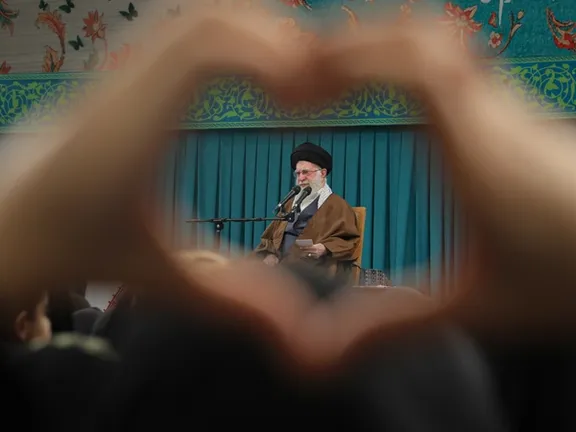
Iran's supreme leader Ali Khamenei is seen through hands clasped in the shape of a heart raised by a female supporter, December 3, 2025

The once-hushed conversation about who will succeed Iran’s 86-year-old Supreme Leader Ali Khamenei has not only spilled into the open, but has curdled into public intimidation of contender and former president Hassan Rouhani.

Rouhani has become the focal point of a succession debate that appears to be increasingly unavoidable after a June war with Israel and the United States which the theocrat largely watched from hiding.

The dovish former president invoked hardliners' ire with a call after the conflict to open up the country's politics and rein in Tehran's confrontational foreign policy.

Reading like implicit criticism of Khamenei’s military and governance record, his plea was decried as weakness and treason by detractors determined to shape the post-Khamenei future.

The most striking came from Babak Zanjani, the billionaire tycoon whose 2016 death sentence for embezzling $2.8 billion in oil funds was quietly commuted before his conditional release this year.

On 2 December, Zanjani posted a message on X that did not name Rouhani but included an image of the moderate cleric along with a headline that floated the former president as Iran’s next leader.

“They will carry this wish to the grave,” Zanjani wrote. “Iran will be cleansed of incompetence and unqualified managers. Iran needs young, educated, and capable people, not holders of fake and baseless degrees.

The swipe at Rouhani’s disputed academic credentials—and the suggestion that his aspirations should be taken to the grave—was difficult to mistake even without the image he had quoted.

Avoidable no more

It was not the first such threat against the moderates’ foremost figure. Hardline MP Kamran Ghazanfari recently argued that Rouhani should be tried and executed if accusations of treason “prove true.”

Rouhani championed the 2016 international nuclear deal from which US President Donald Trump later withdrew but has a deep background as a security and political apparatchik of the Islamic Republic with broad support among insiders.

Zanjani’s intervention stands out among the criticism: a convicted billionaire, pardoned by Khamenei, now declaiming on the succession—a sign, perhaps, of a system losing its old constraints because the stakes have changed.

Tehran’s sharpened confrontation with Israel has revived speculation that the 86-year-old cleric could become a target. War and economic crisis, coupled with the unavoidable fact of age, have created unusual license.

Zanjani, indebted to and no doubt confident in the powers of those who secured his release, speaks with a confidence unthinkable even a year ago, treating Khamenei’s departure as inevitable and focusing solely on blocking Rouhani.

Until the US and Israeli strikes on Iran in June 2025, few dared to broach succession without the ritual “God forbid.”

Even reformist academic Sadeq Zibakalam has prefaced remarks on the succession with the formulaic blessing—“after Khamenei lives for 120 years”—before saying plainly that Rouhani considers himself better suited for leadership than any other contender, including Khamenei’s son Mojtaba.

It’s just the beginning

For Khamenei, less visible after the war and perhaps aware of the system’s erosion, such discussions are perilous.

Openly grooming Mojtaba risks signaling vulnerability; suppressing the conversation only highlights how exposed the system has become when its future rests on a single, ageing figure.

Without a designated heir—even informally—the system remains brittle, its future hostage to uncertainty and factional strife.

At a moment when external adversaries may be girding for further war, living standards are collapsing and public anger is close to boiling point, stepping forward as a potential leader requires nerve, discipline and broad support.

Few, if any, among Iran’s political elite possess all three.

The result is a succession struggle waged through innuendo: a contest as bitter and murky as any yet seen in Tehran, which may last until Khamenei is no more, if not longer.

Most Viewed

Ghalibaf defends Iran-US talks amid hardline backlash
1
INSIGHT

Ghalibaf defends Iran-US talks amid hardline backlash

2
INSIGHT

Iran diplomacy wobbles as factions compete to avoid looking soft on US

3
VOICES FROM IRAN

Bread shortages, soaring prices strain households in Iran, residents say

4
ANALYSIS

The politics of pink: how Iran uses cuteness to rebrand violence

5

War-hit homeowners feel abandoned as Iran’s reconstruction aid fades

Banner
Banner

Spotlight

  • Lights out, then gunfire: Witnesses recount Mashhad protest crackdown
    VOICES FROM IRAN

    Lights out, then gunfire: Witnesses recount Mashhad protest crackdown

  • Family told missing teen was alive, then received his body 60 days later
    EXCLUSIVE

    Family told missing teen was alive, then received his body 60 days later

  • Is Iran entering its Gorbachev moment?
    INSIGHT

    Is Iran entering its Gorbachev moment?

  • Iran crackdown reaches cemeteries as graves of slain protesters defaced
    EXCLUSIVE

    Iran crackdown reaches cemeteries as graves of slain protesters defaced

  • Iran diplomacy wobbles as factions compete to avoid looking soft on US
    INSIGHT

    Iran diplomacy wobbles as factions compete to avoid looking soft on US

  • The politics of pink: how Iran uses cuteness to rebrand violence
    ANALYSIS

    The politics of pink: how Iran uses cuteness to rebrand violence

  • Bread shortages, soaring prices strain households in Iran, residents say
    VOICES FROM IRAN

    Bread shortages, soaring prices strain households in Iran, residents say

•
•
•

More Stories

Iran moderates sound alarm over lost role as buffer between state, people

Dec 4, 2025, 00:31 GMT+0
•
Behrouz Turani

Moderate insiders in Tehran are warning that the public’s alienation may have deprived the system of the very vehicle it once relied on to manage public anger.

For years, reformists and centrist pragmatists served as a pressure valve — urging participation, tempering public frustration, and giving voters the sense that gradual change was still possible.

But since the record-low turnout of 2024, when even many who voted for Masoud Pezeshkian described it as the last time they would give moderates a chance, their ability to channel discontent appears to have evaporated.

Moderates privately concede they cannot mobilize their base, cannot convert anger into engagement, and cannot claim any mandate to shape policy.

Leading moderate daily Arman Melli wrote on Monday that factions and political parties have offered very little to solve the country’s problems.

Conservative factions, it argued, “have offered no progressive discourse,” while reformist groups “have not changed their rhetoric since 1997” and remain “unattractive to the new generation.”

‘Not cutting through’

Saeed Hajjarian, once the moderates’ foremost theoretician and strategist, has diagnosed the same problem in even starker terms.

“Even the very few ideas put forward by reformists are not picked up by the elite, let alone finding their way into public dialogue,” he said last week, branding the situation tragicomic.

Iran is navigating simultaneous crises—economic freefall, deep factional feuds and lingering insecurity after a June war with Israel and the United States—without any credible political structure capable of absorbing or redirecting the public mood.

Pezeshkian cannot rely on party machinery that barely exists. Conservatives cannot mobilize a constituency they never cultivated and the generation that came of age after 2009 sees no reason to engage with institutions it views as irrelevant.

Deeper roots

The erosion of political parties was not accidental. The old Persian motto “politics is a bastard” endured because it reflected lived experience.

For more than seven decades, successive rulers have treated organized politics as a threat to be contained.

After the 1953 coup, thousands of activists in the Tudeh Party and National Front were jailed, teaching a generation that political engagement offered more peril than promise.

The Islamic Republic intensified this dynamic: the execution of thousands of leftists in the 1980s, followed by show trials in 2009, cemented the view that activism brings risk without protection.

These waves of repression produced what the state wanted: fragmented citizens, hollow parties, and political actors more responsive to power than to society.

Reformists were the exception—tolerated not because they posed a challenge but because they helped to manage one. For two decades they served as a controlled outlet for public frustration, a way to delay rupture rather than resolve it.

Now even that exception is failing, and moderates themselves are the first to sound the alarm.

Iran protest anthem crooner takes heat for official license on debut album

Dec 3, 2025, 19:33 GMT+0
•
Maryam Sinaiee

An Iranian singer who won a Grammy for a ballad which became the unofficial song for a scotched national uprising in 2022 has incurred fury for announcing the release of an album which received an official state license.

Earlier this week, he revealed that digital and physical pre-orders for his debut record, Real, were open on his website—a surprise to many after he had recently complained of new restrictions, including being barred from gyms and concerts.

Hajipour gained international recognition in 2022 with Baraye, the song widely associated with Iran’s Woman, Life, Freedom protest movement and winner of the Grammy for Best Song for Social Change.

His arrest soon after the song went viral, and the pressure that followed, made him one of the most visible cultural figures linked to the unrest, which authorities quashed with deadly force.

The approval of his album by Iran’s culture ministry quickly drew criticism from dissidents who argue that official licenses remain a privilege often withheld as punishment for dissent.

‘Privilege is privilege’

“You’re not the people’s Shervin,” wrote Sheldon, a dissident account with nearly 250,000 followers. “You’re a regime-made figure. If you were anything else, you’d have been eliminated like thousands of artists of this homeland.”

Others framed the license as a symbol of privilege in a politicized system. “Privilege is privilege,” wrote X user Arash Aalam, “whether it’s tiered internet access or permission to distribute an album when others are deprived of such a natural right.”

Hajipour hit back on social media.

“I finally managed to release my album after three years of being banned from working and unemployment,” he wrote. “How does that contradict the collective interests of our people? I don’t want to leave Iran. I just want to work … May I die if I ever betrayed anyone.”

Hajipour has released unlicensed songs in the past couple of years, including Ashghal (“Trash”), which became one of the most-watched Persian music videos of the year with nearly 30 million views in the first 24 hours.

‘Lynching from afar’

The artist’s popularity was apparent in many sympathetic posts on social media.

“I’m angry that Shervin applied for a permit, but I won’t forget his song reached everyone’s ears and created such remarkable emotional unity during the protests,” wrote Mahsa on X, vowing not to let the state “destroy that unity.”

Some had harsher views about his critics, pointing fingers at dissidents outside Iran. “This is not criticism, it’s lynching by the mob,” wrote Tehran-based journalist Hossein Yazdi on X.

“Dirty and cowardly lynching from behind keyboards with fake accounts, by the very ones who sip hundred-dollar coffee in the best places in the world while prescribing do's and don't's to a young artist inside Iran who was brave enough to speak of the people's pain.”

Against permits

The dispute comes amid a broader shift in Iran’s cultural sphere.

Since the widespread protests of 2022, many artists have chosen to work without permission, refusing to submit their creations for government vetting.

Filmmakers have produced entire features inside the country without permits—often defying hijab mandate and other rules—and sent them directly to international festivals.

Musicians, visual artists and writers have similarly turned to unlicensed work, forming a parallel creative economy outside the state’s control.

Where Iranians dare to speak to each other without fear

Dec 3, 2025, 15:46 GMT+0
•
Kambiz Hosseini

In Iran today, the riskiest act is neither protest nor journalism. It's conversation.

Around eleven o’clock on a winter Thursday night in Tehran, when smog hangs low and the city braces for yet another morning of inflation, something improbable happens.

People lift their phones and dial into a live call-in program that invites them to do what the state has discouraged for nearly 50 years, speak to one another without fear. In no other broadcast media do Iranians speak so freely.

Conversation, elsewhere, is a habit. In Iran, it is an act of retrieval. The Islamic Republic has regulated public expression so thoroughly that even a modest exchange, an honest memory, an unfiltered admission can feel subversive.

Authoritarian systems seldom fear noise, they fear permeability, the small openings through which private truth seeps back into collective life.

Conversation cannot, on its own, remake a country.

But it can remind people that they still constitute a public, and that a public, once it begins to speak, is difficult to extinguish.

On Thursday nights in Tehran, beneath a sky thick with pollutants and unspoken truths, that public can be heard, quietly but insistently, returning to life.

Each week I begin my program the same way: "What should Iran talk about tonight?" And the phone lines come alive.

Nostalgia

The first caller, a woman in Tehran named Artemis, speaks with the steadiness of someone who has carried a sentence around all day.

We know what we have lost, she begins, political rights, economic stability, clean air, the artists and scientists driven into exile. But we do not talk enough about what survived. Our culture, our sense of who we were.

She identifies as a monarchist, yet her critique is directed at her own camp. When monarchists scream and insult online, she says, they betray the very values they claim to defend, dignity, coexistence.

She pauses. Iran was once a place where different voices lived safely, she claims: we should try to be those voices again. It is a simple thought, but in a country where political language has been battered for decades, simplicity can sound radical.

Then the tone of the program shifts. A man named Ehsan calls from abroad with the urgency of someone carrying unresolved grief.

The time for talk is over, he declares. Forest fires, a collapsing currency, students expelled from school—none of it, he argues, will change until Iranians swear an oath to reclaim their homeland.

His language is harsh, almost martial, yet the emotion beneath it is unmistakably human: grief straining toward agency.

'I was wrong'

Then, a quieter voice enters the line, one woven deeply into Iran’s cultural memory.

Esfandiar Monfaredzadeh, the composer behind the defining soundtracks of pre-revolution Iranian cinema and several anthems that accompanied the uprising of 1979, speaks with a calm that cuts through the evening’s tension.

To many, he embodies the contradictions of that era, an artist who lent his talent to a revolution that promised liberation and delivered something narrower. What he does next is rare for his generation.

"I was wrong," he says. "I hope the generations after me can forgive us."

The confession does not land softly for everyone. A woman named Irandokht calls in, her voice tight with exhaustion. You left, she tells him. We stayed. And we live with what followed.

Her anger is not directed solely at him, it is aimed at the long silence surrounding his generation, decades in which few publicly reckoned with how a movement born in the language of justice hardened into repression.

Monfaredzadeh listens and responds without defensiveness. Under the Shah, he explains, Iranians had social and cultural freedoms, but not political ones.

Under the Islamic Republic, even those limited freedoms contracted. Until political freedom exists for everyone, he says, monarchists, republicans, leftists, Islamists, there can be no future worth building.

Other callers widen the frame. A woman from Karaj admits that during recent protests many workers stayed home out of fear of losing their salaries, leaving young demonstrators exposed.

Another describes an improvised referendum, the clanging of pots and pans from balconies, a city speaking through metal because speech itself had become unsafe.

I close the program the same way each week, Take good care of the person sitting next to you, I say, and sign off the national dialogue.

Then I sit for a moment longer and think to myself, we have a long way to go, yet the possibility of change feels close.

So close, no matter how far.

Iran journalists under fire for privileged internet access

Dec 2, 2025, 19:21 GMT+0
•
Maryam Sinaiee

The revelation that Iranian journalists received government-issued SIM cards for unfettered access internet access while most users endured heavy state censorship has led to accusations that their privilege skewed their output.

The controversy erupted after a recent update on social media platform X rendered the location from which users operated visible.

Those whose location was listed as Iran and not a third country, scrambled by a VPN, appeared to have unfettered access.

In Iran, the new feature exposed that thousands of officials, lawmakers, political activists, journalist and even some pro-government artists, had uncensored internet—even during full national shutdowns.

Critics describe internet in Iran as “tiered," with a hierarchy of favored voices given greater freedom via so-called “white SIMs”, or government issued phone cards with carte blanche to navigate the internet.

'Distrust, discrimination'

Communication researcher Saeed Arkanzadeh-Yazdi told the Shafaqna news outlet that the revelations have generated “an unprecedented wave of collective anger,” clearly visible in the online backlash.

“The distrust toward politicians and activists, and the resentment over the discrimination ... is far greater than what we see on social media,” he said, singling out journalists, whose standing in the public eye, he said, was deeply harmed by the affair.

Some journalists defended the use of the privileged SIM cards while condemning limitations imposed on the public.

Reformist columnist Abbas Abdi—a long-time opponent of internet filtering—said he had openly acknowledged his access years ago. But in an article in Etemad daily, he argued that the benefit itself had been misunderstood.

“In fact, this was not a privilege for journalists," Abdi wrote. "They exempted journalists from a punishment from which everyone should have been exempt … If the exemption required some kind of commitment, then the act should be condemned.”

'Soft-war fighters'

Some with White SIMs were even more direct in defending their privilege.

“Unfiltered internet is not a personal privilege," hardline commentator Abdollah Ganji posted on X. "It is a decision by past and present governments to equip the fighters of the soft war.”

Just as the government is obliged to strengthen the armed forces, he wrote, “for example by helping to develop the Revolutionary Guard's missile program," it must also equip “the frontline warriors of the soft, cognitive and hybrid war."

More backlash

Reformist media figure Isa Saharkhiz rebuked Abdi’s defense in a post on Telegram, asking whether journalists should have chosen solidarity with the public.

“Could the correct, principled and law-abiding behavior not have been to self-sanction until the majority of society was freed from these restrictions?” he wrote.

Political activist Zeinab Zaman wrote on X: “Friends with white SIM cards: if X hadn’t introduced this feature, you would have continued silently. Any explanation now only worsens your image. You accepted this discrimination in silence.”

Journalist Mohammad Raei-Fard called the privileged SIM cards “an insult to the people,” in a post on X, arguing the government had turned internet access into yet another class privilege.

Apologies under pressure

Public backlash has pushed some journalists to apologize.

Reporter Somaye Baghi expressed remorse and promised to request that her access be revoked. She revealed that her SIM was unfiltered “a few weeks after the 12-Day War,” but said she now sees the ethical dimension more clearly.

“I benefited from an unequal privilege. I viewed it as a tool for journalism, but now I know it is also a moral issue,” she posted on X.

Baghi stressed that although she neither requested nor gained access through political connections, she had accepted it. “In Iran’s non-transparent system, any special access becomes questionable — and such criticism is legitimate.”

Spotlight turns to parliament as crises heighten Tehran infighting

Dec 2, 2025, 18:10 GMT+0
•
Behrouz Turani

Iran’s fractious parliament is the crosshairs of increasingly strident criticism as factional infighting has precluded any concerted response to a deepening economic and ecological crisis.

Tehran media marked Parliament Day on Monday not with praise but with pointed attacks on lawmakers and the institution itself.

The centrist Ham Mihan called the Majles an example of “institutional backwardness,” arguing that the body has undergone “too many negative changes” compared even to the first post-revolutionary parliament.

Moderate outlet Khabar Online highlighted what it described as lawmakers’ exclusive perks, even as they fail to advance legislation that addresses worsening economic hardship as the rial plumbed new lows against the dollar this week.

The institution that Iran’s first Supreme Leader Ruhollah Khomeini, once branded “above all else” has seen its role steadily diminished—at times bypassed altogether, such as when Supreme Leader Ali Khamenei tasked the heads of the three branches with drafting the annual budget.

‘Indifferent to public’

Ham Mihan noted that today’s Majles bears little resemblance to the institution defined in the Constitution, accusing lawmakers of corruption and poor judgment for pursuing restrictions on personal freedoms rather than alleviating public distress.

Former lawmaker Mahmoud Abbas Zadeh Meshkini told Khabar Online that MPs enjoy government-funded vehicles and special traffic lanes in Tehran, while many or their relatives sit on the boards of major companies.

He accused lawmakers of ignoring the plight of ordinary Iranians and argued that the Majles is no longer capable of overseeing government performance.

Another former lawmaker, Moineddin Saeedi, said legislators have grown indifferent to public concerns, consumed instead by factional disputes and personal gain.

Addressing the broader infighting, Saeedi said: “The people do not care about these matters and find the constant fight between reformists and conservatives laughable.”

Factional interests

The parliament has been the central platform for attacking Iran’s moderates in the past year, with the administration of Masoud Pezeshkian getting the most heat.

Lawmakers—led by Speaker Mohammad Bagher Ghalibaf, who lost the 2024 presidential race to Pezeshkian—have repeatedly summoned ministers, launched probes and used floor debates to chip away at the government’s credibility.

Last week, the establishment daily, Ettela’at, criticized MPs for spending more time attacking the administration and prominent moderates—former Foreign Minister Javad Zarif and former President Hassan Rouhani—than on substantive legislation.

Even the conservative Jomhouri Eslami weighed in against the legislature on Monday, blaming Iran’s Guardian Council for what it described as a biased vetting process that undermines genuine representation.

Many sitting MPs won their seats with under 5 percent of eligible votes in low-turnout elections in March and May 2024.