• العربية
  • فارسی
Brand
  • Iran Insight
  • Politics
  • Economy
  • Analysis
  • Special Report
  • Opinion
  • Podcast
  • Iran Insight
  • Politics
  • Economy
  • Analysis
  • Special Report
  • Opinion
  • Podcast
  • Theme
  • Language
    • العربية
    • فارسی
  • Iran Insight
  • Politics
  • Economy
  • Analysis
  • Special Report
  • Opinion
  • Podcast
All rights reserved for Volant Media UK Limited
volant media logo
OPINION

Where Iranians dare to speak to each other without fear

Kambiz Hosseini
Kambiz Hosseini

Host of nightly show The Program
Dec 3, 2025, 15:46 GMT+0Updated: 23:47 GMT+0
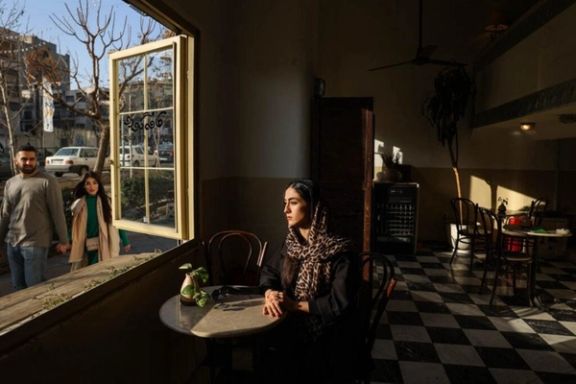
An Iranian woman sits in a cafe in Tehran, Iran, in this December 2024 file photo.

In Iran today, the riskiest act is neither protest nor journalism. It's conversation.

Around eleven o’clock on a winter Thursday night in Tehran, when smog hangs low and the city braces for yet another morning of inflation, something improbable happens.

People lift their phones and dial into a live call-in program that invites them to do what the state has discouraged for nearly 50 years, speak to one another without fear. In no other broadcast media do Iranians speak so freely.

Conversation, elsewhere, is a habit. In Iran, it is an act of retrieval. The Islamic Republic has regulated public expression so thoroughly that even a modest exchange, an honest memory, an unfiltered admission can feel subversive.

Authoritarian systems seldom fear noise, they fear permeability, the small openings through which private truth seeps back into collective life.

Conversation cannot, on its own, remake a country.

But it can remind people that they still constitute a public, and that a public, once it begins to speak, is difficult to extinguish.

On Thursday nights in Tehran, beneath a sky thick with pollutants and unspoken truths, that public can be heard, quietly but insistently, returning to life.

Each week I begin my program the same way: "What should Iran talk about tonight?" And the phone lines come alive.

Nostalgia

The first caller, a woman in Tehran named Artemis, speaks with the steadiness of someone who has carried a sentence around all day.

We know what we have lost, she begins, political rights, economic stability, clean air, the artists and scientists driven into exile. But we do not talk enough about what survived. Our culture, our sense of who we were.

She identifies as a monarchist, yet her critique is directed at her own camp. When monarchists scream and insult online, she says, they betray the very values they claim to defend, dignity, coexistence.

She pauses. Iran was once a place where different voices lived safely, she claims: we should try to be those voices again. It is a simple thought, but in a country where political language has been battered for decades, simplicity can sound radical.

Then the tone of the program shifts. A man named Ehsan calls from abroad with the urgency of someone carrying unresolved grief.

The time for talk is over, he declares. Forest fires, a collapsing currency, students expelled from school—none of it, he argues, will change until Iranians swear an oath to reclaim their homeland.

His language is harsh, almost martial, yet the emotion beneath it is unmistakably human: grief straining toward agency.

'I was wrong'

Then, a quieter voice enters the line, one woven deeply into Iran’s cultural memory.

Esfandiar Monfaredzadeh, the composer behind the defining soundtracks of pre-revolution Iranian cinema and several anthems that accompanied the uprising of 1979, speaks with a calm that cuts through the evening’s tension.

To many, he embodies the contradictions of that era, an artist who lent his talent to a revolution that promised liberation and delivered something narrower. What he does next is rare for his generation.

"I was wrong," he says. "I hope the generations after me can forgive us."

The confession does not land softly for everyone. A woman named Irandokht calls in, her voice tight with exhaustion. You left, she tells him. We stayed. And we live with what followed.

Her anger is not directed solely at him, it is aimed at the long silence surrounding his generation, decades in which few publicly reckoned with how a movement born in the language of justice hardened into repression.

Monfaredzadeh listens and responds without defensiveness. Under the Shah, he explains, Iranians had social and cultural freedoms, but not political ones.

Under the Islamic Republic, even those limited freedoms contracted. Until political freedom exists for everyone, he says, monarchists, republicans, leftists, Islamists, there can be no future worth building.

Other callers widen the frame. A woman from Karaj admits that during recent protests many workers stayed home out of fear of losing their salaries, leaving young demonstrators exposed.

Another describes an improvised referendum, the clanging of pots and pans from balconies, a city speaking through metal because speech itself had become unsafe.

I close the program the same way each week, Take good care of the person sitting next to you, I say, and sign off the national dialogue.

Then I sit for a moment longer and think to myself, we have a long way to go, yet the possibility of change feels close.

So close, no matter how far.

Most Viewed

100 days after carnage: Iran economy reels from war, inflation, unemployment
1
INSIGHT

100 days after carnage: Iran economy reels from war, inflation, unemployment

2
INSIGHT

Ghalibaf defends Iran-US talks amid hardline backlash

3
EXCLUSIVE

Iranian assaulted in London amid concern over threats to regime critics

4

IRGC fires at Indian vessel in Hormuz

5
INSIGHT

A nation in limbo: 100 days after the massacre, has the world moved on?

Banner
Banner

Spotlight

  • War-hit homeowners feel abandoned as Iran’s reconstruction aid fades

    War-hit homeowners feel abandoned as Iran’s reconstruction aid fades

  • 100 days on: the anatomy of Iran’s January crackdown
    INSIGHT

    100 days on: the anatomy of Iran’s January crackdown

  • Ghalibaf defends Iran-US talks amid hardline backlash
    INSIGHT

    Ghalibaf defends Iran-US talks amid hardline backlash

  • 100 days on: why Iran’s January protests spread across social classes
    ANALYSIS

    100 days on: why Iran’s January protests spread across social classes

  • From instability to influence: Pakistan’s pivotal role in US-Iran diplomacy
    ANALYSIS

    From instability to influence: Pakistan’s pivotal role in US-Iran diplomacy

  • A nation in limbo: 100 days after the massacre, has the world moved on?
    INSIGHT

    A nation in limbo: 100 days after the massacre, has the world moved on?

•
•
•

More Stories

Prices soar, basics scarce: Iranians struggle to fill the cart

Dec 3, 2025, 10:14 GMT+0

Iranians report rising prices and sporadic shortages of everyday goods and groceries, making it harder to cover basic needs and put food on the table, according to messages sent to Iran International.

Iran International asked ordinary shoppers in Iran to share their experiences of price hikes, the falling value of money, and the daily affordability challenges they face. A series of videos, audio clips, and text messages show mounting hardships.

Relentless price increases and runaway inflation have pushed families to the brink, forcing many to fight to survive rather than live any kind of normal life.

Their messages describe thinning shelves, collapsing purchasing power, and a growing sense that while ordinary people sink deeper into hardship, only profiteers and those connected to power continue to thrive.

“Everything is expensive and people are exhausted from all this inflation. There are no sales, businesses are dead. Only a miracle can save us from this situation,” one message said.

“In Iran, the government doesn’t care about these problems. Right now there is no business. Even if you work 24 hours a day, you’ll still come up short at the end of the month – unless you earn 3 million tomans (about $25) a day, which almost no one does, perhaps only 10% of the population,” another message said. Average Iranian income is about 100 to $150 per month.

Purchasing power

Local media tracking shows that in the past year, food prices in Iran have risen by an average of more than 66%.

Bread and grains are up 100%, fruits and nuts 108%, vegetables 69%, beverages 68%, fish and seafood 52%, and dairy products like milk, cheese and eggs 48%.

“Small retailers are either shut down or semi-closed because prices rise daily and the purchasing power of the middle class and the poor has completely collapsed. Only profiteers and those connected to the corrupt government benefit,” one message said.

“Prices for food, clothing, medicine, doctor visits, car parts – everything – are extremely high. Ninety percent of people fight just to survive, not to live.”

Daily rise

Other messages said conditions worsened after the 12-day war with Israel in June and the subsequent return of UN sanctions.

“I swear I haven’t bought red meat for a year. Same with chicken. After the 12-day war, I lost my job and my wife and children left me,” one message said.

Based on the accounts, some families have eliminated dairy except for cheese, stopped buying seasonal clothing, and cut out snacks entirely.

Dining out, visiting coffee shops, and even holding family gatherings have all but disappeared. For many, buying birthday gifts for children is no longer possible.

“This is our situation as a semi-affluent family above the poverty line. I can’t even imagine what life is like for those below it,” another message said.

Iran taekwondo athlete quits tournament to avoid Israeli rival

Dec 3, 2025, 09:24 GMT+0

An Iranian taekwondo athlete withdrew from the world under 21 championships in Kenya after the competition draw placed her against an Israeli opponent in the first round.

Rozhan Goudarzi, who won a bronze medal last month in the women’s under 51 kilogram category at the Islamic Solidarity Games in Riyadh, pulled out in line with Iran’s long standing policy that bars its athletes from competing against Israelis.

Iran’s Supreme Leader Ali Khamenei repeated in a speech last year that athletes must not face Israeli opponents and called on sports bodies to compensate those who withdraw, describing such decisions as a “sacrifice” for national and religious ideals.

He said “we must not neglect the well being of this athlete,” urging officials to support competitors who refuse to take part.

The policy has been in place since 1979 and has led to athletes forfeiting matches or intentionally losing to avoid Israeli rivals. Authorities have punished athletes who violate it, including a lifetime ban issued against a weightlifter who shook hands with an Israeli competitor at an event in Poland.

Rights groups and sports analysts say the stance has contributed to a rise in Iranian athletes leaving the country in recent years, with several competing abroad under new flags or joining the International Olympic Committee’s Refugee Team.

Iran-linked hackers target infrastructure in Israel, cyber firm says

Dec 3, 2025, 08:52 GMT+0

Cybersecurity firm ESET said it found new activity by the Iran aligned MuddyWater group that targeted critical infrastructure in Israel and one organization in Egypt.

MuddyWater, also known as Mango Sandstorm or TA450, has links to Iran’s Ministry of Intelligence and National Security and has targeted government and infrastructure in the Middle East and beyond since at least 2017.

Researchers said victims in Israel included technology, engineering, manufacturing, local government and education sectors. They said the group used new custom tools to improve its ability to hide and stay active inside networks, including a backdoor called MuddyViper that can gather system data, run commands, move files and steal Windows credentials and browser data.

  • US offers reward for information on two Iran-linked cyber actors

    US offers reward for information on two Iran-linked cyber actors

The report said the attackers used Fooder, a loader that reflects malware into memory and at times imitates the classic Snake game, to deploy MuddyViper. It said the group also used several credential stealers and avoided interactive sessions to reduce detection.

Researchers said the campaign relied on spearphishing emails that sent victims to installers for remote monitoring tools hosted on free file sharing sites. They said the operators used a range of malware, including VAX One, which imitates products such as Veeam and AnyDesk.

Past MuddyWater operations include attacks in Saudi Arabia and campaigns that overlapped with Lyceum, suggesting the group may serve as an initial access broker for other Iran linked actors.
US offers reward for information on two Iran-linked cyber actors

Dec 3, 2025, 08:32 GMT+0

The US State Department said Rewards for Justice is offering up to 10 million dollars for information that helps identify or locate two Iran linked cyber actors tied to operations against US critical infrastructure.

The program said Mohammad Bagher Shirinkar oversees the Shahid Shushtari cyber group and that Fatemeh Sedighian Kashi is a long time employee who works closely with him in planning and carrying out cyber operations. Shahid Shushtari is part of the Islamic Revolutionary Guard Corps Cyber Electronic Command and has operated under names that include Emennet Pasargad, Aria Sepehr Ayandehsazan and Net Peygard Samavat Company.

US officials said the group has caused financial damage and disruption to US businesses and government agencies and has targeted news, shipping, travel, energy, financial and telecommunications sectors in the United States, Europe and the Middle East.

Rewards for Justice said Shahid Shushtari actors ran a multi step operation during the 2020 US presidential election and had earlier carried out cyber enabled information operations that used a false flag persona.

The Treasury Department in 2021 designated the group, then known as Emennet, and six of its employees under an executive order for attempting to influence the 2020 election.

The State Department urged people with information on Shirinkar, Sedighian or the Shahid Shushtari group to send tips through its Tor based reporting channel.

Rising psychotherapy fees push Iranians out of treatment – report

Dec 3, 2025, 02:54 GMT+0

Soaring psychotherapy costs in Iran are forcing many patients to sell personal belongings or take on debt yet large numbers still abandon treatment due to the steep fees, the Tehran-based daily Ham-Mihan newspaper reported on Tuesday.

The paper said interruptions in care have intensified feelings of helplessness, despair and the recurrence of mental health symptoms among those unable to continue.

While the official psychotherapy tariff for the current Iranian year, which began in late March, is set at 5,000,000 to 6,200,000 rials ($4–$5) per session, actual prices in Tehran range from 10,000,000 to 50,000,000 rials ($8–$42), the report said.

It added that the minimum monthly wage for a married worker with two children is about 163,000,000 rials (around $137), while the average monthly income nationwide is 240,000,000 to 250,000,000 rials ($202–$210).

At these income levels, each therapy session costs the equivalent of one-third to one-fifth of a monthly salary for middle- and lower-income households.

Ham-Mihan’s report said that to respond to rising demand, the government has expanded a network of community mental-health centres known as Seraj, with about 100 centres now operating nationwide offering basic support.

However, it added that these centers do not offer psychotherapy and that coverage remains uneven and capacity limited, particularly outside major cities, forcing many patients toward the more expensive private sector.

The report cited a national study published this summer by Iran’s National Institute of Health Research found that 62.5% of people with psychiatric disorders felt they needed treatment in 2021–22, but only 35.7% received services — a rate unchanged from a decade earlier.

Cost was one of the main barriers, alongside stigma and the belief that symptoms would resolve without professional help.

Last December, Iran’s Health Ministry said one in four people in the country suffers from a psychiatric disorder, almost double the global estimate of one in eight according to World Health Organization (WHO) mental-health data.

Global data show Iran carries a heavier mental-health burden than the world average, with mental disorders accounting for 10.3% of total disability-adjusted life years (DALYs) in 2019 compared with roughly 8% globally, according to the Global Burden of Disease Study (GBD), published by the UK-based medical journal The Lancet.

Meanwhile, last November, Iranian authorities announced plans to open a treatment clinic for women who defy the country's compulsory hijab rules.

The initiative, announced by Mehri Talebi Darestani, head of the Women and Family Department at the Tehran Headquarters for the Promotion of Virtue and Prevention of Vice, would offer what she described as “scientific and psychological treatment for hijab removal,” signaling the government’s focus on behavioral enforcement even as access to mental-health care remains limited.