• العربية
  • فارسی
Brand
  • Iran Insight
  • Politics
  • Economy
  • Analysis
  • Special Report
  • Opinion
  • Podcast
  • Iran Insight
  • Politics
  • Economy
  • Analysis
  • Special Report
  • Opinion
  • Podcast
  • Theme
  • Language
    • العربية
    • فارسی
  • Iran Insight
  • Politics
  • Economy
  • Analysis
  • Special Report
  • Opinion
  • Podcast
All rights reserved for Volant Media UK Limited
volant media logo

Reformist ex-president says most Iranians focus on life, not politics
Nov 19, 2025, 16:26 GMT+0Updated: 23:53 GMT+0

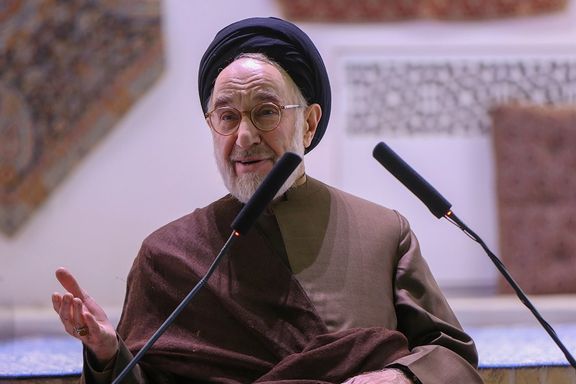
Iran’s former president Mohammad Khatami said most people in the country are more concerned with living their lives amid worsening economic conditions than with who governs them.

“Eighty percent of the Iranian people are not political in a certain sense, and it does not matter much to them who governs or how; they only want to live and to have security and a clearer outlook for the future,” Khatami said.

He said the country has never experienced a situation as severe as the one it faces now, with challenges and threats unlike anything seen since the 1979 Islamic revolution.

Khatami compared Iran’s governing system to “a sturdy tree” that had long endured hardship but now faced mounting dangers.

“This sturdy tree may be able to withstand drought and storms for many years, but today the internal and external threats and problems are so vast and significant that there is a fear this sturdy tree may suddenly wither and collapse, may that day never come,” he said.

Economic hardship

The former reformist president's remarks come as the government struggles to contain soaring prices and widening poverty.

According to Iran's Parliament’s Research Center, over a third of Iranians live in poverty.

Rising inflation and a weakening currency have helped drive up costs of living in Iran and economic pain has deepened as Western and European-triggered international sanctions compound the country's international isolation.

Earlier this month, a senior economist at Iran's Ahvaz University, Morteza Afghah, warned that annual inflation could exceed 60% by the end of the Iranian calendar year (March 2026).

Surveys say otherwise

Last week, a survey by Tehran-based news site Rouydad24 found that 92% of Iranians are unhappy with the country’s direction.

“What is clear is that total public satisfaction with all governments since the revolution is now overshadowed by a 92 percent dissatisfaction with the country’s current situation,” Rouydad24 said.

According to the outlet, the level of satisfaction with Khatami's successor Mahmoud Ahmadinejad’s administration was highest overall, while those of Hassan Rouhani and Masoud Pezeshkian ranked lowest.

Another survey conducted by a Netherlands-based polling institute last year found that the majority of Iranians would vote for either a regime change or a structural transition away from the Islamic Republic.

The Group for Analyzing and Measuring Attitudes in Iran (GAMAAN), which conducted the survey in June 2024, said it polled more than 77,000 respondents inside Iran, weighting the results to represent the literate adult population.

“A majority of the population opposes the Islamic Republic and supports changing or transforming the political system,” the report’s author Ammar Maleki said.

Only around 20 percent of respondents want the Islamic Republic to remain in power, according to the survey.

The survey found no single consensus on what system should replace the current order. A secular republic was backed by 26 percent of respondents, while 21 percent supported a monarchy.

Another 22 percent said they lacked enough information to decide, and 11 percent said that the form of an alternative system was not important so long as change occurred.


Most Viewed

Ghalibaf defends Iran-US talks amid hardline backlash
1
INSIGHT

Ghalibaf defends Iran-US talks amid hardline backlash

2
ANALYSIS

From instability to influence: Pakistan’s pivotal role in US-Iran diplomacy

3
ANALYSIS

100 days on: why Iran’s January protests spread across social classes

4

War-hit homeowners feel abandoned as Iran’s reconstruction aid fades

5

Iran says no decision yet on talks as Pakistan prepares to host US team

Banner
Banner

Spotlight

  • Iran diplomacy wobbles as factions compete to avoid looking soft on US
    INSIGHT

    Iran diplomacy wobbles as factions compete to avoid looking soft on US

  • The politics of pink: how Iran uses cuteness to rebrand violence
    ANALYSIS

    The politics of pink: how Iran uses cuteness to rebrand violence

  • Bread shortages, soaring prices strain households in Iran, residents say
    VOICES FROM IRAN

    Bread shortages, soaring prices strain households in Iran, residents say

  • 100 days on: the anatomy of Iran’s January crackdown
    INSIGHT

    100 days on: the anatomy of Iran’s January crackdown

  • Ghalibaf defends Iran-US talks amid hardline backlash
    INSIGHT

    Ghalibaf defends Iran-US talks amid hardline backlash

  • From instability to influence: Pakistan’s pivotal role in US-Iran diplomacy
    ANALYSIS

    From instability to influence: Pakistan’s pivotal role in US-Iran diplomacy

•
•
•

More Stories

Iran’s top brass grappling with distrust after June war - Telegraph

Nov 19, 2025, 10:47 GMT+0

Iranian security institutions have come under growing internal pressure and suspicion since Israel’s June attacks, with accounts describing heightened oversight inside the Revolutionary Guard, The Telegraph reported on Wednesday. 

According to the report, unnamed Iranian officials and security sources said this week that members of the Islamic Revolutionary Guard Corps (IRGC) and other agencies have become increasingly distrustful of one another after what the newspaper described as “extensive Israeli infiltration” during the 12-day war in June. 

The report said officials inside Iran spoke of security personnel seeking to demonstrate their loyalty as investigations widen.

One senior Iranian official told The Telegraph that “many officials, including within the Sepah [IRGC], are doing everything they can to convince the system that they haven’t done anything wrong,” adding that “the Israelis have massively infiltrated several agencies.” 

Another official said, “what’s becoming an even greater concern is the growing number of people who are, in one way or another, betraying the system,” according to the paper.

According to analysts cited in the report, the atmosphere of suspicion could complicate Iran’s crisis-management capabilities. “The paranoia within the IRGC risks weakening Iran’s most powerful military force and the regime’s ability to respond coherently to future crises."

Hundreds of people have been arrested on espionage charges since June and several Iranians have been executed, actions that officials speaking to the outlet described as intended to show that “the system is still functioning.”

The Telegraph also cited officials describing confusion over the status of Tehran’s regional allied forces and unease about the country’s longer-term direction.
  • Tehran metro arrests fuel debate over protests and change in Iran

    Tehran metro arrests fuel debate over protests and change in Iran

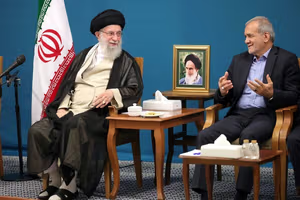
  • Iran could turn on itself if Supreme Leader harmed, president warns

    Iran could turn on itself if Supreme Leader harmed, president warns

A poll by the Iranian Student Polling Agency reported public dissatisfaction at 92%, attributing the figure to Iran’s economic troubles and renewed UN sanctions after the collapse of the 2015 nuclear deal. 

President Masoud Pezeshkian offered a similar note of concern in remarks to parliament last week, warning that Iran could “turn on itself” if the Supreme Leader were harmed during a crisis. 

He said the country’s cohesion rests on Ali Khamenei’s leadership and cautioned that an attack on him during the June war might have triggered internal clashes “without the need for Israel to intervene.” He urged officials to avoid factionalism and to reinforce cooperation across state institutions.

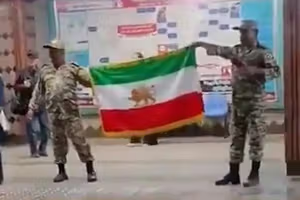
Earlier in the month, the arrest of two men displaying the pre-1979 Iranian flag at a Tehran metro station sparked debate about discontent within parts of the security forces. 

Despite the reported pressures, the Telegraph said experts believe the Iranian state remains structurally stable, pointing to what it called “rally-around-the-flag” dynamics during and after the June conflict with Israel. 

Iran releases seized Marshall Islands-flagged tanker with crew safe

Nov 19, 2025, 09:10 GMT+0

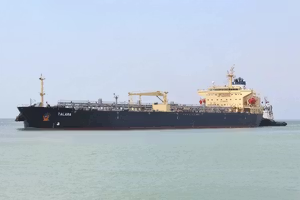
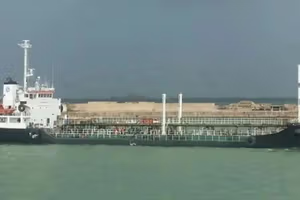
Iran has released the Marshall Islands-flagged product tanker Talara and all 21 crew are safe, the vessel’s operator Columbia Shipmanagement said on Wednesday, days after Iran’s Revolutionary Guards confirmed they had seized the ship off the country’s southern coast.

"We have informed their families, and the vessel is now free to resume normal operations," Reuters quoted the manager as saying.

The Guards said on Saturday that rapid-reaction units intercepted the tanker near the Makran coast under a judicial order to confiscate its cargo. State media quoted sources saying the vessel carried about 30,000 tons of petrochemical products owned by Iran that were being transferred illegally to Singapore.

Fars news agency said the ship was directed to an Iranian anchorage for inspection and was found to be in breach of rules on transporting unauthorized goods. The Guards said the operation was carried out under legal authority “to protect national interests.”

  • Iran's Guards confirm seizure of Marshall Islands-flagged tanker

    Iran's Guards confirm seizure of Marshall Islands-flagged tanker

  • Oil tanker crew safe after Iran seizes ship, vessel manager says

    Oil tanker crew safe after Iran seizes ship, vessel manager says

  • US accuses Iran of violating international law over tanker seizure

    US accuses Iran of violating international law over tanker seizure

Vessel diverted from UAE waters

The Talara, operated by Cyprus-based Columbia Shipmanagement and owned by Pasha Finance, had been sailing from Sharjah to Singapore with a load of high-sulphur gasoil when contact was lost on Nov. 15. Maritime security firm Ambrey said the tanker was about 22 nautical miles east of the UAE port of Khor Fakkan when small boats approached and the vessel changed course toward Iranian waters.

Iran has stepped up maritime enforcement in the Gulf of Oman and the Strait of Hormuz in recent months, citing efforts to curb fuel smuggling. The seizure came amid continuing legal cases involving other foreign vessels detained by Iranian forces in past incidents.

The operator said on Tuesday the ship and crew were in good condition and that the Talara would soon resume normal operations.

Jailed ex-official urges end to Iran clerical rule via constituent assembly

Nov 19, 2025, 03:00 GMT+0

A freely elected constituent assembly to rewrite Iran’s constitution is the only peaceful path to democratic transition, imprisoned politician Mostafa Tajzadeh said in a letter from prison made public on Tuesday.

Tajzadeh said the constituent assembly is the only way to avert state collapse or violent chaos once Supreme Leader Ali Khamenei is no longer in power.

“As of now there are the likely scenarios: Continuing the status quo (which will lead to gradual “state failure from above”), violent overthrow (likely producing anarchy, foreign intervention and possible territorial break-up), or fundamental structural reform while Khamenei remains alive,” Tajzadeh said in the letter published on his Telegram channel.

Tajzadeh said mass civil disobedience has already defeated the compulsory hijab and internet filtering, and the same strategy can force the government’s hard core, including the Revolutionary Guards and senior clerics, to accept a national referendum and the formation of a constituent assembly.

“The ceiling and floor of constitutional amendments will be determined by representatives elected by the nation in a constituent assembly, who will then submit the new charter to a referendum,” Tajzadeh said.

‘Constitutional revolution'

“The minimum national demand will be the removal of velayat-e faqih (Guardianship of the Islamic Jurist) from the constitution and the end of clerical rule – a failed experiment that has revived the bitter experience of Church domination in the Middle Ages in the modern era,” he added.

Tajzadeh said the path forward would be the model of Iran’s 1905–1911 Constitutional Revolution.

“The only peaceful transition passes through the Constitutional Revolution model: forcing the hard core (including the IRGC and clergy) to accept change while the Leader is still alive,” Tajzadeh said.

“Both preserving the status quo and violent overthrow would lead to the same destination - state collapse, prolonged chaos, foreign intervention, and possible fragmentation of Iran.”

'Chalice of poison'

In the letter titled 'Iran After 12 Days', Tajzadeh said Khamenei "has neither the courage to drink the chalice of poison, nor the bravery to resign."

The phrase "chalice of poison” is one of the most famous metaphors in the political lexicon of the Islamic Republic. It was used by Ayatollah Ruhollah Khomeini in 1988, when he accepted UN Resolution 598 that mandated a ceasefire to end the eight-year Iran–Iraq War.

Tajzadeh said “Khamenei no longer has the power to impose the compulsory hijab on women, nor the capacity to tolerate their freedom to choose. He can neither continue the militarization of the state and the barracks-style governance of society, nor hand over the management of the country to civilians.”

“Khamenei’s refusal to go along with unfolding transformations will not discourage the people from pursuing them; but his confrontation with the nation’s demands will carry unpredictable and extremely dangerous consequences — to the point where it may leave no path to repair the damage caused by his obstinacy.”

The letter, which was released just 13 days after Tajzadeh was rearrested and returned to Evin Prison after a brief furlough, is his clearest roadmap yet for a post-Khamenei Iran.

Tajzadeh, a former deputy interior minister under President Khatami, has been in and out of prison since 2009 for criticizing the Supreme Leader and calling for structural reform.

Australia registers Press TV as Iranian foreign agent

Nov 19, 2025, 02:15 GMT+0
•
Alireza Mohebbi

Iranian state broadcaster Press TV has been formally registered under Australia’s Foreign Influence Transparency Scheme (FITS) as an entity acting on behalf of the Islamic Republic of Iran, the Attorney General’s Department told Iran International.

According to an email sent by the Attorney-General’s Department to Iran International, Press TV received a provisional transparency notice on 21 October 2025, which was finalized on Tuesday after the network failed to provide evidence rebutting the designation within the 28-day period.

Under the scheme, Press TV must now register on the public FITS portal and submit periodic reports on its activities in Australia. Failure to comply can result in prison terms of one to five years, heavy fines, or further prosecution under national security laws.

Press TV is only the third organization to be compulsorily registered under FITS. The two previous entities were Chinese. The Confucius Institute at the University of Sydney and the Australian Council for the Promotion of Peaceful Reunification of China.

The scheme, in force since 2018, aims to increase public awareness of activities conducted in Australia on behalf of foreign governments.

Australia previously sanctioned Press TV in September 2023 over its role in broadcasting forced confessions and aiding the suppression of dissidents, one year after the death of a young woman, Mahsa Amini, in morality police custody in 2022.

Despite the sanctions, the network continued filing reports from Sydney via its correspondent Shahane Batt until at least February 2025.

The registration comes as Australia’s Foreign Minister warned on Monday that Iran, Russia and North Korea continue to engage in sabotage and destabilization, while China seeks to reshape the region in its own interests.

Australia's Foreign Influence Transparency Scheme (FITS), launched in 2018 amid concerns over Chinese interference, is a more targeted and strictly enforced version of the US Foreign Agents Registration Act (FARA) of 1938.

While both require public registration and disclosure for activities on behalf of foreign principals to promote transparency, FITS focuses narrowly on political and governmental influence with clearer exemptions and criminal penalties up to five years in prison.

Iran-linked hackers hit Mideast defense, space firms with new malware

Nov 19, 2025, 01:22 GMT+0

Google-owned security firm Mandiant reported on Tuesday that Iran-linked UNC1549 breached Middle East aerospace, aviation and defense organizations in a campaign from late 2023 to October 2025.

“The operation represents a notable technical advancement for the group, which introduced two previously undocumented custom backdoors: TWOSTROKE, a lightweight Windows implant written in C++ that supports command execution, file operations, screenshot capture and various persistence methods,” Google-owned firm said.

“The other is DEEPROOT, a cross-platform backdoor developed in ‘Go’ language crossed platform that works on both Linux and Windows systems, enabling shell commands and file transfers,” the report added.

Attackers gained initial access primarily through spear-phishing emails containing tailored job recruitment lures aimed at defense and aviation professionals, as well as through supply-chain compromises involving trusted third-party software vendors and virtual desktop infrastructure providers, Mandiant reported.

“Once inside victim networks, UNC1549 (aka Nimbus Manticore/Tropical Scorpius) deployed additional tools including SIGHTGRAB for screenshots and CRASHPAD for credential harvesting and data staging,” Mandiant said. “Command-and-control traffic was routed through compromised Microsoft Azure tenant accounts to blend with legitimate cloud activity and avoid detection.”

Mandiant said with high confidence that the activity supports Iranian state interests focused on strategic intelligence collection.

Sensitive data was exfiltrated from compromised networks, though the specific content and affected countries have not been disclosed.