• العربية
  • فارسی
Brand
  • Iran Insight
  • Politics
  • Economy
  • Analysis
  • Special Report
  • Opinion
  • Podcast
  • Iran Insight
  • Politics
  • Economy
  • Analysis
  • Special Report
  • Opinion
  • Podcast
  • Theme
  • Language
    • العربية
    • فارسی
  • Iran Insight
  • Politics
  • Economy
  • Analysis
  • Special Report
  • Opinion
  • Podcast
All rights reserved for Volant Media UK Limited
volant media logo

As nuclear standoff festers, Iran's UN envoy vows not to surrender

Nov 14, 2025, 21:43 GMT+0Updated: 23:55 GMT+0
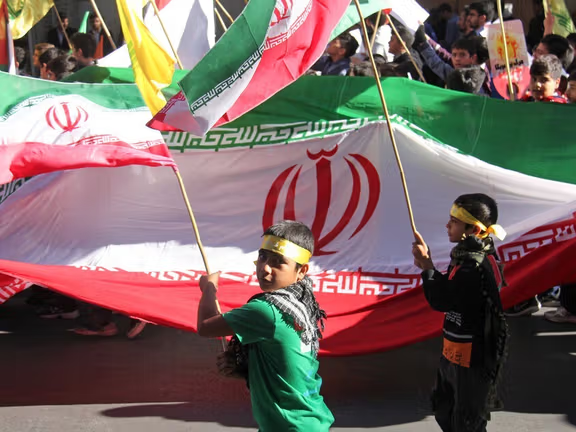
Students wave Iran's flag in a rally to mark the day the US embassy in Tehran was stormed 1979, Gorgan, Iran, November 5, 2025

Iran's UN ambassador Amir Saeid Iravani said Tehran will never surrender to threats or coercion during a General Assembly speech on Friday addressing a report by the UN nuclear agency urging to restore international inspections.

Iravani said the International Atomic Energy Agency (IAEA) insists on access and inspection of attacked sites, but that requires new “modalities” to ensure the safety of the nuclear sites and their staff.

The IAEA's November report highlights Iran's denial of access to seven attacked nuclear sites for five months, voiding a September access deal and eroding safeguards verification.

Iravani criticized the reimposition of UN sanctions on Iran triggered by European powers, saying the a mechanism to reinstate them was based on a lapsed nuclear agreement.

“Resolution 2231 expired permanently in October, ending all related restrictions. Any attempt to revive or reimplement them is an illegal abuse of procedures and must be firmly rejected by this assembly and the Secretary-General,” Iravani said in a speech published by official media.

Under UN Security Council Resolution 2231, any participant in the Iran nuclear deal (JCPOA) - the E3 (France, Germany, UK), Russia, China or the United States could file a non-compliance complaint with the UN Security Council.

The E3 initiated the non-compliance process in August, and UN sanctions were fully activated and reimposed in September.

“The action by the three European countries to activate the so-called ‘trigger’ mechanism is an illegal, reckless move aimed at destroying the last bridge of diplomacy, and thus lacks any validity,” Iravani said.

'Inspection mdalities'

Iravani condemned Israel's June strikes on Iranian nuclear sites and subsequent US attacks, demanding condemnation from UN and IAEA officials.

The IAEA report also criticizes Iran's nuclear program for non-compliance, citing undeclared uranium traces at secret sites and stockpiles of 440.9 kg (972 pounds) enriched to 60% purity.

A 12-day war in June killed hundreds of military personnel and civilians; Iranian counterattacks killed 32 Israeli civilians and an off-duty soldier.

"Our response is only to respect, the rule of law, and equality. Military aggression and economic terrorism will never force Iran to forgo its legitimate rights,” Iravani said.

Iran says as a participant in the Non-Proliferation Treaty, it has the right to pursue uranium enrichment, which the West disputes.

Tehran denies seeking a nuclear weapon, citing a religious decree by Supreme Leader Ali Khamenei; it rejects giving up its nuclear activities and has said discussions on its defense posture are a non-starter.

G7 foreign ministers urged Iran to fully comply with UN resolutions and NPT obligations during their Niagara summit on Tuesday, calling for renewed IAEA cooperation and direct US engagement backed by the E3.

Most Viewed

Ghalibaf defends Iran-US talks amid hardline backlash
1
INSIGHT

Ghalibaf defends Iran-US talks amid hardline backlash

2
ANALYSIS

From instability to influence: Pakistan’s pivotal role in US-Iran diplomacy

3
ANALYSIS

100 days on: why Iran’s January protests spread across social classes

4

War-hit homeowners feel abandoned as Iran’s reconstruction aid fades

5
INSIGHT

100 days on: the anatomy of Iran’s January crackdown

Banner
Banner

Spotlight

  • Bread shortages, soaring prices strain households in Iran, residents say
    VOICES FROM IRAN

    Bread shortages, soaring prices strain households in Iran, residents say

  • War-hit homeowners feel abandoned as Iran’s reconstruction aid fades

    War-hit homeowners feel abandoned as Iran’s reconstruction aid fades

  • 100 days on: the anatomy of Iran’s January crackdown
    INSIGHT

    100 days on: the anatomy of Iran’s January crackdown

  • Ghalibaf defends Iran-US talks amid hardline backlash
    INSIGHT

    Ghalibaf defends Iran-US talks amid hardline backlash

  • 100 days on: why Iran’s January protests spread across social classes
    ANALYSIS

    100 days on: why Iran’s January protests spread across social classes

  • From instability to influence: Pakistan’s pivotal role in US-Iran diplomacy
    ANALYSIS

    From instability to influence: Pakistan’s pivotal role in US-Iran diplomacy

•
•
•

More Stories

In a first since 1979 Revolution, a woman conducts the Tehran Symphony

Nov 14, 2025, 20:02 GMT+0

Paniz Faryousefi made history as the first woman to lead Iran's Tehran Symphony Orchestra since the 1979 Islamic Revolution, conducting sold-out shows Wednesday and Thursday at Vahdat Hall despite long official gender bias in the arts.

Though other Iranian women have led youth ensembles or smaller groups, Faryousefi achieved a major breakthrough.

The violinist, trained at Tehran's Music Conservatory and Armenia's Komitas State Conservatory, drew inspiration from conductors Aram Gharabekian and Stanislav Kochanovsky.

As concertmaster of the Tehran Philharmonic and a composer, she helmed the "Land of Simurgh" program with works by Iranian composers Aftab Darvishi and Golfam Khayam, plus Schumann, Sibelius, and Khachaturian.

"Art belongs to humanity, not to men and women," Faryousefi said after the performances, underscoring the milestone for women artists.

Paniz Faryousefi
100%
Paniz Faryousefi

The concerts highlight a cultural flux in Iran.

"Woman, Life, Freedom" protests against the theocracy's mandatory hijab were crushed with deadly force, but further draconian legislation and much enforcement has lapsed as authorities seek to avoid unrest.

Women presence

Apart from Faryousefi, two other women have conducted orchestras in Iran. Nazanin Aghakhani led the Tehran Youth Orchestra in 2014, and Nezhat Amiri directed a 71-member ensemble in Tehran in 2018.

Vienna-born Aghakhani has a history of conducting orchestras in various countries, was invited to Iran in 2011 on the recommendation of Loris Tjeknavorian to lead the Tehran Symphony Orchestra. She was scheduled for four performances but was denied public performance permits.

Tjeknavorian is an Iranian-Armenian composer and conductor who is renowned for symphonies, operas and leading orchestras like the Armenian Philharmonic.

Women defying the headscarf are tools for Israel, senior cleric says

Nov 14, 2025, 17:32 GMT+0

Tehran's state-appointed Friday prayer leader said that defiance of the Islamic veil was tantamount to collaboration with Israel and the United States, underscoring tension in the clerical establishment on hijab enforcement.

“An American author said: 'Remove the hijab, and you've effectively joined Mossad operations.' I urge all women to consider their faith and country,” Ahmad Khatami said at a prayer gathering on the Islamic holy day of the week.

Khatami went on to say half of those defying the mandatory headscarf need to come back to Shi'ite Islam.

"Unveiled women fall into two groups: adversaries whom the law confronts, and Shi'ite well-wishers who must align with Fatima Camp. I implore all women to prioritize their faith and nation,” Khatami said.

Fatima al-Zahra, daughter of Prophet Muhammad, wife of Ali the first Shiite Imam holds unparalleled status as the only woman in the Prophet's infallible household, making her central to Shiite theology and devotion.

An Iranian woman walks on a street amid the implementation of the new hijab surveillance in Tehran, Iran, April 15, 2023.
100%
An Iranian woman walks on a street amid the implementation of the new hijab surveillance in Tehran, Iran, April 15, 2023.

Visible change

Despite mounting threats, civil resistance to the mandatory hijab persists, with many women appearing in public without it to reject the policy.

Enforcement has slackened and a draconian new law on veiling was paused.

While political and espionage arrests have mounted along with executions, authorities have tamped down on veiling as social and economic pressures mount in Iran.

Women and girls in Iran have increasingly defied the mandatory headscarf since the "Woman, Life, Freedom" protest movement, sparked by the death of young Mahsa Amini in morality police custody in 2022.

Critics argue the state’s expanding enforcement apparatus shows that the priority is social control rather than easing economic hardship.

The death of a street vendor: who killed Ahmad Baledi?

Nov 14, 2025, 16:28 GMT+0
•
Kambiz Hosseini

At dawn on a November morning in Ahvaz, a city in Iran’s oil-rich southwest, municipal enforcers arrived at Zeytun Park to demolish a small food kiosk that had sustained one family for more than two decades.

By noon, the stand was rubble. Ahmad Baledi, a twenty-one-year-old university student, watched as the officers came to dismantle his father’s livelihood. Then he poured gasoline over his body and lit a match.

He died a few days later, burned beyond recognition in a hospital bed.

Baledi’s death was not an act of madness, it was the death of a promise. The Islamic Republic came to power in 1979 vowing to defend the poor. Forty-six years later, the same government polices them with bulldozers.

Across Iran, municipal squads clear vendors, confiscate carts, destroy kiosks, and often humiliate those who resist. Unconfirmed reports suggest that Baledi warned an officer he would set himself on fire. “Go ahead, let’s see,” the officer allegedly said. And Baledi did it.

That exchange -accurate or not- is entirely believable by Iranians exposed to something more corrosive than cruelty, a state so practiced in coercion that the sees value of life as negotiable.

Bouazizi moment

The scene echoed another young man, thousands of miles away. In 2010, Mohamed Bouazizi, a Tunisian fruit seller, set himself on fire after officials seized his cart, igniting the Arab Spring.

But where Bouazizi’s death cracked open a political order, Baledi’s has been met mostly with silence, a measure of how exhaustion now tempers outrage in a country smothered by inflation, censorship and despair.

Ahvaz, the capital of Khuzestan Province, is a city of contradictions: immense petroleum wealth, staggering poverty and air so thick with refinery dust it dims the sun. For years, residents have lived under a system in which the law is elastic for the powerful and absolute for the weak.

In the hours after Baledi’s death, a wave of grief and anger shook this system in a way the authorities had not anticipated. His self-immolation, captured in trembling phone videos, forced the local government into an uncharacteristic retreat.

The mayor of Ahvaz, Reza Amini, resigned, and the Khuzestan governorate announced the dismissal of four senior municipal officials.

Days later, the prosecutor acknowledged that the mayor and one of his deputies had been arrested and briefly jailed before being released on bail, with additional cases opened against several municipal employees.

But the rush of resignations and arrests sharpened an underlying truth. In Iran, impunity is procedural. Investigations are ritual gestures, designed less to reveal responsibility than to contain it.

Ground truth

Each tragedy is framed as excess zeal at the bottom rather than intent at the top. The machine stays intact.

For many outside Iran, the country registers as an abstraction: centrifuges spinning in Natanz, proxy fights in the Persian Gulf, headlines about sanctions or war with Israel.

But its political reality begins at ground level, in moments like this —a family’s livelihood crushed at dawn, a young man driven to flame.

These are not aberrations; they are the daily grammar of a state that has turned humiliation into an instrument of order.

Baledi’s father later said the family had paid “fees” for years to keep their stand open, bribes functioning as rent to local authorities. It is a metaphor for the nation itself, citizens renting their survival from the very state that claims to protect them.

Bouazizi’s act in Tunisia derived its force from recognition. People saw in his burning the reflection of their own submission and, for a moment, turned that recognition into revolt. In Iran, recognition has hardened into fatigue.

Outrage flares, then recedes beneath the next injustice. The Islamic Republic has mastered the art of exhausting empathy.

Yet Ahmad Baledi’s fire endures as a warning. It exposes a government that mistakes fear for stability and silence for peace. It reminds us that dignity is not ornamental, it is political. Baledi did not die because of gasoline or flame. He died because no one in authority believed his life mattered.

Who killed Ahmad Baledi? The answer, written in fire, is that people eventually stop asking for mercy and start asking to be seen.
Iranian prosecutors set to target anti-hijab groups

Nov 14, 2025, 13:39 GMT+0

Iran’s judiciary chief instructed prosecutors nationwide to work with security and police agencies to identify what he called “organized groups linked to foreigners” involved in “social irregularities,” escalating the state’s campaign to enforce the mandatory hijab.

Gholamhossein Mohseni Ejei delivered the directive on Friday in the religious city of Qom, warning that foreign adversaries sought to exploit issues such as unveiled women and online activity.

“One manifestation of the enemy’s efforts is in the matter of nudity and lack of hijab, and another is the virtual space,” he said.

He urged officials to avoid amplifying internal disputes. “We must be alert to the enemy’s mischief and not inadvertently play on its field,” he said. “A small domestic issue should not be framed in a way that gives the enemy an opportunity.”

Senior officials call for tougher enforcement

Ejei’s comments align with a series of recent directives by senior Iranian officials favoring stricter enforcement of the mandatory hijab, a policy advanced in recent months with judiciary backing and active support from security institutions and state-aligned media.

Kayhan, a newspaper overseen by a representative of Iran’s supreme leader, wrote on Wednesday that hijab was “the first defensive shield of Islamic identity,” warning that its erosion would open the way for broader cultural decline.

Prosecutors were also obliged to act with seriousness against women who do not observe the compulsory dress code, Prosecutor General Mohammad Movahedi Azad said on Sunday.

Days earlier, Esfahan’s judiciary chief, Asadollah Jafari, called for action against what he described as “norm-breaking behavior.”

Iranian women look at jewellery displayed in a store in Tehran, Iran, September 27, 2025.
100%
Iranian women look at jewellery displayed in a store in Tehran, Iran, September 27, 2025.

More than 80,000 so-called promoters of virtue had been organized to monitor women’s clothing in public spaces, Ruhollah Momen-Nasab, head of Tehran’s headquarters for the Promotion of Virtue and Prevention of Vice said in October.

Clerics intensify pressure

In Mashhad, senior cleric Ahmad Alamolhoda renewed warnings on Friday, saying unveiled women posed a threat. “We must fight lack of hijab. Today, lack of hijab has reached nudity,” he said. He likened the situation to a house fire, urging officials to intervene directly.

Alamolhoda also criticized domestic streaming platforms, accusing them of exposing young viewers to inappropriate content at a vulnerable age.

Critics argue the state’s expanding enforcement apparatus shows that the priority is social control rather than easing economic hardship.

Despite mounting threats, civil resistance to the mandatory hijab persists, with many women appearing in the public without hijab to reject the policy.

Iran loses 12,000 professors in decade-long academic exodus

Nov 14, 2025, 11:05 GMT+0

Iran has lost 12,000 university professors over the past decade, a former deputy science minister said on Friday, highlighting the rapid unraveling of the country’s higher-education workforce.

Iran’s academic system had been confined by shifting governance structures that weakened its capacity, Gholamreza Zarifian told an annual assembly of university instructors.

“In the past ten years, 12,000 university professors have left Iran, and 60 percent of them did so in the past four years,” he said.

Vetting pressures

“These days, we lose one university professor every week,” Ebrahim Azadegan of Sharif University of Technology said in an interview with KhabarOnline last month.

The latest wave of departures has sharpened criticism of vetting rules that academics say have disqualified candidates over personal matters.

Karan Abri-Nia, secretary of the Iranian University Professors’ Trade Union, said in late October that at least 1,500 engineering and technical faculty members at leading institutions had emigrated in the past five years. “I see migration as a wound on the body of our universities, one that keeps deepening,” he said.

100%

Between the 2018-19 and 2022-23 academic years, Abri-Nia added, about a quarter of the 6,000 faculty members in core engineering departments at top universities left the country. At the University of Tehran, he said about ten professors in engineering mechanics either took early retirement to continue work abroad or went on sabbatical and did not return.

Broader professional flight

The academic exodus reflects a wider flight of skilled workers, including doctors and nurses seeking opportunities in the United Arab Emirates, Oman and elsewhere. Medical associations in Iran have warned repeatedly of a growing strain on the healthcare system and the risk of future breakdown if departures continue.

Officials have recently authorized passport and immigration police to monitor elite migration in coordination with the National Elites Foundation, which operates under the presidency, a sign of growing concern over the accelerating loss of talent.

The steep decline in faculty numbers points to a structural crisis for Iran’s universities as they face shrinking resources, political constraints and persistent economic pressures.