• العربية
  • فارسی
Brand
  • Iran Insight
  • Politics
  • Economy
  • Analysis
  • Special Report
  • Opinion
  • Podcast
  • Iran Insight
  • Politics
  • Economy
  • Analysis
  • Special Report
  • Opinion
  • Podcast
  • Theme
  • Language
    • العربية
    • فارسی
  • Iran Insight
  • Politics
  • Economy
  • Analysis
  • Special Report
  • Opinion
  • Podcast
All rights reserved for Volant Media UK Limited
volant media logo

Iran military spokesman vows Israel’s destruction

Nov 13, 2025, 10:37 GMT

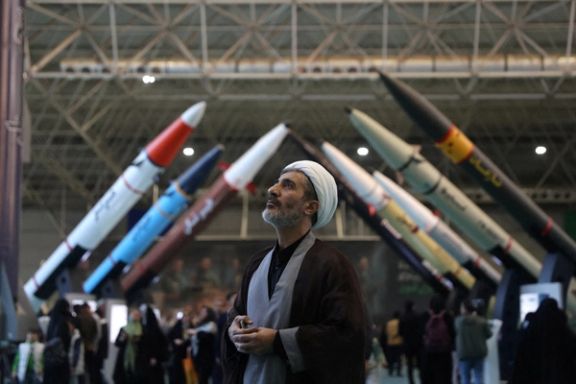
Israel’s destruction remains a core aim for the Islamic Republic, Iran’s top armed forces spokesman said on Thursday at a memorial ceremony in Tehran, as senior officials sharpened their rhetoric amid growing talk of another clash with Israel.

Abolfazl Shekarchi said the late Revolutionary Guard commander Hassan Tehrani Moghaddam, widely regarded as the father of Iran’s ballistic-missile program and killed in a 2011 explosion at an IRGC base west of Tehran, had “carried the wish to see Israel wiped out,” adding: “With God’s help, this wish will be fulfilled.”

He said Iran’s aerospace forces grow “more powerful by the day” and insisted the Islamic Republic becomes stronger when its commanders are killed.

“We never become weak — with every martyr we become more steadfast,” he said.

Other senior commanders used the same gathering to revisit the twelve day June war with Israel. Deputy IRGC chief Ali Fadavi said “all the world stood with Israel but they did not succeed,” adding that Iran had “acted on its duty” during the fighting and that “when duties are carried out, the promises of God are fulfilled.”

Vahid Azizi, head of parliament’s national security committee, said Tehran viewed the conflict as “an opportunity to understand the shortcomings and the needs” and as a chance to “prepare for what may come next.”

Growing signals of a new confrontation

The messaging reflects broader signals in Tehran, where several officials have spoken more openly in recent weeks about the prospect of fresh fighting with Israel. Some have said Iran is ready for “all scenarios” as political and military rhetoric intensifies.

Israeli Prime Minister Benjamin Netanyahu told the Knesset this week that Iran “remains a threat,” yet was weakened in the June war. He said Israel had “distanced and neutralized the nuclear threat and the ballistic threat alike” and warned that any next clash would be “much more aggressive” and could last far longer than twelve days.

Most Viewed

Worst outcome is Islamic Republic’s survival, ex-CIA official says
1
PODCAST

Worst outcome is Islamic Republic’s survival, ex-CIA official says

2
ANALYSIS

Iran brings unusually broad team to US talks to blunt future blame

3
INSIGHT

Tehran sends tough message but keeps diplomacy door open

4

Zoroastrian religious figure arrested in Iran

Banner
Banner

Spotlight

  • What the US naval blockade would mean for Iran’s economy
    INSIGHT

    What the US naval blockade would mean for Iran’s economy

  • Tehran sends tough message but keeps diplomacy door open
    INSIGHT

    Tehran sends tough message but keeps diplomacy door open

  • Worst outcome is Islamic Republic’s survival, ex-CIA official says
    PODCAST

    Worst outcome is Islamic Republic’s survival, ex-CIA official says

  • Why the Iran-US truce is more likely to buy time than peace
    ANALYSIS

    Why the Iran-US truce is more likely to buy time than peace

  • Engaged but uncommitted: China watches Iran and US fight and talk
    ANALYSIS

    Engaged but uncommitted: China watches Iran and US fight and talk

  • A truce for the world, a reckoning for Iran’s economy
    ANALYSIS

    A truce for the world, a reckoning for Iran’s economy

•
•
•

More Stories

Iran to send test alerts as fear of another war looms

Nov 13, 2025, 10:13 GMT

Iran will run a drill to test its mobile phone warning system on Friday, Iranian media said, sending test alerts to selected users between 10 and 12 local time as officials speak more often of renewed conflict with Israel.

The reports said the test is part of a technical review of the Cell Broadcasting system used to warn residents during earthquakes, floods and other emergencies. Officials said the alerts will appear automatically on some phones, may include sound and vibration, and require no action from the public. They stressed the exercise does not reflect any real threat.

The test follows weeks of warnings from senior figures in Tehran. Foreign Minister Abbas Araghchi said that the country expects “any aggressive act” from Israel and is preparing for all scenarios, while former parliament speaker Ali Larijani said the war “is not over.” In Israel, former intelligence officials have also warned of a second round of fighting.

Tehran council chief says only 'special places' have new shelters

The drill comes as Tehran’s city council chief Mehdi Chamran said no new public shelters had been built for civilians, saying only “in special places” had new structures been prepared. “It is not necessary to say where,” he told the council, adding that the locations were not intended to be publicly disclosed.

Chamran said some metro stations were designed as shelters, including for chemical incidents, and were inspected during the twelve-day June war with Israel. He said work to complete these areas was ongoing, while stressing that he hoped no conflict would erupt.

His remarks echoed earlier comments from Iran’s passive defense agency, which said most residents would still rely on metro stations, underground car parks and basements in an emergency. The agency noted that limits on services and sanitation prevent the wider use of metro stations as full shelters.

During the June conflict, senior Iranian officials, including Supreme Leader Ali Khamenei, took cover in secure underground sites, while ordinary residents had no designated public shelters, prompting criticism. Tehran council members later admitted that no citywide shelter plan had been built in the past decades.

British couple jailed in Iran are on hunger strike, son says

Nov 13, 2025, 09:08 GMT

A British couple held in Iran on spying charges have begun a hunger strike inside Evin prison, their son told the BBC on Thursday, saying his mother described the move as her only means of protest.

Joe Bennett said his mother, Lindsay Foreman, told him in a brief phone call that “not eating was the only power she’s got.” The call, he said, ended without warning. Foreman and her husband, Craig, were arrested in January while travelling through Iran on a motorbike tour and deny the charges.

The family says the pair entered the country with valid visas, a licensed guide and a cleared itinerary, but were detained after Foreman asked locals routine questions for a personal project. Both were first held in Kerman, where they spent 30 days in solitary confinement, before being transferred to separate cells in Evin.

  • Kin of couple detained in Iran urge UK to win their freedom by Christmas

    Kin of couple detained in Iran urge UK to win their freedom by Christmas

  • Verdict nears for British couple detained in Iran as diplomacy sours

    Verdict nears for British couple detained in Iran as diplomacy sours

Bennett said his mother is isolated among inmates who do not speak English, while his stepfather is suffering from an untreated tooth abscess. He said the couple had been promised a visit with each other last Sunday, but it did not take place.

The couple were tried in October as tensions between Tehran and European capitals deepened following new nuclear-related sanctions. Rights groups say their case fits a wider pattern of detentions used to gain political leverage, an accusation Iran denies.

Bennett has urged officials to secure the pair’s release and said the charges against them are “completely bonkers.” He said the couple had praised Iran before their arrest, calling it “a beautiful country.”

Syria is stepping up moves against Iran’s Guards and Hezbollah, US envoy says

Nov 13, 2025, 08:08 GMT

Syria will help the US take on Iran’s Guards and Hezbollah as part of a sharp turn in its ties with Washington, US special envoy for Syria Tom Barrack said on Thursday in a post on his X.

“Damascus will now actively assist us in confronting and dismantling the remnants of ISIS, the IRGC, Hamas, Hezbollah, and other terrorist networks, and will stand as a committed partner in the global effort to secure peace,” Barrack wrote, saying the pledge came during Syrian President Ahmed al Sharaa’s visit to the White House, the first by a Syrian head of state since independence.

Al Sharaa told the Washington Post this week that Syria had driven out Iranian and Hezbollah forces and was ready for a new phase with the US after decades of strain. He said Syria and Israel were in direct talks and had made progress toward a deal, and he said Israel should pull back to its pre Dec 8 lines to seal an accord. He said President Donald Trump backed the push.

He added that Syria wanted a working tie with Russia to secure its vote at the UN Security Council even as the two sides tried to settle the future of former president Bashar al Assad, who is in Russia. He said Syria wanted to bring Assad to justice and would press its case.

Washington has suspended most sanctions on Syria for 180 days while keeping curbs tied to Iran and Russia. US officials removed al Sharaa from a terror list before the visit as part of the effort to reopen ties.

Two men arrested in Tehran metro after displaying pre-revolution Iran flag

Nov 13, 2025, 02:08 GMT

Iran's metro police arrested two men dressed in army air defense uniforms on Wednesday after they held up the pre-1979 Iranian flag at a Tehran station, according to Iranian media reports.

Jamaran news website said the incident occurred in the capital's subway system, but provided no names, charges, or further details on the arrests.

A video circulating on social media showed the pair unfurling the green-white-red banner emblazoned with the Lion and Sun emblem— a potent symbol of the ousted Pahlavi monarchy and frequent emblem in anti-government protests—on a crowded platform.

Bystanders film as the men, in camouflage fatigues, pose defiantly amid commuters.

The Jamaran report said they were wearing imitation military uniforms. Iran International cannot independently verify whether they were members of the armed forces.

Jamaran said metro security forces swiftly intervened, detaining the duo for "disrupting public order."

The pre-revolution flag, banned under the Islamic Republic, has surged in visibility during nationwide unrest, from the 2022 Mahsa Amini protests to recent economic demonstrations, representing calls for secular governance and fundamental change.

100%

'Call to action'

Another video surfaced on social media on Wednesday showing a man introducing himself as Colonel Ebrahim Aghaei Kamazani, delivering a speech to the people of Iran and calling on them to act.

“The fact is that we, the people of Iran, have handed our country over to the enemy for 47 years. People of Iran, come to Iran's aid. The criminal regime has done nothing but create poverty, vice, and Iran's destruction,” the man is heard saying.

“We too are playing a role in the country's destruction through our indifference. Rise up on November 25. People, hear your son's voice. Long live the Shah; long live Iran,” he said.

Iran's noble-born openly tout their 'good genes'

Nov 13, 2025, 02:02 GMT
•
Kambiz Hosseini

In Iran, privilege often dresses itself as virtue, with the best-known example being a former vice president’s son boasting about his “good genes”—a phrase now firmly embedded in the national lexicon.

Asked in a 2017 interview about his 'success', Hamidreza Aref, son of moderate politician Mohammadreza Arf, said with calm assurance that his talents were inherited.

"I’m proud to say that my abilities come from two good genes," he added, "one from my father and one from my mother.”

The “good gene” generation was never defined by ideology but by access, the invisible currency of name, family and connection.

In a country where most citizens fight for the barest margin of survival, the noble-born inherit both the stage and the script.

It’s close to midnight in Tehran when I open the phone lines for my live call-in show, The Program. The night’s question is simple but piercing: Why have so many children of Iran’s political elite left the country their fathers built, and what are they doing in the West?

Within minutes, the microphone that begins in my hand belongs to the people.

The conversation ignited after photographs surfaced online showing the daughter of a senior Revolutionary Guard commander, one of the architects of Iran’s “cultural jihad” and a defender of compulsory veiling, living freely in Australia.

No veil. No slogans. No fear. Sometimes a single image can dissolve decades of propaganda.

This one exposed the contradiction at the heart of the Islamic Republic: a state that has spent forty-some years warning its citizens of Western corruption while quietly sending its own families to live within it.

The father’s ideology collapses in the daughter’s freedom. She doesn’t need to rebel; she only needs to exist and live her life.

Calls pour in. From Tehran, a mother describes the daily arithmetic of survival, rising prices, shrinking futures, the quiet negotiations with fear. From Khuzestan, a woman recounts raising two children while the authorities police her clothing more zealously than their own corruption.

Power preaches sacrifice at home and practices privilege abroad.

Ordinary Iranians sell heirlooms, borrow from relatives, and wait years for visas. The powerful simply transfer assets and arrive with ease. It isn’t exile, it’s insurance: a second passport for the family while the father appears on state television condemning the West.

In Farsi, we have a phrase for this duplicity: yek bam o do hava, meaning one roof and two climates. The body stays in Iran; the future does not.

This hypocrisy has roots. After the Iran-Iraq War, during the so-called Reconstruction Era, a new class emerged, publicly pious, privately prosperous. Their children became the first generation of Aghazadeh, literally “the noble-born.” Around them grew an ecosystem of lobbyists, academics, and businessmen who laundered not only money but meaning, translating repression into the vocabulary of “cultural nuance.” You can find them now in Western universities and think tanks, where moral clarity often gives way to the comfort of complexity.

But the leadership has misread its own people. The young Iranians who call my show, students, teachers, workers, aren’t asking for Western salvation; they’re asking for a normal life at home. A seventeen-year-old from a provincial town once listed Iran’s riches, its gas, its minerals, its history, and then asked a question no economist could answer: “Why does a land so rich make its children feel so worthless?”

For readers outside Iran, it may be tempting to treat such stories as distant tragedies. Don’t. What you’re hearing is a society struggling to reclaim the simplest tools of citizenship: free speech, accountability, choice.

The photographs of officials’ children living comfortably in Western cities are not gossip; they are evidence. If the guardians of a revolution refuse to let their own families live under its rules, why should anyone else?

There is another revolution already underway, quiet, persistent, deeply human. A mother keeping her son out of prison, a teacher urging her students to ask questions, a teenager refusing the false choice between exile and obedience.

What ends on nights like these is not faith or tradition but the official story of power. What begins is the practice of freedom, first in conversation, then in life.

The microphone is open. The nation answers. The show ends. I close my eyes and whisper to myself, we need a Martin Luther King.