• العربية
  • فارسی
Brand
  • Iran Insight
  • Politics
  • Economy
  • Analysis
  • Special Report
  • Opinion
  • Podcast
  • Iran Insight
  • Politics
  • Economy
  • Analysis
  • Special Report
  • Opinion
  • Podcast
  • Theme
  • Language
    • العربية
    • فارسی
  • Iran Insight
  • Politics
  • Economy
  • Analysis
  • Special Report
  • Opinion
  • Podcast
All rights reserved for Volant Media UK Limited
volant media logo

Netanyahu says Iran remains a threat but was diminished in war
Nov 10, 2025, 22:00 GMTUpdated: 23:58 GMT

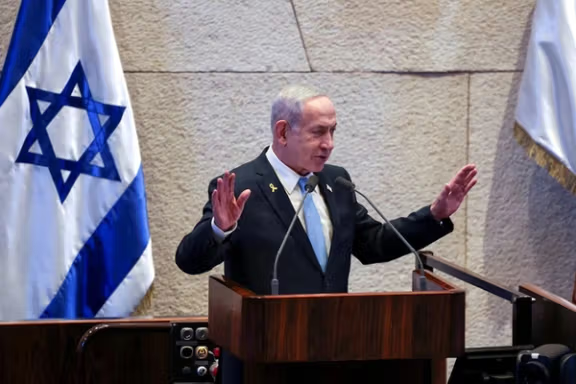
Prime Minister Benjamin Netanyahu said on Monday that Tehran remains a threat to Israel but was weakened by the punishing 12-day war in June.

“We crushed Iran’s axis of evil. We distanced and neutralized the dual threat from Iran—the nuclear threat and the ballistic threat alike," Netanyahu told the Knesset amid growing criticism from opposition lawmakers.

“This is a real threat, but not what it once was. We act with determination, initiative, and strategy," he added.

Israel launched a surprise military campaign against Iran in June, striking nuclear and military sites. Tehran responded with hundreds of drones and ballistic missiles.

Following Israel's strikes, the United States targeted major nuclear sites in Fordow, Natanz, and Esfahan on June 22. President Trump called the attack successful, resulting in the “obliteration” of Iran's nuclear facilities.

The 12-day war concluded with a US brokered ceasefire on June 24, halting the military attacks on two sides. Yet in the months since, officials in both Iran and Israel have openly hinted at the prospect of another confrontation.

'Regime change in next war'

Israel will respond “much more aggressively” in the next confrontation with Iran and is preparing for fighting that could last more than 12 days, Israel’s Channel 13 reported on Monday, citing a security official.

Israel should move to topple the Islamic Republic before the end of US President Donald Trump’s term, the Jewish State's public broadcaster Kan News reported citing a senior Israeli official.

Israel was preparing a final wave of attacks aimed at toppling Iran’s ruling system when Trump announced a ceasefire, The Washington Post reported in July, citing Israeli and American officials involved in the operation.

“When Trump declared a ceasefire, Israel was moving into a final phase of attacks intended to topple the regime,” said David Ignatius in an opinion piece published by The Washington Post on Friday evening.

The final phase, which Israeli planners believed could bring down the Islamic Republic according to the report, was halted when Trump enforced a ceasefire.


Most Viewed

Worst outcome is Islamic Republic’s survival, ex-CIA official says
1
PODCAST

Worst outcome is Islamic Republic’s survival, ex-CIA official says

2
ANALYSIS

Iran brings unusually broad team to US talks to blunt future blame

3
INSIGHT

Tehran sends tough message but keeps diplomacy door open

4

Zoroastrian religious figure arrested in Iran

Banner
Banner

Spotlight

  • What the US naval blockade would mean for Iran’s economy
    INSIGHT

    What the US naval blockade would mean for Iran’s economy

  • Tehran sends tough message but keeps diplomacy door open
    INSIGHT

    Tehran sends tough message but keeps diplomacy door open

  • Worst outcome is Islamic Republic’s survival, ex-CIA official says
    PODCAST

    Worst outcome is Islamic Republic’s survival, ex-CIA official says

  • Why the Iran-US truce is more likely to buy time than peace
    ANALYSIS

    Why the Iran-US truce is more likely to buy time than peace

  • Engaged but uncommitted: China watches Iran and US fight and talk
    ANALYSIS

    Engaged but uncommitted: China watches Iran and US fight and talk

  • A truce for the world, a reckoning for Iran’s economy
    ANALYSIS

    A truce for the world, a reckoning for Iran’s economy

•
•
•

More Stories

US lifts some Syria sanctions, keeps curbs on Iran and Russia business

Nov 10, 2025, 21:08 GMT

The United States on Monday suspended sanctions on Syria for 180 days except for certain transactions involving Iran and Russia, according to a statement by the Treasury.

The announcement came as President Donald Trump hosted Syrian President Ahmed al-Sharaa at the White House for landmark talks, the first visit by a Syrian president to Washington.

The Treasury order replaced a May 23 waiver and effectively extends the suspension of some of the toughest US sanctions on Syria.

The department said the move signaled its "commitment to continued sanctions relief for Syria,” while maintaining restrictions linked to Iran and Russia.

"The suspension halts the imposition of sanctions pursuant to the Caesar Act except for certain transactions involving the governments of Russia and Iran, or the transfer of provisions of Russian-origin or Iranian-origin goods, technology, software, funds, financing, or services," the Treasury said.

The 2019 Caesar Act aimed at cutting financial support to the former government and entities tied to abuses during the civil war that began in 2011.

Sharaa’s visit marked a turnaround for the former Islamist commander who toppled longtime leader Bashar al-Assad, an ally of Iran, in December and has since sought to rebuild relations with Western and regional governments.

The White House meeting followed Washington’s decision to remove Sharaa from the US list of Specially Designated Global Terrorists.

A report by Reuters citing an unnamed US official said removing the remaining Syria sanctions, including the Caesar Act, would require congressional action, which the administration would support.

Iran arrests local mayor after young student's public self-immolation

Nov 10, 2025, 20:14 GMT

Iranian authorities have arrested five people including a district mayor and a municipal enforcement officer in Ahvaz, southwestern Iran, after a young man set himself on fire following the demolition of his family’s kiosk, state media reported.

Twenty-year-old student Ahmad Baledi suffered severe burns after dousing himself with gasoline and setting himself on fire in front of officers who demolished his family’s kiosk last week.

The incident sparked protests in Ahvaz, where residents demanded accountability. The arrests suggest authorities are seeking to draw a line under the case before it attracts any broader protests.

Municipal workers accompanied by police arrived without notice according to the Karun Human Rights group, which added that the deputy for municipal services in the district “behaved violently” and forcibly ejected Baledi's wife from the kiosk.

“The municipality ignored the judicial orders and unilaterally proceeded with the eviction at an inappropriate time,” the Judiciary's Mizan News Agency quoted Ahvaz prosecutor Amir Khalafian as saying.

“The municipality did not act according to the judicial order in this case.”

Khalafian said the man had rented a small municipal kiosk, but after the lease expired and plans to expand the park were approved, the municipality repeatedly instructed him to vacate.

Both the district mayor and the municipal enforcement chief, he added, were released on bail and are currently suspended from their duties until the investigation into their violations is completed.

The official added that arrest warrants were also issued for three other individuals linked to the case.

"Several others who sought to create tension and unrest on social media have also been released on bail,” Khalafian said without elaborating.

Witnesses cited by Karun said some of the officers made no effort to stop him and watched with indifference and mockery.

The incident comes amid deepening economic hardship in Iran, where soaring joblessness and inflation have pushed many households into street vending, peddling, and other informal work to survive.

The self-immolation echoes that of Tunisian street vendor Mohamed Bouazizi, who had been frustrated the confiscation of his wares by police. His case helped ignite the Arab Spring uprisings in 2011.

Street protests erupted in Iran in 2022 after a young woman, Mahsa Amini, died in morality police custody. Authorities quashed the demonstrations with deadly force.

Iran-backed militias’ election gains may expand Tehran’s sway in Iraq - FT

Nov 10, 2025, 19:17 GMT

Iran-backed Shiite militias in Iraq are hoping victories in the parliamentary elections on Tuesday will deepen their sway, the Financial Times reported on Monday, in polls Tehran views as a boon to its flagging regional fortunes.

The Coordination Framework—a coalition of pro-Iran parties and factions within the Popular Mobilization Units (PMU)—have refrained from engaging in direct conflict with Israel since the October 7, 2023 Hamas attack.

Their low profile stands in contrast to Iran-aligned forces in Gaza, Lebanon and Yemen, which have taken a more confrontational stance.

This strategic restraint amid a broader regional conflict has enabled Iraqi militias to focus on domestic politics, the FT reported.

By avoiding escalatory drone or missile strikes that have drawn retaliation against Iran’s other allies, the militias have preserved their operational strength—transforming potential battlegrounds into electoral strongholds.

“Iraq is both a historic ally and a cash cow for Iran. What [Tehran] wants is a stable Iraq to ensure money flows to them and their allies,” the Financial Times quoted an unnamed source familiar with internal political dynamics told

Key figures within the Coordination Framework—including leaders from Asa'ib Ahl al-Haq and Kata'ib Hezbollah - are leveraging their roles in the fight against ISIS and their involvement in post-war reconstruction to appeal to voters disillusioned by corruption and economic stagnation, the daily reported.

Strategic restraint

Citing internal documents and interviews, the FT reported that the coalition plans to contest up to 150 of the 329 parliamentary seats in the November 11 elections. A strong showing could allow them to shape the next government and secure control over key ministries such as defense and interior.

With Hezbollah suffering heavy losses in Lebanon, Hamas weakened in Gaza and Bashar al-Assad ousted in Syria, Tehran’s influence has reined, likely making Iraq an important venue for its regional outreach.

The lack of confrontation as the region was hit with heavy fighting, the paper reported, may indicate that Iraqi factions are prioritizing their economic privileges.

“Forget Iran and forget ideology: the factions are now playing with major money and they’re afraid to lose it either by getting bombed or sanctioned,” the FT quoted a senior Iraqi Shia politician close to militia groups as saying.

Israel arrests man allegedly paid in crypto to spy for Iran - media

Nov 10, 2025, 17:15 GMT

Israeli intelligence agency detained a 27-year-old man in Tel Aviv on suspicion of collaborating with Iran's intelligence services, allegedly in exchange for cryptocurrency payments to film various public locations, local media outlets reported on Monday.

Israel's Shin Bet security agency and police said an investigation into the suspect's communications and laptop devices revealed his alleged outreach to Iranian operatives via social media.

He initiated contact, Ynet and i24 news outlets cited security sources as saying, received assignments and was compensated financially in return.

The suspect who was detained last week, was instructed to film several public sites in the Tel Aviv area including the Tel Aviv Museum of Art, Avramovitch Park in the Bavli neighborhood, and the site of a recent missile impact in Ramat Gan, according to the agencies' statement.

The locations are primarily suburban and public spaces with no direct access to military or intelligence facilities, though Ramat Gan is a densely populated suburb east of Tel Aviv that has been targeted in recent rocket and missile attacks.

Ongoing cases

Israeli prosecutors on Sunday indicted a 23-year-old hotel worker from Tiberias on charges of spying for Iran, marking the latest in a string of espionage cases connected to Tehran over recent months.

This incident underscores a growing wave of espionage prosecutions linked to Iran, as Israeli security agencies have warned that Tehran has ramped up recruitment of Israeli citizens through social media platforms like Telegram—particularly since the onset of the Gaza war in 2023.

The case comes amid heightened tensions following the 12-Day War in June, a brief but intense direct conflict between Israel and Iran. In response, both Iran and Israel have escalated counter-intelligence measures.

Iran foreign minister doubles down on strengthening ‘axis of resistance’

Nov 10, 2025, 14:27 GMT

Iran’s foreign ministry has channeled much of its political and diplomatic capacity into strengthening regional alliances and supporting what it describes as ‘axis of resistance,’ Minister Abbas Araghchi told parliament on Monday.

“By strengthening the Axis of Resistance and supporting unity-building movements across the Islamic world, the ministry of foreign affairs has devoted a significant portion of its capacity to providing political and diplomatic backing for the Resistance Front,” he said.

The term "axis of resistance" is used by the Islamic Republic to describe a network of allied groups in the region, including Palestinian militant organizations, Lebanon’s Hezbollah, several factions in Iraq and Syria, and the Houthi movement in Yemen.

Araghchi told the lawmakers that the foreign ministry’s activities over the past 14 months have followed four main strategic tracks. 

According to him, the first, focused on security diplomacy, covers deterrence, defense, and resistance coordination. The second on economic and development diplomacy, including “resistance economy” initiatives. The third centered on building regional influence and the fourth was aimed at shaping ideas and narratives through think-tank, public, and media diplomacy.

He described recent months as a period of intensified confrontation involving the United States and Israel, citing assassinations and airstrikes across the region, including attacks on Hamas and Hezbollah figures, as justification for increased diplomatic engagement.

"Under these circumstances, a significant portion of the Foreign Ministry’s efforts has been devoted to supporting the axis of resistance, effectively functioning as the foreign ministry of the axis."

Western governments have renewed pressure on Tehran to engage in direct talks not only over its nuclear and missile programs, but also its continued backing of armed groups across the Middle East.

They argue that Iran’s support for militias in Lebanon, Iraq, and Yemen fuels instability in the region.

Iran’s diplomatic agenda, Araghchi said, also sought to build a “multipolar order,” defend national sovereignty, and counter Western sanctions through cooperation with blocs such as the Shanghai Cooperation Organization, BRICS, and the Non-Aligned Movement.